

In Taiwan, a sense of threat is part of daily life, shaped by persistent and growing military pressure from across the Taiwan Strait.
The Chinese Communist Party (CCP), which sees democratically governed Taiwan as a Chinese province, has been rapidly modernizing its armed forces and expanding capabilities that could be used in a conflict over the island nation.
Should Taiwan come under CCP control, the consequences would extend far beyond the region, according to Alexander Yui, Taiwan’s top representative to the United States.
A conflict involving Taiwan would cause a “crisis much larger” than the war in Iran and the situation in the Strait of Hormuz, Yui told EpochTV’s “American Thought Leaders” on May 3.
Such a conflict would affect not only China and Taiwan, but also Japan, South Korea, Europe, and the United States, Yui said, and the ripple effects would be “almost unimaginable.”
There have been many studies estimating the economic costs of a Chinese attack on Taiwan. The Center for Strategic and International Studies projected that the economic cost would reach $10 trillion, and the burden would fall heavily on the developing world, which would “suffer disproportionately” from an economic downturn, according to a January report.
Two U.S. allies—Japan and South Korea—would be among the countries most affected by disruptions in the Taiwan Strait, because both are dependent on the waterway for energy imports, according to a 2024 Center for Strategic and International Studies report.
A 2025 review by the Federal Reserve Bank of St. Louis said a conflict in the strait would have more severe economic consequences for the global economy than any conflict in which the United States has been involved in recent decades, including the war in Ukraine.
The importance of Taiwan’s geolocation extends far beyond the narrow confines of the strait. The island sits at the center of the so-called First Island Chain, a concept in maritime strategy involving a strategic arc stretching from Japan through the Philippines to Indonesia. The chain acts as a barrier constraining the Chinese regime’s ability to project its naval and air power into the wider Pacific.
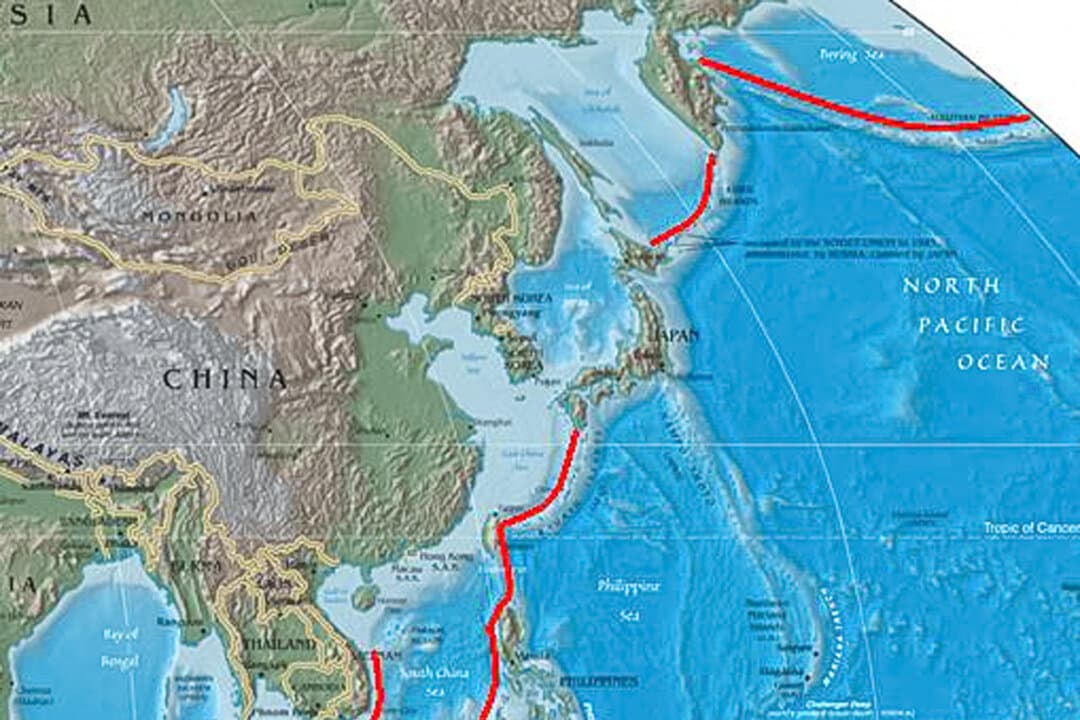
The first island chain (marked in red) is shown in this map dated April 10, 2012. Taiwan sits at the center of the first island chain—a concept in maritime strategy involving a strategic arc stretching from Japan through the Philippines to Indonesia—that acts as a barrier, constraining China’s ability to project its naval and air power into the wider Pacific. (Suid-Afrikaanse/CC BY-SA 3.0)
Taiwan is “holding the line” within the strategic arc, Yui said, extending the U.S. defensive perimeter into the Western Pacific, a role analogous to NATO’s security posture in Europe.
Yui serves as Taiwan’s de facto ambassador to the United States, representing Taipei through the Taipei Economic and Cultural Representative Office because of the absence of formal diplomatic relations between the two governments.
Despite the lack of formal ties, Taipei and Washington have maintained a robust relationship under the Taiwan Relations Act, a law authorizing the United States to provide the island with military equipment for self-defense.
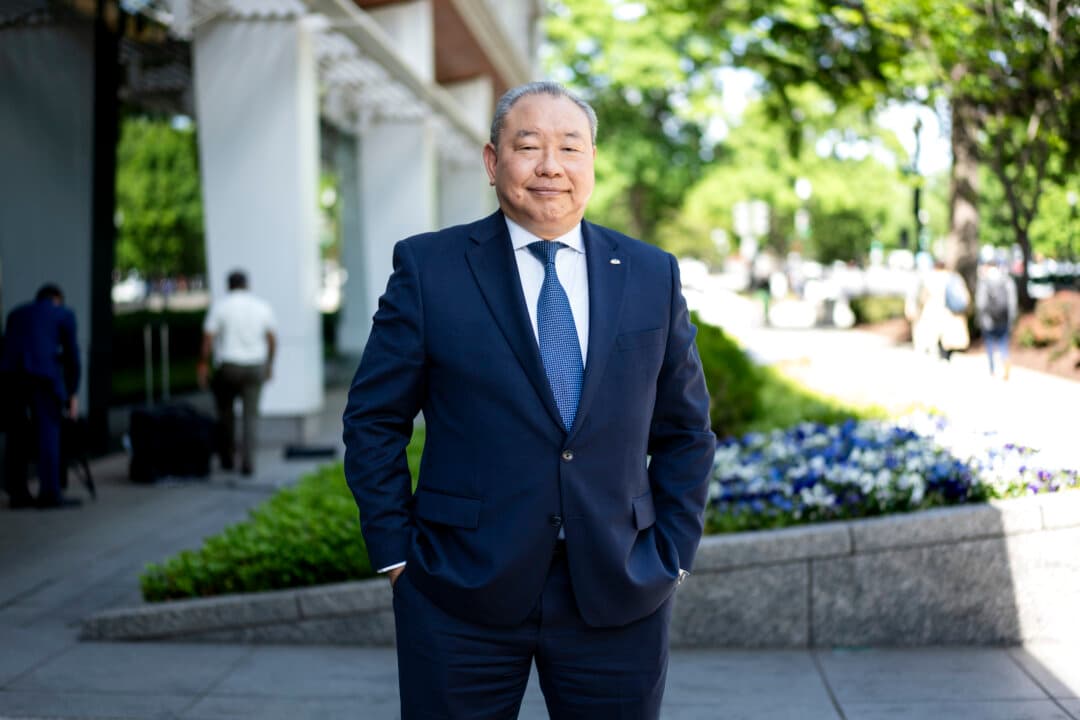
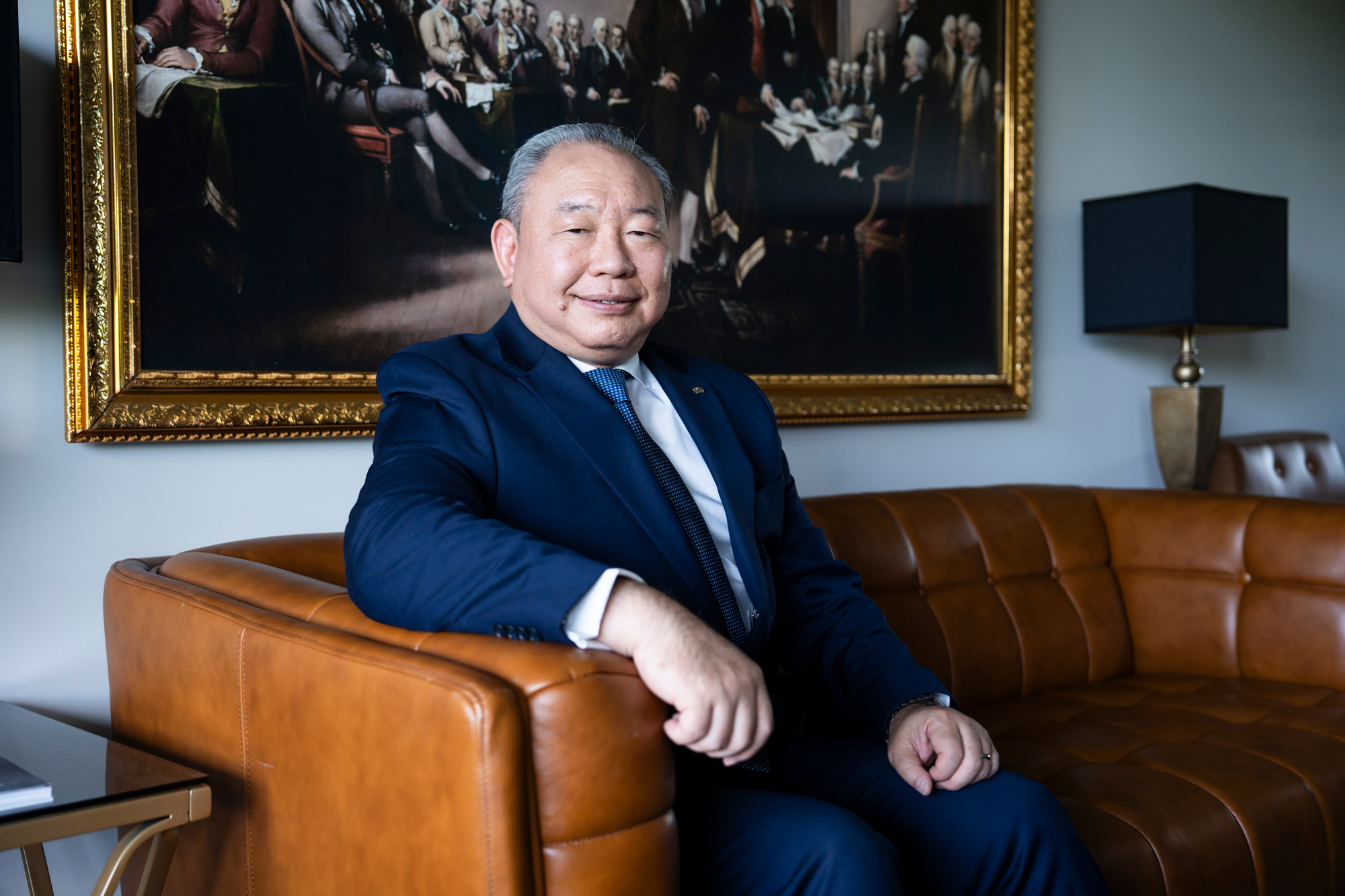
Alexander Yui, Taiwan representative to the United States, in Washington on April 30, 2026. A conflict involving China and Taiwan would cause a “crisis much larger” than the war in Iran and the situation in the Strait of Hormuz, Yui said. (Madalina Kilroy/The Epoch Times)
Coercion
Refusing to recognize Taiwan as a country, Beijing has sought to isolate the self-ruled democracy on the international stage. That includes blocking Taipei’s participation in global organizations, poaching Taiwan’s allies, and pressuring foreign governments and officials to not engage with the island nation.
The latest example of this approach came when Taiwanese President Lai Ching-te’s scheduled trip to Eswatini in April was abruptly canceled. Taiwan authorities said China had exerted “intense pressure” on Seychelles, Mauritius, and Madagascar, all of which revoked overflight permissions for his presidential aircraft without prior notice.
According to Taiwan’s semi-official Central News Agency, a national security official said Beijing had threatened to revoke substantial debt relief granted to the three African nations, halt further financing, and impose economic sanctions to pressure them into the decision.
Yui called the incident a reminder of the “caveat of working with, or investing, or doing business” with Beijing.
The CCP “will weaponize things according to their interests,” he said.
The setback was short-lived. On board a plane provided by the government of Eswatini, Lai arrived in the southern African country on May 2 for a state visit.
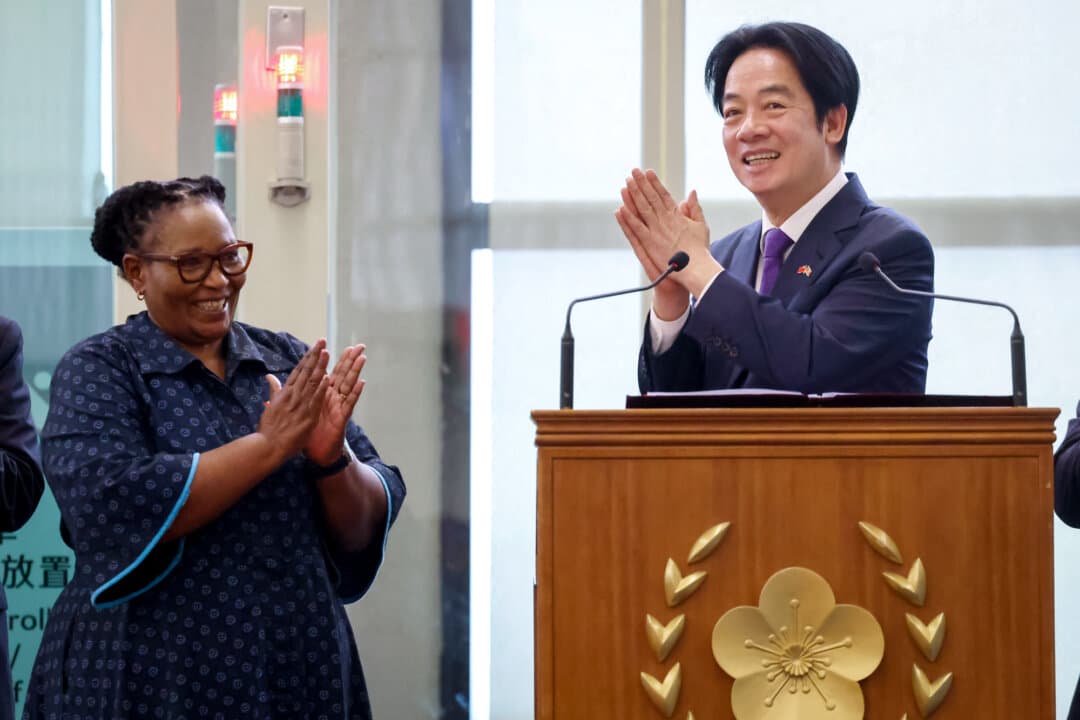
Taiwan President Lai Ching-te (R) and Eswatini Deputy Prime Minister Thulisile Dladla (L) arrive at Taiwan Taoyuan International Airport after Lai’s visit to Eswatini in Taoyuan, Taiwan, on May 5, 2026. A previously scheduled April trip was canceled amid pressure from Beijing. (I-Hwa Cheng/AFP via Getty Images)
There are similar events across the Western Hemisphere. For example, after Panama’s top court ruled in January that a contract allowing a Hong Kong corporation to operate ports on the Panama Canal was unconstitutional, Beijing warned that the Central American country would pay “heavy prices” for complying with the decision.
In March, the U.S. Federal Maritime Commission raised concerns about a surge of detentions and inspections of Panama-flagged ships by Beijing “under the guise of port state control,” a trend it said was tied to Panama’s takeover of port contracts.
The United States and its allies have denounced the regime’s maritime actions as “a blatant attempt to politicize maritime trade” and an infringement on Panama’s sovereignty, according to an April 28 statement.
In light of the danger of doing business with China, Yui said, Taiwan has reduced its economic exposure there.
In 2010, more than 80 percent of Taiwan’s outbound investment went to China, but that share was less than 4 percent last year, according to Taiwanese government data.
“China is an unreliable partner,” Yui said. “That’s not a healthy environment to do business.”
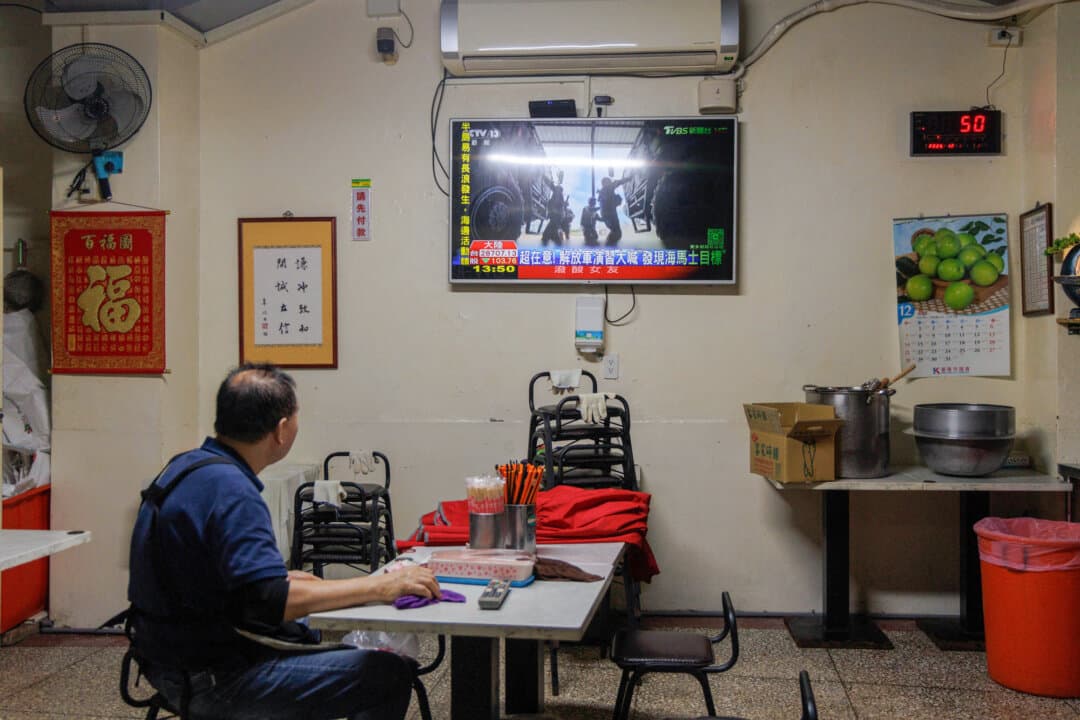
A man watches TV news coverage of the Chinese People’s Liberation Army military drills around Taiwan in Keelung, Taiwan, on Dec. 30, 2025. In recent years, the CCP has frequently carried out large-scale military exercises in the Taiwan Strait, while sending military jets and warships to the airspace and water near Taiwan on an almost daily basis. (Cheng Yu-chen/AFP via Getty Images)
Trade
As they withdraw from communist China, many Taiwanese investors have set their sights on markets that share their values, particularly the United States.
Taiwan ranked as the United States’ fourth-largest trading partner in the first two months of this year, following Canada, Mexico, and China, according to February data from the U.S. Census Bureau.
The growth was largely driven by booming demand for semiconductor and electronics products. Taiwan produces more than 95 percent of the world’s advanced chips and more than 90 percent of data servers and artificial intelligence servers, Yui said.
Leading the production was Taiwan Semiconductor Manufacturing Co., the world’s largest chip manufacturer, which has ramped up its investment plans in the United States in recent years. The company’s expansion plan in Arizona includes building six wafer labs, two advanced packaging facilities, and one research and development center.
To support its tech companies’ investment in the United States, Taiwan inaugurated its second trade and investment service center in Phoenix on May 1.
Taiwan has committed to investing at least $250 billion through its tech and chip companies on U.S. soil, as part of a trade deal officials from Taipei and Washington reached in January. Under the deal, the Taiwanese government will also provide $250 billion in credit guarantees to companies seeking to expand manufacturing capacity in the United States.
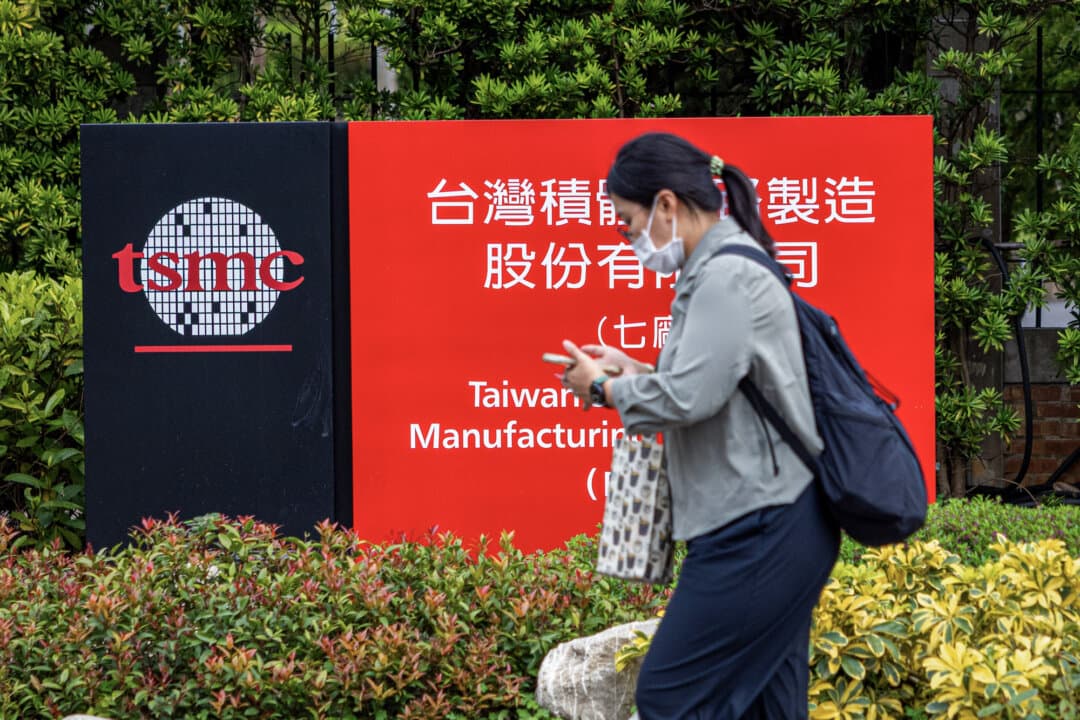
A person walks past the logo of Taiwan Semiconductor Manufacturing Company at Hsinchu Science Park in Hsinchu, Taiwan, on April 18, 2025. TSMC has ramped up its investment plans in the United States in recent years. (Annabelle Chih/Getty Images)
The two countries have developed a strong and reliable partnership, Yui said.
“The thriving and ever-growing trade relationship between Taiwan and the United States is happening partly because of decoupling from China, but also the common values that we have in terms of investment, in terms of what we do together,” Yui said.
In the equity market, Taiwan overtook Canada to become the world’s sixth-largest stock market in late April, according to data compiled by Bloomberg.
“So Taiwan, economically, is relevant to the world, yet politically, internationally, we’ve been facing this blockage from the People’s Republic of China for us to be able to act normally in [the] international scene,” Yui said.
“And that’s something that we’ve been appealing to the world—that Taiwan deserves to have a space in [the] international arena.”
Harassment
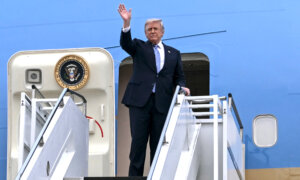
A little more than two weeks before Chinese leader Xi Jinping and U.S. President Donald Trump’s planned summit in Beijing, the regime signaled that Taiwan would likely be on the meeting’s agenda.
Speaking by phone with U.S. Secretary of State Marco Rubio on April 30, Chinese Foreign Minister Wang Yi called Taiwan “the biggest risk factor” in bilateral ties, according to a Chinese readout.
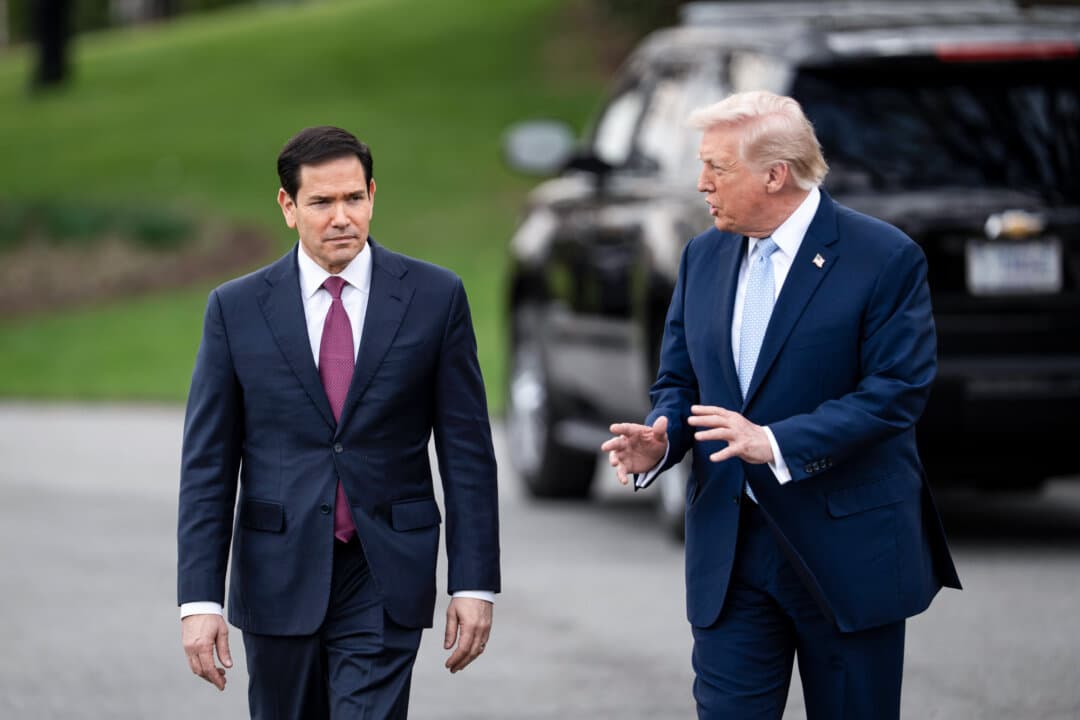
Secretary of State Marco Rubio and President Donald Trump walk toward the press as they depart the White House on March 20, 2026. In an April 30 call with Rubio, Chinese Foreign Minister Wang Yi called Taiwan “the biggest risk factor” in bilateral ties, according to a Chinese readout. (Madalina Kilroy/The Epoch Times)
Rejecting Wang’s characterization, Yui said the Chinese regime is the aggressor that is “militarily preparing for conflict.”
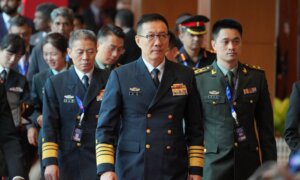
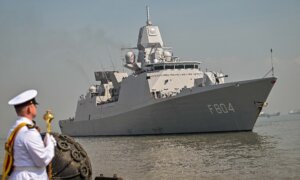
In recent years, the CCP has frequently carried out large-scale military exercises in the Taiwan Strait, while sending military jets and warships to the airspace and waters near Taiwan on an almost daily basis.
On May 3, the defense ministry in Taipei said it had detected seven Chinese military ships, three Chinese official vessels, and one Chinese military aircraft over the previous 24 hours.
“[The Chinese military is] constantly harassing our naval and air surroundings, trying to coerce Taiwan to create panic and uneasiness within Taiwanese society,” Yui said.
The military harassment is merely a facet of Beijing’s tactics that the public sees, Yui said. The regime also cut Taiwan’s undersea communication cables, seeks to drive wedges between political parties, and deploys disinformation, cyberattacks, and other means to try to destabilize Taiwan from within.
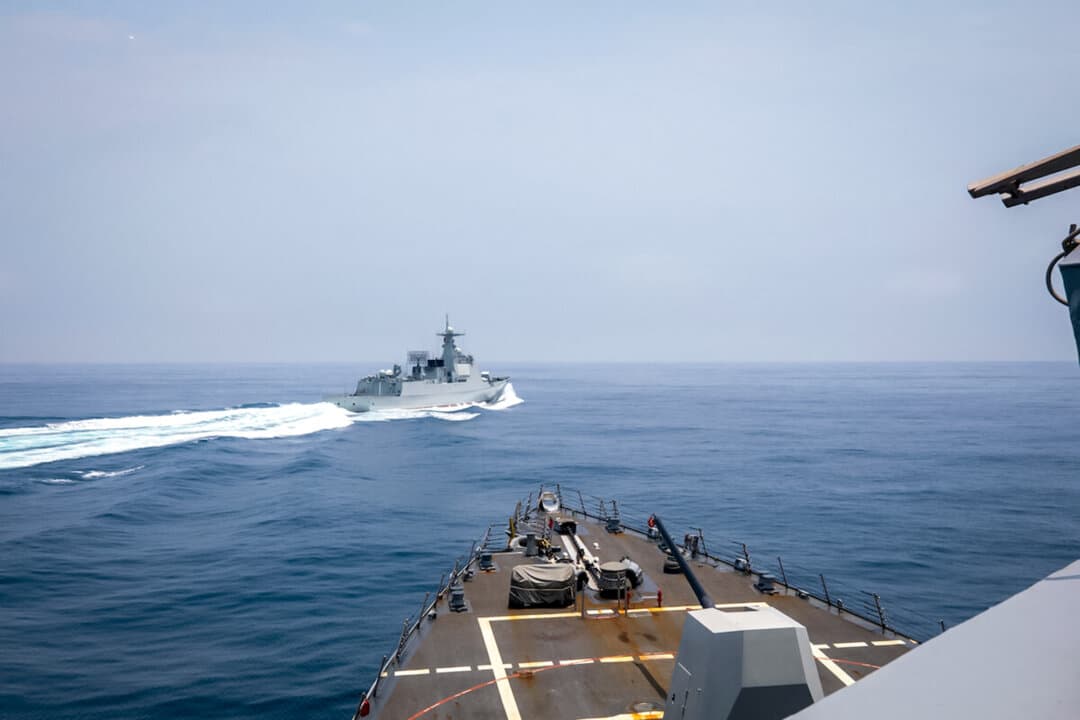
The guided-missile destroyer USS Chung-Hoon observes a Chinese PLA Navy Luyang III-class vessel (top) alongside the Royal Canadian Navy’s HMCS Montreal while transiting the Taiwan Strait on June 3, 2023. (Andre T. Richard/U.S. Navy via AFP)
“That’s just an example of what we face, but they do that to other parties, including the United States,” he said.
The Chinese regime, Yui said, poses the “greatest risk factor for peace and stability in the Taiwan Strait and the Pacific region.”
“The People’s Republic of China has engaged in the largest peacetime military preparedness in human history,” he said. “And I think that’s unfounded, because their borders are not under threat.”
However, Yui said that recent U.S. actions in other parts of the world, including the capture of Venezuelan leader Nicolás Maduro and strikes on the Iranian regime, would likely affect Xi’s calculation on claiming Taiwan.
“It shows a resolve from the United States to use the necessary tools to fix problems or achieve its objectives,” he said. “And obviously, there will be a relevance or reference to that on the Indo-Pacific, in particular to the Taiwan Strait.”