

The Chinese communist regime has exported its censorship technology to Iran, according to an official from Iran’s Supreme Council of Cyberspace, as Tehran eyes permanent restrictions in cyberspace that mirror those implemented in China.
The revelation by Mohammad Sarafraz, a member of the council—a state authority responsible for cyberspace policymaking—came as Iran partially reopened its internet after months of near-total blockade.
In an interview with the online news portal Faraz published on May 23, Sarafraz said some council officials believe that the internet should be “permanently” shut off for the public.
They seek a highly controlled digital ecosystem in which only selected users can access the global internet in a limited, controlled manner, according to Sarafraz.
The equipment needed to build the system has been “purchased and imported from China,” he said, without providing further details.
In China, major Western platforms such as Google, YouTube, and WhatsApp, as well as news websites, are blocked across the country. Hundreds of millions of Chinese internet users are forced to rely on websites approved by the communist regime.
The Chinese Communist Party (CCP) wields extensive control over cyberspace through a data-based surveillance infrastructure officially called Golden Shield, which was launched by the regime’s Ministry of Public Security in the late 1990s.
In addition to monitoring and filtering online information deemed sensitive by Beijing, the system connects with the security apparatus and can access the state’s database containing every resident’s records, thereby enabling Beijing to track and silence dissidents.
Digital Repression
Max Meizlish, a research fellow at the Foundation for Defense of Democracies, described Beijing as “a significant partner” in selling censorship and surveillance technologies to “malign actors” such as Tehran, Moscow, and Pyongyang.
Meizlish told Iran International that such a transfer of cyber technology should be viewed through the perspective of human rights abuses and digital repression.
“There’s an argument to be made that this form of censorship constitutes a wide-scale human rights abuse,” Meizlish told the London-based news channel on May 26.
He noted that Iran’s control over internet infrastructures already grants it power over online information. The authorities might be building their own national network to ensure Iranian people can see only what the regime wants them to see, according to Meizlish.
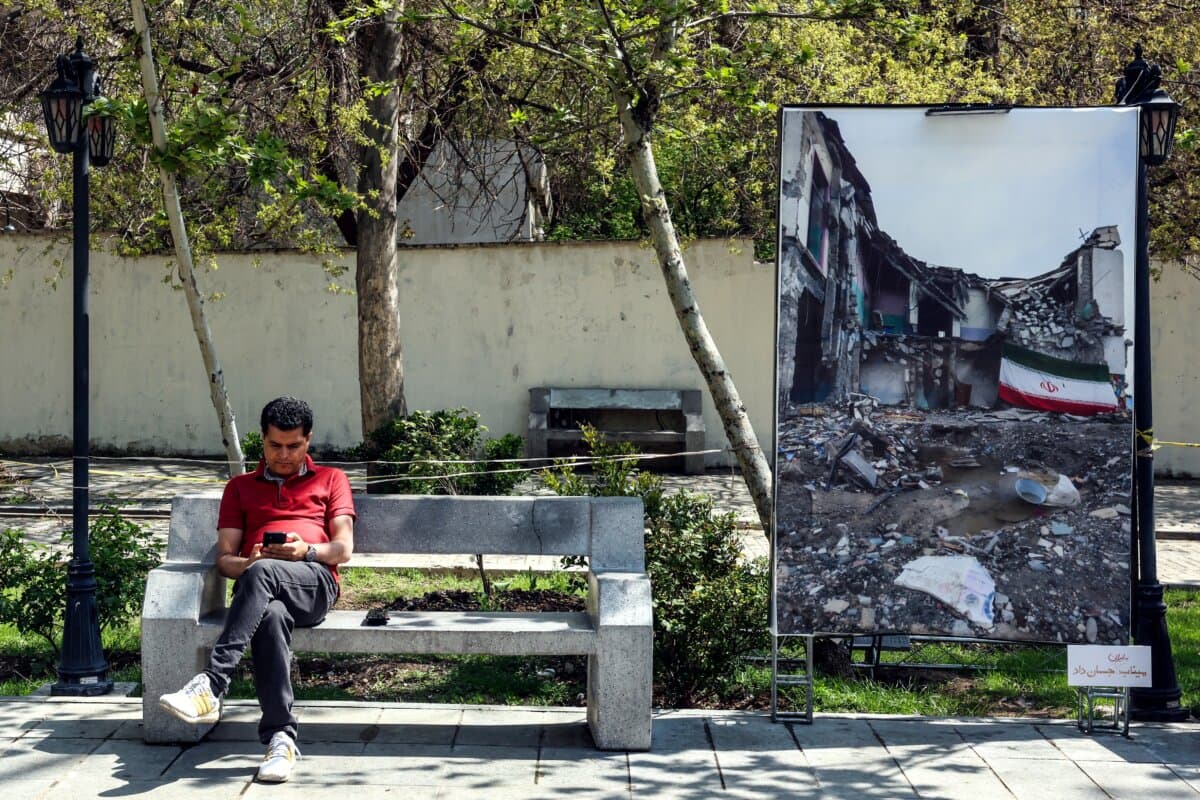
An Iranian man looks at his mobile phone as he sits near a large photograph depicting the current "Middle East war" in a Tehran park on April 16, 2026. (AFP via Getty Images)
Ehsan Chitsaz, Iran’s deputy communications minister, previously dismissed the idea of fully copying CCP-style internet restrictions as infeasible.
He pointed out that China’s model relies on a vast internet market—something Iran couldn’t replicate, according to RFE/RL, a news agency funded by the U.S. government. At a news conference on May 9, he also warned that a prolonged blockade could pose security risks to the country.
‘Heavily Filtered’
After 88 days of near-total isolation from the world, Iran began to restore some access starting May 26, according to NetBlocks, a cybersecurity watchdog that monitors the global internet. The group called the nationwide shutdown the longest-running in modern history.
“Service remains heavily filtered, with new restrictions on messaging and app stores compared to pre-January,” NetBlocks said in an update on May 27.
The Iranian regime took the internet offline after the U.S.–Israeli military strikes began on Feb. 28. Since then, millions of ordinary citizens have largely been cut off from the online world, although the regime’s officials still appeared on foreign media via online platforms like Zoom.
The Iranian authorities claim the shutdown was necessary to prevent cyberattacks, protect officials from being assassinated, and stop the spread of information they consider harmful to public morals, according to Sarafraz, the former head of Iran’s state broadcaster.
Sarafraz disputed these reasons in the interview with Faraz. He pointed out that severe cyberattacks occurred after they imposed an internet shutdown, and that assassinations of officials have continued amid the joint U.S. and Israeli strikes.
He argued that the destruction of businesses in a country already plagued by heavy sanctions and inflation, along with internet access limited only to the wealthy, posed more psychological harm to society than the potentially harmful content on the internet.
He also criticized the Supreme Council of Cyberspace as a failed model of governance. Established in 2012, the council is responsible for blocking popular online news and communications websites and has used digital technology to spy on and harass journalists and dissidents, according to the United States and the European Union.