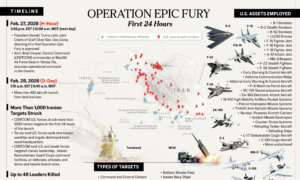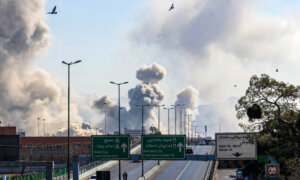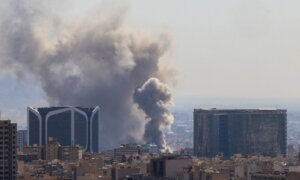


For two decades, the Chinese communist regime has been courting, investing in, and coordinating with the Iranian regime, its proxies, and Gulf nations to build out a stronghold for its strategy of a new global order, says Hudson Institute research fellow Zineb Riboua. According to her, that all ended with Operation Epic Fury.
“From a U.S. perspective ... being involved does not just mean helping an ally, it means reshaping the configuration of a Middle East that has been, for a very long time, I think, a Chinese chessboard,” Riboua said on EpochTV’s “American Thought Leaders” program on March 4. The full episode will run on EpochTV at 9 p.m.
Beijing cannot rise without weakening the United States, and “Iran has been that tool” in the Middle East, Riboua said.
China has built up Iran’s military might and received much in return, but U.S. involvement in striking down the Iranian regime’s leadership is “reversing that calculus,” according to her.
“I think the recalibration will cost China a lot,” she said.
How China Helped Iran
China has done a great deal to build up Iran’s arsenal and influence in the region, but the speed at which the Iranian regime is falling apart will have ripple effects around the world and lead countries negotiating with China to reconsider whether Beijing truly has the upper hand, according to Riboua.
Riboua, who studies China’s impact on the Middle East, published a piece titled “The Iran Question Is All About China,” calling Iran the “opening act” of the Indo-Pacific century shortly after the strikes began.
China has helped Iran acquire different components of its military arsenal, including its missile buildup, most critically in the chemical components the Iranian regime needs. Iran’s production is focused on petrochemicals, and its domestic industry lacks the capacity and know-how to produce these other chemicals, Riboua said.
China has also exported its digital authoritarianism to Iran, selling the regime mass surveillance technologies that came into focus earlier this year as the regime killed thousands of protesters and tried to censor events. Iran’s telecommunications infrastructure also relies heavily on Chinese companies Huawei and ZTE.
Yet this support meant little in the face of the coordinated strikes on the regime on Feb. 28, Riboua said.
“The world is watching that,” she said. “African states are watching that.”
Many regimes, including in Africa and Southeast Asia, she said, face instability issues and “are desperate as well to maintain power.”
Chinese companies were able to sell these regimes technology as a suppression tool and demonstrate to authoritarian regimes the advantages of doing business with China, but “all of that is really vanishing today,” Riboua said.
“In fact, a lot of their own technology ... has been proven to just not be that good,” Riboua said, referring to missile detection systems Venezuela and Iran had purchased from China that did nothing to stop U.S. operations.
“It’s a huge embarrassment when you are trying to depict yourself as a competitor to the United States.”
Riboua said she expects that countries will still deal with China but that the Chinese regime “will no longer have the upper hand” to dictate terms—such as the terms of the Belt and Road Initiative, which are disproportionately favorable to Beijing.
She said the quick turnaround in Iran could also be embarrassing for the Chinese regime domestically.
“Beijing has been selling to [its] own people, 1.4 billion people, that America is in decline ... that the East is rising, that the West is in total decline and collapse, that Americans cannot do much,” she said. “And the United States has proven [it] wrong.”
Iran’s Role in a Taiwan Invasion
According to Riboua, Iran would also play a major role if Chinese Communist Party leader Xi Jinping were to invade Taiwan.
“Iran is absolutely key when it comes to sanctions evasion,” she said.
The Chinese regime saw Russia get squeezed by Western sanctions with the onset of its war with Ukraine, she said, and “therefore [has] been building this parallel system with Iran through barter agreements, through other agreements, making sure they bypass a lot of Western financial channels.”
“They were very proud of it to the point where it became one of their talking points,” Riboua said, pointing to speeches by Chinese regime officials touting the rise of a global south and new world order that excludes the United States. If Iran undergoes regime change, this option could evaporate.
Moreover, previous Iranian proxy battles in the Red Sea were a costly, drawn-out affair that could have led allies to doubt U.S. military capabilities, Riboua said.
U.S. forces had taken a role in managing freedom of navigation in the Red Sea as members of the Houthi terrorist group targeted shipping vessels with missiles and drones to disrupt a corridor for some 12 percent of global sea trade at great cost to European countries, Gulf States, and the United States.
“[The United States was] not really successful, and they were really, really stuck,” Riboua said. “That’s exactly what would help China in case of an invasion; you want to make sure that you’re able to distract the United States. You want to be able to, first of all, make sure that U.S. allies do not trust the United States’ involvement militarily when it comes to securing their interests.”
The Houthis were not only a proxy for Iran, but also for China, according to Riboua, who said that about 35 percent of Houthi weapons come from China.
“After the Hezbollah [terrorist group] pager attacks, it was very clear that the Islamic Republic is not capable of rescuing its own major partner,” she said, pointing to reports of controversy among proxy groups at the time.
“The Chinese, I think, stepped in.”
Islamic Regime Becoming Powerless
Riboua said Iran’s Islamic regime was already weak after last year’s war with Israel, and is now being dismantled with resounding geopolitical implications.
“Their chain of command has been just completely dismantled,” she said. “They don’t know what they’re doing, and this is just not an understatement. They thought that they had it totally under control ... but it seems that that restructuring made them more vulnerable. The key commanders, they were killed in the first 100 hours of the conflict.”
Iran has launched strikes on neighbors—including Turkey, which had been against U.S. strikes on Iran—in what Riboua characterized as a “desperate” bid to trigger calls for a cease-fire from U.S. allies.
“But what is happening is that everyone is watching them being weaker and weaker,” Riboua said.
This became clear after the 12-day war with Israel last year, according to Riboua.
“There is a cost when [you’ve] lost a war,” she said.
Before, Riboua said, Iranian leader Ali Khamenei had always been able to delay negotiations with and even mock the United States, but the Iranians have been steadily losing confidence in the regime, whether they be pro- or anti-Islamic Republic.
“When you’re an Islamic Republic, you’re not just a theocracy or a dictatorship,” Riboua said. “They are revolutionaries. They need to send people. They need to train people. They need to teach and educate people, which is why they have so many seminaries across the Middle East, but across Africa as well, and they’ve been trying to have more and more in Europe.
“It means that they have always been in the business of creating the next generation of Islamic Republic loyalists and soldiers. A lot of that absolutely collapsed. The Islamic Republic was completely incompetent when it comes to basic things such as water management.
“You look at it objectively, as a citizen: What is this Islamic Republic giving you? Nothing.”
This has led to increasing protests from young people completely disillusioned by the regime, according to Riboua.
“No one believes in those things anymore, at least in Iran,” she said. “Why? Because they also see how all of their neighbors are modernizing. Azerbaijan is absolutely rising as a power. Saudi Arabia, the [United Arab Emirates], all of the Gulf countries, they are investing in the youth. They’re investing, modernizing. And so Iranians watch that. ‘Why can’t the government provide that?’”
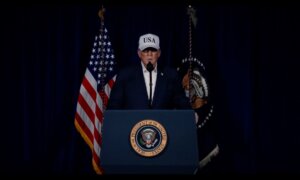
Meanwhile, U.S. President Donald Trump’s vision with the current operation is not “playing the game of the Iran threat, this forever threat” and managing problems, nor is it “regime change” by way of installing a transplanted democracy, Riboua said. This is “global restructuring” in the interest of America and the free world, according to her.
“The Iranian market is basically a virgin market,” she said. “If it opens up and you have a friendly regime, it’s thousands of European businesses back. It’s the whole German industry finding new clients. It’s endless opportunities also for the region. It’s a new corridor. It’s the dismantlement of [China’s] Belt and Road Initiative.”