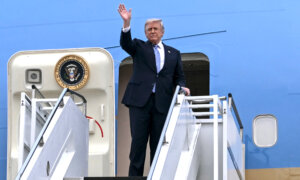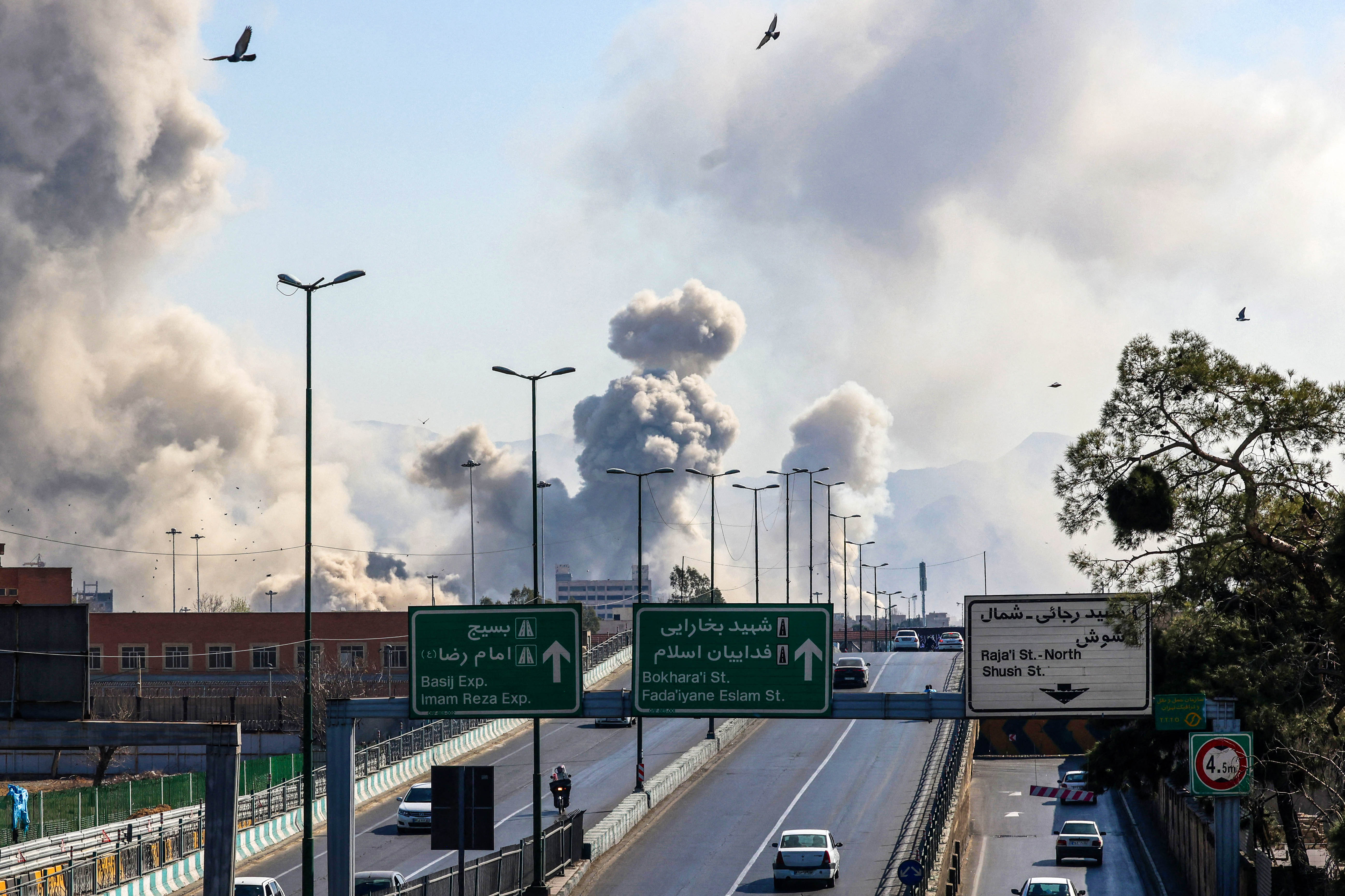

President Donald Trump on Monday said that the U.S.-Israeli operation against Iran is “very complete,” giving an indication that the one-week-long war is coming to an end soon.
“I think the war is very complete, pretty much,” Trump told Weijia Jiang, CBS’s senior White House correspondent. “They have no navy, no communications, they’ve got no Air Force,” he said, according to Jiang.
The CBS reporter also asked Trump whether he had a comment for Iran’s new leader Mojtaba Khamenei, who was named by the regime over the past weekend. Trump stated, “I have no message for him. None, whatsoever.”
Mojtaba’s father, former Iranian leader Ali Khamenei, was killed in one of the first strikes launched against Iran more than a week ago.
Trump said the United States is “very far” ahead of the initial four-to-five week estimated timetable, and said that the administration is considering taking over the Strait of Hormuz, a strategic waterway that provides the only passage from the Persian Gulf to the ocean.
“They’ve shot everything they have to shoot, and they better not try anything cute, or it’s going to be the end of that country,” Trump told CBS, referring to Iran’s military.
Iranian Foreign Minister Abbas Araghchi said the regime would reject calls for a cease-fire with the United States and Israel, telling NBC News on Sunday that Iran would “continue fighting for the sake of our people.”
“There needs to be a permanent end to the war,” Araghchi said. “Unless we get to that, I think we need to continue fighting for the sake of our people and our security.”
Israel has said that its war aim is to overthrow Iran’s system of clerical rule. U.S. officials have said Washington’s main objective is to destroy Iran’s missile capabilities and nuclear program, and Trump has said the war can end only with a compliant Iranian government.
The remarks come as the price for a barrel of oil has increased significantly since the start of the conflict on Feb. 28.
Iran is a major producer of oil; the operation has led to a slowdown in oil shipments from the Persian Gulf and oil-rich countries such as Saudi Arabia and the United Arab Emirates.
Trump told the New York Post in another interview Monday that he has a plan to deal with surging oil prices.
“I have a plan for everything. You'll be very happy,” he said, without providing additional details.
The president also said he is “not happy” with the younger Khamenei.
As the slowdown in oil shipments continued, U.S. gas prices have surged in recent days, according to the American Automobile Association (AAA) and GasBuddy.
The average price for a gallon of regular gasoline stood at $3.478, which is up more than 40 cents from the $2.997 average seven days ago, according to data from AAA. GasBuddy said Monday that the average nationwide price has risen 51 cents per gallon over the past week; it currently stands at $3.45.
“I estimate the chance of the national average reaching $4/gal in the next month is now 80 percent,” GasBuddy analyst Patrick De Haan said Sunday in a post on X. There is an 85 percent chance diesel will reach $5 per gallon in the next week, he said in the post, which was published before Trump’s Monday comments on the progress of the conflict.
Meanwhile, the U.S. military reported a seventh American service member has died from wounds sustained during Iran’s initial counter-attack a week ago. Pentagon Secretary Pete Hegseth said over the weekend that he expects there will be “more casualties” as the war continues.
The price for a barrel of crude oil dropped to around $90 later on Monday after Trump’s comment to CBS.
The Dow Jones Industrial Average dropped more than 880 points but rebounded, trading higher by 239 points by the market’s closing time on Monday.
Meanwhile, the United States is considering coordinating sales of oil from the U.S. Strategic Petroleum Reserve with releases from other countries, Energy Secretary Chris Wright said on Monday.
“We are talking about coordinated releases from the SPR,” Wright told reporters gathered at a natural gas plant in Colorado, using an acronym for the Strategic Petroleum Reserve. The SPR, located on the coasts of Texas and Louisiana, holds 415 million barrels of oil.
Wright also said the United States has “some other options” on allowing more sales of Russian oil held in tankers on the water in Asia.
The U.S. was not considering imposing restrictions on exports of U.S. energy as a way to control prices, Wright said.
Reuters contributed to this report.