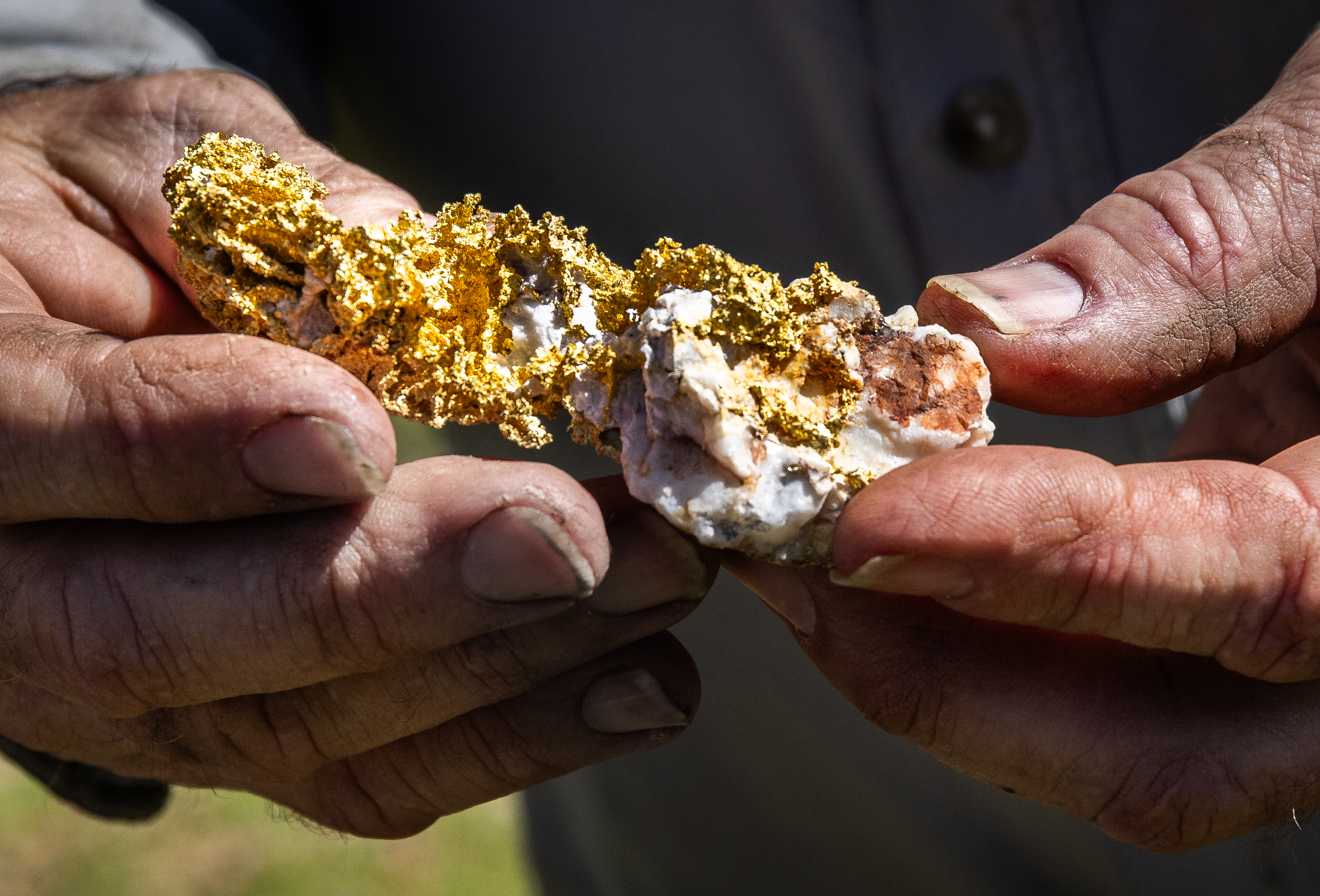

ANGELS CAMP, Calif.—Record-high gold prices hovering at about $5,000 per ounce have triggered a renewed interest in prospecting and mining and what could be the start of a mini gold rush in the California Mother Lode, according to local miners.
The historic belt of gold quartz veins in the Sierra Nevadas spawned the 19th-century gold rush and continues to draw modern prospectors.
The spike in gold prices has made small- and medium-scale mining operations more feasible, said Rusty Simpson, co-CEO of Meeting of the Mines Goldstrike Corp., based in Angels Camp.
“Up in the Mother Lode, there’s tailing piles everywhere that the old miners back in the day didn’t crush because it was low grade,” Simpson told The Epoch Times. Tailings are the waste materials left behind from previous mining operations.
“That low-grade stuff now is worth crushing, so we’re actually crushing a lot of the old tailings.”
Gold prices spiked to the highest they have ever been, peaking at more than $5,600 per troy ounce on Jan. 29, as investors and banks increased gold holdings to hedge economic uncertainty and inflation. The price has since dropped but has remained at about $5,000.
At those prices, it does not take much gold to make money even “a quarter ounce at [a] time,” Simpson said.
The surge has not only inspired seasoned miners, but is also drawing newcomers who want to learn how to find gold.
“There’s people everywhere mining,” he said. “A lot of the older people are coming back, since gold’s been so high. A lot of newcomers wanting to learn how to placer mine are getting into it.”
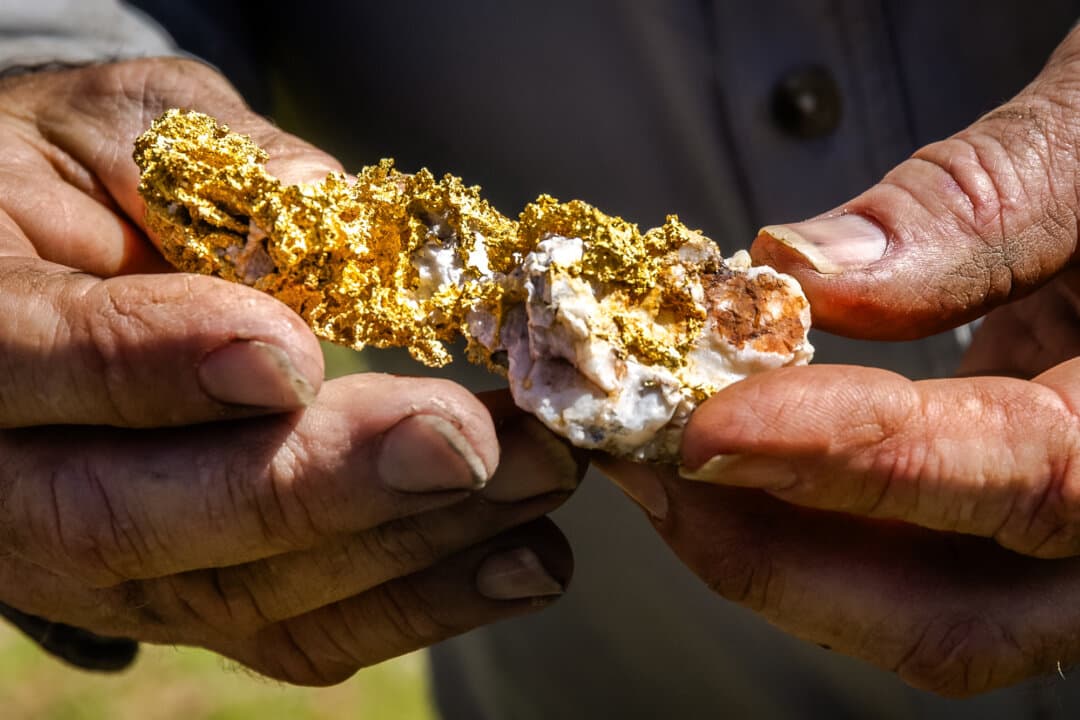
Miners display gold samples found outside of Angels Camp, Calif., on Feb. 5, 2026. Record-high gold prices have triggered a renewed interest in prospecting and mining, and what could be the start of a mini gold rush in the California Mother Lode, according to local miners. (John Fredricks/The Epoch Times)
Hard Rock Versus Placer Mining
Simpson and his partners operate three hard rock mines in three counties: the Gumboot Mine near Angels Camp in Calaveras County and two others in Tuolumne and Mariposa counties.
Hard rock mining means extracting minerals from lode sources in solid rock, underground ore veins in mine tunnels, and vertical mine shafts. It usually requires heavy machinery. It differs from placer mining, which is digging through looser material that has broken away from the lode through erosion and washed downstream.
Placer mining can mean anything from panning or sluicing for gold in a stream to dredging or dry washing to separate gold particles and nuggets from lighter sands and gravel.
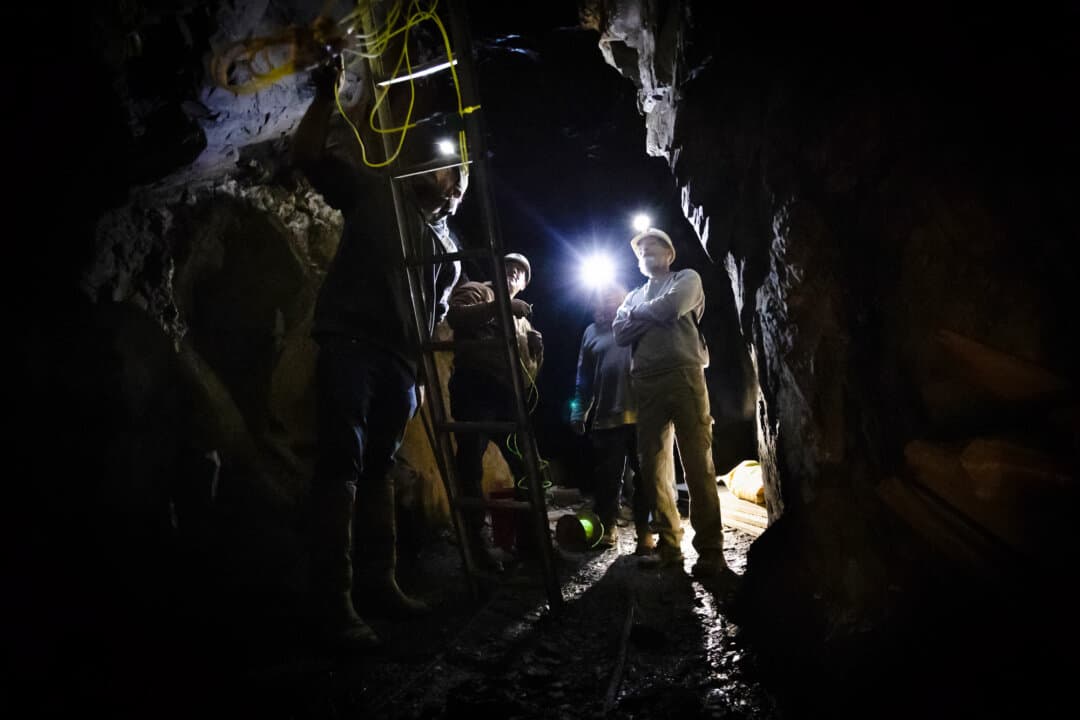
Miners search for gold deep within a mine outside of Angels Camp, Calif., on Feb. 5, 2026. (John Fredricks/The Epoch Times)
Inside a Gold Mine
On a recent journey to explore the Gumboot Mine, Simpson’s mining crew prepared explosives to blast about 20 tons of gold-rich ore loose from the tunnel walls.
At today’s prices, that much ore could yield about 10 troy ounces of gold or $50,000 in revenue once it is mucked, crushed, and refined, Simpson said.
“We’re stoping up on the vein out of the original shaft,” he said, pointing up at the vertical opening from inside the tunnel. The openings created in the mining process are called stopes.
“We’re after the quartz, but we’re also after the host rock, too, which holds sulfides, which hold gold.”
Using an air compressor and hoses, the miners carefully filled several drill holes 1 1/2 inches in diameter, which reached at least four feet into the rock, with a sodium nitrate-based explosive and set the detonation cords.
Bart Hanford, a seasoned miner and certified blaster overseeing the operation, checked the cords.
“It burns at 26,000 feet per second,” he said, with a gleam in his eye. “Good stuff!”
Once given the OK, another miner, Ismael “Smiley” Melendez, lit the fuse, yelling, “Fire in the hole!” to warn the rest that they had about two minutes to get out before the blast.
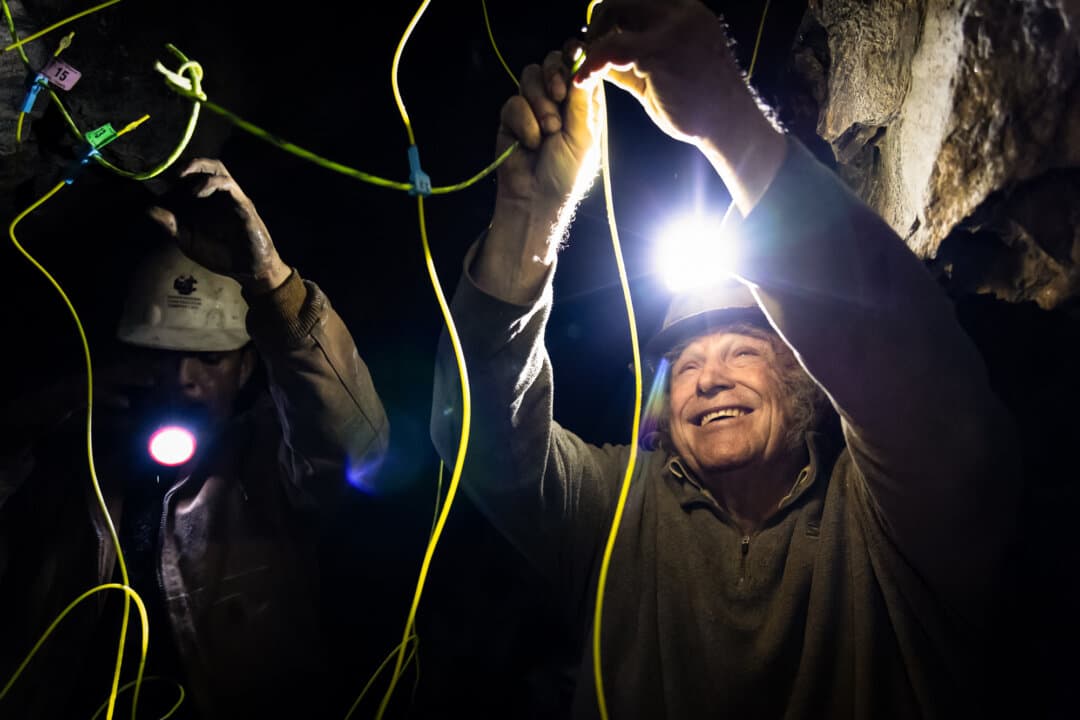
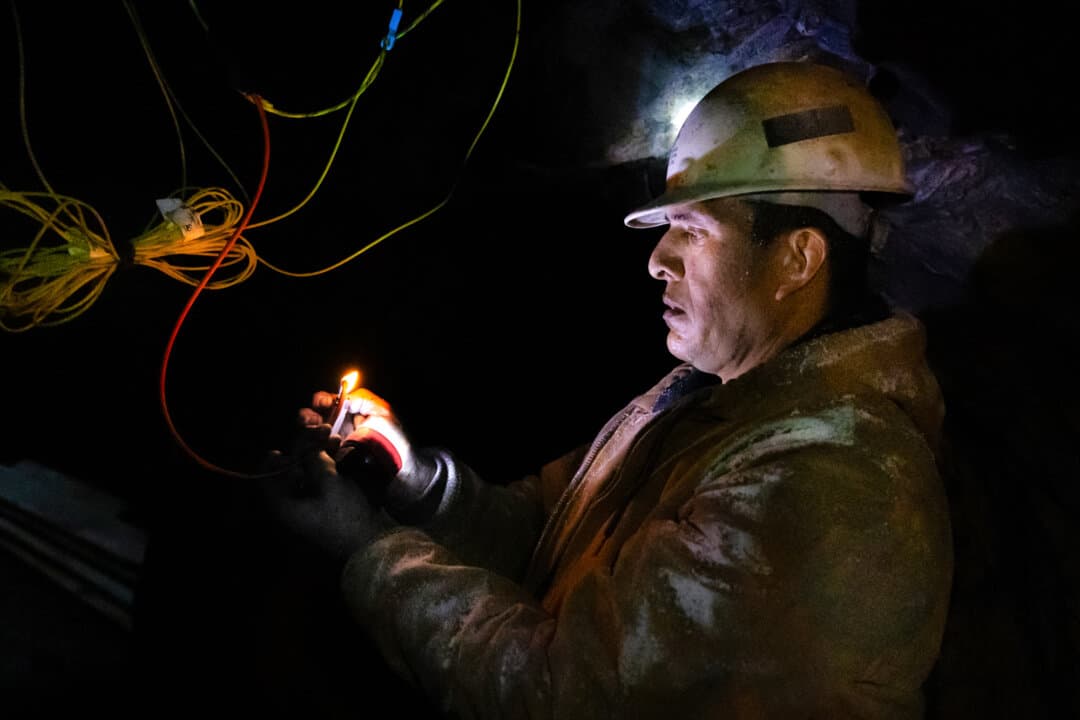
(Left) Bart Hanford, 79, sets up explosive charges deep within a mine outside of Angels Camp, Calif., on Feb. 5, 2026. (Right) Ismael Melendez lights a fuse for explosives outside of Angels Camp, Calif., on Feb. 5, 2026. (John Fredricks/The Epoch Times)
Once outside, the miners waited in gleeful anticipation of the explosions as the smell of smoke from the burning fuse wafted out. Moments later, a series of thunderous booms from deep inside the belly of the mine shook the mountainside, belching first light and then darker clouds of smoke and dust out of the tunnel mouth.
“Good job,” Simpson told his crew members as they moved down the mountain and waited for the smoke to clear and dust to settle.
Reentering the Tunnel
About a half hour later, Melendez reentered the mine to inspect it for safety before the other miners returned.
Then Chase Kliest, an expert metal detectorist, used a top-end detector to scan tons of fallen ore on the mine floor and newly exposed surfaces on the tunnel roof and walls. Listening for the sound of gold, he knew that the high-pitched squawking of the detector would mean that the crew was in luck.
“After a blow, I come in and I metal-detect all the easy surface,” he said. “If there’s more gold back in the wall, it’s easier to pick up rather than just chipping away aimlessly. I pinpoint where these pockets are, so that way they know where to drill.”
Standing on a mound of fresh ore on the mine floor, he ran his hands over the freshly blasted yellowish-orange ore on the tunnel roof. The gold could be another eight inches deeper in the rock, he estimated.
“Gold can be all through here,” Kliest said. “We’re already finding a couple little pieces, so there’s probably a nice pocket of gold right back in there. Just from what it sounds like, it could be a big one.”
Family Legacy
Simpson is a sixth-generation miner. His family has been gold prospecting and mining in the region since about two decades after the original California Gold Rush that began in 1848 and ended in 1855.
In 1875, his ancestors settled in Hornitos, a small town in Mariposa County, near where they found “all sorts of gold” in El Dorado Creek, he said.
Simpson said he remembers finding his first gold panning in the same creek when he was about 12 years old. But even before that, he said, he would go to the family’s hard rock mines, where his great-grandfather taught him how to drill and blast.
“Gold fever struck early, especially seeing all the gold that my great-grandfather had, and then my grandpa,” Simpson said.
Although he said he still loves placer mining, he has more faith in hard rock mines for bigger strikes.
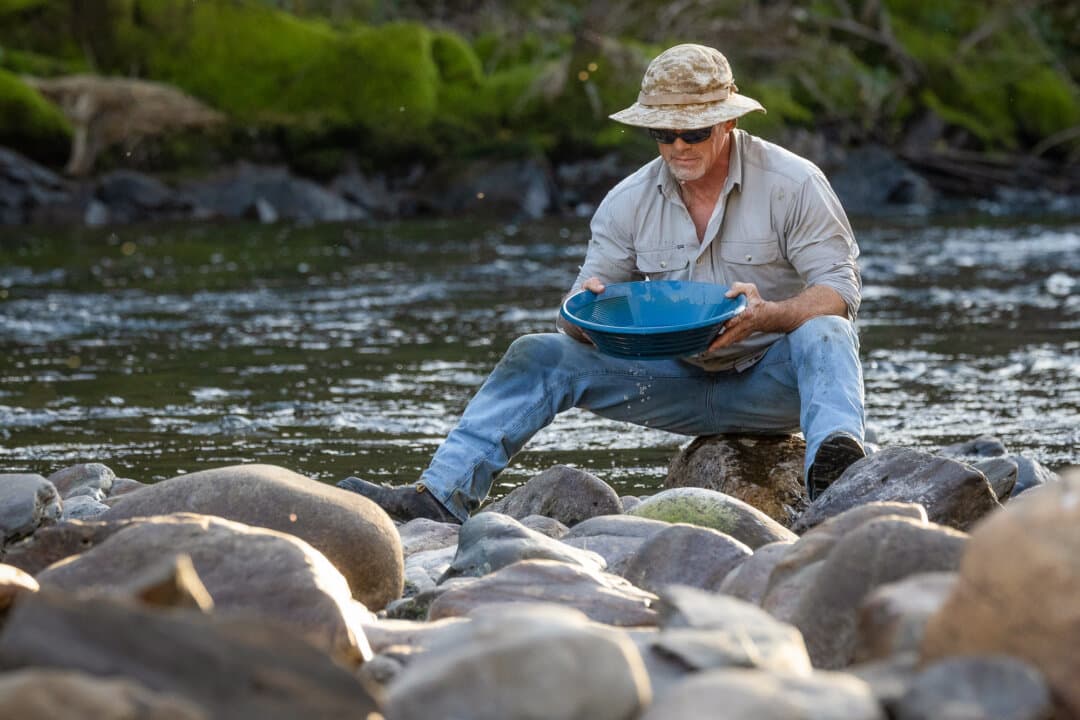
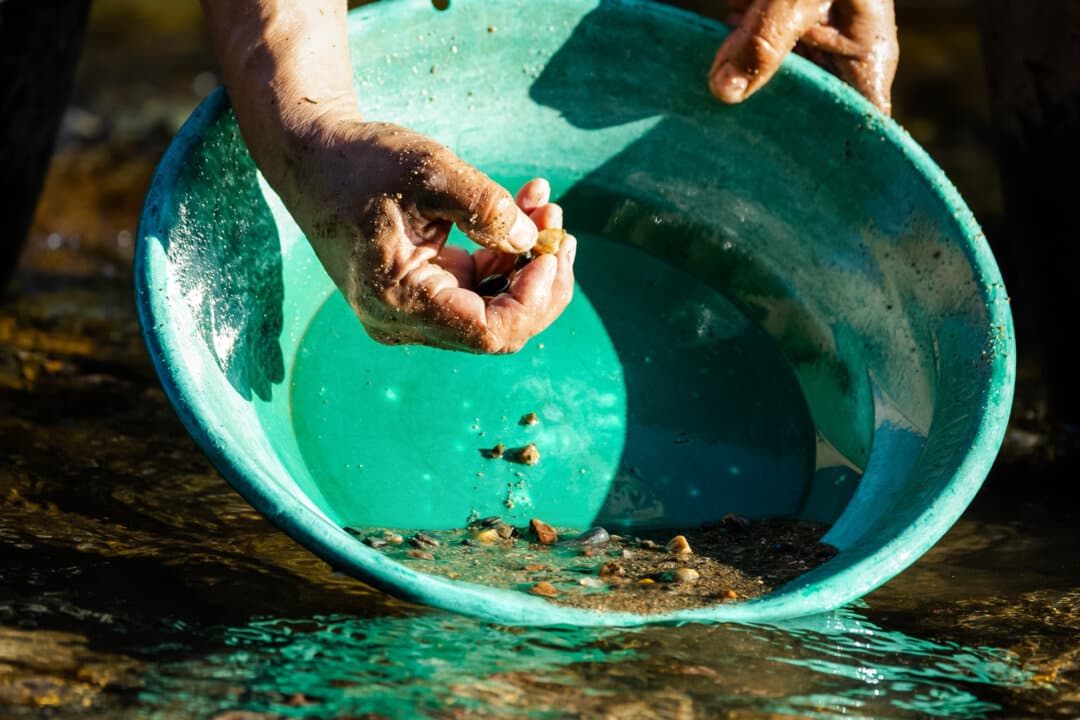
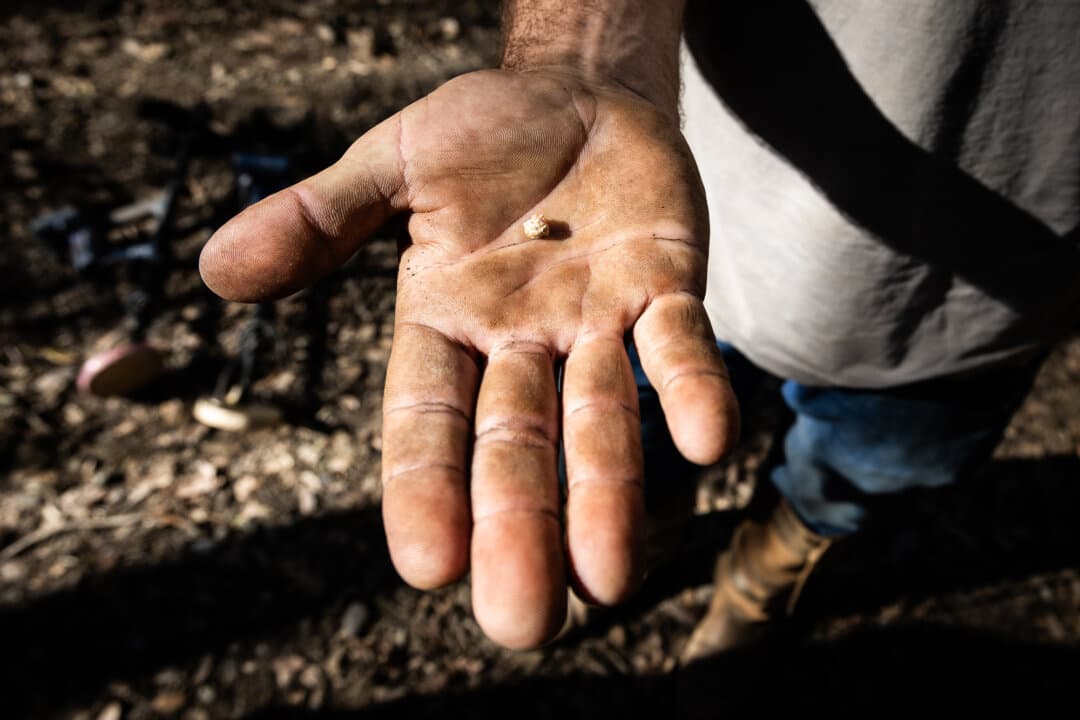
(Top) Rusty Simpson searches for gold in a river outside Angels Camp, Calif., on Feb. 5, 2026. (Bottom Left) Miners search for gold in a river outside Angels Camp, Calif., on Feb. 5, 2026. (Bottom Right) A gold sample found outside Angels Camp, Calif., on Feb. 5, 2026. (John Fredricks/The Epoch Times)
Spectacular Finds
“I’ve been very fortunate in the last 10 years,“ Simpson said. ”I’ve done really well with hard rock mining. My very first pocket was 100 ounces.”
Most placer gold found in the creeks and rivers is about 85 percent to 89 percent pure, but some of the gold found in hard rock mines is 97 percent pure, he said.
“Two years ago, we found a 10.5-ounce nugget at one of our mines that we actually sold last year,“ he said. ”A lot of people don’t think there’s that kind of gold left in the ground.”
The Bigfoot Nugget was named for its shape and was sold for $65,000, about twice the spot price of refined gold, Simpson said.
“It was about the size of an egg—a little bigger,” he said.
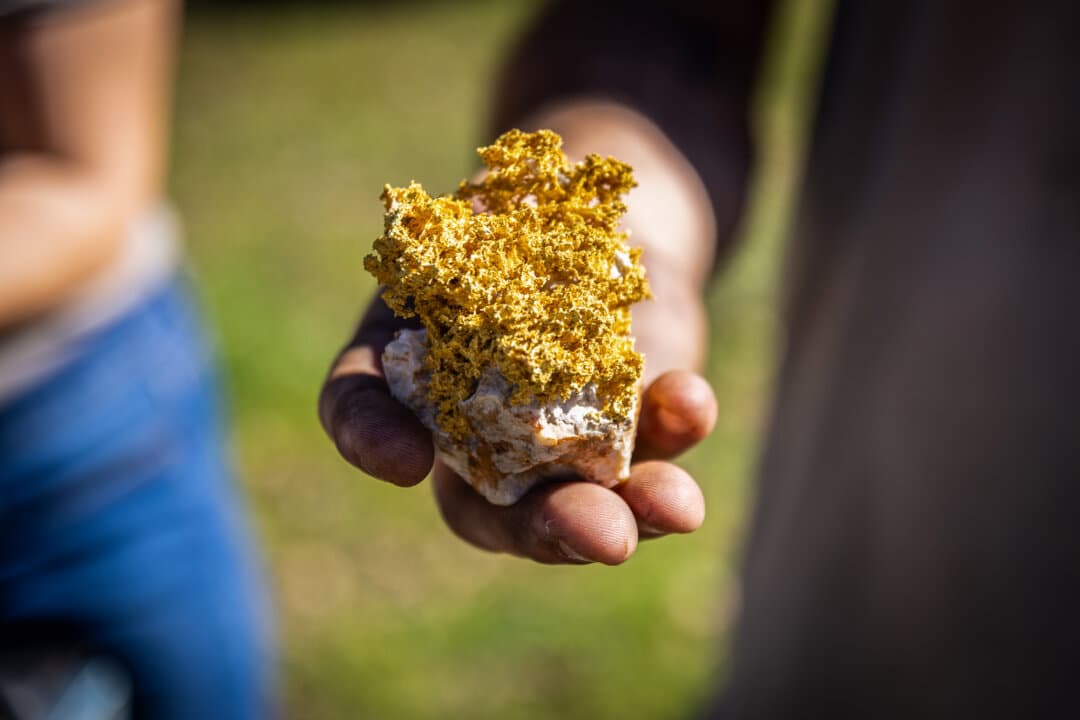
Miners display a gold nugget named The Bonsai, found outside Angels Camp, Calif., on Feb. 5, 2026. The nugget is estimated to be worth $35,000 to $45,000. (John Fredricks/The Epoch Times)
Most larger nuggets are worn smooth by years of erosion in the rivers and streams, but the Bigfoot was found only about 300 feet from the quartz vein that once contained it, Simpson said.
“This one never hit the water,“ he said. ”It just rolled down. It was behind a rock. We found it with a metal detector 18 inches down. It was just a beautiful nugget. There was just a little tiny bit of quartz ... so it was kind of on the higher end of the nugget world.”
A nice crystalline gold specimen can sell for up to five times the spot price, he said.
“We have some beautiful specimen gold, too—obviously stuff you don’t crush,” he said.
Simpson said he and his partners usually sell most of the gold and reinvest the profits back in to the company to buy equipment and expand their mining operations.
“We’re trying to take our company to the next level,” he said.
Panning for Gold
For anyone eager enough, there is still “gold in them thar hills” waiting to be unearthed. Modern metal detectors and small-scale mining equipment have made gold prospecting easier and, for some, a weekend hobby and a fun outdoor family activity.
As Simpson and his wife, Stacy Simpson, co-CEOs of the company, demonstrated at the Mokelumne River, all it takes is a pan, a pick and shovel, a little know-how, and a positive attitude to land a nugget.
While she panned, Stacy Simpson pointed out a large quartz vein in the mountainside across the river, where erosion had loosened the gold-bearing quartz and winter rains had most likely washed gold into a mountain stream and to the river below.
A fast-flowing river can carry smaller nuggets downstream but, because gold is heavy, only so far before they settle to the bottom as they reach calmer water—usually near a bend or behind rocks along the banks.
Rusty Simpson warned newcomers that during the heavy rains and flash floods in the mountains, it is too dangerous to pan streamside.
“It gets pretty scary sometimes,” he said.
Gold Fever
Rusty Simpson and his crew also hold fundraising events for mining rights groups on his claims.
“I like to give back to the mining community because I’ve actually done pretty well myself, so it’s nice to be able to have new people that want to get into hard rock mining or get into just regular placer mining,” he said. “We show them how it’s done.”
The events are important to protect mining rights but “it’s more about camaraderie” and the joy of seeing newcomers learn to prospect and mine, he said.
But newcomers—or greenhorns, as they are known in prospecting circles—can be fickle.
“If they find gold, they’ll come out again,“ he said. ”If they don’t find any gold, not so much.”
The first time you see a nice little “picker,” a piece of gold big enough to hold in your fingertips, in your pan, is when you are “hooked” and “gold fever takes over,” he said.
Those who do get the gold bug usually return to the goldfields with all types of prospecting gear and small-scale mining equipment, he said.
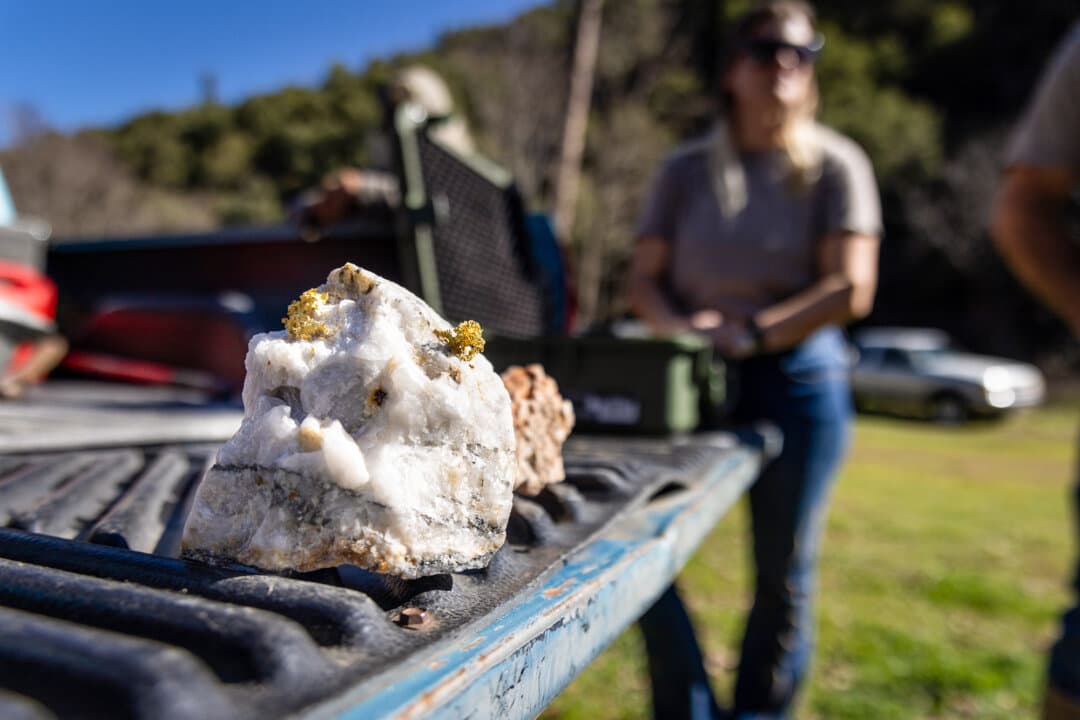
Miners display a crystalline gold sample found outside of Angels Camp, Calif., on Feb. 5, 2026. (John Fredricks/The Epoch Times)
Staking a Claim
Some public lands managed by the Bureau of Land Management are still open to prospecting, but one must be careful not to do so on land that is already claimed.
Although there are still “really good” spots open for people to stake mining claims on, Rusty Simpson said they are usually in remote places, which can mean hiking in steep and rough terrain that is not for the faint of heart.
Those untamed places that seem out of reach for most people are often where the most gold is found, he said.
Staking a mining claim on public lands is not easy for first-timers, so part of his business is showing people how to do it.
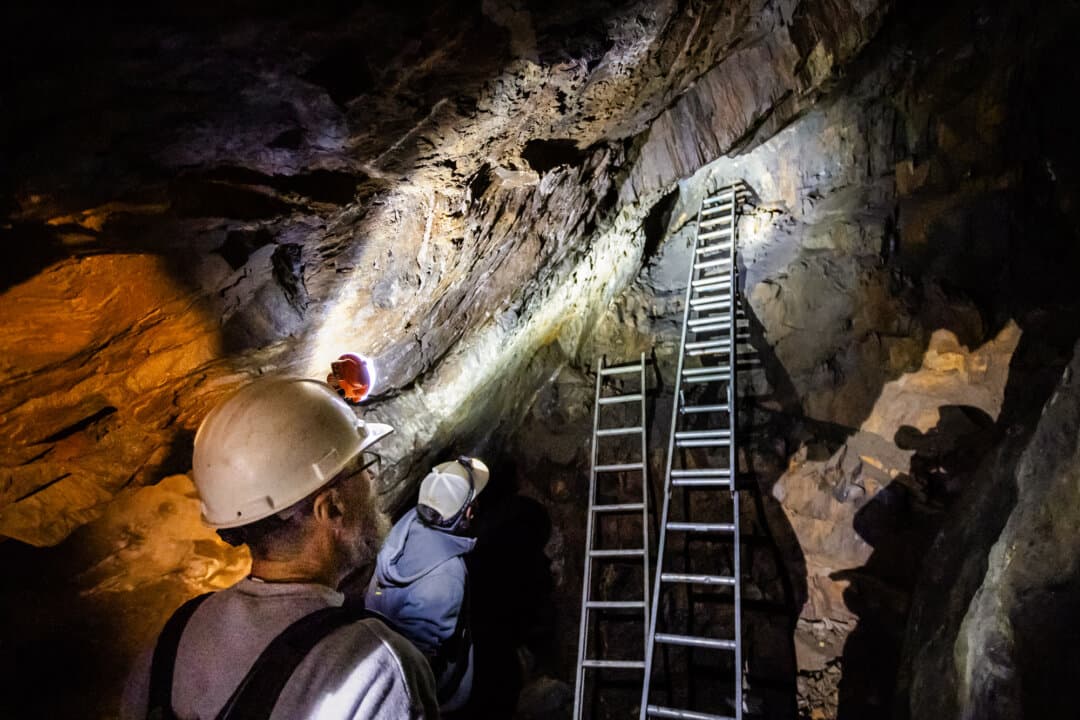
Miners travel within a mine shaft outside of Angels Camp, Calif., on Feb. 5, 2026. (John Fredricks/The Epoch Times)