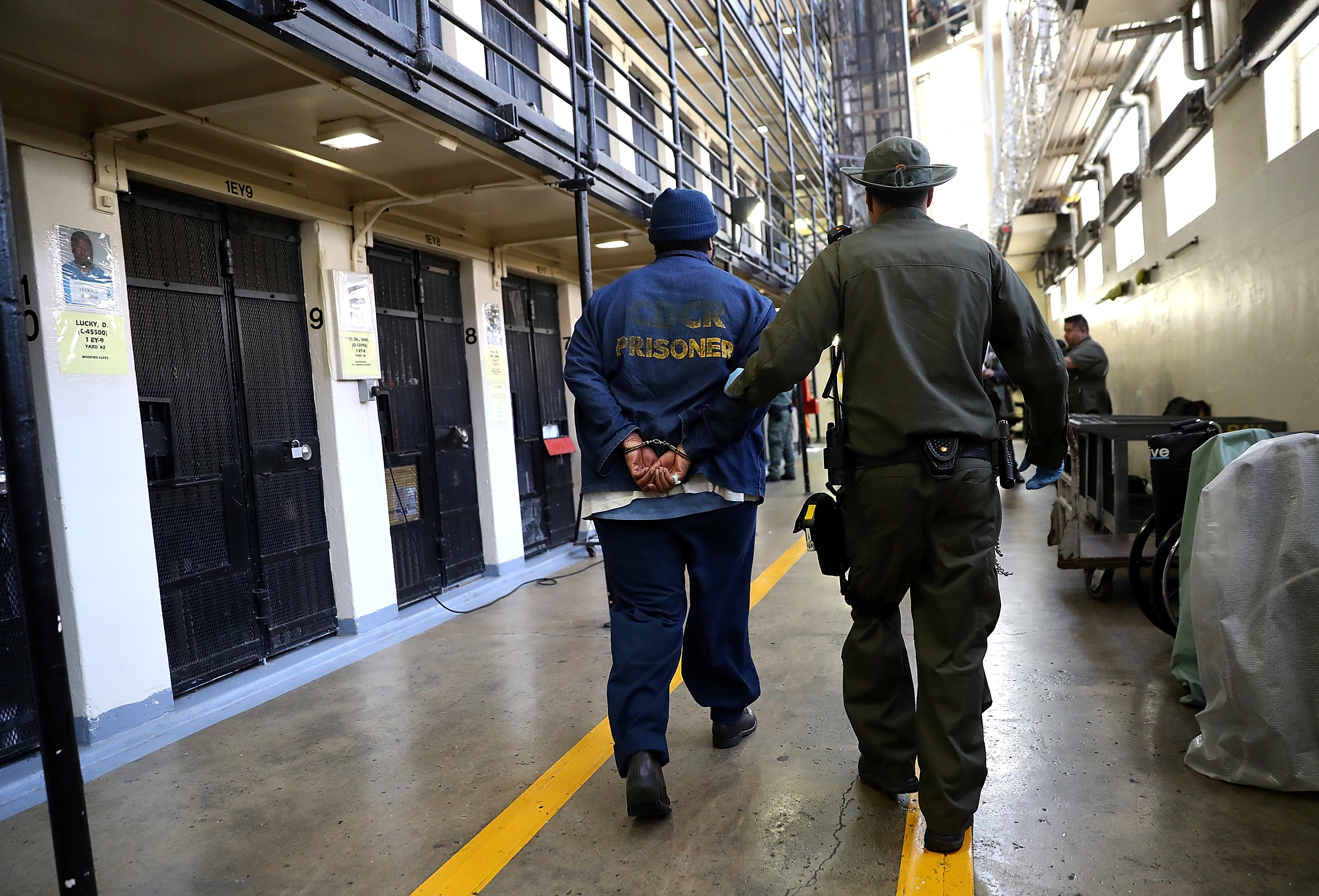

People sentenced for crimes involving sexual offenses could be excluded from California’s Elderly Parole Program under a new state bill. This comes as three inmates convicted of such crimes are being reviewed for parole.
In the state legislature, a bipartisan effort is underway to revise the Elderly Parole Program.
Senate Bill 1278, a Republican-backed bill, would exclude people convicted of certain sexual offenses from being eligible for release under the Elderly Parole Program. Under current state law, people convicted of serious felonies, those convicted of first-degree murder of a peace officer, or individuals facing a life sentence without the possibility of parole are already excluded from the program.
SB 1278 was referred to the Senate Public Safety Committee on April 8 and is waiting for its first hearing.
In the other chamber, Assembly Bill 2727, a Democrat-backed bill, would similarly specify that people convicted of offenses involving multiple victims or offenses “including rape, sodomy, or aggravated sexual assault of a child ... are not suitable for parole under the Elderly Parole Program.”
However, under certain situations, a person could be “eligible for parole only if the person is 75 years of age or older and has served a minimum of 30 years of continuous incarceration on their current sentence,” according to the bill. This is an increase from the current requirement of being 50 years of age or older and serving at least 20 years of continuous incarceration.
The bill would also allow the secretary of the Department of Corrections and Rehabilitation to refer inmates for mental health evaluations within four months of their scheduled release date.
AB 2727 passed its first hearing on April 7 in the Assembly Public Safety Committee.
“When predators prey on our children, the impact is devastating, and it stays with victims for life,” bill author State Assemblymember Stephanie Nguyen said at the hearing.
She added that her bill is taking a more targeted approach by focusing on the most serious offenders.
“We’ve seen cases that raise serious concerns about how this program is being applied to individuals convicted of violent sex offenses, and it’s clear we need to draw a clear line,” said Nguyen.
During the committee hearing, a victim shared her story of being targeted by a man who was later convicted as a child molester.
“When I was seven years old, playing outside, I was approached by a man named David Allen Funston,” said Turrina, who was only identified by her first name.
She testified that Funston approached her with a necklace and then with candy. He eventually lured her into a laundry room, where he tried to undress her. In the end, Turrina was able to run away and get back to her mother.
“Now, 30 years later, I am hearing that my real-life boogeyman is able to get released early,” Turrina told lawmakers, adding that she believes Funston “will never stop hurting children.”
3 Inmates Reviewed for Release
Funston, 64, is among three inmates convicted of sexual offenses who have recently received approval for parole, although none have been officially released yet. The other two are Gregory Lee Vogelsang and Roberto Antonio Detrinidad.
Funston remains in custody at the local level after Placer County filed new charges in February against him related to the 1996 sexual assault of a young child in Roseville. This prevents his immediate release following the Board of Parole’s September 2025 decision to grant him parole.
He is now being held in the Placer County jail pending his conviction on new charges.
“To be clear, this individual was previously sentenced to multiple life terms for extremely heinous crimes,” said Placer County District Attorney Morgan Gire in a press release on Facebook. “It is our duty to re-evaluate those cases and act accordingly.”
Funston was originally sentenced to life with the possibility of parole in 1999 for “kidnapping and lewd and lascivious acts with a child under 14 years of age,” according to the California Department of Corrections and Rehabilitation.
Vogelsang, 57, was approved for release following his Board of Parole hearing in November 2025. But his release has since been paused following a board decision to reevaluate his case in response to a request from Gov. Gavin Newsom as well as public opposition from lawmakers and the Sacramento County District Attorney and County Sheriff.
“This inmate had a risk assessment that was above average for reoffending,” said Sacramento County District Attorney Thien Ho during a March 12 press conference. “My office fought [his parole approval] every single step of the way.”
Lawmakers Call for Change
“Make no mistake that these releases that are happening, that we’re seeing in our communities, are a choice,” said Assemblymember Josh Hoover during a March 18 press conference. “They are a policy choice that are putting the interests of criminals over the interests of victims and the interests of public safety.”
Vogelsang originally faced a life sentence for cases dating back to the mid-1990s, when he molested five boys who were 5 to 11 years old, the District Attorney stated on X.
As for Detrinidad, 39, the Board of Parole decided during a January hearing that he “does not pose an unreasonable risk to public safety and is therefore eligible for parole,” pending outcomes of the review process.
Detrinidad was imprisoned in 2014 and convicted in 2016 for breaking into a woman’s San Francisco apartment in the middle of the night and raping her.
He has served 11 years of his original sentence of life in prison with the possibility of parole. His parole has been attributed to Proposition 57, which was passed by voters in 2016. It allows the state to reduce the prison population by granting parole to inmates who “no longer pose a current, unreasonable risk to the public” and allowing them to earn credits for good behavior.
Unless the governor intervenes, Detrinidad will likely be able to leave prison around May or June this year. However, unlike parole grants in murder cases, which the governor can reverse, Newsom’s powers are limited in sexual assault cases, in which he can only ask the parole board to reevaluate its decision.