A humorous point among therapists is how vulnerable we are to the aches, pains, and injuries we treat in others. Generally, if you can suffer from it, we can suffer from it, too, including tension headaches.
Office work and electronics are some of the biggest culprits for tension headaches in the modern world. Many of us sit in the same positions for extended periods, and not with an upright posture. Instead, we hunch forward, trying to read words that are just a little too small.
One of the messy realities of modern computer interfaces is that enlarging them to try to see better often forces us to move the screens around to be able to see everything, which can be cumbersome. The alternative? Poor posture.
While there are many causes for tension headaches, two of the most common factors are stress and tension in the shoulder and neck muscles, often provoked by bad posture. These also happen to be two of the most common pathologic contributions of the modern work environment.
There is help—and it comes in the form of exercises directed at decreasing muscle tension and helping preserve proper posture.
These exercises work well for my patients, but I recommend conferring with your medical provider to ensure that they’re right for you.
1. Chin Tucks
Chin tucks are great for helping reposition your neck and providing flexibility and strengthening.
Step 1: Sit with your head upright, your trunk straight, and your shoulders back.
Step 2: Keeping your head upright and level, move your chin rearward as far as you can. You can push gently on your chin with your fingers to enhance the movement, but don’t push into pain. Hold for five seconds before returning to the starting position.
Step 3: Moving your head back and returning to the starting position counts as one repetition. Try to perform three sets of 10 repetitions.
Why I Like It: Being aware of your head position prevents you from sitting or standing with poor posture and helps you directly reset your head position.
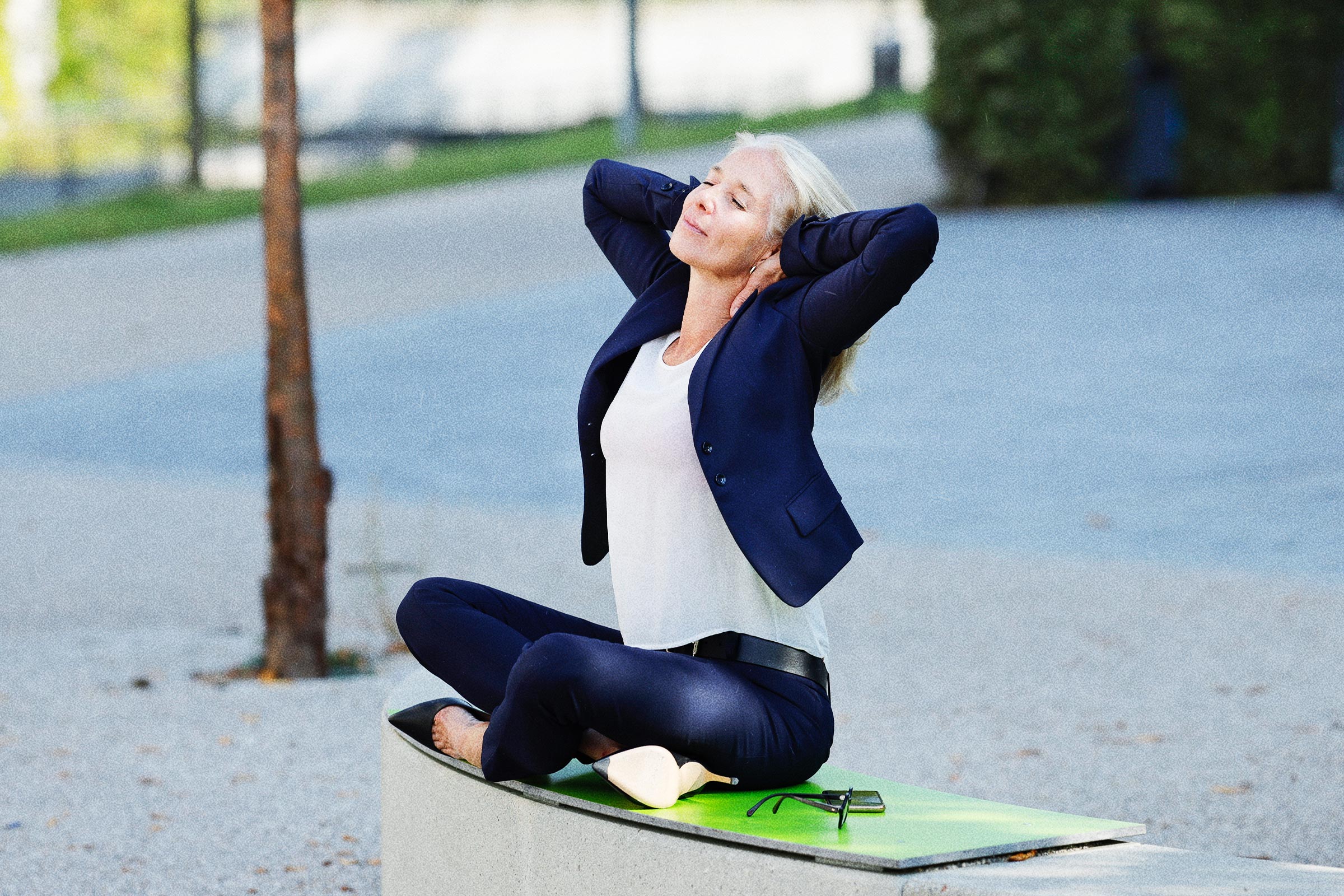
2. Seated Thoracic Extension
This exercise is one of my personal favorites. It’s easy to perform since your upper body is well-stabilized during the movement portion.
Step 1: Sit upright all the way back in a chair with fingers interlaced behind your head.
Step 2: Initiate movement by slowly extending your upper back so your shoulders move over the back of the chair. You should feel a great stretch in your upper back.
Step 3: Hold for five seconds before returning to the starting position. Moving back into a stretch and returning to the starting position counts as one repetition. Try to perform three sets of 10 extensions per side.
Modifications: If you can’t move far into this stretch, just do the best that you can. Over time, you will find that you can do more. You can also reach straight up and back as you complete the movement to further intensify the stretch, as if reaching to take a ball from someone standing behind you.
Why I Like It: Easy to perform and extremely effective, what’s not to like about this exercise? My favorite aspect is that it effectively targets the often neglected upper thoracic area.
3. Seated Neck Rotation
Seated neck rotations are easily performed and maximize the neck’s rotational range of motion.
Step 1: Sit in a chair with your neck upright, head facing forward. Slowly rotate your head straight to the left as far as you comfortably can. You can optionally use your right hand to help rotate your head a little farther from there, either by holding on to the top of your head with your fingers and turning it, or by gently pushing on your right jaw or cheek to help. Hold the stretch for five seconds.
Step 2: Return your head to the starting position and repeat on the other side.
Step 3: Turning your head in both directions counts as one repetition. Try to perform three sets of 12 repetitions.
Modifications: Neck rotation ability is highly variable between people. Only move as far as you comfortably can at first, knowing that you will probably be able to move farther over time.
Why I Like It: These simple stretches enhance cervical mobility and are great endpoint stretches for the involved muscles.
4. Masseter Stretch
The masseter muscles are large, powerful muscles that attach at the back of the jaw and provide biting or clenching force. Unfortunately, during stress, they often participate in muscular tension by clenching for prolonged periods. Equally unfortunately, they are often neglected by stretching regimens aimed at reducing tension—but we won’t let that happen here. I have just the exercise for you.
Step 1: Sit upright with your mouth closed and your teeth touching but not clenched.
Step 2: Open your mouth as far as you can and hold this position for five seconds, allowing your masseter muscles to stretch.
Step 3: Return your mouth to the starting position before repeating the motion.
Step 4: Opening your mouth and closing it again counts as one repetition. Try to perform one set of 12 repetitions, feeling free to modify sets and repetitions to suit your needs.
Modifications: Masseter muscles can be tight, so you may not be able to open your mouth very wide. Just open as far as you can at first, knowing that you will likely be able to do more as they become more relaxed.
Why I Like Them: Our masseter muscles don’t get a lot of love, but this exercise specifically focuses on them.
5. Side Bend Neck Stretch
The side bend neck stretch—also known as the lateral neck stretch—emphasizes lateral movements of the head and is a great complement to the other exercises, providing a full set of movements and stretching for your neck.
Step 1: Sit with your head straight up and looking forward.
Step 2: Slowly move your head straight down toward the right, as if trying to touch your ear to your shoulder. Move as far as you comfortably can and then hold the position for five seconds. You can use your hands to help provide a slightly greater pull to the side.
Step 3: Return to the starting position and repeat on the left side. Moving your head to one side and back to the starting position counts as one repetition. Try to perform one set of 12 repetitions per side.
Modifications: Many people are surprisingly limited in lateral neck movement. Don’t push your head farther than its natural stopping point. Over time, the weight of your head will begin to open those tight muscles for greater range of motion.
Why I Like It: Many neck stretches focus on head rotation and nodding movements, excluding your lateral musculature. Side bends focus directly on your lateral neck and shoulder muscles, giving them the love they need.
6. Pectoral Stretch
There are many great pectoral muscle stretches to choose from, and that makes me happy because the pectoral muscles can have a pronounced adverse effect on posture and pain when they get tight.
Step 1: Sit or stand with your back straight and your head up.
Step 2: Reach your hands behind you and clasp them together.
Step 3: Initiate movement by pushing your hands straight back as far as possible while pushing your chest forward.
Step 4: Next, raise your hands behind you as far as you comfortably can and then take a large breath, feeling the stretch in your chest. Hold this position for approximately four seconds before relaxing back down.
Step 5: Stretching and then relaxing counts as one repetition. Try to perform one set of 15 repetitions.
Modifications: If you can’t reach behind you, you can hold on to a towel or a wooden spoon or stick with both hands, which lets you get your hands behind your back and open your chest.
Why I Like It: This particular exercise can be performed anywhere—at a desk, on the edge of a bed, or while standing or sitting—and is a decidedly efficient, effective movement. I perform this exercise several times a day, and always appreciate how well it works.
I recommend performing the above routine regularly and proactively to help you stay ahead of tension headaches. While it serves to soothe an active headache, why wait for the pain? I hope you find them beneficial.
About the fitness model: Aerowenn Hunter is a health editor and fitness model for The Epoch Times. Vibrant in her 60s, she’s an accredited yoga therapist who has dedicated three decades to teaching yoga.