It used to be that the older we got, the more we worried about our blood lab results—but in this day and age, the young needn’t feel excluded. The truth is, lab values are growing steadily worse across even the younger generations. I'll also include blood pressure here, because though it is a vital sign and not a lab value per se, blood pressures are climbing all over the globe.
Fortunately, there are ways to lighten our sense of dread over lab results and vital signs.
While managing the health issues associated with lab values can be a complex and sometimes daunting science, there is ample evidence that regular exercise can provide much-needed support for stable health.
6 Exercises for Normalizing Health Indicators
The following exercises have proven effectiveness for promoting better health and quality of life—and I believe you will enjoy them. Although my patients tolerate them well, I recommend discussing them with your medical provider to ensure they are right for you.
1. Walking
Walking is an easy and pleasurable exercise that requires little instruction, yet is often overlooked. That’s a shame, because walking is an excellent booster of our vitals. Regular walking is known to improve cholesterol, blood pressure, blood sugar levels—and the list goes on.
Step 1: To warm up, walk at your normal pace and maintain that speed for five minutes.
Step 2: Increase your pace to a fast walk—or maintain your current pace if you prefer—and continue walking for at least 15 minutes and up to 30.
Step 3: Slow down to your regular walking pace for five minutes to cool down.
Modifications: Feel free to adjust your walking speed as needed, and use a stabilizing device, such as a walking stick, if necessary.
Why I Like It: Walking is great for warming up and is uniformly beneficial. If you do only one exercise on any given day, let it be walking.
2. Ski Jumps
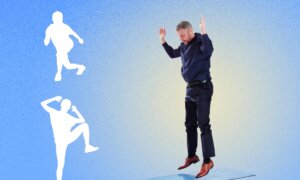
The ski jump is a highly energetic side-to-side movement that works on balance and aerobic capacity, which improves lab values such as
cholesterol, blood lipids, glucose levels, and more. Easy to perform, ski jumps can enhance aerobic fitness with regular practice.
<iframe src="https://vod.brightchat.com/embed/fad0f467-7c17-4edf-acf4-7138817c82c9?r=1x1&d=13" width="560" height="315" frameborder="0" allowfullscreen playsinline></iframe>
Step 1: Stand with your feet hip-width apart and your arms by your sides and elbows bent. Imagine an invisible line running lengthwise beside your right foot, or place a piece of tape on the ground as a visual guide.
Step 2: Jump with both feet at the same time, approximately 1 foot to the right of the line (you hop over the line), while also pulling your hands up rapidly to your chest. As you land, move your arms straight back.
Step 3: Immediately hop 1 foot to the left of the line, again using your arms to help.
Step 4: Perform the movement for one minute before resting. This counts as one set. Try to perform three sets, modifying as needed.
Modifications: If jumping a full foot is too much, just leap as far to each side as is comfortable for you. If jumping itself is too much, simply stepping with a bit of spring action to either side can achieve similar results and is just as fun.
Why I Like It: Ski jumps are loads of fun and highly effective. There’s precious little not to like about them, making them a very friendly exercise.
3. Pogo Hops
OK, let’s have some fun. While all of these exercises are very productive, this one is also fantastically fun. Just like the young, hopping and leaping animals in the springtime, this exercise will leave you jumping for joy—or at least hopping.
<iframe src="https://vod.brightchat.com/embed/d9b94f1a-1f2b-4e75-a86b-c192048f776e?r=1x1&d=7" width="560" height="315" frameborder="0" allowfullscreen playsinline></iframe>
Step 1: Start this exercise in a standing position, with your feet approximately 1 foot apart.
Step 2: Rise up on the balls of your feet, then begin hopping no more than 1 foot off the ground. Keep your entire upper body straight and allow only a slight bend in the knee. Jumping for 30 seconds counts as one set. Try to perform four sets of 30 seconds each.
Modification: If balance is challenging while pogo hopping, stand next to a wall for support.
Why I Like It: As I said, they’re fun! Fast, repetitive hopping motions can provide a significant amount of cardiovascular exertion in a short period, offering a fun and fitness experience all at the same time.
4. Chair Squats
Chair squats are a superb way to build gluteal and quadriceps strength. They also have a powerful cardiovascular component.
<iframe src="https://vod.brightchat.com/embed/2412db5d-646f-489f-9d25-b5f977df7bc5?r=1x1&d=15" width="560" height="315" frameborder="0" allowfullscreen playsinline></iframe>
Step 1: Sit at the front of your chair with your feet shoulder-width apart and your arms straight out in front of you.
Step 2: Lean forward and slowly stand up, taking approximately two seconds to fully rise to your feet. You can lower your arms to your sides at the same time or keep them extended.
Step 3: Once standing, slowly lower back down to sitting, being sure to move gently. Rising up and then sitting back down counts as one repetition. Try to perform three sets of 12 repetitions.
Up the Challenge: Slow your movements by half.
Why I Like It: Chair squats are a highly supported bodyweight squat that uses support to simulate an essential everyday activity.
5. Step Jumps
Step jumps are another highly aerobic exercise with very natural movement components. There are many variations, but I love the jump forward/jump backward version for its simplicity and because it works for you in both directions.
<iframe src="https://vod.brightchat.com/embed/9b115861-08f0-410c-8262-2ed8c32de4d6?r=1x1&d=13" width="560" height="315" frameborder="0" allowfullscreen playsinline></iframe>
Step 1: Stand with your feet hip-width apart, facing a staircase, yoga step, or other stable surface.
Step 2: Carefully jump onto the step and then immediately jump back down.
Step 3: Jumping up and then down counts as one repetition. Try to perform three sets of 12 jumps, modifying the sets and repetitions as needed.
Modifications: Want to make it easier? Step up with one foot at a time, rather than jumping. Want to make it harder? Increase the speed of your jumps, being careful to maintain your exercise form.
Why I Like It: There’s a lot of cardiovascular goodness in step jumps, and they also work on improving your balance.
6. High Knees
This marching exercise is stable and controllable, and can be performed while holding on to something for support. It’s a great exercise to get your heart rate up while performing a stationary exercise.
Step 1: Stand with your feet approximately hip-width apart.
Step 2: Begin running in place. Try to bring your knees up as high as possible with each step, swinging your arms for added benefit. I suggest starting with a jog and moving up into a run if you can.
Step 3: Try to perform three sets of 60 seconds each, modifying sets and durations to suit your needs.
Modifications: If jogging or running is too challenging, march in place with high knees. If you can’t lift your legs high or have less mobility on one side, just do your best.
Why I Like It: High knees is a fast-paced movement with an aerobic component.
Together, these lab-leveling exercises can help stabilize and normalize your body, support optimal function, and potentially assist in bringing abnormal labs back into normal ranges. At the very least, you’ll get an excellent workout and have fun at the same time. I suggest performing these exercises three times per week and optimally five times. I hope you enjoy them.
About the fitness model: Aerowenn Hunter is a health editor and fitness model for The Epoch Times. Vibrant in her 60s, she’s an accredited yoga therapist who has dedicated three decades to teaching yoga.