Almost all of my therapy cases start with patients lying in bed. It is true—most people who come into the hospital or a skilled nursing facility are on their backs when I first make contact. Their supine position is actually optimal for me because I can do a deep evaluation of their bed mobility skills in addition to everything else I plan to check. Conducting the evaluation early in the morning makes it even easier, because I can get a feel for how they perform when their bodies are stiff from sleep.
By the time we finish the rolling, scooting, and sliding portions of the evaluation, the patients have already had a good workout before they place their first foot on the floor. In short order, it’s common to see people vastly increase their ability to perform bed mobility, and their gains in muscular strength are very apparent.
If exercising in bed is great for my patients, it follows that it can be good for you, too.
5 Great Core Exercises You Can Perform in Bed
You can perform plenty of exercises out of bed, and I encourage you to do as many of those as you want to. However, this is a set that you can perform before even getting out of bed—especially if you tend to get distracted by everything you need to do once you get up.
My patients tolerate these exercises well, but I suggest that you speak with your medical provider to ensure that they are right for you.
1. Plank
The plank is one of the classic exercises for strengthening your core. Although initially challenging, it pays off quickly.
Step 1: Assume a prone position in the bed, your feet approximately one foot apart and your elbows bent. From there, rise onto your forearms and the balls of your feet with your upper arms straight up and down and your palms flat. Keep your body in a straight line; don’t sag or arch your back, and keep your head aligned with your spine.
Step 2: Holding the position for as long as you can, up to one minute, counts as one repetition.
Step 3: Attempt three repetitions, allowing one minute of rest between each. You will likely get a little out of breath by the time you perform the third plank.
Modifications: Only do as many planks as you comfortably can at first, because they are challenging. Do not fault yourself if you cannot do much. Just do what you can at first, and you will see improvement as you go.
Why I Like It: The plank exercise wakes your body up to the core and gets your engine running.
2. Dead Bug
The dead bug is both funny-looking and funny-sounding—it is also an excellent hip and shoulder movement that further works your core. It is the only dead bug you will not mind finding in your bed.
Step 1: Lie on your back in your bed. Extend your arms straight up toward the ceiling so that your shoulders are at 90 degrees of flexion. Next, bend your hips and knees to 90 degrees.
Step 2: Slowly lower one arm straight backward toward the bed surface as you also take the opposite leg down toward the bed, straightening your knee. Move to where your arm either touches the bed or as far as it can, with your opposite leg extended all the way out and your heel almost touching—try not to touch, however, because this can allow your core muscles to disengage.
Step 3: Return your arm and leg to the starting position while simultaneously performing the lowering movements with your other arm and leg. One arm and one leg will go up, while the other arm and leg go down.
Step 4: With each hand-leg switch counting as one repetition, try to perform three sets of 20 repetitions. Move slowly, taking approximately one to two seconds to alternate positions.
Modifications: Only move your arms and legs as far as you can to avoid stressing your joints.
Why I Like It: These are highly effective exercises that I perform myself. The dead bug introduces a constant core contraction while superimposing arm and leg movement over that. A bonus benefit is that movements using opposite limbs strengthen brain–body communication, sharpen coordination and focus, and boost circulation and neuron-supporting proteins, giving your cognitive function a jump-start before you even get out of bed.
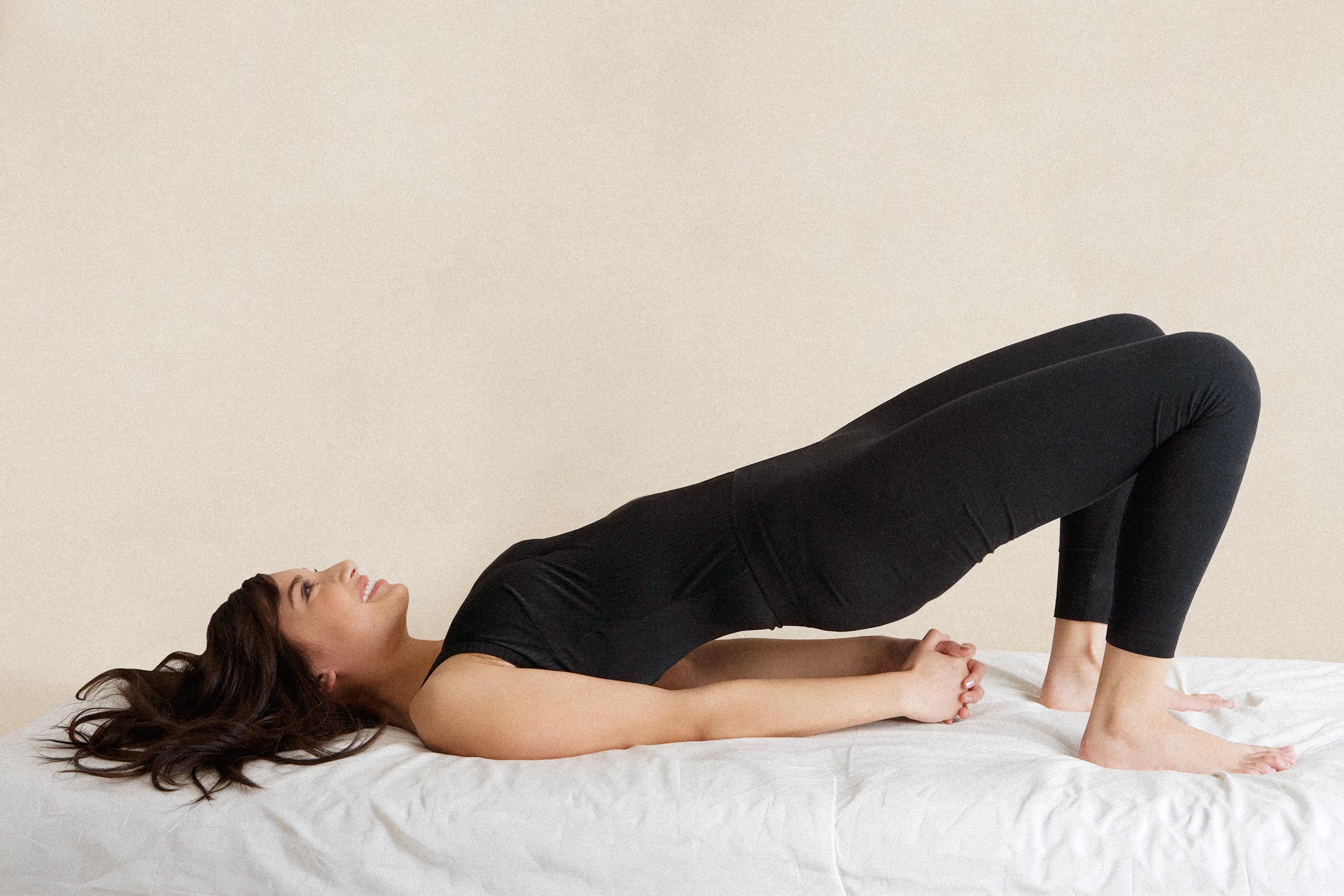
3. Glute Bridge
Let’s include one of the all-time great exercises for alleviating low back pain, which can creep in during the night. The glute bridge exercise also targets a wide range of core and leg muscles in a tidy, stable movement that can be performed virtually anywhere—even a bed.
Step 1: Lie with your arms by your sides, bend your knees, and place your feet flat on the bed—be sure to remove the pillow from behind your head.
Step 2: Slowly lift your hips until your body is in a straight line between your knees and your shoulders. Hold this position for 30 seconds before lowering back down.
Step 3: Raising up and then lowering back down counts as one repetition. Try to perform three sets of five repetitions.
Modifications: Cannot get your hips up very far—or not at all? Just come up as high as you comfortably can, or at least commit the muscular effort, as the exertion will strengthen the muscles needed to perform the movement. Eventually, you should rise successfully.
Why I Like It: A tidy package for strengthening the core and lower back, glute bridges actually factored into my own low back rehabilitation once upon a time, so they hold a special place in my heart.
4. Crunches
Good old-fashioned crunches have been performed to strengthen people’s core musculature for what seems like forever—and for good reason. It’s a simple exercise that readily accesses your core muscles, hitting your abdominals squarely.
Step 1: Lie on your back with your feet flat on the bed and your knees bent, and interlace your fingers behind your head, supporting the base of your skull.
Step 2: Slowly bring your shoulders up toward your knees, moving as far forward as you can. Visualize curling up instead of simply hinging at your hips. Take approximately one to two seconds to move up.
Step 3: Slowly lower back down until your upper body is flat on the bed again. Rising and moving back down counts as one repetition.
Step 4: Try three sets of 10 repetitions.
Modifications: If you cannot lift very far when trying to perform crunches, just do what you can at first. Your abdominal and core muscles will soon strengthen, making it easier to move better. If you want more of a challenge, you can cross your arms over your chest to increase the difficulty.
Why I Like Them: Crunches are a great exercise to awaken the heart rate, rev up circulation, and nudge the core muscles after hours of lying in bed, jump-starting the nervous system and metabolism.
5. Supine Heel Touches
Heel touches are an excellent spinal lateralization exercise that also works on your abdominal muscles. They are easy to do from the comfort of your bed and provide the extra oomph your spine needs to warm up for the day.
Step 1: Lie on your back with your feet flat on the bed and knees bent to approximately 90 degrees. Place your arms straight by your sides with your elbows straight.
Step 2: Crunch upward by contracting your stomach muscles and lifting your shoulders off the surface.
Step 3: Lift your arms off the ground and turn your hands so that your palms face your ankles.
Step 4: Holding your arms still and maintaining the crunch, move your trunk side to side so that your hands move toward your heels first on one side, then the other.
Step 5: Reaching toward or touching your heel counts as one repetition. Try to perform three sets of 15 repetitions per side.
Modifications: If you cannot hold yourself up for very long, stay up as long as you can and then rest as appropriate. If you cannot quite touch your heel, just reach as far as you can.
Why I Like Them: Heel touches are a great complement to the basic crunch and add an excellent lateral flexion component to lubricate your spine.
Performing these simple yet effective core-strengthening exercises before you ever get out of bed can help you get ready for the day and generate a healthy appetite for breakfast, to boot. Trust me, a strong core is the best gift you can give yourself at any age and is worth far more than most people think—and being able to work on core strengthening before your feet even hit the floor makes it even better.
About the Fitness Model: Aerowenn Hunter is a health editor and fitness model for The Epoch Times. She’s an accredited yoga therapist with three decades of teaching experience.