
The U.S. credit market could be fracturing into a K-shape, according to recent industry data.
Economists have been noticing the formation of a K-shape—a pattern of consumer behavior that shows wealthier consumers advancing while the less well-off lose purchasing power—in various parts of the marketplace, from spending to traveling.
A new report shared with The Epoch Times suggests a similar pattern may be emerging across the credit market.
High-income households are voluntarily reducing borrowing, the American Financial Services Association says. Conversely, low-income families are borrowing out of necessity.
“Affordability remains a crucial issue for a sizable share of households,” Tim Gill, the group’s chief economist and vice president for research, said in a statement to The Epoch Times.
Overall loan demand slumped to its lowest level since the firm launched the series in the first quarter of 2024, as “borrowers pulled back from large financial commitments.”
But subprime demand—consumers with weaker credit histories or low scores—surged to the highest level in five quarters.
While borrowers are generally keeping up with their loans, subprime performance deteriorated for the third consecutive quarter, the report stated.
Similar findings were reported by TransUnion, which found a pronounced divergence between super-prime and non-prime consumers across the credit spectrum.
The divide has been expanding over the last several years, and has become “increasingly evident in consumer risk profiles,” said Jason Laky, head of financial services at TransUnion.
“As super prime consumers gain ground, with more consumers moving into that highest-scoring tier, many below‑prime borrowers are taking on higher debt loads, increasing their reliance on credit and showing early signs of performance stress at a time when affordability pressures remain elevated,” Lansky said in a statement.
Researchers found in the April 30 report that the super prime segment expanded by approximately 15 million consumers between the fourth quarters of 2019 and 2025. But the subprime credit risk category has also seen recent gains.
The near-term outlook could be mixed for low- and middle-income consumers.
Various inflation measures have picked up amid a sharp increase in energy and fuel costs. This could offset some of the stimulative effects of higher tax refunds and greater take-home pay.
But the economy continues to perform well. In addition to the 2 percent GDP growth in the first quarter, the labor market is intact, wages are growing, and consumers are still opening their wallets.
“The subprime loan performance highlights the financial strain on higher-credit risk groups, one of the salient realities of the current economic situation,” Celia Winslow, president and CEO of the American Financial Services Association, said.
Looking ahead, lenders are cautiously optimistic, with their outlook for the next six months positive on balance, according to the American Financial Services Association.
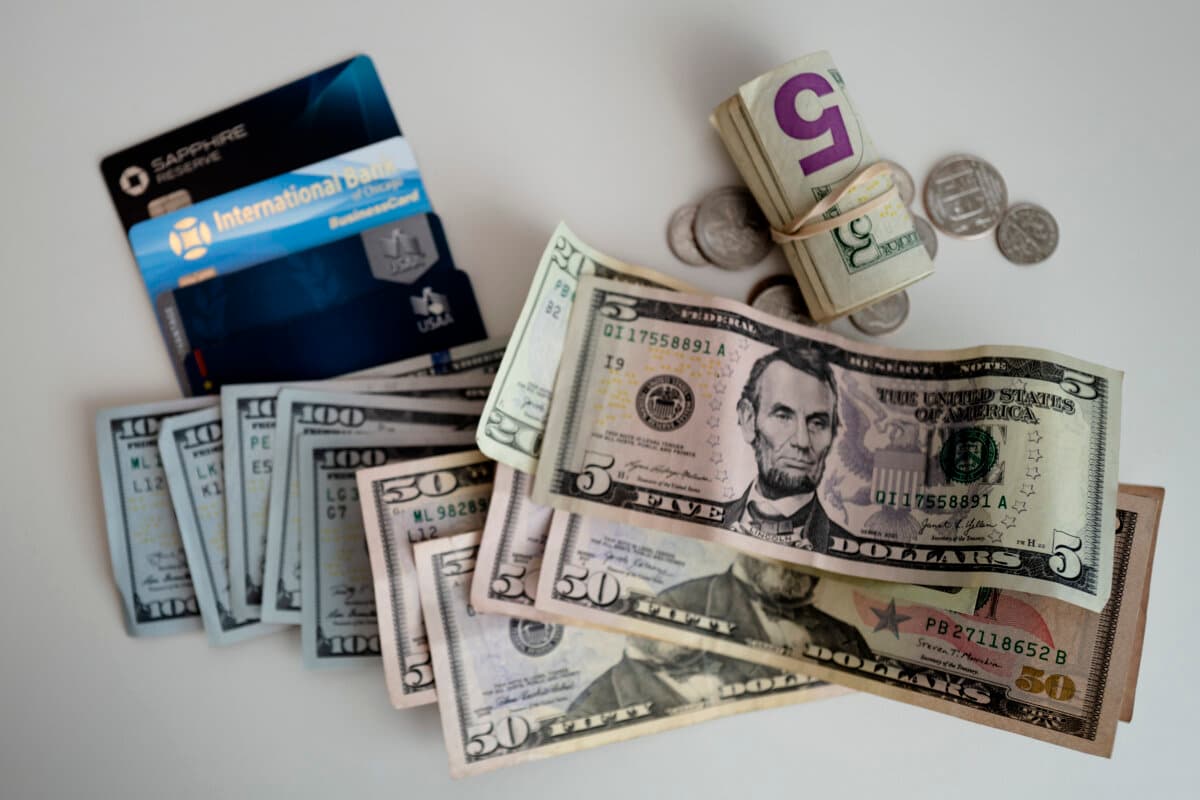
U.S. dollar bills and credit and debit cards in Washington on Oct. 4, 2024. (Madalina Vasiliu/The Epoch Times)
Consumers’ outlook on credit, meanwhile, is the same as last year.
April’s New York Federal Reserve Survey of Consumer Expectations found that 48 percent of Americans said it will be harder to obtain credit one year from now, unchanged from a year ago.
‘Relative Harmony’
Consumption accounts for two-thirds of the U.S. economy.
Since the pandemic, consumer spending has remained resilient, with shoppers regularly opening their wallets, supporting growth.
Retail spending popped by 1.7 percent in March. Excluding gasoline and automobiles, transactions still surged 0.6 percent.
Market watchers have been debating whether a K-shape is forming in retail, and, if so, by how much.
Bank of America’s internal data show that total credit card and debit card spending per household rose more than 4 percent year-over-year in March, the strongest growth since 2023.
At the same time, high-income households’ spending growth has outpaced that of middle- and low-income households. Moreover, spending by lower-income groups increased mainly because gasoline accounted for a larger share of outlays.
“Consequently, those with lower incomes curbed discretionary purchases (spending outside of groceries, utilities and gasoline) last month, and their YoY spending growth on discretionary goods dropped back relative to increases seen among middle- and higher-income households,” the bank’s economists said in the April 10 report.
Other economists argue that if a K-shape market is forming, it could be thin.
The New York Fed’s quarterly Economic Heterogeneity Indicators report shows that high-, middle-, and low-income households have moved in “relative harmony” regarding retail spending since 2020.
“If there is a K-shaped trend since the pandemic, it is subtle,” Minneapolis Fed economists wrote in a March 20 paper.
Still, they noted, slightly faster spending growth among higher‑ and middle‑income households has compounded over time into stronger overall nominal spending gains. But these cumulative gaps widened mainly during 2023 and have held fairly steady since, they stated.