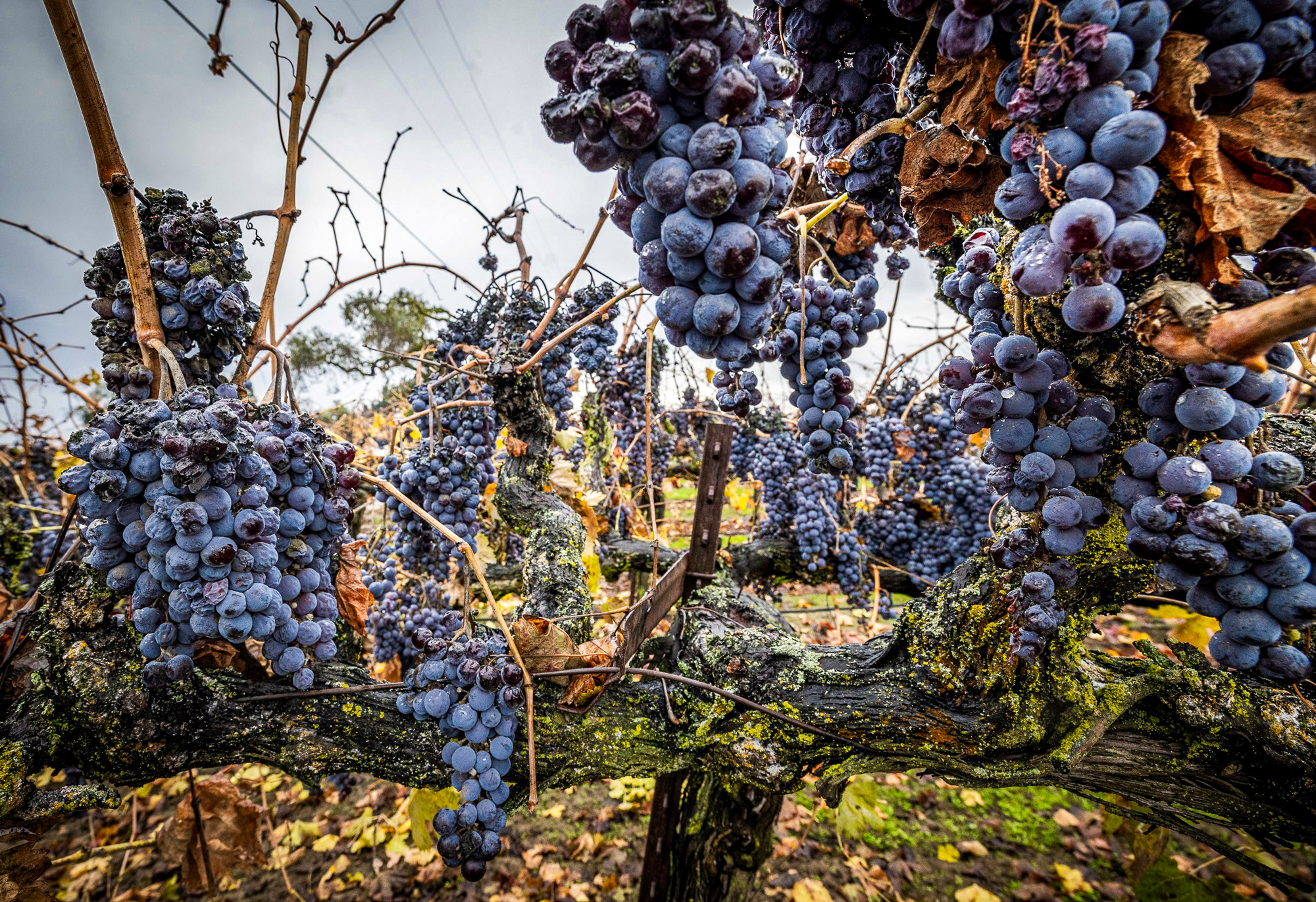

World-renowned for its picturesque vineyards, California’s wine country is now facing a crisis involving an overpopulation of grapes, a shrinking consumer base, and competition from imports.
According to data from the Wine Institute, California wine accounted for an average of 81 percent of total U.S. wine production from 1995 to 2024.
Grapes Going Away
Farm Progress, North America’s largest agricultural information and marketing firm, recently reported that California farmers may be forced to remove another 40,000 acres of vineyards this year to deal with the oversupply of grapes.
The state’s vineyards shrank to an estimated 477,475 acres in 2025 from an estimated 590,000 acres in 2024, according to the Wine Institute.
“There [are lots of vineyards] you could drive by and see the fruit still hanging, and there’s vineyards that from the year prior, you can still see the fruit hanging,” Rodney Schatz, a local winery owner and manager of 1,100 acres of vineyards, recently told Siyamak Khorrami, host of The Epoch Times’ “California Insider.”
“So we’re in a stress situation where we spent money to farm, we spent money to make the wine, and now again, we’re hoping somebody’s going to come in and buy wine.”
In its 2026 State of the U.S. Wine Industry Report, Silicon Valley Bank noted that when ranked by sales, wineries in the top quarter saw sales grow by 8 percent in 2025 and those in the bottom quarter experienced a decline of more than 10 percent.
The report attributed part of the problem to a declining preference for wine as older wine enthusiasts age out and are not being replaced at the same rate by millennials and members of Generation Z. Many are now drinking less alcohol or are spreading their preferences to other types of alcoholic beverages.
“Roughly half of wineries rate 2025 negatively, and about a third rate it positively,” the report states. “The most resilient wineries are shifting from transactional tactics to hospitality-driven strategies that emphasize connection and retention.”
Schatz said the weight loss trend is also affecting their business.
“People are drinking less,“ he said. ”There’s this whole movement with what they call GLP-1, the weight loss drugs. I’m not saying it’s a bad thing. ... This is affecting our business.”
GLP-1 stands for glucagon-like peptide-1. They are prescription drugs that help control blood sugar and reduce appetite, used for diabetes and weight loss.
According to a RAND report, 11.8 percent of U.S. adults have tried GLP-1 drugs such as Ozempic. However, because of common side effects, including nausea and diarrhea, 74.2 percent of those surveyed said they do not plan to use them.
Cost of Importing Versus Buying at Home
At the same time, Schatz said, local wineries must also contend with the growing volume of imported wine, which adds to the competition.
“There’s a lot of imported wine coming into the United States ... to the point where it’s almost more than what we produce in this current vintage of 2025, it’s almost equal,” he said on the show.
Schatz said wineries like his welcome the Trump administration’s tariffs on imported wine.
“We like the tariffs. ... [They] slow down the imports,” he said.
Effective Aug. 1, 2025, the United States imposed a 15 percent tariff on wine and other European Union goods under a U.S.–EU trade deal reached in July.
However, Schatz said, he views tariffs as a “double-edged sword.”
“You hate to see somebody else lose something in a world where we’re all drinking less, pulling out our vines, and going through the same emotional stress that maybe is going on in France or Australia or wherever,” he said.
Schatz said the United States is the one place to which everyone wants to bring their wine, so imports are likely to remain a key factor in the business.
According to Schatz, about 40 percent of America’s wine industry consists of imports. Although he acknowledged that consumers enjoy wines from other nations, he noted that California produces hundreds of varieties of wine.
He said that without new tariffs, importing bulk wine costs just a fraction—roughly one-quarter to one-third—of buying it in the United States.
Still, Schatz said that although some California wines garner more than $100 per bottle, there is a plethora of inexpensive options. He noted that some grocery stores offer domestic wines from $5 to $25 per bottle.
Local Wineries Face Market Barriers
But getting those wines to those stores can be challenging.
“When you have big conglomerates that are kind of controlling that whole grocery chain and distribution situation, and a handful of distributors that are nationwide, then the barriers for us, for a small winery that produces 5,000 cases, to get in there are very difficult,” Schatz said.
He suggested that wine shop owners consider featuring a section for domestic wines from California and other states, just as they do for wines from France, Italy, and other countries.
“Most of the producers are very small in this country and in California, to the point where they make less than 5,000 cases of wine,” he said.
“So I think it’s just a matter of, how do we get these people to find each other and then open their eyes a little bit to what we can do? There’s so much wine right here.”
According to the U.S. Wine Industry Report, 2026 will continue to be a challenging year for wineries, as some may be forced to close.
“The market is beginning to form a bottom, especially in the premium segment,” the report reads.
The report states that wineries need to align with the lifestyles and drinking occasions of various consumers to remain competitive in a crowded market.
Meanwhile, the California Association of Winegrape Growers is sponsoring three bipartisan bills for the California State Legislature to consider.
“Growers are under real pressure, but they’re not sitting on the sidelines,” Natalie Collins, president of the California Association of Winegrape Growers, said in a recent statement.
The legislative package includes Assembly Bill 1585, which would require wine labeled as “American” to be made from 100 percent American-grown wine grapes.
Senate Bill 921 would create a tax credit for agricultural employers to offset the costs of overtime wages, and Senate Bill 917 would expand opportunities for small wineries purchasing local grapes to sell wine and offer tastings at certified farmers markets.