
The number of Americans filing for unemployment benefits slipped last week, signaling the low level of layoffs in today’s labor market.
Initial jobless claims declined by 1,000, to 213,000, for the week ending on March 7, according to new Department of Labor data released on March 12.
The previous week’s reading was revised slightly higher to 214,000.
Markets had forecast 215,000 jobless claims.
The four-week average, which strips out week-to-week volatility, fell to a lower-than-expected 212,000 from 216,000 in the previous week.
Claims continue to hover around historically low levels, ranging from 199,000 to 232,000 throughout most of the year so far.
Last month’s volatility was largely driven by the severe winter storm that blanketed the country.
While layoffs remain low, the health of employment conditions remains under the spotlight.
In February, the U.S. economy unexpectedly lost 92,000 jobs, with market watchers attributing the decline to a strike by health care workers, winter weather, and uncertainty surrounding the outlook.
A disappointing retail sales report further added to fears about the broader economic landscape.
“The loss of 92,000 jobs alongside a dip in retail sales shows both hiring and consumer spending are beginning to soften,” Gina Bolvin, president of Bolvin Wealth Management Group, said in a note emailed to The Epoch Times.
“At the same time, we’re seeing companies lean more heavily on AI and productivity investments, which may be dampening hiring even as businesses continue to grow.”
Recent data also provides “a complicated picture” for the Federal Reserve, Bolvin said.
“A softer labor market argues for eventual rate cuts, but policymakers will need clearer evidence that inflation is easing before making that move,” she said.
Optimism that the labor market was turning a corner after January’s jobs report has faded somewhat.
At the same time, concerns that the conflict in Iran is reviving inflationary pressures are increasingly shaping the thinking of monetary policymakers.
The Fed is widely expected to leave interest rates unchanged next week, futures market data show.
Additionally, traders are not anticipating that the central bank will pull the trigger on a quarter-point rate cut until late summer, according to the CME FedWatch Tool.
The talk of stagflation—an environment of rising unemployment, ballooning inflation, and anemic growth—has also been resurrected this month.
“Stagflation is always the worst-case scenario for the central bank, because there’s not an obvious monetary-policy answer,” Chicago Fed President Austan Goolsbee told Bloomberg Television on March 6.

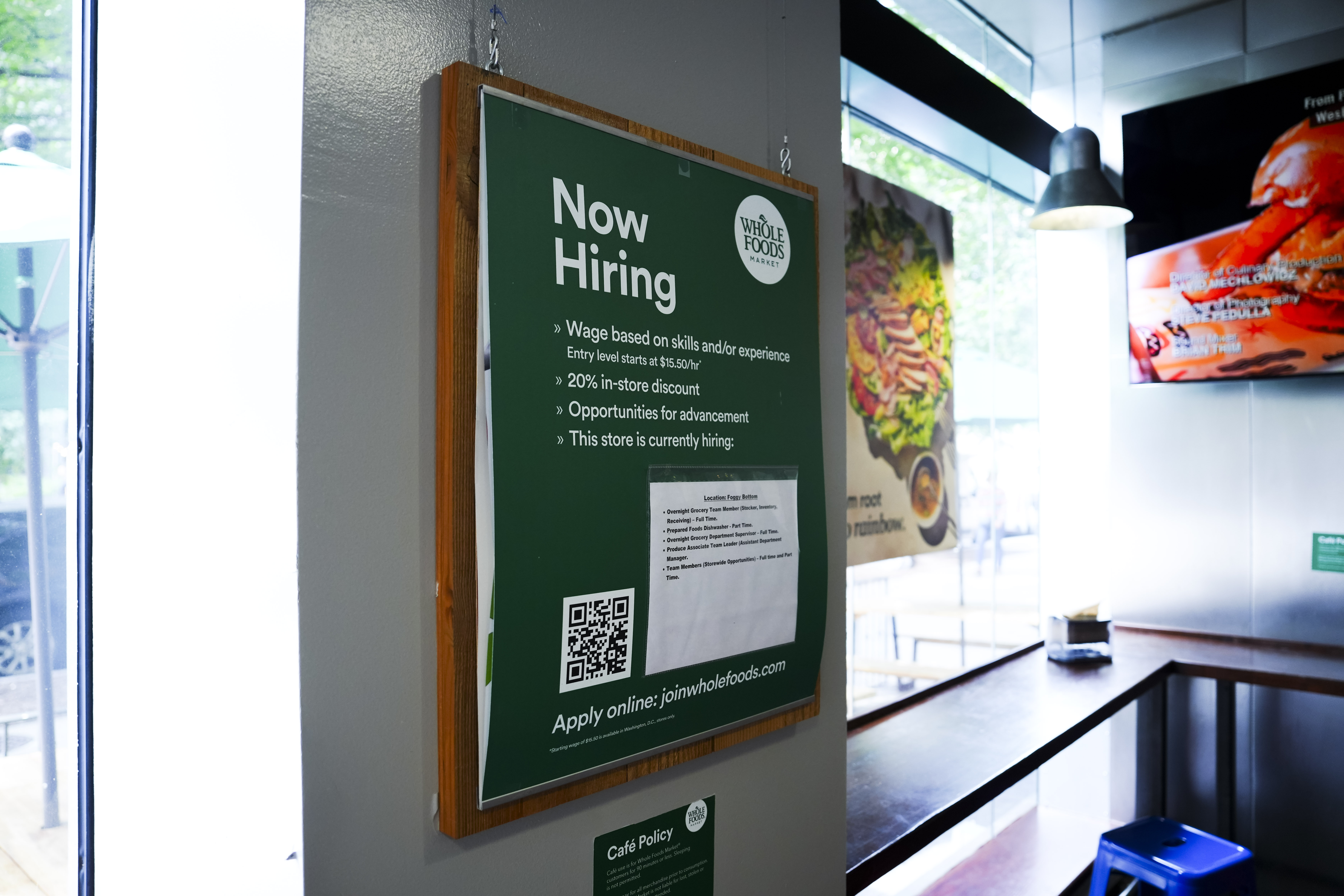
A hiring sign at a grocery store in Glenview, Ill., on Nov. 25, 2024. (Nam Y. Huh/AP Photo)
Beth Ann Bovino, chief U.S. economist at U.S. Bank, indicated last week that a stagflation situation “cannot be ruled out at this point.”
“The concern for sticky inflation has been a risk that we have noted even before the war in Iran,” Bovino said during an American Bankers Association event.
While the annual headline inflation has been slowly coming down, the main concern is “that the war with Iran could push that up even higher.”
February’s 12-month consumer inflation rate was unchanged at 2.4 percent.
Core inflation, which omits the volatile energy and food categories, held steady at a five-year low of 2.5 percent.
Finding Work
Further complicating the labor market picture, recurring jobless claims dipped.
Continuing jobless claims—a measure of out-of-work individuals currently receiving unemployment benefits—declined to 1.85 million from the previous week’s upwardly adjusted 1.871 million.
Economists use this statistic to gauge the difficulty level that workers may have in finding new employment.
Additionally, it can also reflect the exhaustion of jobless benefits because many states cap eligibility at 26 weeks.
That said, February’s long-term unemployment rate—jobless for 27 weeks or longer as a percent of the total unemployed—edged higher to 25.3 percent, from 24.7 percent in January.
Various economic indicators suggest that labor demand has been mixed.
After reaching their highest levels since late December 2025 earlier this month, Indeed job postings have started trending lower.
The employment sub-indices in the Institute for Supply Management’s manufacturing and services surveys rebounded modestly in February.
Private-sector payrolls climbed an average of 15,500 jobs per week in the four weeks ending on Feb. 21, according to data from the ADP Research Institute.
This represented the fastest pace of job creation since late November 2025.
Although it is a lagging indicator, the Bureau of Labor Statistics will release the January job openings numbers on March 13.
In the end, according to Jeffrey Roach, chief economist for LPL Financial, the labor market is essentially frozen.
“Underlying conditions are stable,” Roach said in a note emailed to The Epoch Times.
“After lackluster job gains in 2025, the labor market is coming to a standstill,” he continued. “The three-month average is 6,000, and the six-month average is negative for the fourth time in five months.”
The unemployment rate could start to rise in the coming months after ticking up to 4.4 percent in February, Roach added.