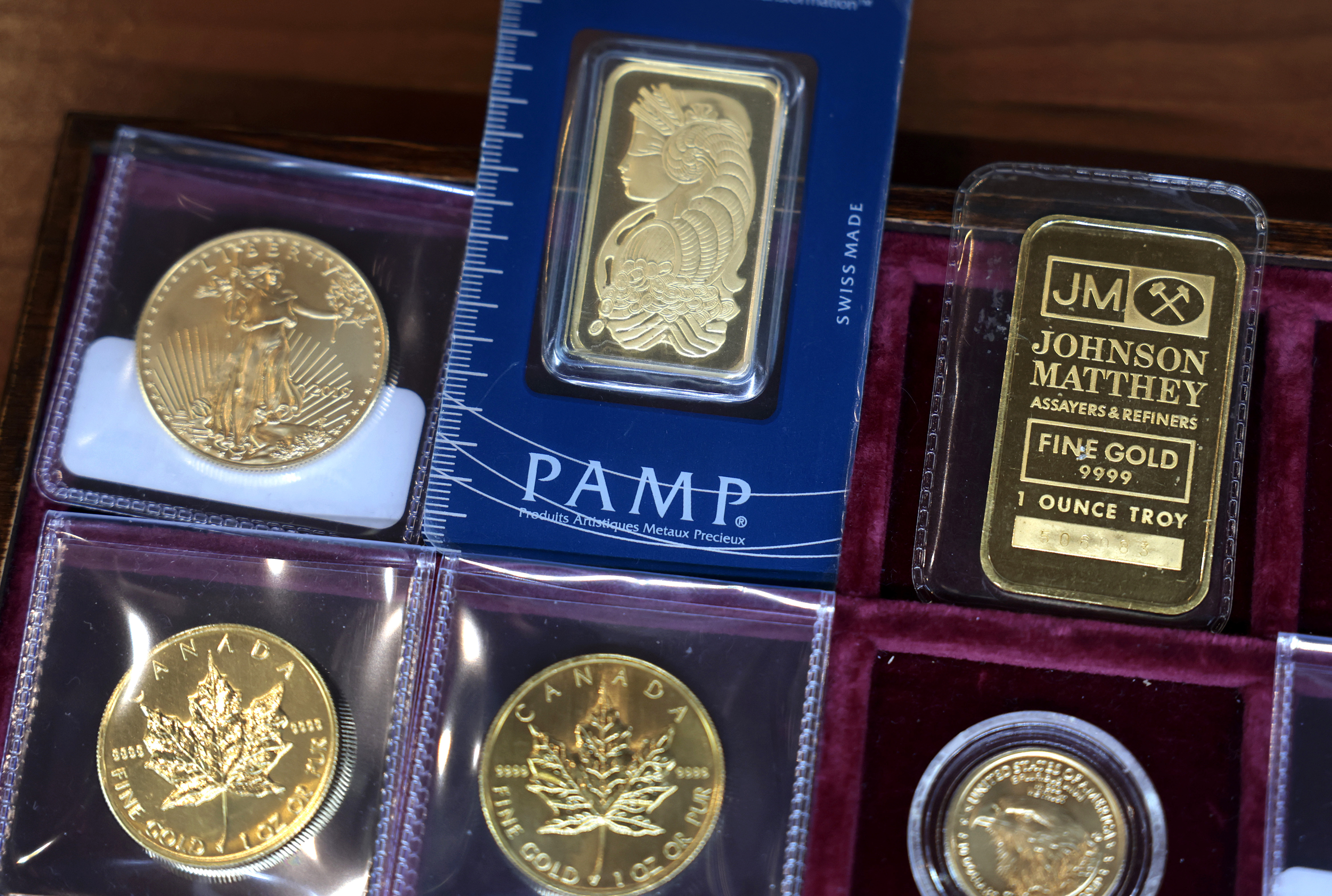

Gold and silver swam in red ink during the March 19 trading session, joining the broader market decline amid economic and geopolitical uncertainty over the Iranian conflict.
An ounce of gold fell by almost 6 percent, to about $4,620 on the COMEX division of the New York Mercantile Exchange. Following a meteoric start to the year, the yellow metal has pared most of its gains and is up by just 6 percent year-to-date.
Silver, the sister commodity to gold, plunged by about 10 percent, to below $70 per ounce. The white metal has erased all of this year’s gains and is down by nearly 2 percent.
Exchange-traded funds (ETFs) connected to the precious metals also sank at the opening bell. The iShares Silver Trust ETF, for example, fell by 10 percent, while the ProShares Ultra Silver ETF tanked by about 20 percent.
Mining stocks also slumped: Share prices of Newmont Corp. (NEM) and Barrick Mining (B) tumbled by more than 7 percent. Share prices of Agnico Eagle Mines (AEM), Franco-Nevada Corp. (FNV), and Wheaton Precious Metals Corp. (WPM) fell by 6 percent.
Similar downward movements were observed in overseas markets.
The metals market is responding to expectations that the Federal Reserve and other major central banks will leave interest rates higher for longer amid upside inflation risks.
“The war’s impact on energy markets has lifted inflation expectations at a time when central banks were already cautious about easing,” Ole Hansen, head of commodity strategy at Saxo Bank, said in a March 18 research note.
“The surge in oil and refined product prices—particularly diesel—has reduced the likelihood of near-term rate cuts and, in some cases, pushed market pricing toward a ‘higher-for-longer’ rate outlook.”
The leading benchmark averages were also firmly in the red.
The blue-chip Dow Jones Industrial Average shed more than 300 points, or 0.7 percent. The tech-heavy Nasdaq composite index fell by about 0.7 percent, and the broader S&P 500 dipped by 0.6 percent.
Dollar, Fed, and Yields
Following its two-day March policy meeting, the Fed kept the benchmark federal funds rate unchanged for the second consecutive meeting, maintaining it in its current range of 3.5 percent to 3.75 percent.
Although officials are still penciling in one rate action this year, futures market data show that investors have pushed back their forecasts for a quarter-point cut to later next year.
This week, the European Central Bank, the Bank of Canada, and the Bank of Japan all kept rates steady, pointing to upward inflationary pressures from higher energy prices.
“The net of the oil shock will still be some downward pressure on spending and employment and upward pressure on inflation,” Fed Chairman Jerome Powell said at his post-meeting news conference.
However, Powell noted that the United States could absorb some of the shocks of surging oil prices as domestic energy producers weigh potential increases in output.
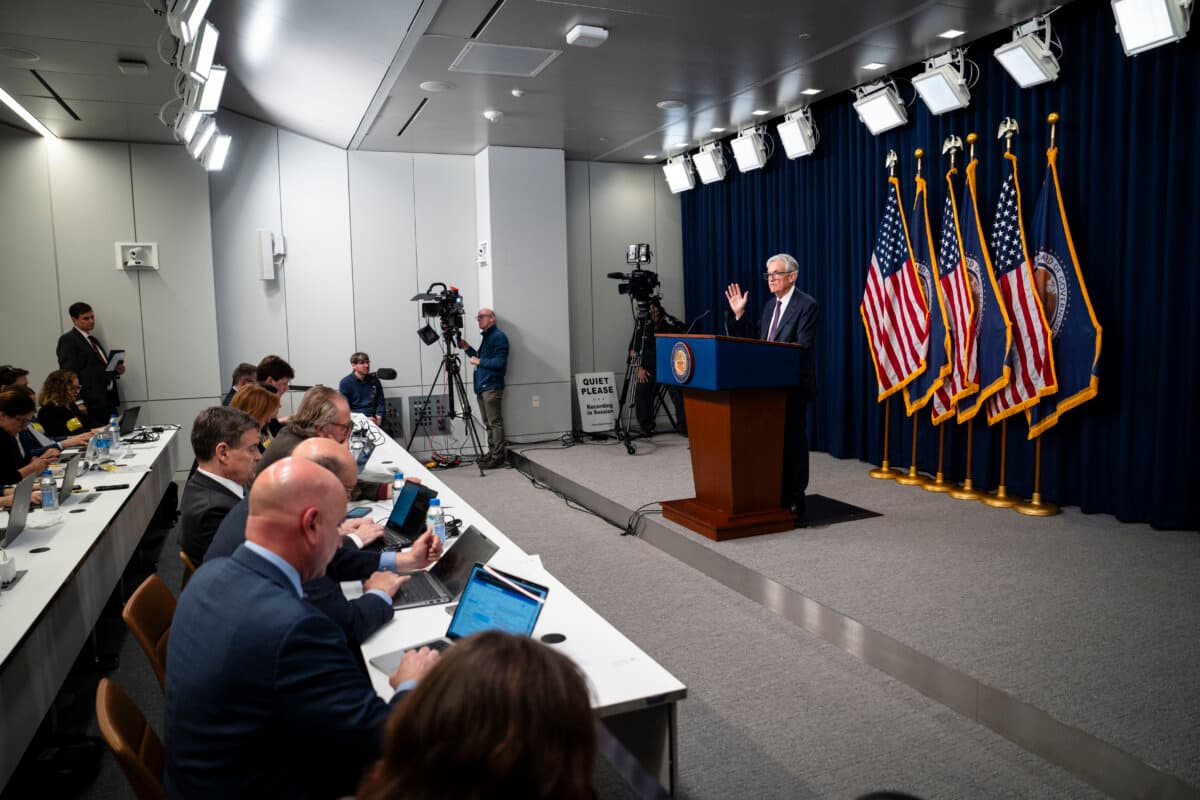
Federal Reserve Chairman Jerome Powell speaks at a news conference following the Federal Open Market Committee meeting in Washington, on March 18, 2026. (Madalina Kilroy/The Epoch Times)
Still, investors repriced their expectations for Fed policy, lifting yields on U.S. Treasury securities.
The two-year Treasury note, which typically tracks monetary policy, surged by 9 basis points, to higher than 3.83 percent. The benchmark 10-year was little changed at about 4.27 percent. The 30-year erased almost 3 basis points, to 4.85 percent.
Higher yields are bearish for the metals market because they raise the opportunity cost of holding non-yielding bullion.
Middle East tensions have also bolstered the U.S. dollar following an abysmal 15-month performance. Investor demand for the greenback has surged as traders seek shelter in conventional safe-haven assets.
The U.S. dollar index—a gauge of the buck against a weighted basket of currencies such as the Japanese yen and British pound—slumped by 0.4 percent on March 19, but it has rallied by about 1.4 percent this year.
A stronger greenback is also bad news for dollar-denominated commodities, as it makes them more expensive for foreign investors to purchase.
“In the current environment, geopolitical stress combined with rising energy prices tends to channel capital into dollar-denominated assets,” Hansen said. “This creates a competing safe-haven dynamic where gold’s traditional role is partly diluted by a firmer dollar.”
Silver, meanwhile, is more sensitive to weaker growth expectations since it is an industrial metal.
Although a plethora of gross domestic product forecasts remain intact—the Federal Reserve Bank of Atlanta estimates 2.7 percent growth in the first quarter—the longer the war drags on, the worse it could be for the broader economy.
Stagflation talk has resurfaced this month. Akin to the 1970s, this economic environment would consist of anemic growth, high unemployment, and rising inflation. But not everyone is convinced that this will happen.
Powell dismissed the fears, noting that the term was coined 50 years ago to describe the climate.
“I always have to point out that that was a 1970s term, at a time when unemployment was in double figures and inflation was really high,” he said. “We actually have unemployment really close to longer-run normal, and we have inflation that’s 1 percentage point above that.”
“I would reserve the term stagflation for a much more serious set of circumstances,” he said.
In other metal markets, copper futures fell by nearly 3 percent to $5.44 per pound. Platinum and palladium each declined by 6 percent, to $1,917 and $1,438 per ounce, respectively.