

Last year’s U.S. trade deficit dipped slightly from that of 2024, but was still the third-largest on record, driven by record-high imports.
The 2025 trade imbalance was $901.5 billion, a tepid 0.2 percent decrease from the previous year, according to new Bureau of Economic Analysis data released on Feb. 19.
Imports climbed by 4.8 percent to an all-time high of nearly $4.33 trillion, led by foreign purchases of computers.
Exports increased by more than 6 percent to more than $3.43 trillion, driven by a sharp increase in shipments of nonmonetary gold, finished metal shapes, and natural gas.
But the numbers may be skewed by the sizable increase in imports in the first quarter of 2025 as companies attempted to front-run President Donald Trump’s tariffs and accelerate their purchases of goods from abroad. Global commerce then stabilized for the remainder of the year.
The administration’s sectoral and reciprocal tariffs went into effect later in the year.
Before the latest trade data were released, the president had stated that the deficit had plummeted by 78 percent “because of the tariffs being charged to other companies and countries.”
“It will go into positive territory during this year, for the first time in many decades,” Trump said in a Feb. 18 Truth Social post.
The United States’ deficits with the European Union and China narrowed from 2024 to 2025.
The U.S.–EU shortfall fell by about 7 percent, to $219 billion from $236 billion.
Meanwhile, the U.S.–China trade gap narrowed by 28 percent, falling to $202 billion from $296 billion.
Conversely, deficits with Vietnam and Taiwan widened substantially, reaching $178 billion and $147 billion, respectively. The U.S.–Mexico deficit rose to $197 billion from $171 billion.
These figures raise questions about whether China has been using transshipments—that is, routing goods through a third country to disguise their true origin—to circumvent the tariffs.
On a monthly basis, the U.S. trade deficit jumped by 33 percent to a higher-than-expected $70.3 billion in December, from $53 billion in November.
Imports rose by 3.6 percent to $357.6 billion amid an increase in purchases of computer accessories. Exports dropped by almost 2 percent to $287.3 billion because of a notable decline in nonmonetary gold.
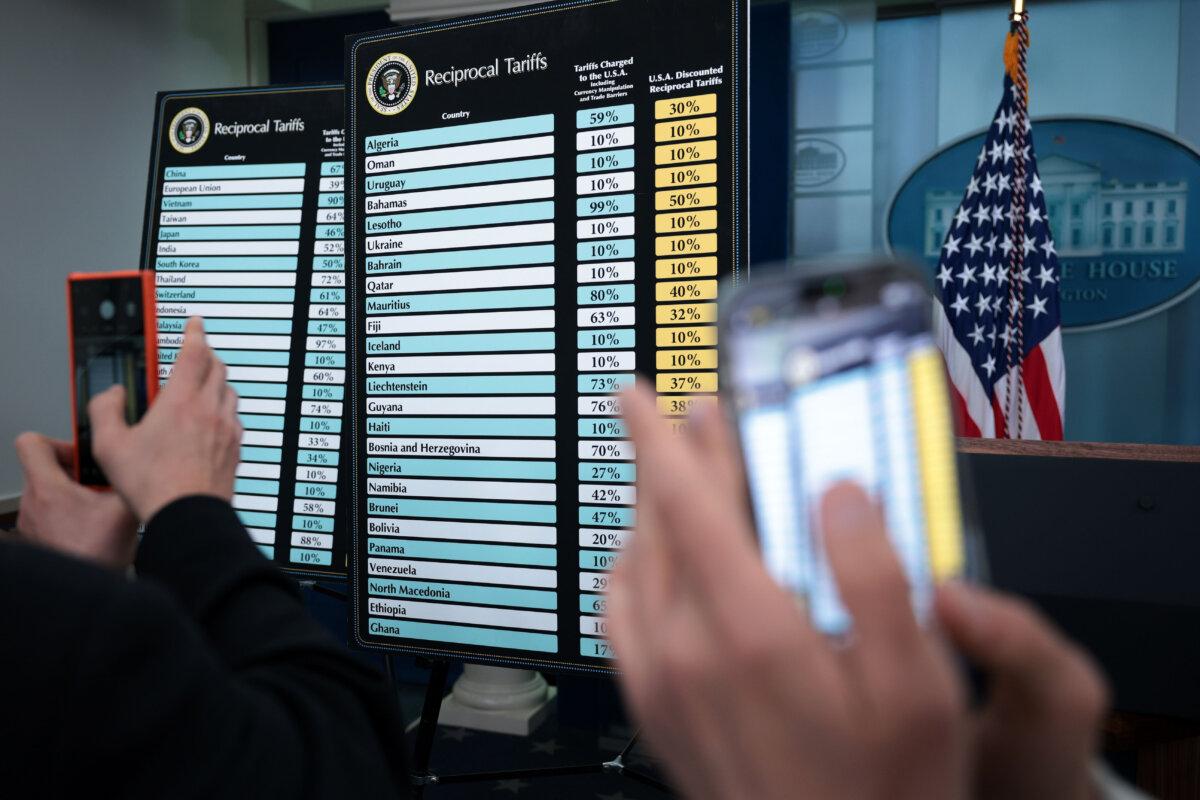
Charts that show the reciprocal tariffs the United States is imposing on trading partners are on display at the James Brady Press Briefing Room of the White House on April 2, 2025. President Donald Trump announced new tariffs targeting goods imported from dozens of countries. (Alex Wong/Getty Images)
The current average effective tariff rate is 16.9 percent, according to The Yale Budget Lab, up from about 2.3 percent when Trump took office.
Tariff Effects
Tariffs are taxes on imports of foreign goods entering the United States. Economists say higher import duties generally lead to a one-time price increase in products that is passed on to consumers by businesses.
Although aggregate inflation levels have been little affected by the president’s levies, Americans are still absorbing the costs, according to economists at the Federal Reserve Bank of New York.
In a paper released on Feb. 12, researchers estimated that U.S. firms and consumers cover 86 percent of the tariffs, while foreign exporters cover 14 percent.
“Given that the average tariff in December was 13 percent ... our results imply that U.S. import prices for goods subject to the average tariff increased by 11 percent (13 times 0.86) more than those for goods not subject to tariffs,” they said in the report.
“These higher import prices caused firms to reorganize supply chains.”
The White House was not pleased by the paper, calling it an “embarrassment.”
In an interview with CNBC’s “Squawk Box” on Feb. 18, National Economic Council Director Kevin Hassett criticized the report, calling it the worst paper he had ever seen “in the history of the Federal Reserve System.”
“The people associated with this paper should presumably be disciplined, because what they’ve done is they’ve put out a conclusion which has created a lot of news that’s highly partisan based on analysis that wouldn’t be accepted in a first-semester econ class,” Hassett said.
The next batch of major economic data will be available on Feb. 20, when the fourth-quarter gross domestic product and the Federal Reserve’s preferred inflation measure—the personal consumption expenditures price index—are released.
Trade Challenges at Home
A wrench could be thrown into the administration’s trade agenda, as the Supreme Court is soon expected to rule on the president’s tariffs.
The high court will determine whether Trump acted legally or overstepped his authority under the International Emergency Economic Powers Act.
Trump has warned that it would be a “complete mess” if the Supreme Court were to rule against him.
“The actual numbers that we would have to pay back if, for any reason, the Supreme Court were to rule against the United States of America on Tariffs, would be many Hundreds of Billions of Dollars,” he wrote in a Jan. 12 Truth Social post.
“It would be Dollars that would be so large that it would take many years to figure out what number we are talking about and even, who, when, and where, to pay.”
Many of the president’s tariffs would remain in place, including levies on imports of automobiles, car parts, and metals. His current 10 percent fentanyl tariff on China would also continue.
Administration officials have stated that they would use other tools to implement Trump’s trade objectives.
“There are a lot of other legal authorities that can reproduce the deals that we’ve made with other countries, and can do so basically immediately,“ Hassett told CNBC’s ”Squawk on the Street” in January.
“And so our expectation is that we’re going to win, and if we don’t win, then we know that we’ve got other tools that we could use that get us to the same place.”
Some Republican members of Congress have rebuked the president’s tariff pursuits.
Last week, the Republican-controlled House voted 219–211 to overturn Trump’s levies on Canada, with six GOP lawmakers joining Democrats.
It was largely a symbolic vote, as the president will likely veto any anti-tariff bills that reach his desk.
The United States’ trade deficit with Canada in 2025 was $46.4 billion.