
The number of Americans filing applications for unemployment benefits dipped last week, signaling the labor market’s resilience amid a volatile climate.
Initial jobless claims totaled 209,000 for the week ending on May 16, down by 3,000 from the previous week, according to new Department of Labor data released on May 21.
Economists had penciled in a reading of 210,000.
The four-week average, which strips out week-to-week volatility, slipped to below 203,000—the lowest in more than two years.
Various employment indicators have suggested that the U.S. labor market is heating up.
The economy added 115,000 new jobs in April, topping the consensus forecast. The unemployment rate also remained low at 4.3 percent.
But new labor data suggest that private sector hiring momentum continues.
In the four weeks ending on May 2, private employers added an average of 42,250 jobs per week, according to a May 19 report by payroll processor ADP. This is the highest since the series began this past fall.
Job postings on Indeed have also edged higher. Demand for labor has also been broad-based, with postings in health care, software development, and manufacturing and production near or above pre-COVID-19 pandemic levels.
“The labor market’s key stabilizing factor is that layoffs remain low,” Matt Schoeppner, senior economist at U.S. Bank, said in a May 13 note. “As long as job losses [remain] contained, the risk of a meaningful rise in the unemployment rate is limited.”
One reason is the shift in employment dynamics, specifically lower immigration flows and slowing labor force participation.
As a result, the breakeven rate—the number of new jobs needed to keep unemployment in its current form—is close to zero, according to research from Dallas Federal Reserve economists.
But job seekers could be having a better time searching for new employment opportunities.
Continuing jobless claims—a measure of the number of individuals currently receiving unemployment benefits—were little changed at a lower-than-expected 1.78 million.
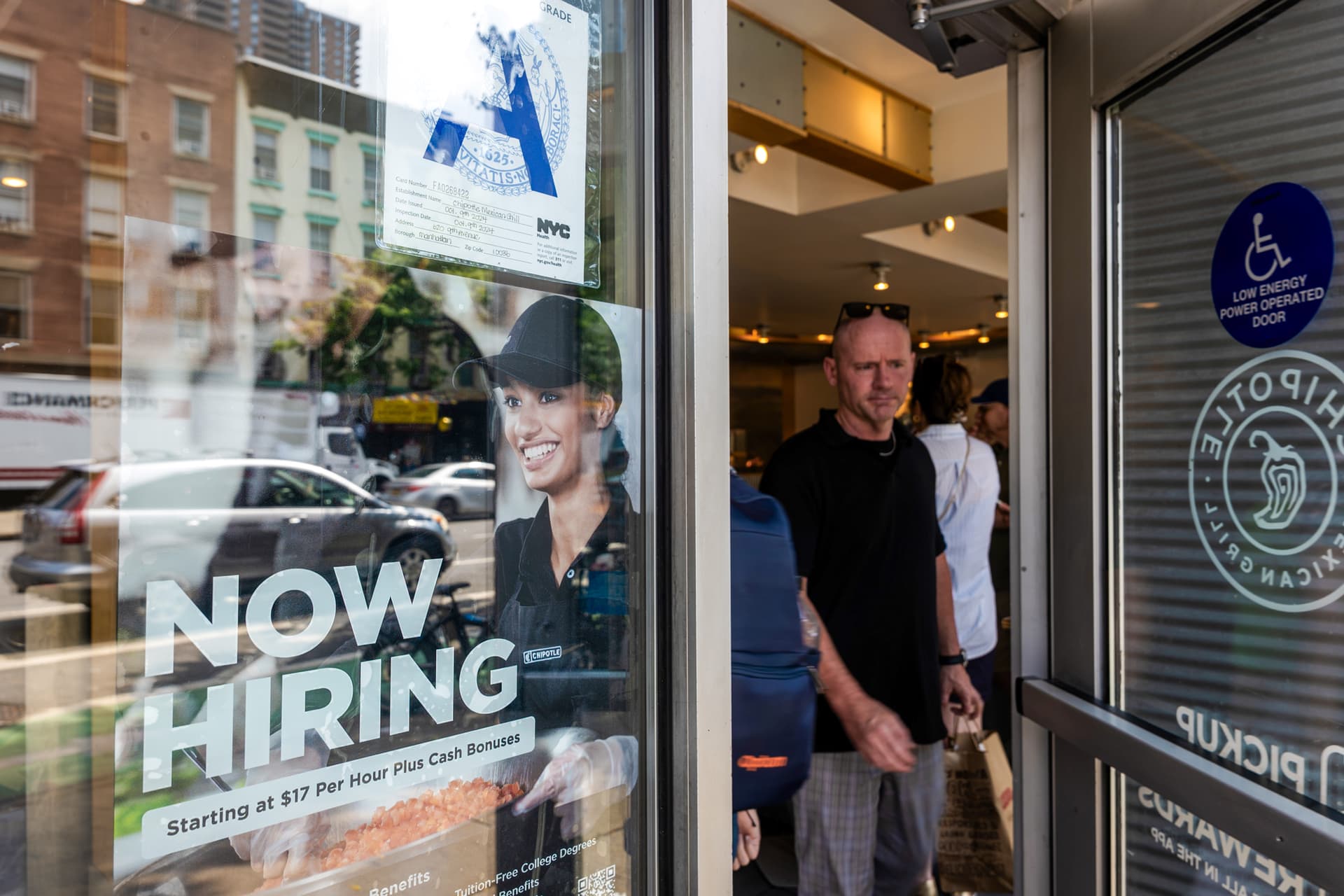
A hiring ad is displayed in a business window in New York City on Sept. 5, 2025. (Spencer Platt/Getty Images)
Recurring claims have remained below 1.9 million all year.
Economists use it as a proxy to gauge the labor market’s health and to assess the difficulty people have in finding work. Others also note that the overall downward trend since late last year could be Americans exhausting their benefits, since many states’ maximum eligibility is 26 weeks.
Businesses have indicated that they plan to expand their hiring efforts.
Almost 60 percent of U.S. human resource chiefs plan to bolster hiring over the coming six months, The Conference Board’s latest chief human resource officer confidence index shows.
Fed Policy Implications
If employment remains unchanged for the rest of the year, the Federal Reserve can grapple with the other side of its dual mandate: inflation.
Minutes from the Fed’s April policy meeting reveal officials striking a more hawkish tone.
Policymakers ostensibly believe that an interest rate hike is back on the table and that some additional policy firming would be appropriate if inflation continues to run above the central bank’s 2 percent target.
“The Fed minutes reminded markets that inflation remains the main concern—and rate hikes are still on the table if price pressures stay elevated,” Gina Bolvin, president of Bolvin Wealth Management Group, said in a note emailed to The Epoch Times.
Even before the war in Iran—now approaching its 13th week—policymakers had discussed raising interest rates to bring inflation back down to the 2 percent level. The Fed has continually missed this goal for more than five years.
But although it was not their base case back then, it is increasingly becoming likely, based on movements in the futures market.
The odds of a rate hike in December have risen to 57 percent, according to fresh CME FedWatch data.
Until then, the Fed is expected to leave the benchmark federal funds rate in the current target range of 3.5 percent to 3.75 percent.