

Commentary
There is the old expression of “what a difference a year makes.” This is certainly true for the 28 school districts in Orange County, California.
While four moved up the annual rankings by four or more places, six dropped by three or more positions and one, although it only dropped one place, it had no further to go. We’re talking more than a third of the districts having major fiscal stories to tell.
We start by obtaining their audited financial statements online, hopefully on their websites. For six of the districts, I had to go to the California Policy Center’s Local Fiscal Health Dashboard.
On Aug. 22, Gov. Gavin Newsom signed Senate Bill 1126 by Republican state Sen. Steven Choi from Irvine. This bill will require immediate posting of audited financial statements for most municipalities. However, school districts were absolved, as they have separate code sections requiring them to do so.
Once we have the audited financial statement, we obtain the unrestricted net position (UNP) for governmental activities and divide it by the population the district serves. This provides a per capita that can be used for comparison purposes.
The lower a district is in the rankings, the higher the possibility of the district being taken over by the county’s Department of Education (OCDOE) or the Fiscal Crisis & Management Team (FCMAT) out of Bakersfield. Los Angeles Unified was recently informed by its Department of Education of such a notice. The rankings matter. And if your district is not near the top, then you may want to get more involved.
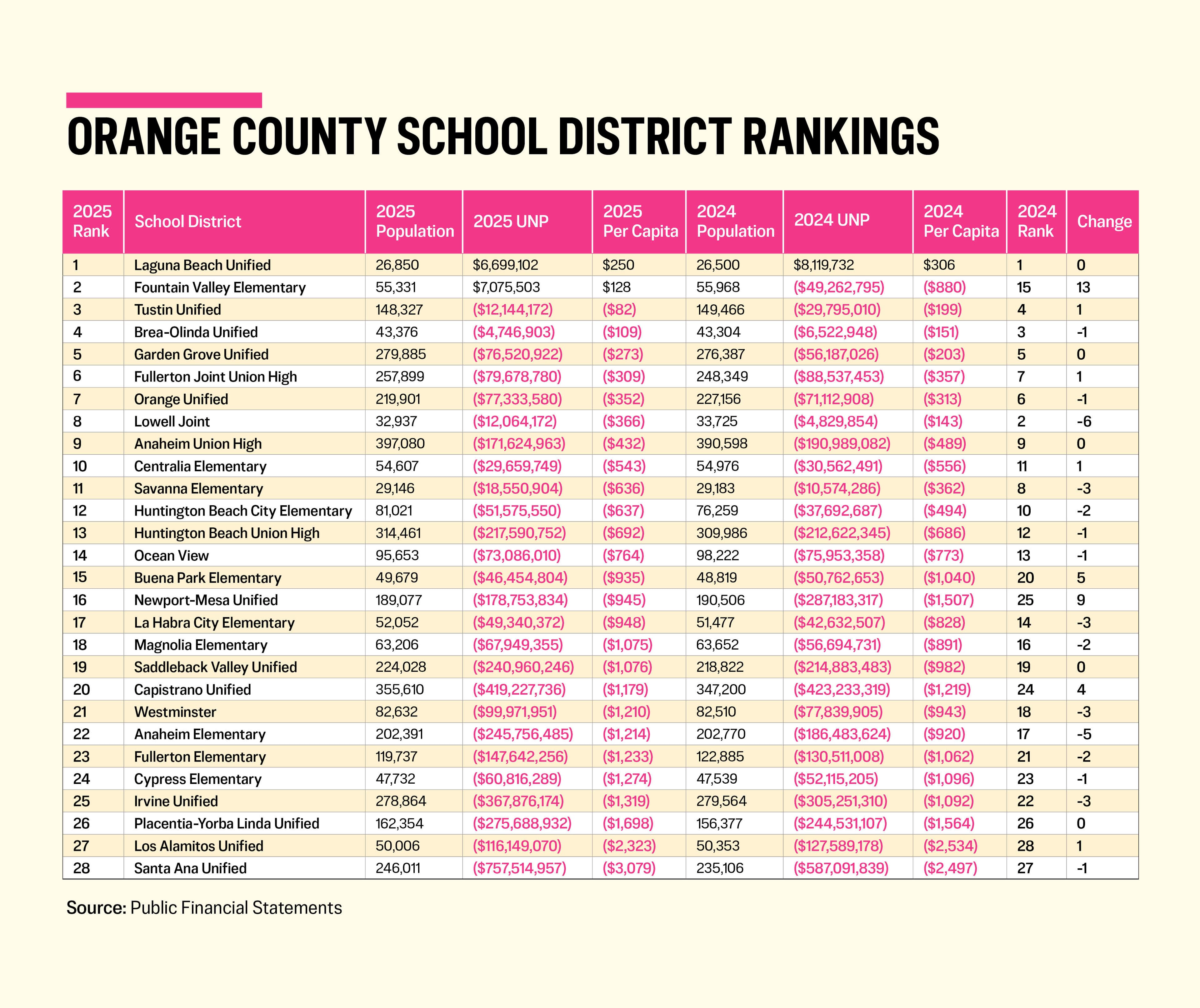
Historically, Fountain Valley Elementary has always been fiscally strong. It sold unneeded school properties and wisely escrowed the proceeds to avoid quickly dwindling this buffer. Back in the fiscal year ending June 30, 2021, it transferred a significant amount, $79.5 million, into restricted assets.
For the fiscal year ending June 30, 2025, Fountain Valley transferred $65.4 million back. It also had revenues in excess of expenditures of $3.0 million and appropriated $4.3 million toward its net investment in capital assets. Due to Government Accounting Standards Board (GASB) Pronouncement 101, dealing with compensated absences, it reported a $7.8 million restatement. Many school districts had similar restatements. Taking all of this into account, its unrestricted net position improved by $56.3 million. It moved up 13 places and back to its previous perch near the top of the rankings.
Newport-Mesa had expenditures in excess of revenues of $9.1 million, transferred $66.4 million out of restricted assets ($50.0 million for capital projects), and supposedly reduced its net investment in capital assets by $59.3 million. There was also a GASB 101 adjustment, but the disclosures are rather opaque, so I assume the net restatement was $6.6 million. The net result was a reduction of its unrestricted net deficit of $110.0 million.
Newport-MesaHere’s where it gets more interesting for Newport-Mesa. Its capital assets actually grew by $90.3 million, mostly for construction in progress. And its general obligation bond debt only decreased by $0.3 million. Accordingly, its net investment in capital assets should have increased by $90 million. But it decreased by $59.3 million—a $149.3 million disparity!
That Newport-Mesa had a net loss in revenues of $9.1 million, when it disclosed that its net liability for its other post-employment benefits decreased by $41.8 million and its net pension liability decreased by $28.6 million, it should have reflected a bonus year in excess earnings.
This is where GASB needs to step in with another pronouncement that will require the details of net investment in capital assets to be disclosed in the footnotes. All these curious accounting maneuvers caused Newport-Mesa to move up nine places.
Buena Park had revenues in excess of expenditures of $12.1 million. It further increased its negative net investment in capital assets by $17.8 million, only seen when the related debt exceeds the book basis of the capital assets. It also transferred $25.6 million into restricted assets. Combined, the unrestricted net deficit decreased by $4.3 million and moved the district up five places. The previous year, the capital assets were $65.8 million, and the related debt was $68.0 million, resulting in a negative net investment in capital assets of $2.2 million. During the current year the district increased its capital assets by $10.9 million but increased its related debt by $28.7 million. This increased the negative net investment in capital assets by another $17.8 million. But the amounts agree with the balance sheet.
Capistrano Unified had revenues in excess of expenditures of $10.2 million, but had a $2.5 million restatement for compensated absences resulting from implementing GASB 101, offsetting it. It appropriated $31.5 million for its net investment in capital assets and transferred out $27.8 million from restricted assets. The net result was a $6.5 million decrease to the unrestricted net deficit originally reported in its 2024 audited report. It moved up four places.
Anaheim Elementary had expenditures in excess of revenues of $0.8 million, increased its net investment in capital assets by $45.0 million and withdrew $8.6 million from restricted assets. All told, the unrestricted net deficit increased by $59.3 million. But it only should have been $37.2 million, a $22.1 million difference. Its capital assets increased by $21.6 million and its general obligation bonds balance decreased by $8.6 million. Accordingly, the net investment in capital assets should have increased by only $30.2 million, being overstated by $14.8 million. But, like Buena Park, the capital assets were $389.3 million and the related debt was $389.6 million, so the net investment in capital assets should have been close to zero.
Again, like was mentioned with Newport-Mesa, GASB needs to require a disclosure as to how the amount for the net investment in capital assets was calculated in order for the financials to be correct and, consequently, the bottom-line for the unrestricted balance to be correct. The current audited financial statements show Anaheim Elementary dropping five positions.
Lowell Joint had revenues in excess of expenditures of $3.4 million, with a $2.5 million restatement to implement GASB 101 for compensated absences. It appropriated $7.3 million toward its net investment in capital assets and added $0.9 million to its restricted assets. The net result was an increase in its unrestricted net deficit of $7.3 million of the amount originally provided on the 2024 audited financial statements. It dropped six places.
Santa Ana Unified increased its unrestricted net deficit by $170.4 million, giving it a massive negative per capita of more than $3,000 for each of its nearly quarter million residents. It may need an intervention by the OCDOE or FCMAT.
Santa Ana Unified made layoffs in the previous fiscal year. It needs to sharpen its pencils. The June 30, 2026, audits will tell and they should be available by the end of December. Hopefully.