

Commentary
French economist Frédéric Bastiat in the 19th century famously wrote of the broken window fallacy, which mischaracterizes wealth destruction as wealth creation. Breaking windows is good for the economy, the sophist said, because it generates more spending and jobs. We should celebrate when people throw rocks through windows, goes the claim.
Bastiat’s correction explores the counterfactual, all the uses of resources had the rock not been thrown at all. The lesson, he said, is that understanding economic output and wealth creation requires contemplating the unseen and not just the seen.
The seen part of the story is the money that the shopkeeper spends to pay the glazier to fix the window, and the money spent by the glazier on groceries and tools. The unseen is what the shopkeeper would have done with his money had he not been burdened with the need to repair the window. He might have hired a new employee, bought a new suit, or saved for a capital expansion.
The lesson here is powerful and has many applications. It was the journalist Henry Hazlitt who made it famous with his remarkably powerful book “Economics in One Lesson,” which appeared in 1946. He wrote the book in 10 days following his job loss after 15 years writing at The New York Times. The purpose of the book was to teach a basic economic lesson to a generation that seemed very confused.
The book appeared shortly after World War II ended. The output data from the previous five years registered substantial economic growth. Indeed, people at the time were saying that the war ended the depression. Hazlitt knew this was not true, regardless of what the gross domestic product (GDP) said.
War destroys resources and diverts wealth from productive purposes. It might be necessary, but let’s not be confused about its economic consequences. Contrary to what John Maynard Keynes said, wrote Hazlitt, an economy is sustained and grown not by more churn and burn of consumption but by saving, investment, and enterprise. War diverts wealth, whereas peace creates it.
This was his point. He called it “one lesson” not to create a shortcut for readers or an invitation to quick pedagogy. The point was that there is one lesson that is central, and thousands of applications of this lesson. The first chapter maps the principle while the rest of the book applies it to taxation, inflation, price controls, regulations, and every other attempted fix to give the economy a boost. All these policies are destroying wealth in ways that are hidden from view.
Let’s now reflect on a counterintuitive application of the idea. Americans are celebrating the rise of the medical-care sector as a jobs machine and wealth creator. The insurance companies are buying up ever more real estate. The hospitals are growing larger. The care facilities are flooded with both patients and money. The spending is astronomical.
National health expenditures were a reasonable 5 percent of GDP in 1960. In 2024, they reached $5.3 trillion, or 18 percent of GDP ($15,474 per person). They will reach $20,000 per person per year in short order. That’s from $2,200 (in 2024 dollars) in 1970. Total spending went from $74 billion in 1970 to $1.4 trillion in 2000 and a jaw-dropping $5.3 trillion in 2024.
The federal government now sponsors about 31 percent of total health spending; households sponsor 28 percent. Medicare and Medicaid, created in 1965, marked a major expansion of public financing. Main drivers of the long-term rise are aging, broader insurance coverage and utilization, new technologies and drugs, and prices that have risen faster than general inflation.
Healthcare has become the country’s largest industry by jobs. Employment in the sector roughly doubled from about 9.3 million in 1990 to 18 million-plus by the early 2020s and has continued growing. The sector overtook manufacturing in about 2006 and retail later; by the mid-2020s it accounted for roughly 13 percent of the workforce (up from 9 percent in 2000) and was the biggest employer in 38 states.
Broader “health care and social assistance” figures from the Bureau of Labor Statistics are even larger (about 24 million recently). Growth has been relatively recession-resistant compared with other sectors. The soaring of workers into this sector has trended inversely with making things. Instead of making things, we have a workforce dedicated to keeping us alive and charging for it.
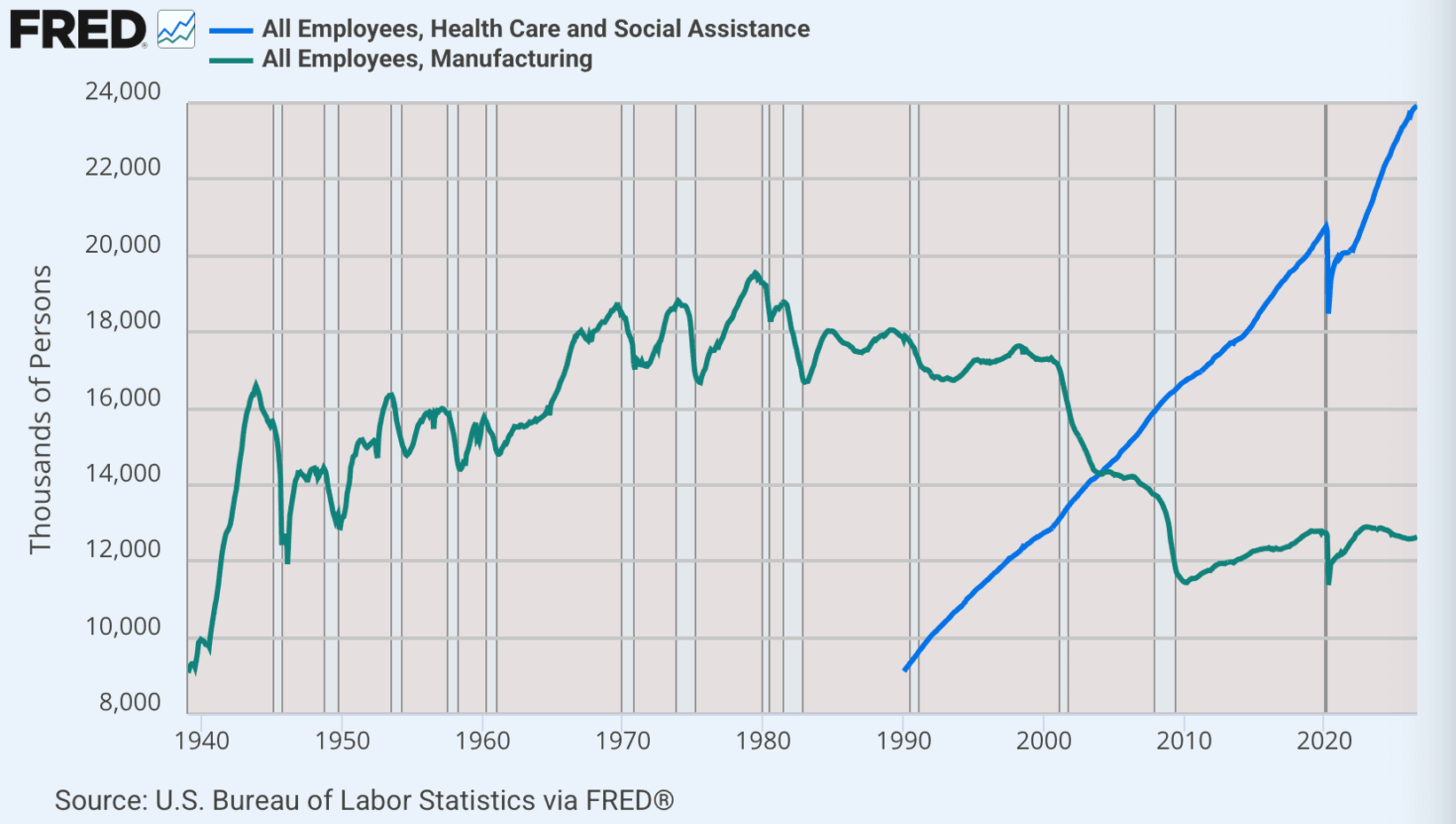
Reflect, however: Is this really economic growth and wealth creation? Or is it a population-wide breaking of windows? I fear that much of what is celebrated as the jobs machine of the medical-care industry is a fallacy in action. It is people getting ever sicker, many from iatrogenic injury, generating more service provision, more profits for the massive and growing insurance industry, and more drugs sales.
It is broken windows, much of it, especially when you consider that taxpayers are shelling out for a third of the revenue. This is not output expansion much less wealth creation. It’s evidence of wealth destruction and declining population health.
If we subtract health care from GDP (output) figures, the total would collapse by 18 percent, generating an immediate depression. My concern is that much of this output gain is really illusory, based on what we see and not on what we cannot see. Imagine if tomorrow, everyone decided to prioritize health and lost their pharmaceutical and medical dependencies. The data would register a downshift in output. That is strange, not different from the Bastiat story.
Our current day broken windows are harder to discern than in the simple parable, but they are no less real.