
Commentary
Back in 1994, I predicted what was, at the time, the largest municipal bankruptcy in United States history. As a county treasurer, I then served with the team to successfully exit Chapter 9. And later, as a county supervisor, to implement defined benefit pension plan and retiree medical (also known as other post-employment benefits) reforms. I then worked in the state Senate to improve the fiscal status of California’s cities and counties.
Before all of this fun, I was a licensed certified public accountant and certified financial planner. I have major concerns about debt, personal and corporate. So, I now review the audited financial statements of the Golden State’s cities, school districts, counties and even the 50 states. Why? To see how they are managing their finances. Do they have enough assets to cover their liabilities? Are the unfunded employee benefit plan annual required contributions crowding out key public services?
Allow me to tell you what I’m seeing statewide. You won’t like what I have to say. But facts are stubborn things. And, as Justin Menkes stated in his book, “Better Under Pressure: How Great Leaders Bring Out the Best in Themselves and Others,” Harvard Business Review Press, 2011: “It is your ultimate responsibility as a leader to teach your people to face reality.”
Every city in California is required to prepare an annual financial statement and have it audited by an independent outside certified public accountancy firm. This publication is called an annual comprehensive financial report (ACFR). If this is not possible, then the city should at least provide a compilation or review financial statement on its website. In a state where Silicon Valley is located, this should be an easy and simple request. Apparently, it is not.
To determine how California’s cities are doing, I have broken the state up into the following nine regions, trying as best as possible to follow the Caltrans statewide District map:
Orange County (Caltrans District 12) . . . . . . . . . . . . . . . . . . . . . . . . . . . . . . . 34 cities
Los Angeles County (Most of Caltrans District 7) . . . . . . . . . . . . . . . . . . . . . 88
Riverside and San Bernardino Counties (Inland Empire) (District 8) . . . . . 52
San Diego County (Larger half of District 11) . . . . . . . . . . . . . . . . . . . . . . . . .18
Imperial County (Smaller half of District 11) . . . . . . . . . . . . . . . . . . . . . . . . . 7
Ventura, Santa Barbara, San Luis Obispo and Kern Counties (5, 6 and 7) .36
Central (Other Portion of District 5, 9 and 10) . . . . . . . . . . . . . . . . . . . . . . . . 78
Bay Area (Caltrans District 4) . . . . . . . . . . . . . . . . . . . . . . . . . . . . . . . . . . . . . 101
Northern (Caltrans Districts 1, 2 and 3) . . . . . . . . . . . . . . . . . . . . . . . . . . . . . .68
Total . . . . . . . . . . . . . . . . . . . . . . . . . . . . . . . . . . . . . . . . . . . . . . . . . . . . 482 cities
Orange County’s cities are the best at preparing and posting their ACFRs in a timely manner. Los Angeles County has 14 cities that still need to post their June 30, 2025, ACFRs on their websites. The Inland Empire has one town, Apple Valley, that has yet to post its 2023 ACFR and following. Indio has also not posted its 2024 ACFR, and there are 10 additional cities still needing to provide their 2025 ACFRs.
San Diego County is waiting on the cities of Escondido, La Mesa and National City for their 2025 ACFRs. Imperial County is such a laggard area of the state, I had to split it off from San Diego County. The city of Calipatria is the delinquent child.
The cities of Taft and Guadalupe need to complete and post their 2023 and forward ACFRs. For 2024, add the cities of Arvin and Santa Maria. Add 17 more cities for 2025, including Kern’s county seat of Bakersfield.
In the Central portion of the state, the city of Amador City at least provides compilation reports. Amador City, Ione, Orange Cove, and Plymouth need to provide their 2022 and forward ACFRs. Add Avenal, Ceres, Hollister (a county seat), Huron and Parlier for their 2023 and forward ACFRs. For these farming communities add 10 more cities for 2024 and thirty for 2025, including the county seats of Hollister, Jackson, Merced and Stockton.
For the Bay Area, Sonoma and Tiburon need to complete and publish their 2023 ACFRs. Add Brisbane, Portola Valley, and Union City for 2024 and 13 others, including San Mateo’s county seat, Redwood City, for 2025.
And for Northern portion of the state, the biggest problem child is Fort Jones, which still needs to provide anything for the years 2019 and forward. Sadly, I can provide you with years of email requests. For 2020, add Tulelake. For 2021, add Etna. For 2022, Isleton. For 2023, add Clearlake, Dorris, Loyalton, and Montague. For 2024, add nine other cities.
For 2025, add another 18, including the following county seats: Alturas, Downieville, Marysville, Nevada City, Oroville, Quincy, Susanville, and Woodland. Consequently, there has been no rankings provided for this critical region at all. It’s unfortunate. If you’re going to be a city, then be a city. Or disincorporate and be managed by the county’s Board of Supervisors, like eight county seats are doing.
California cities should provide their residents with an accounting on how the City Council and city manager are spending their property tax dollars on the city’s website. And where is the leadership in this regard in the State Capital? At least California state Sen. Steven Choi (R-Irvine) authored Senate Bill 595 (2025) to hopefully remedy the situation.
Let’s hope more can be done to encourage timely and accurate financial reporting. Why isn’t fiscal transparency a priority for so many of California’s cities? And why doesn’t the state Legislature do even more about it?
A Sacramento city councilman recently contacted me after my most recent California Insider interview with Siyamak Khorrami. “Why don’t you show my city in your rankings?” Answer: “Because I’m waiting on the city of Fort Jones, et al.” Question: “Why let the good suffer on account of the perfect?” Answer: “Great question!”
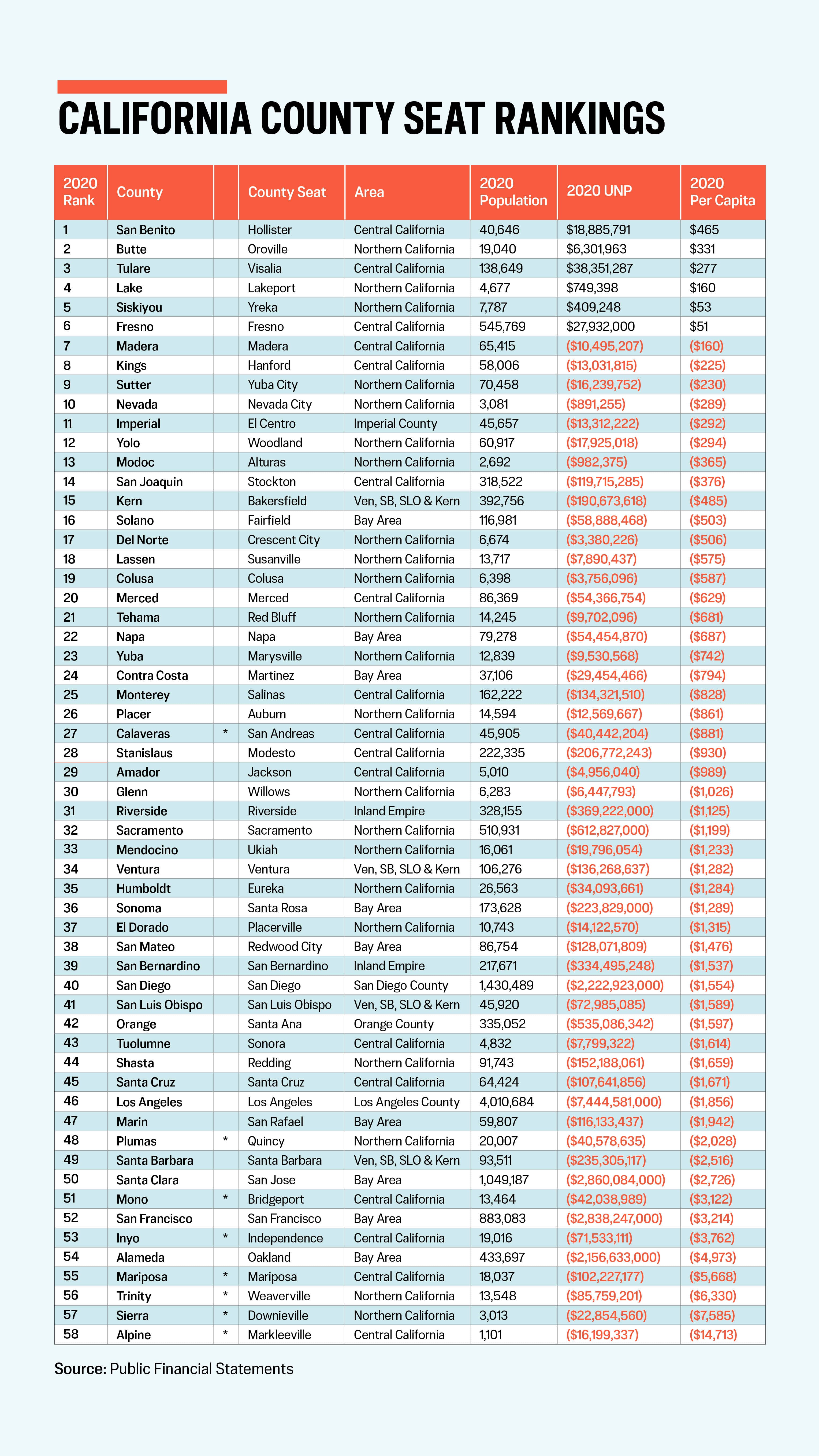
After hanging up, it dawned on me that I should do a ranking of the county seats of all 58 California counties. That way I can communicate how the city of Sacramento is doing. It’s in 32nd place.
The ranking found many interesting facts. Did you know that two counties do not have incorporated cities? And for six counties, the county seats are unincorporated areas? This means they are actually a part of the county, so there is not a separate ACFR for them. Consequently, I used their county ACFRs in the rankings. And, sadly, seven of them are in the bottom 11 counties. For the remaining 50 counties, the county seats tended to rank near the bottom of the cities within their regions.
The state of California also ranks near the bottom when compared to the other 49 states. It looks like its county’s civic centers have followed its lead. And these 58 areas hold one-third of the state’s entire population.
Besides the seven small counties, Los Angeles (4,010,684), San Diego (1,430,489), San Jose (1,049,187), San Francisco (883,083), Oakland (433,697), Santa Ana (335,052), San Bernardino (217,671), Santa Barbara (93,511), Redding (91,743), Santa Cruz (64,424), San Rafael (59,807), and San Luis Obispo (45,920) are in the bottom 20 in the ranking. More than one-fifth of the state’s population lives in these fiscally teetering cities.
One multi-year recession, causing revenues to decline and expenses to increase, especially because pension investment returns will also be in negative territory, causing the annual required contributions to increase, and things will get very, very dicey.
How will a state with 53 of its 58 county seats having unrestricted net deficits (shown in red under the 2020 UNP category) hold its finances together when the fiscal dam breaks?
This is the reality that is being left to our children and their children, should they decide to stay in the Golden State. Voters, do your best to elect councilmembers and supervisors who can do math and face reality. It’s time to address unrestricted net deficits before the next economic downturn.