
Commentary
In the upper portion of southern California, which includes Ventura, Santa Barbara, San Luis Obispo and Kern Counties, one of its cities, Taft, has been holding up the annual rankings of fiscal per capitas.
Every city should engage an independent Certified Public Accounting firm to perform its annual audit and issue an Annual Comprehensive Financial Report. Once available, take the unrestricted net position (UNP) for governmental activities from the statement of net position in the basic financial statements and divide it by the city’s population. This provides the amount every resident would receive or owe if the city liquidated its assets and paid off its liabilities.
Taft is slowly catching up. It completed its field work on November 19, 2025, but did not post the ACFR until the middle of May. It was our laggard in 2021 and 2020. And it has been near the bottom of the rankings for some time, along with three county seats.
As you can see from the graph below, for the fiscal year ending June 30, 2022, the residents of one-third of this area’s cities would have to pony up from $100 to $2,500 to resolve the liabilities in excess of the net book value of the assets.
The population of this area held steady for the fiscal year ending June 30, 2022, and the unrestricted net positions improved for all but three of the region’s 36 cities; Fillmore, Santa Paula and, of course, Taft.
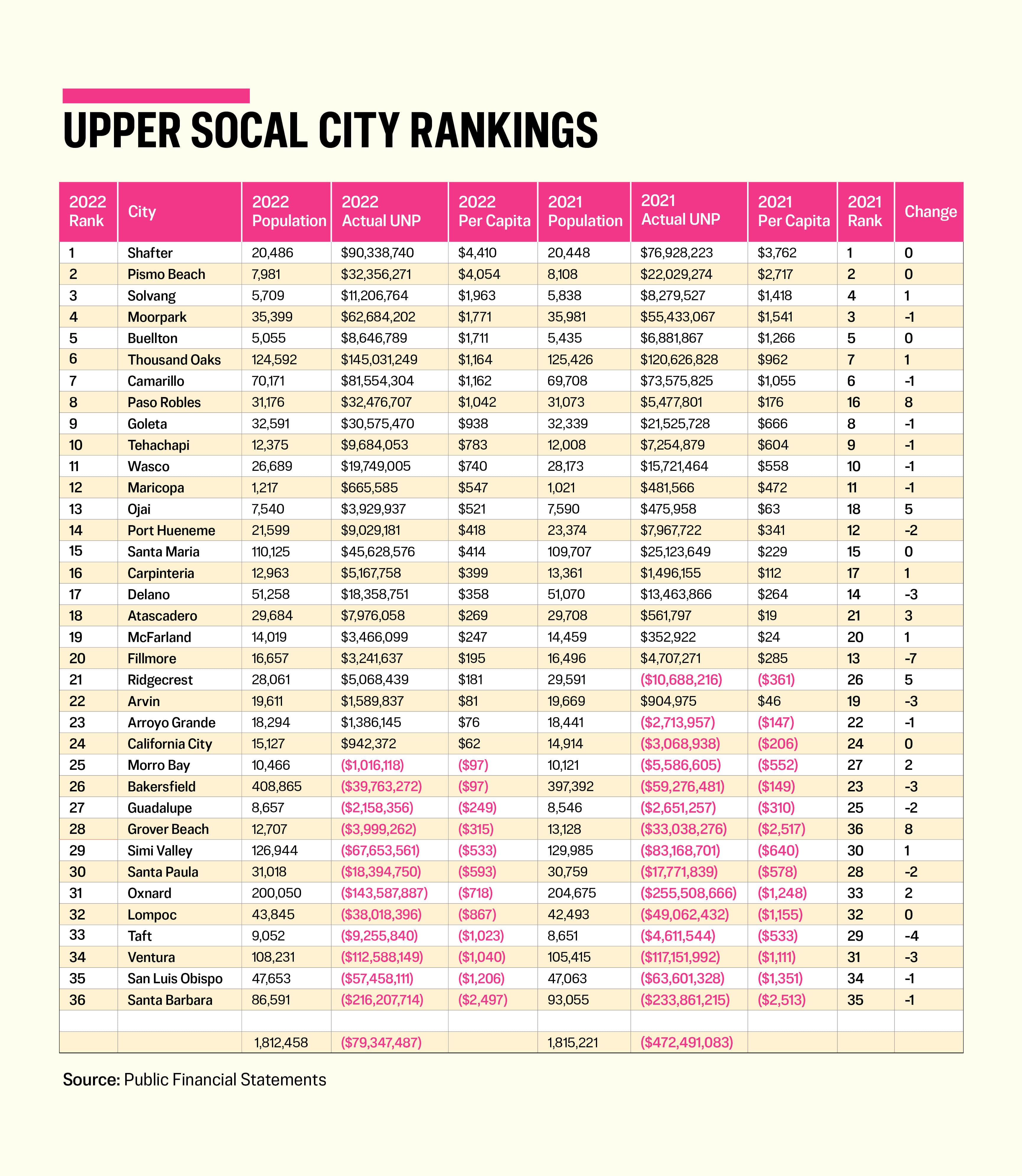
The overall improvement was probably attributed to a pent-up need to travel to the area’s beautiful coastal views and hillside wineries because of the coronavirus lockdown. The cumulative improvement was $393 million. Yet half of the cities dropped in the rankings year-over-year.
Six of the cities moved either up or down four places and twenty-five moved two or less places. Let’s look at the six that moved four or more positions.
The city of Paso Robles, officially El Paso de Robles (The Pass of the Oaks), moved up eight positions. It had revenues in excess of expenditures of $38 million, disbursed $10.2 million for its net investment in capital assets, and moved $0.8 million into restricted assets. This explains the $27 million improvement in its unrestricted net position. It moved up eight places.
The city of Grover Beach only had expenditures in excess of revenues of $436,274 and transferred $1,279,944 out of restricted asset funds. But its net investment in capital assets went nuts, going from $19,441,210 to a negative $3,940,585, or a $23,381,795 swing. The beginning amount for restricted assets was adjusted significantly and so was the unrestricted net deficit.
The reporting of net investment in capital assets needs to have the Government Accounting Standards Board (GASB) providing better continued professional education for CPAs or requiring a section in the footnotes justifying the numbers or both.
The Government Finance Officers Association did not give Grover Beach the certificate of achievement for excellence in financial reporting award, and probably for the reason that it is trying to improve this reporting concern.
Grover Beach jumped up eight places in 2022 but get ready for more disappointing accounting treatments in 2023.
The city of Ojai had revenues in excess of expenditures of $4.7 million and transferred $1.9 million into restricted assets. With a rare reduction of its net investment in capital assets of $0.7 million, thanks to depreciation, the unrestricted net position increased by $3.5 million. It moved up five positions.
Ridgecrest had a similar story, with revenues in excess of expenditures of $16.3 million and a transfer of $2 million to restricted assets. It too had a reduction of its net investment in capital assets of $1.4 million, resulting in an increase of $15.7 million to its unrestricted net position, moving it out of deficit status and moving up five places.
The city of Taft, bearing the burden of Sacramento’s war on fossil fuels, had expenditures in excess of revenues of $2.9 million and transferred $2.2 million into restricted assets. Throw in a positive prior period adjustment of $0.5 million and you have the $4.6 million increase in its unrestricted net deficit.
The city of Fillmore had revenues in excess of expenditures of $12.9 million and transferred $5.2 million into restricted assets. It also increased its net investment in capital assets by $7.4 million. Combined, it explains the majority of the decrease in its unrestricted net position by $1.5 million and dropping it seven places.
As the city of Taft slowly, but surely, becomes current on its reporting requirements, we can provide accurate rankings for this area of California in a timelier manner. Perhaps the State Capitol can give a grant to Taft from California’s cap-and-trade revenues to help expedite the process.