
Commentary
With all eyes on the city of Los Angeles, thanks to a most unusual mayoral primary that captured the attention of the nation, besides the optics, how is it doing under the hood?
What do this city’s audited annual comprehensive financial reports (ACFRs) tell us?
Well, Los Angeles is not in the best fiscal shape. It is deeply underwater, with liabilities exceeding assets by a significant amount. And the recent trend line shows that things are getting worse, not better.
In the most recent rankings of Los Angeles County’s 88 cities for the fiscal year ending June 30, 2024, the city of L.A. ranked 70th. And it’s been hovering around this placement in the annual rankings for quite some time.
Taking the unrestricted net position from the statement of net position and dividing this amount by the city’s population, the per capita gives us a metric that provides a city’s fiscal engine oil level.
Here are the details of this metric for the last 11 years:
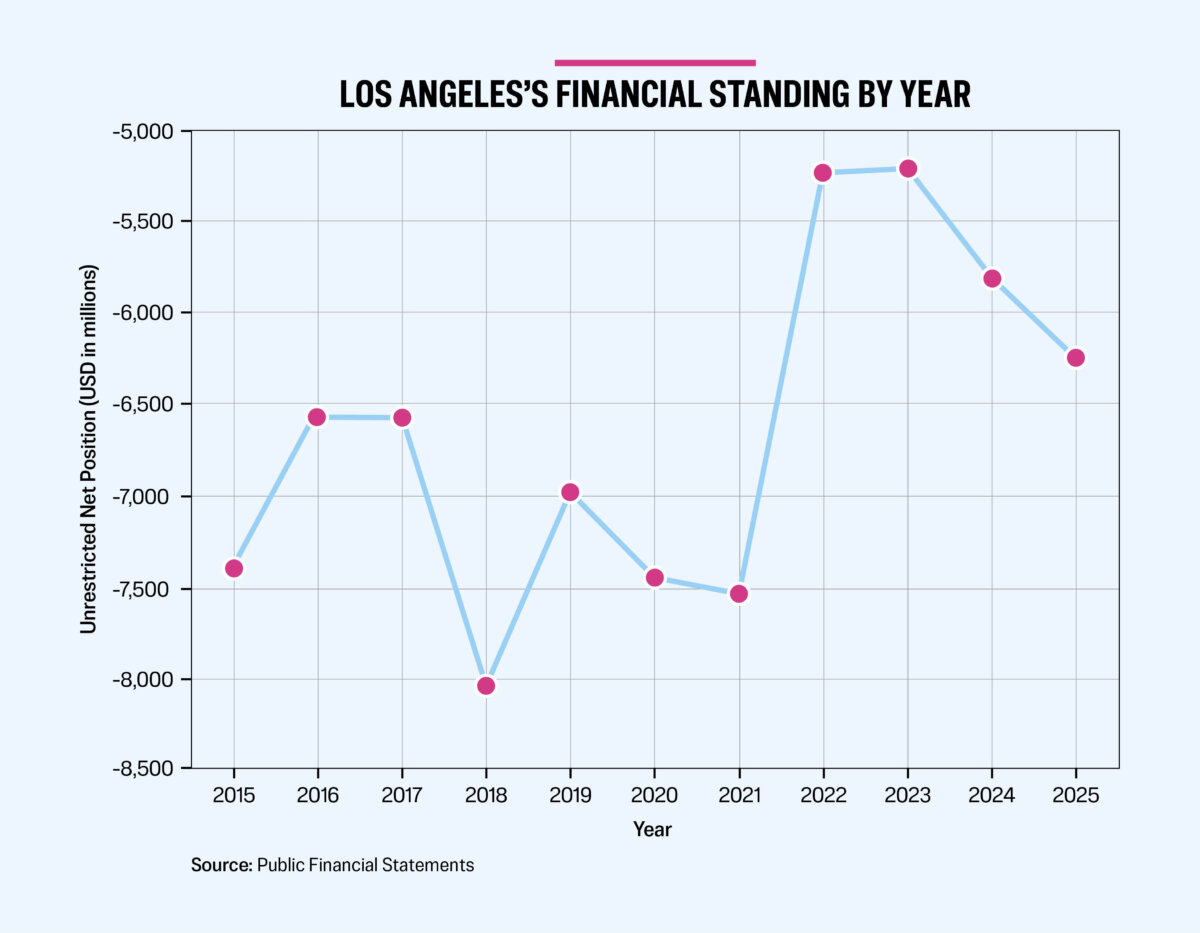
Allow me to make a few observations. The first is that the last time all then-482 California cities were ranked was 2019, and Los Angeles ranked in 431st place. This was based on the data that was available. Obtaining ACFRs is not an easy project. For instance, the city of Fort Jones in Siskiyou County still has not issued its ACFR for 2019, so the rankings were done with old data for too many cities. But L.A.’s placement in the bottom 20th percentile is nothing to brag about.
The population numbers are usually provided by the California Department of Finance. Over this period, it averaged around 3,930,000. But a declining population does not help when a city is this deep in debt. It really needs an increasing population. Unfortunately, Sacramento has been doing a terrific job of encouraging residents to flee to other states. Consequently, this means those remaining will be dealing with larger per capita.
The per capita indicates how much each Angelino would have to chip in to bring the city’s balance sheet to zero. A family of four would be responsible for about $7,500. In 2019, there were 210 cities, or 43.6 percent, that had a per capita of zero or higher.
In 2022, after the overly restrictive COVID-19 lockdown by Governor Gavin Newsom, the city experienced two interesting fiscal dynamics. Its expenses for governmental activities were lower than the previous year by $1,702.6 million. Its program revenues were up by $203.8 million. And its general revenues were up $719.0 million; overall, it explained the revenues in excess of expenditures of $2,625.4 million more than the previous year.
The city invested $176.8 million toward its net investment in capital assets and transferred $211.3 million into restricted assets. Along with the revenues in excess of expenditures of $2,682 million, the unrestricted net deficit declined by $2,293.9 million. This dramatic year reduced the negative per capita to ($1,372).
However, the trend is now reverting back to 2016 levels, starting with the following year. In 2023, the unrestricted net deficit increased by 1.17 percent; in 2024, by 9.65 percent; and in 2025, by 7.03 percent.
For a city in the fiscal shape of L.A., it should be reducing the unrestricted net deficit incrementally with each succeeding year. It explains why fire safety is down, why potholes are not being repaired, why police response times are longer, and why homeless encampments are still used for campaign photo ops. The city is running low on resources.
With the city of Los Angeles spending more than it receives in revenues every year, it will be theoretically unable to provide additional salary increases for its bargaining units. Because the mayor and City Council approved a 22 percent pay increase and a doubling of sick leave payments in 2024, according to the Daily Caller News Foundation, maybe putting a hold on similar moves for the next few years would be an understandable strategy.
With defined-benefit pension plan contributions for certain employees at 50 percent of wages, a 22 percent salary increase is really a 33 percent increase in total compensation. No wonder the public employee unions are involved in the race for mayor.
Last year’s generosity to the public employee unions also helps to explain why L.A. had to fill a $1 billion shortfall in its budget last June. And these budget concerns remain. Spending must be reduced, or revenues have to be increased, or both.
But raising revenues is not likely to happen. The city’s sales tax rate is already at the maximum 9.75 percent. And this is virtually the only tax that is available for California cities to increase. With a potentially declining population and with housing prices leveling out, property tax revenues, the city’s biggest revenue generator, may increase, but not dramatically.
Residents will probably see charges for city services increase. Perhaps higher Planning Department fees for those trying to rebuild their homes in the Pacific Palisades? So much for elected officials running on the theme of reducing the cost of living for residents.
To lower personal expenses, as the minimum sales tax rate is 7.75 percent, the level for many nearby cities, that extra 2 percent could be enough to motivate buyers to make certain larger acquisitions elsewhere. For example, if one is purchasing a $15,000 Rolex, they could purchase it at South Coast Plaza in Costa Mesa and use the $300 savings for a nice dinner while in the area.
Like other large California metropolitan cities, such as San Diego and San Francisco, it’s time for their mayors to thoroughly scrutinize annual budgets and make the tough fiscal decisions.