

Commentary
For the fiscal year that ended June 30, 2022, the 42 school districts in San Diego County had a relatively better year in the post-coronavirus era. The net increase in the overall unrestricted net positions was $584.5 million. The county’s Department of Education, Regional Occupational Program, and charter districts are not included.
At a time when school finances are getting tighter and public teacher unions are striking for higher wages, it would be helpful to gauge if this is possible for certain school districts in the southernmost coastal county in California. If this is where you reside, the graph below will help you determine how your district is doing.
By reviewing the annual audited financial statements, take the unrestricted net position (UNP) and divide it by the 2020 population served. This provides a per capita that can be ranked and reviewed for those districts that make significant moves over the previous year, either up or down.
The audited financial statements are usually provided online, either in a specific area or with the board minutes. If it is not online, then contact the district’s chief business officer and he or she will gladly email you a PDF. They should normally be online, per state code, and California state Sen. Steven Choi (R-Irvine) has authored Senate Bill 1126 to put a stronger emphasis on this digital public transparency opportunity.
There were nine districts that moved four or more places. Let’s review them. If your district is not mentioned in the narrative, then you are more than welcome to review the information online and research the financial activity and the related disclosures and footnotes.
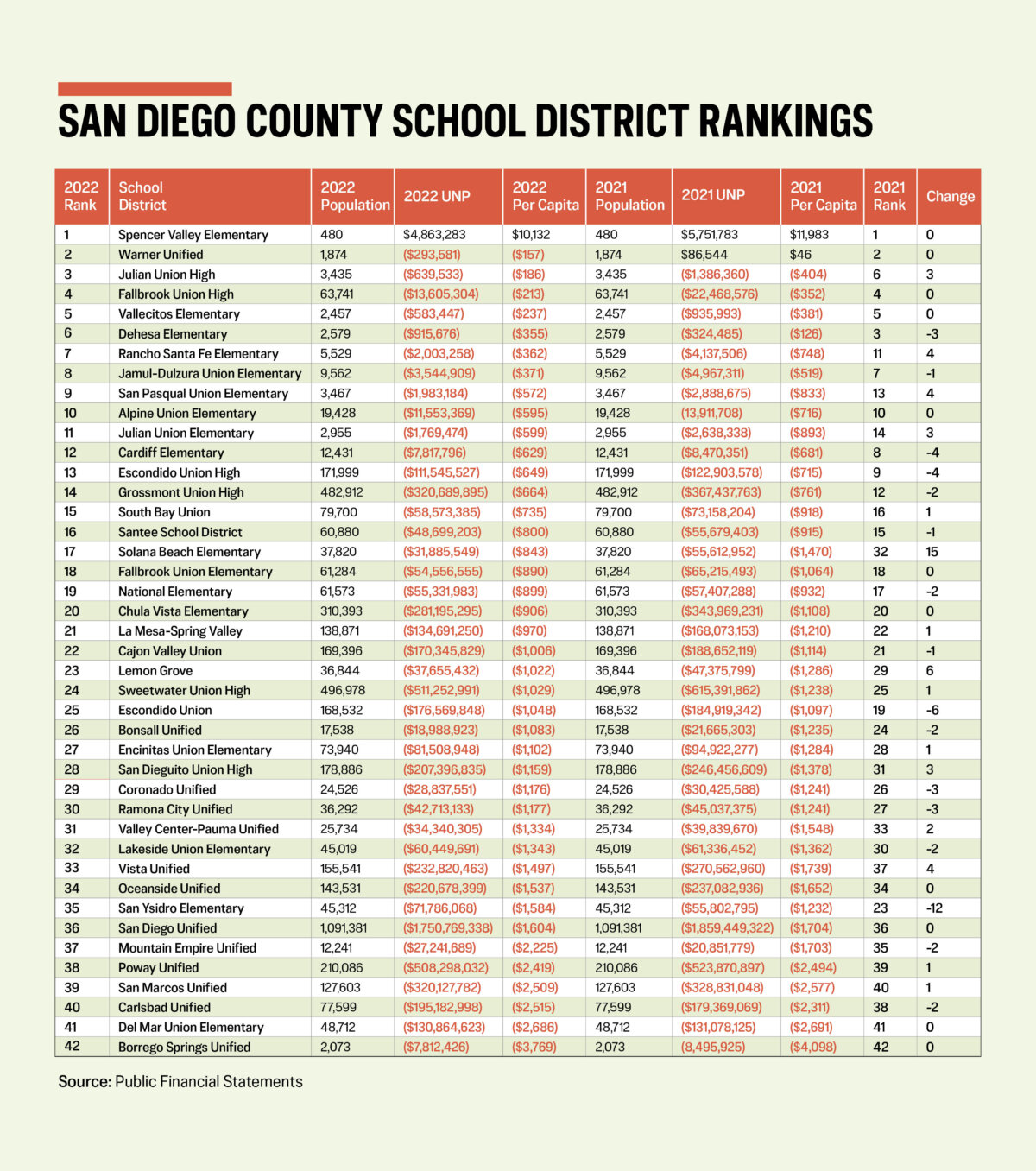
Solana Beach Elementary was the biggest upward mover. It was in 38th place in 2019, 36th in 2020, 32nd in 2021, slowly moving up the rankings. But this year it jumped up 15 places to 17th place. It had revenues in excess of expenditures of $4 million and allocated half of toward its net investment in capital assets. The big move was transferring $22.3 million out of restricted assets, explaining the majority of the $23.7 million reduction in its unrestricted net deficit. The difference of $0.7 million is explained awkwardly in Note 15, Restatement of Net Position, as a transfer to the Childcare Enterprise Fund.
Lemon Grove jumped back up six places, after dropping 12 the prior year. It out-did the previous year by having revenues in excess of expenditures of $5 million, due mainly to reducing its expenditures. It withdrew $4.7 million from restricted assets. Combined, its unrestricted net deficit was reduced by $9.7 million.
Rancho Santa Fe had revenues in excess of expenditures of $3.5 million. It plowed $0.8 million into its net investment in capital assets and transferred $0.6 million into restricted assets. The remainder of $2.1 million reduced its unrestricted net deficit. This continued its rise the previous year of nine places by another four.
San Pasqual Union Elementary had revenues in excess of expenditures of $1.6 million and allocated $0.5 million into its net investment in capital assets and transferred $0.2 million into restricted assets. Combined, the unrestricted net deficit was reduced by $0.9 million and the district also moved up four places.
Vista Unified had revenues in excess of expenditures of $55.8 million and moved $31.1 million into restricted assets. But its net investment in capital assets went down by $13 million, explaining why its unrestricted net deficit declined by $37.7 million. Oddly, the “capital and right-to-use leased assets” amount on the balance sheet actually went up by $2.4 million. The district did issue long-term debt. General obligation bonds for $138.27 million and Certificates of Participation of $38.6 million. If the proceeds are for capital assets, then more disclosure should have been included in the footnotes. With this reporting, the district also moved up four places.
Escondido Union High had revenues in excess of expenditures of $18.8 million, moved $5.3 million into restricted assets and $2.1 million into net investment in capital assets. The net result was a decrease of its unrestricted net deficit of $11.4 million. But because Rancho Santa Fe Elementary, San Pasqual Union Elementary, Alpine Union Elementary and Julian Union Elementary reduced their unrestricted net positions to a greater extent, Escondido Union High dropped four positions. They are driving a fast car in the right direction, but they just were passed up by four faster cars.
This was also true for Cardiff Elementary, which was the district that moved up the rankings the most in 2021.
Escondido Union had revenues in excess of expenditures of $31.4 million, transferred $17.7 million into restricted assets, and appropriated $5.3 million to its net investment in capital assets. Combined, it reduced its unrestricted net deficit by $8.4 million. But it was passed up by six other school districts, including Lemon Grove, and dropped six places.
San Ysidro Elementary dropped the most, 12 positions, even while having $15.8 million in revenues in excess of expenditures. It transferred $10.1 million into restricted assets and somehow reduced its net investment in capital assets by $22.9 million. In a disclosure to the financial statements, it noted there were $1.2 million in adjustments. Cumulatively, this resulted in an increase in its unrestricted net deficit of $16 million.
But how does a district reduce its net investment in capital assets when the assets reported on the balance sheet held steady and the long-term liabilities actually went down by $30.9 million, due mainly to a major drop in pension liabilities? This is where the Governmental Accounting Standards Board (GASB) could assist the municipal industry by mandating a disclosure of the account titled “Net Investment in Capital Assets.”
When I started as a junior accountant, my boss would constantly remind me that accounting is an art. He was wonderfully right-brained. But this left-brained accountant wants strict reconciliations. Have fun with the art of monitoring your school district’s finances.