
WESTMINSTER, Calif.—Along a 1.5-mile stretch of Bolsa Avenue in Orange County, a generic sprawl of suburban strip malls belies one of the region’s most concentrated cultural hubs. Here, hundreds of bakeries and restaurants, apothecaries and casinos, dentists and sundry storefronts all cater to a Vietnamese diaspora, offering tastes of the Old World—from $8 pho to $850 edible birds’ nests.
Orange County is home to the largest Vietnamese community outside Vietnam, around 240,000 people—most of whom live in and around the Little Saigon neighborhood spanning Garden Grove, Westminster, Fountain Valley, and Santa Ana.
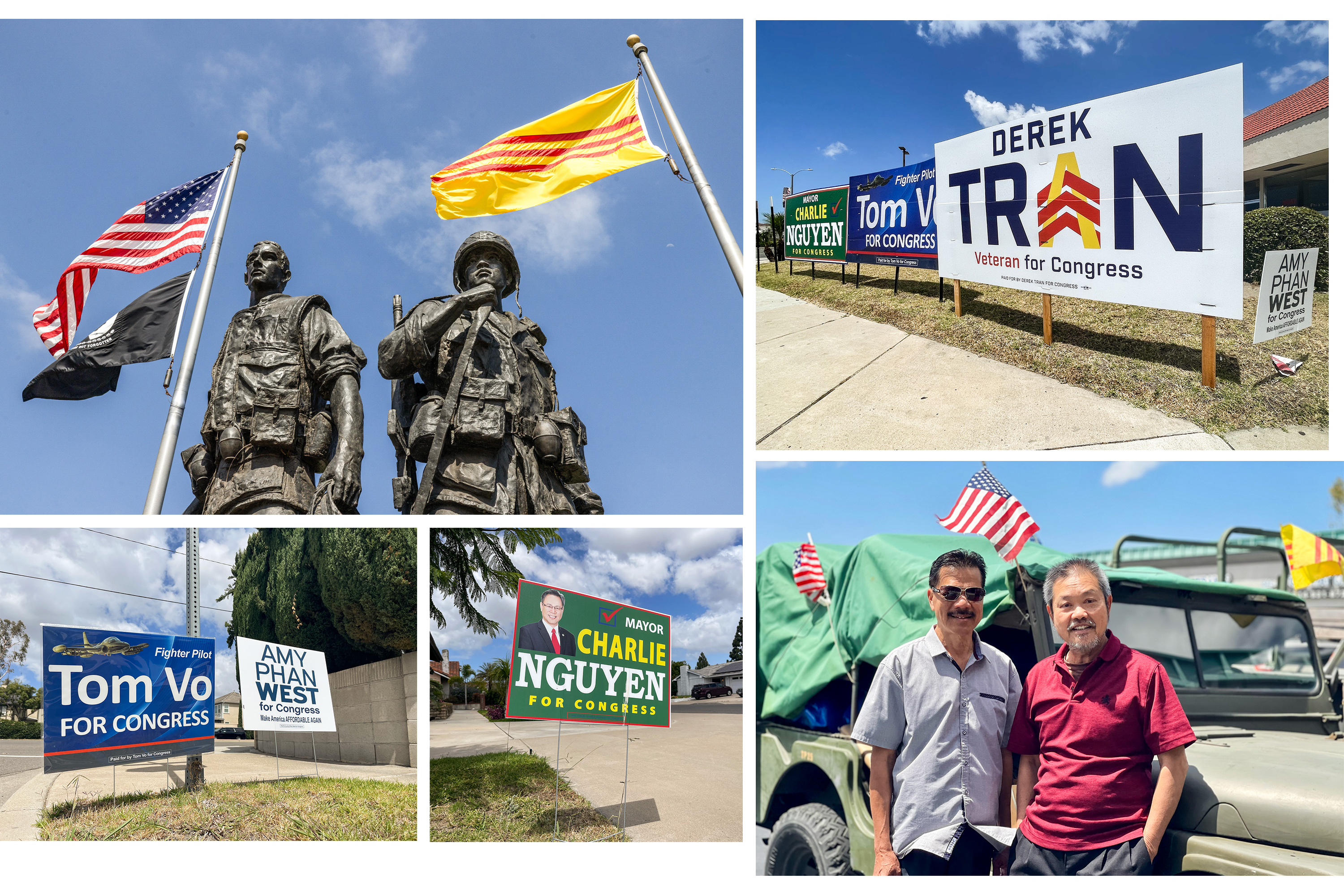
All along Bolsa Avenue, Old Glory flies in tandem with the yellow-and-red striped flag of South Vietnam, a nod to the wave of refugees who settled here after the fall of Saigon in 1975.
That history has played a prominent role in the contentious battle for California’s 45th Congressional District, one of the state’s few remaining swing seats after an aggressive bout of partisan redistricting—and a touchpoint in the GOP’s fight to keep its razor-thin grasp on the U.S. House of Representatives.
In 2024, Democratic newcomer Derek Tran, a Vietnamese American, ousted two-term Republican incumbent Michelle Steel, a Korean American, by a margin of just over 600 votes. This November, Republicans are hoping to tap the district’s conservative roots and snatch it back.
“Vietnamese tend to vote for Vietnamese,” a business owner in Little Saigon told The Epoch Times, repeating a common refrain among residents and political insiders alike.
The GOP learned its lesson.
Tran’s top four challengers 2026 are Republicans—and all are Vietnamese refugees, each with a harrowing story that brought them from communist terror to some version of the American Dream.
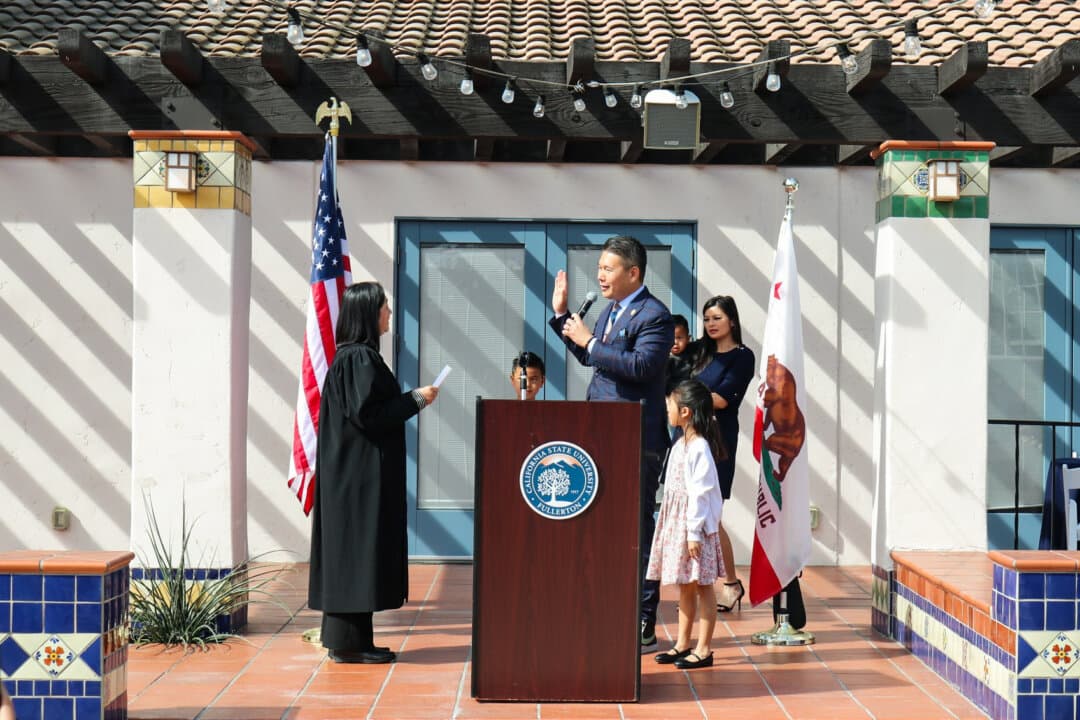
Rep. Derek Tran (D-Calif.) participates in a ceremonial swearing in at the Golleher Alumni House at California State University, Fullerton, in Fullerton, Calif., on Feb. 24, 2025. Tran, a Democrat, is the son of Vietnamese refugees; his top four challengers for the 45th District are Republicans—and all are Vietnamese refugees. (Rep. Derek Tran/public domain)
That experience taps into a deep collective memory and shapes sentiment around issues as diverse as housing and homelessness, affordability and foreign interference. It connects them with conservative Vietnamese voters—but it also means they are struggling to differentiate themselves.
Local business owner David Pham, who runs a photo studio on Bolsa Avenue, said on May 27 that his vote would go to a Republican, but he hadn’t yet decided which one.
“It’s a very hard decision,” he said, noting he’d narrowed it down to two candidates who, in his mind, seemed to have the right balance of experience and age. And while Pham himself spoke limited English, he said he preferred his congressional representative speak without an accent.
Pham pulled out his phone and pointed to a Polymarket prediction giving Tran a 99-percent probability of winning.
Democrats have a slight advantage in the district, and the incumbent is comfortably funded, raising a total of $4.2 million as of May 28; his closest challenger has not breached $800,000.

Sy Nguyen (L) and David Pham stand next to an antique de-comissioned U.S. Army Jeep flying American and South Vietnamese flags near Pham's Little Saigon business in Westminster, Calif., on May 27, 2026. Pham told The Epoch Times his vote would go to a Republican, but he hadn’t yet decided which one. (Beige Luciano-Adams/The Epoch Times)
But one of them is bound to come in second in the state’s June 2 “jungle primary”—in which the top two vote-getters advance regardless of party—and face Tran in November.
If 2024 was any indication—Tran and Steel traded accusations of Chinese Communist Party affiliation as they scrambled for the Vietnamese vote in one of the most expensive races of the election—things could get ugly.
Outside Pham’s strip mall and all along the main drag, competing signs for the top five primary candidates were posted at nearly every corner, their slogans, pitches and color schemes jostling for eyeballs.
“The swing votes will be the Vietnamese,” Amy Phan West, a Westminster city councilmember and the lone female candidate, told The Epoch Times. “In this district, no Caucasian will win this. No black will win this. [For a] Korean, it’s going to be hard, because the vote is predominantly Vietnamese.”
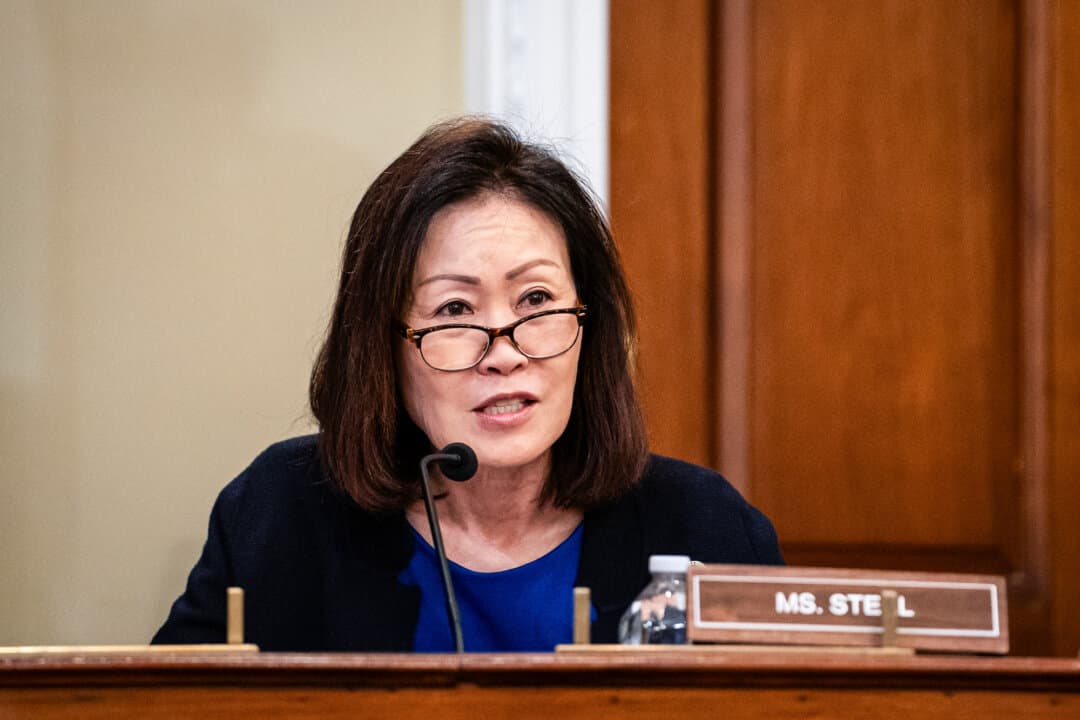
Rep. Michelle Steel (R-Calif.) speaks during a hearing about the Chinese Communist Party's forced organ harvesting before the Congressional-Executive Commission on China in Washington on March 20, 2024. Democratic newcomer Derek Tran, a Vietnamese-American, ousted Steel, a Korean-American, by a margin of just over 600 votes in 2024. (Madalina Vasiliu/The Epoch Times)
The councilwoman’s fundraising, at around $58,000, trails other Republican challengers, but she said her low overhead, name recognition, and strong “ground game” give her a competitive edge.
Phan West’s confrontational style has often put her at odds with members of her own city council; in 2024, the city sued her and another councilmember for “disruptive” behavior on the dais. She argues California needs aggressive representation in Washington.
“We need someone who can fight and who can speak for us—who can debate AOC,” she said, referring to Democratic Congresswoman Alexandra Ocasio-Cortez. “Or else [they’re] going to get eaten alive.”
Democrats gained a slight advantage in the deeply purple district following Prop 50, Gov. Gavin Newsom’s 2025 voter-approved redistricting initiative, heading into June with around 38 percent of registered voters to Republicans’ 30 percent. But 25 percent of registered voters indicate they have no party preference, and the remaining 5 percent or so are divided among Greens, Libertarians and “unknowns.”
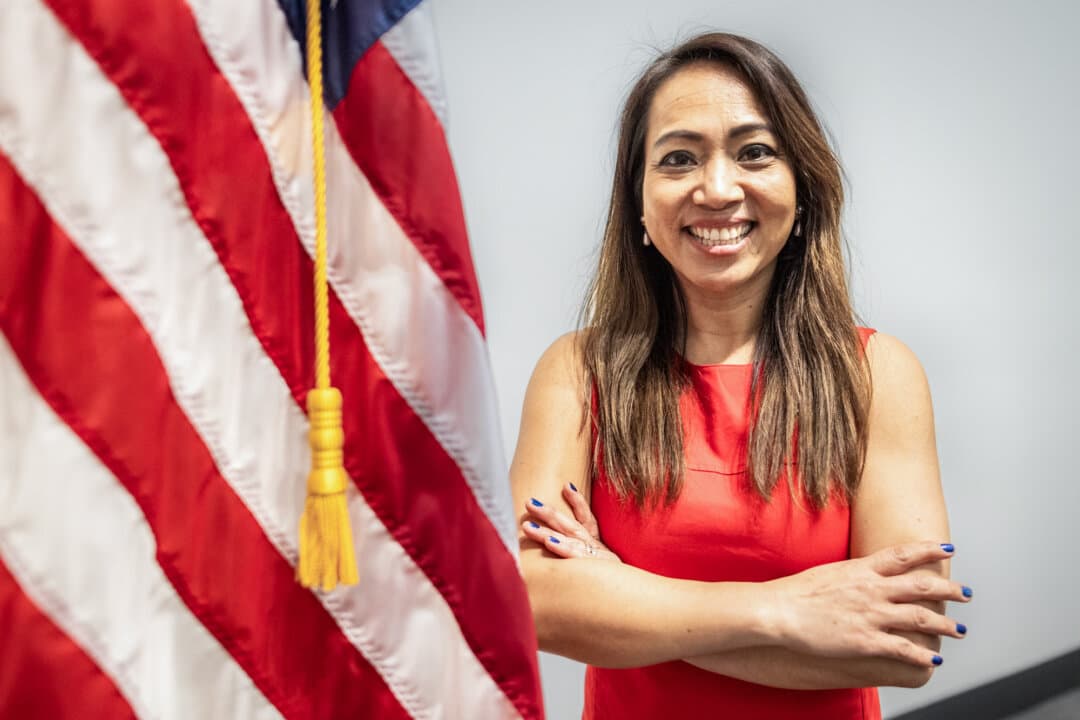
Westminster City Councilwoman Amy Phan West attends the California Republican Party convention in Sacramento, Calif., on March 15, 2025. Phan West left Vietnam at the age of five, obscured in a fishing boat with her pregnant mother and four siblings. (John Fredricks/The Epoch Times)
“The Democrats maybe have a few more points as a result of redistricting. But the non-party preference, they are leaning Republican,” Charlie Nguyen, current mayor of Westminster and a candidate for the seat, told The Epoch Times. “So if we can get enough of those votes to swing to our side, we’re safe.”
Nguyen, who has raised around $473,000, is counting on the depth of his public service experience to beat competitors who have out-fundraised him in the primary.
“I have three decades of volunteering with the community before I actually ran for office. I’ve been involved the longest compared to all of them,” Nguyen said.
Tran, a veteran and personal injury lawyer before he was elected to Congress, has gone on the offensive against Nguyen, sending out mailers framing the mayor as a MAGA loyalist.
But this tactic, challengers say, is a gambit to “handpick” an opponent Tran believes will be easier to trounce in November—a page from Adam Schiff’s playbook. In 2024, Democratic rivals accused Schiff of spending millions to prop up Republican opponent Steve Garvey in order to “game” the jungle primary and avoid a grinding runoff with his closest Democratic challenger in the general election.
A representative told The Epoch Times that Congressman Tran was unavailable for an interview.
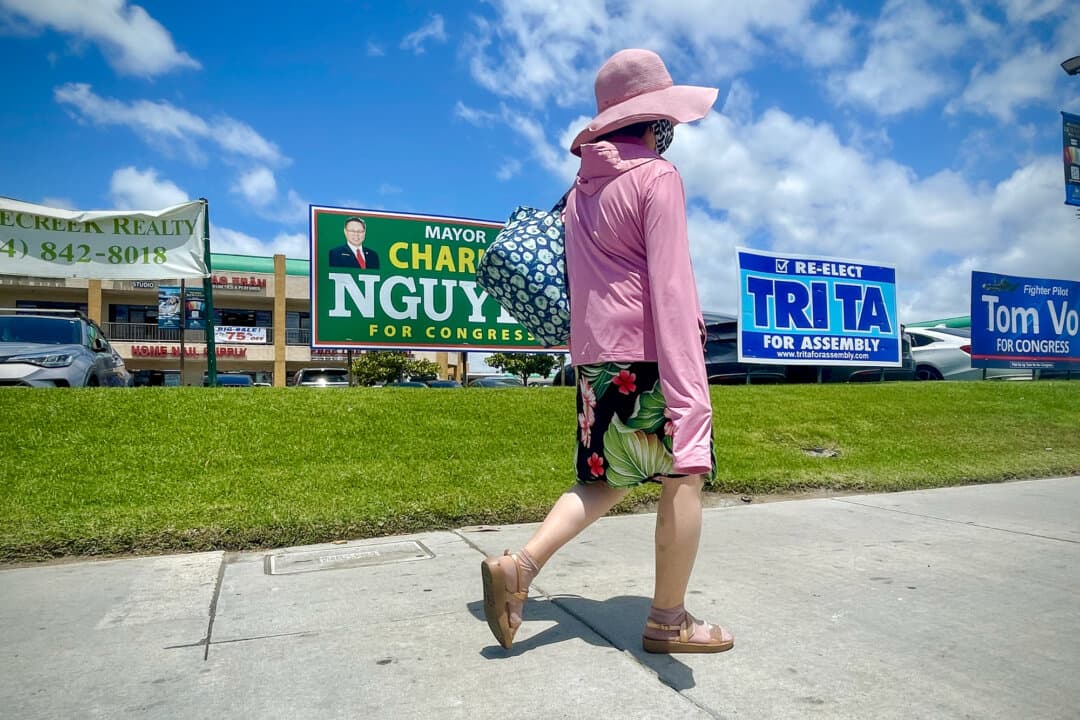
A woman walks near 45th Congressional District primary campaign signs near the Little Saigon neighborhood in Westminster, Calif., on May 27, 2026. (Beige Luciano-Adams/The Epoch Times)
Tom Vo, the oldest of the Republican challengers and a largely self-funded candidate whose $755,910 war chest comes second to Tran’s, leans on his experience as a decorated fighter pilot, often appearing in full uniform or monogrammed flight suit in campaign photos.
Representatives for Vo did not respond to requests for an interview. His campaign website highlights issues of affordability, public safety and secure borders.
Chuong Vo, a 28-year veteran of the Los Angeles Police Department and former mayor of Cerritos, meanwhile, says his pull in the Los Angeles County side of the district gives him an advantage over opponents based in and around Little Saigon.
Where Steel lost votes “because the other side decided to put a Vietnamese American to run against her for the first time,” Chuong Vo said, she also lost votes in cities within LA County that tend to vote blue.
“Where I come in is I’m a Republican Vietnamese—so the conservatives in Little Saigon have an option of Vietnamese representation ... but I was also mayor of Cerritos. ... I’m the only one from the LA side where Michelle lost some of those votes.”
Chuong Vo has raised around $405,000, according to the Federal Election Commission.
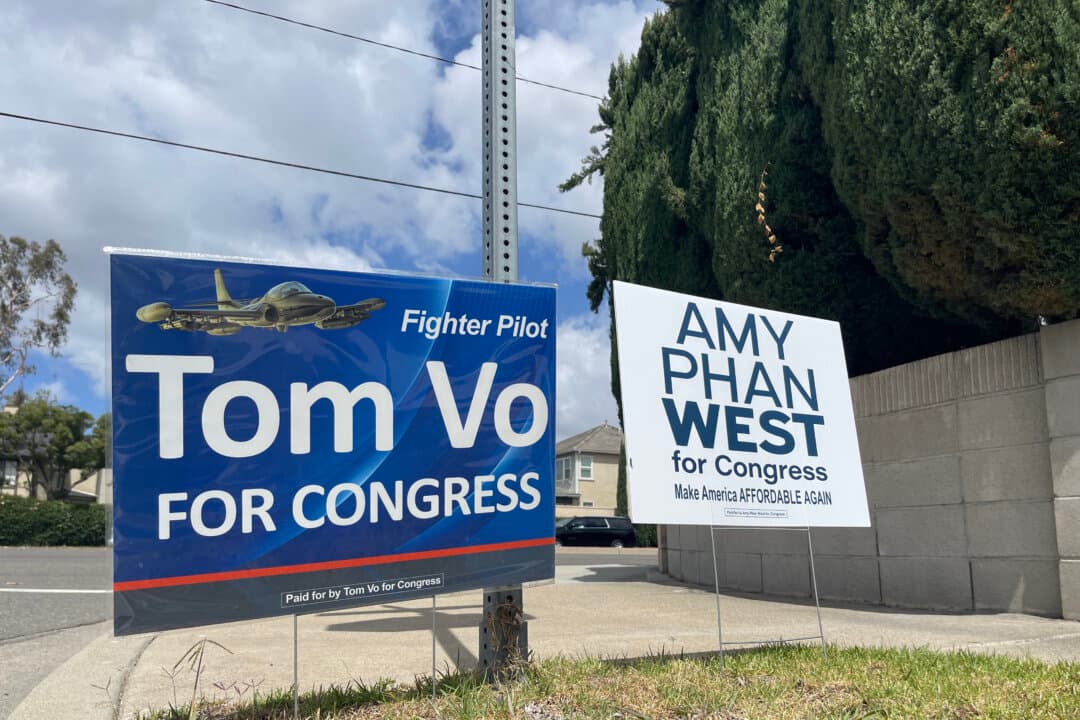
45th Congressional District primary campaign signs near Little Saigon in Westminster, Calif., on May 27, 2026. The district is one of the state’s few remaining swing seats after voters approved Prop 50 in November 2025, leading to partisan redistricting. (Beige Luciano-Adams/The Epoch Times)
While Little Saigon was previously split into three districts, the state’s 2020 redistricting process consolidated the area’s Vietnamese American voter base in the new map, a jagged semi-circle spanning 18 cities and straddling Los Angeles and Orange Counties.
The vast majority, around 350,000 of the district’s 450,428 voters, are in Orange County. And while the county used to be reliably red, Kamala Harris narrowly won it in 2024 with 49.7 percent of the vote, compared to Trump’s 47.1 percent.
But in the 45th Congressional District’s Orange County cities, Trump garnered 140,830 votes to Harris’s 139,400.
American Dream
Chuong Vo, Phan West, and Nguyen all describe a similar commitment to hard work, law and order, and the promise America offered their families as refugees.
Phan West left Vietnam at the age of 5, obscured in a fishing boat with her pregnant mother and four siblings. Her father, who had been captured, tortured, and eventually released after serving alongside U.S. forces, hoped to navigate the family to Thailand. After three days, they ran out of food and water, but were rescued by a German oil tanker, Phan said.
“We sought asylum for 2 1/2 years the right way. We waited our turn in the refugee camp. It’s not beautiful—it’s horrific because people were fighting over spoiled food and water to survive,” she said.
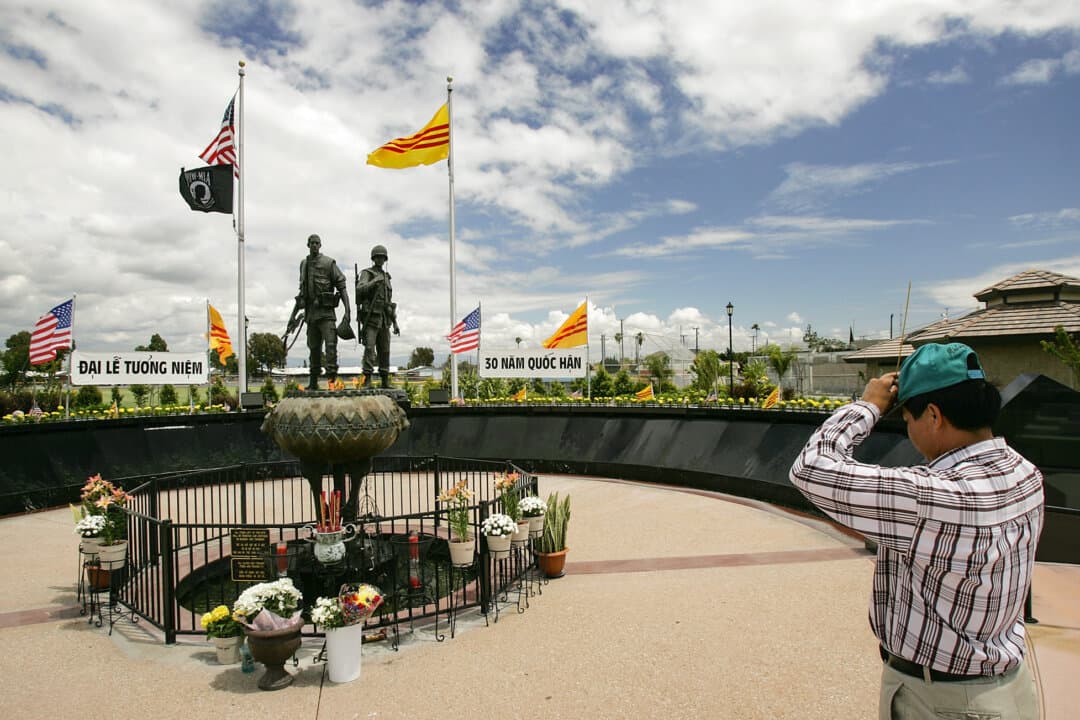
A man pays his respects at a Vietnam War Memorial in the Little Saigon neighborhood of Westminster, Calif., on April 28, 2005. Little Saigon, the largest Vietnamese enclave in the United States, was populated by large numbers of Vietnamese refugees, many of whom were “boat people,” in the late 1970's and 1980's. (David McNew/Getty Images)
“We understand having nothing—and now in America we can have something. It’s just based on our merit, on how hard we work. ... But when we become a socialist country, a communist country, there’s no way of getting back. Look at North Korea, look at China.”
Nguyen, who was 11 when Saigon fell, recalled his father being sent to a “re-education camp.”
“I couldn’t go to school, I had to work to help raise my siblings," he said. “I lived in Vietnam under the communist regime, I know how cruel they are.”
Nguyen came to the United States alone at the age of 15. “I worked, I went to school, and I saved money to sponsor my family over and continued working to live the American Dream,” he said.
Vo, who was only a year old when his family fled the communist regime, said the lessons of their escape and survival deeply shaped his understanding of what it means to be an American.
“We’re refugees and we want to represent the values of America. ... That was ingrained in me as a child growing up—that my parents sacrificed everything, our lives, our possessions, our everything to start over ... not knowing if we were going to survive,” he said.

Viet Cong soldiers paddle small boats on their way to “liberate” the South Vietnamese town of Ca Mau, on May 1, 1975. After the fall of the South Vietnamese capital of Saigon on April 30, 1975, a wave of refugees settled in Orange County, California in what is now known as Little Saigon. The area is now home to the largest Vietnamese community outside Vietnam. (AFP via Getty Images)
“My parents knew that the one country that would provide those opportunities was America. So we waited 2 1/2 years in a refugee camp in Malaysia to come here.
“That shared experience with my family made me respect the governing laws of America. ... We’re Americans, period. We have this shared background no matter what ethnicity you are.”
All three candidates are campaigning on familiar issues—including the region’s housing and homelessness crises, taxation, government waste, secure borders, public safety and cost-of-living issues.
While Vo is promising to shore up funding for senior services, which he says have been sidelined by a myopic focus on homelessness, Phan West says she’s trying to reach Gen Z.
“I talk to [college students] because I want to hear what they’re struggling with,“ he said. ”They’re saying it’s unbearable, that they can’t afford anything. They’re in debt. The one thing they want is someone to fight for them for economic relief.”

Flags of the United States and the Republic of Vietnam (commonly known as South Vietnam) fly over statues depicting U.S. and South Vietnamese soldiers at a Vietnam War Memorial at Sid Goldstein Freedom Park in Westminster, Calif., on May 22, 2026. Vietnam is now known as the Socialist Republic of Vietnam. (John Fredricks/The Epoch Times)
Testing the Waters
While Republican voters such as Pham may be spoiled for choice in the primary, party insiders say they are not worried about the vote being fractured in the June 2 election.
Two candidates—Phan West is an elected member and Nguyen is an alternate—sit on the Republican Party’s Orange County Central Committee, which has not endorsed any candidate in the race.
That decision, said Will O’Neill, chairman of the OC Republican Party, was equally about letting the best one rise to the top in the primaries.
“The party didn’t endorse because we have quite a few good candidates who can go present their case to voters and have the voters tell us who they'd prefer,” O’Neill told The Epoch Times.
“You have Republicans honing their arguments and getting out and competing. ... Whoever ends up running against Derek Tran will be a better candidate than when they started.
“We’re going to end up with a Republican versus Derek Tran– and then we'll be fully behind that Republican.
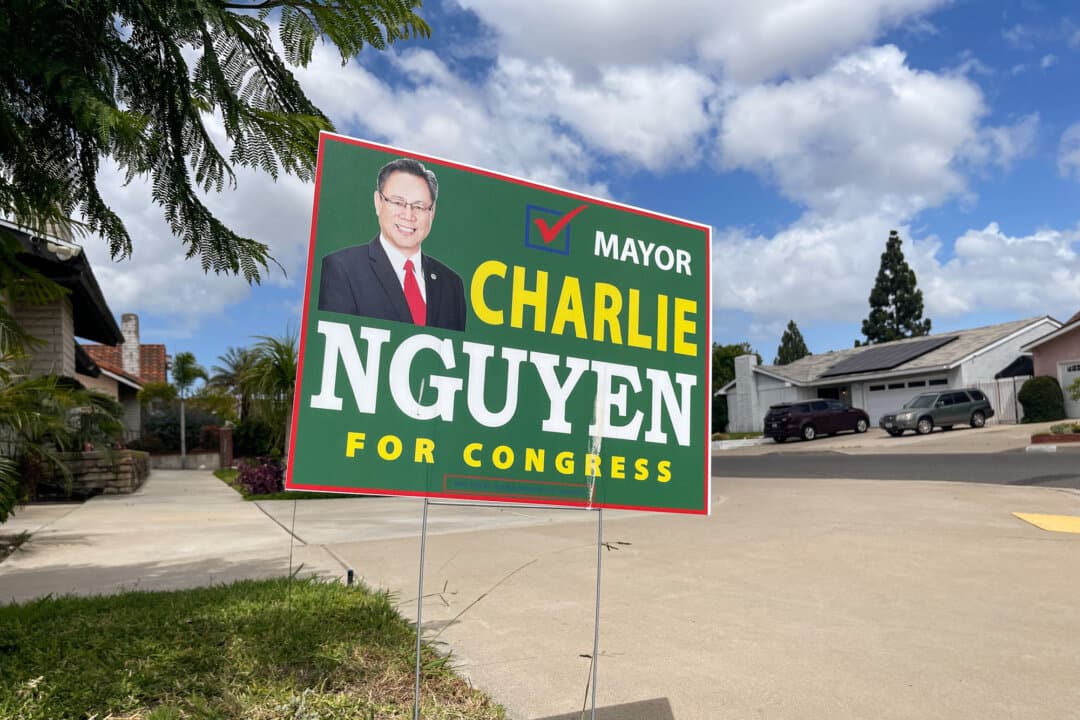
A campaign sign for Westminster Mayor Charlie Nguyen's campaign for the 45th Congressional District is seen in a residential area near the Little Saigon neighborhood in Westminster, Calif., on May 27, 2026. Nguyen has been mayor of Westminster, nucleus of the Little Saigon neighborhood, since 2022. (Beige Luciano-Adams/The Epoch tImes)
Prop 50 redistricting may have made Tran’s seat safer, O’Neill said, “but the Republican turnout so far has been energized. People are excited to vote and you’re seeing it across the board in Orange County right now.”
Around 11 percent of the districts ballots have been returned early, according to nonpartisan tracker PoliticalData.com.
Of those, Republicans have been returning ballots at a higher share—40 percent, compared to their 30-percent registration share, while Democrats are returning at a lower share than their registration, 38 to 39 percent.
Non-party preference and “other” voters, according to the tracker Civiq.com, have returned around 22 percent of their 30-percent share of voter—an 8.2 percent turnout rate, compared to Democrats’ 11.2 percent and Republicans 15.09 percent.
“I’m not sure I’ve ever seen Republicans lead Democrats this early in turnout, but right now there are more Republicans voting in Congressional District 45 than Democrats,” O’Neill said.
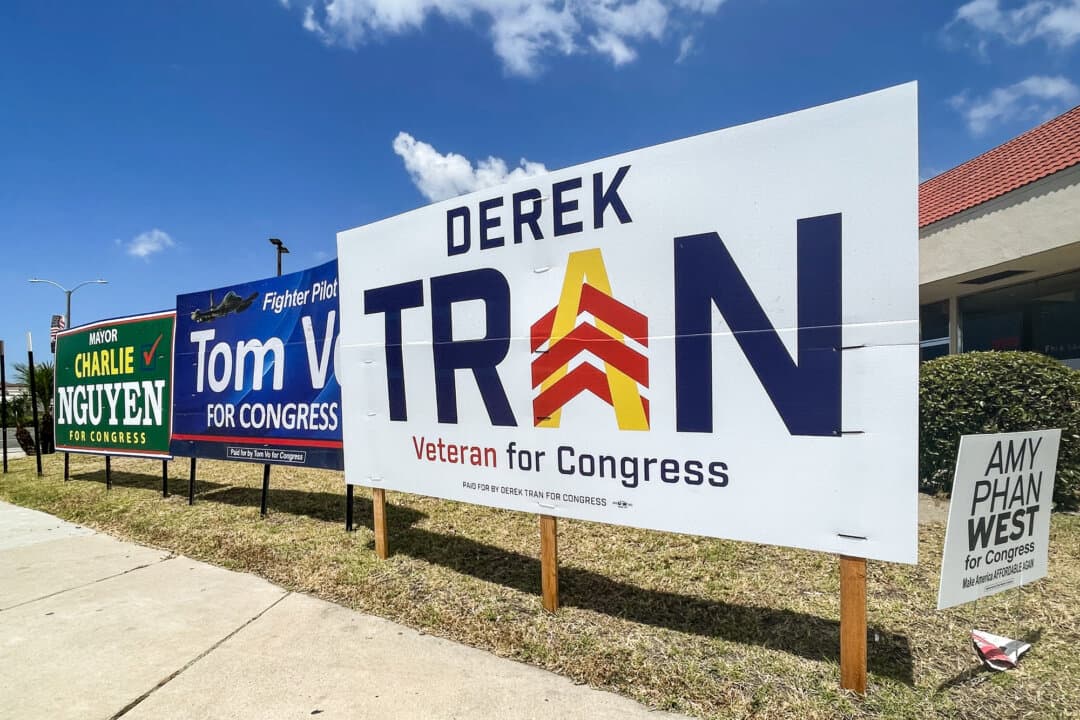
Campaign signs for candidates in California's 45th Congressional District race are displayed in Westminster, Calif., on May 27, 2026. Democrats gained a slight advantage in the district following California's redistricting initiative, but Republicans are looking to the 25 percent of registered voters who list no party preference to help them win. (Beige Luciano-Adams / The Epoch Times)
Time will tell, he said, which way non-party preference voters swing.
“For now,” he said, “this is not the election that Derek Tran was hoping for.”
The district “leans Democrat,” but is among the most competitive races in 2026, according to the nonpartisan Cook Political Report, which identifies 18 pure “toss up” districts
Currently, Republicans control 218 seats in the House, and five are vacant. Overall, Democrats would need to gain a net of three seats in order to wrest control of the chamber.
The California Democratic Party did not respond to inquiries regarding the race.
Correction: An earlier version of this article misspelled the name of Rep. Michelle Steel in one instance. The Epoch Times regrets the error.