After nearly five weeks of evidence, a jury in Los Angeles Superior Court on March 12 heard final pleas in a landmark civil trial considering whether social media companies intentionally designed their platforms to addict young people despite known harms.
In his closing arguments, plaintiff’s attorney Mark Lanier likened defendants Instagram and YouTube to lions stalking wounded gazelles on the Serengeti, figuring out who will be dinner, an image of the same suspended on a large monitor beside the witness stand.
“They never go after the strongest, never go after the boldest,” Lanier told the jury. “They find the one that’s weaker, that’s more vulnerable, and that’s the one they get.”
The gazelle in Lanier’s narrative is a 20-year-old California woman, partially anonymized in court documents as “K.G.M.” or “Kaley G.M,” whose lengthy medical records and sensitive family history have been pried open and picked apart as lawyers argue over whether her mental health struggles were likely caused or worsened by a social media addiction—or by genetic disposition and a chaotic family life marked by neglect and abuse.
Kaley claims that she developed anxiety, depression, body dysmorphic disorder, suicidal ideation, and other conditions after becoming addicted to social media as a child.
“We produced evidence on all of the factors Miss G.M. had going on in her life that contributed or caused her mental health struggles,” Paul Schmidt, an attorney for Meta, said in his closing statements.
“Their case depends on asking you to find that if you focus only on Instagram, somehow her life would be meaningfully different. The evidence did not show that. It showed just the opposite.”
In closing statements, YouTube attorney Luis Li said that the company “did not design the platform to harm anyone.” Echoing claims made throughout the trial, he suggested that YouTube is not really a social media app but the largest video screening platform in the world, which, like Netflix, people mostly watch on their televisions.
The media frenzy that accompanied the early days of the trial, which began on Feb. 9—and, in particular, the testimony of Meta CEO Mark Zuckerberg—had largely faded by the time Kaley took the stand on March 3.
Nearly five weeks in, one juror appeared to be sleeping through much of Lanier’s closing statements.
Judge Caroline Kuhl told the jury in her instructions that they “may not consider the wealth or poverty of any party.” Such details are irrelevant, she said.
According to Forbes, Zuckerberg is now the fifth-richest man in the world, with a fortune estimated at $226 billion.
Kaley filed suit against Instagram (parent company Meta), YouTube (parent company Google), Snapchat (parent company Snap Inc.), and TikTok (parent company ByteDance); the latter two companies settled privately shortly before trial began but remain named in related cases.
Her trial is one of a handful of bellwethers expected to have a profound effect on the direction of thousands of related, consolidated cases brought by children, parents, school districts, and attorneys general across the country.
It is unfolding at a critical moment, when governments around the world are trying to ramp up online safety laws or apply blanket social media bans for younger users, and grieving parents are organizing for regulatory reform.

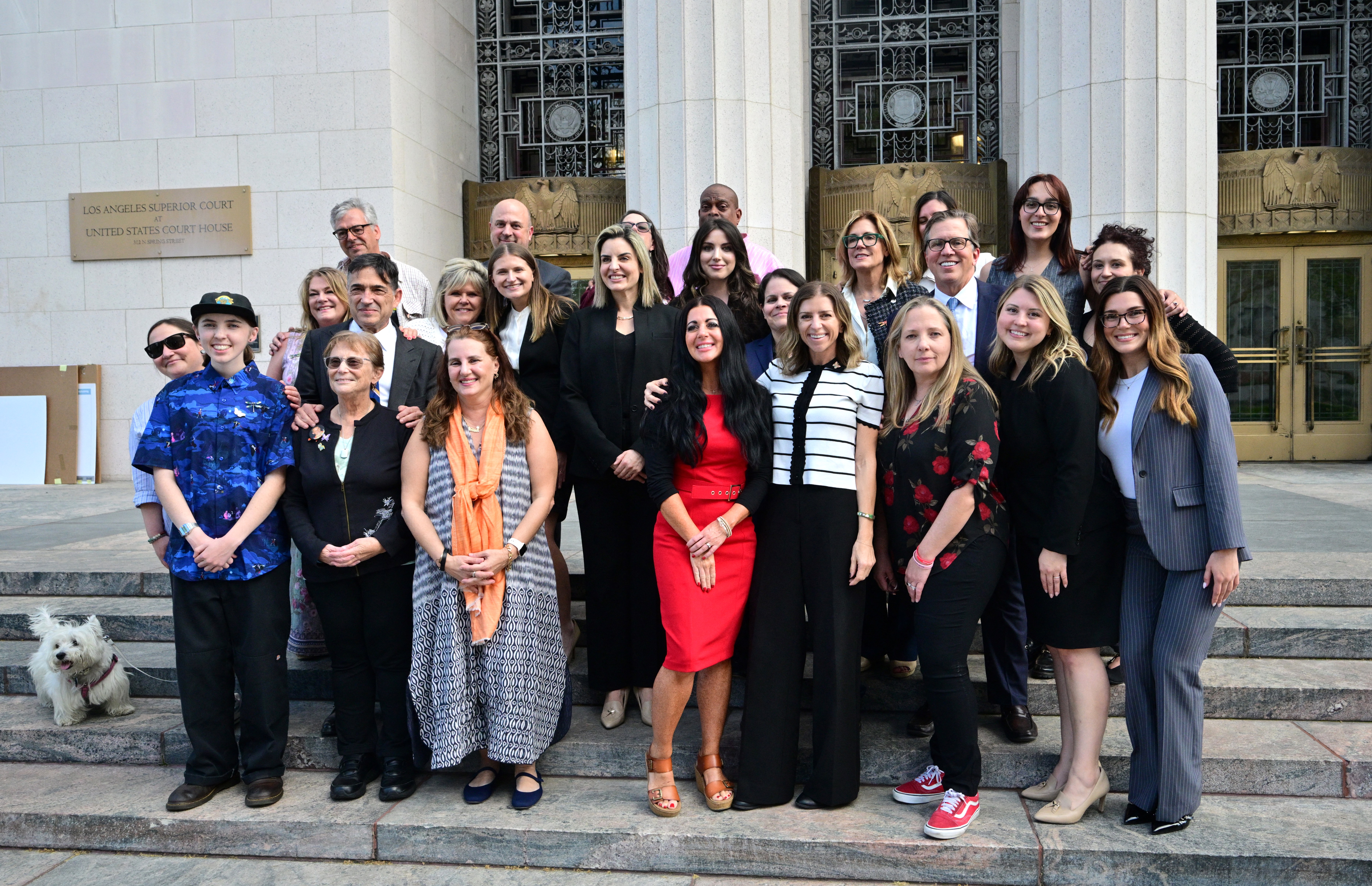
Plaintiff "K.G.M." (C) arrives at the Los Angeles Superior Court on Feb. 26, 2026. She was scheduled to testify in a landmark case accusing Meta and YouTube of building addictive social media platforms, causing harm to children. (Mario Tama/Getty Images)
‘Multiple Factors’
Defendants have, throughout the case, argued that Kaley’s mental health struggles stemmed from a heightened genetic risk, a volatile family dynamic, and learning disabilities that preempted and overshadowed her social media use.
Psychiatric experts hired by each side to evaluate Kaley in the case agreed largely with previous diagnoses of social anxiety, major depressive disorders, and body dysmorphia, but disagreed on whether she was addicted to social media.
Experts for the plaintiff testified about skyrocketing rates of social media addiction among adolescents and about a growing body of research that points to an array of resulting psychological harms.
Throughout the trial, both sides have grappled with a contentious battle over the meaning and import of social media addiction—a relatively novel phenomenon that is by no means standardized in terms of diagnoses, treatment, or even an understanding of its true scope.
Dr. Thomas Suberman, a psychiatrist who treated Kaley for 2 1/2 years beginning in 2020, testified via videotaped deposition on March 11 that social media was “not the through line of what I recall being her main issues.”
Rather, it was interpersonal conflicts, relationships with her mother and sister and her peers, and “her own behaviors handling all those interactions” that were the focus of their work together, he said.
“Depression and anxiety causation is multifactorial, and I think social media played some part. It is not the part that I felt was the majority of the issue,” Suberman said.
Lanier said he is not attempting to prove that social media is the sole cause of the alleged harms.
“We’re not asserting that. We’re saying the problematic use, the addiction, is something that has specifically worsened any kind of problems she ever had. It’s the feedback loop,” he said, referring to how problematic use can exacerbate symptoms that then drive users to continue a cycle of compulsive use and withdrawal.
An internal Meta document that includes a diagram of how these cycles work is at the heart of the case, according to Lanier.
“It shows social media contributes to the harms of people that are already vulnerable. ... It doesn’t have to be the only cause,” he said.
Generational Crisis
While the details of her case are unique, Kaley represents a generation of digital natives and the unprecedented youth mental health crisis that has accompanied the rise of social media.
She testified that she joined YouTube at age 6. At 9, she was sneaking out of bed at night to scroll through Instagram on her phone. At about the same time, she began suffering from anxiety; depression followed.
By age 10, she had posted more than 200 videos to YouTube. Desperate for social validation, she created more than two dozen accounts across the two apps to like her own posts. When she was bullied on YouTube, she continued using it.
“Being off of it bothered me more than the comments and the bullying,” Kaley told the court on March 3.
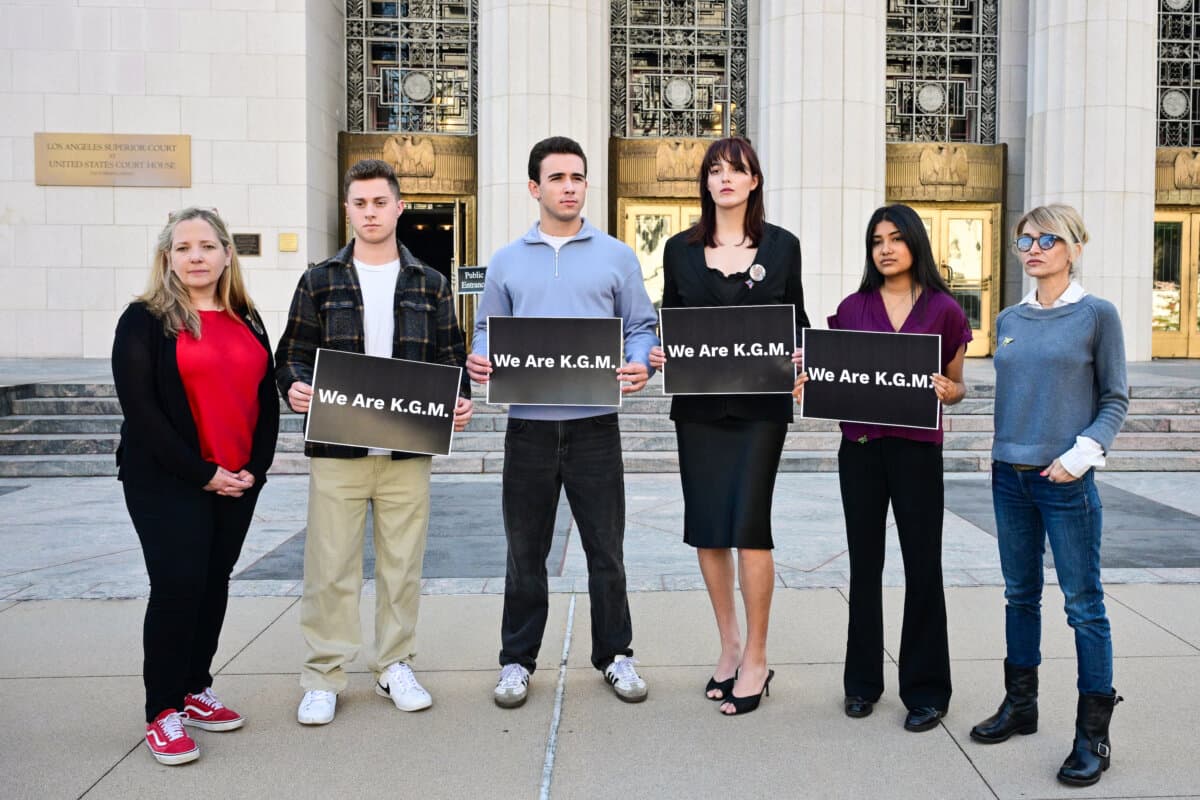
Supporters of "K.G.M." pose with signs outside the Los Angeles Superior Court on Feb. 25, 2026, during the social media trial over whether platforms were deliberately designed to be addictive to children. (Frederic J. Brown/AFP via Getty Images)
From the gallery, grieving parents who have lost children to suicide or fatal “viral challenges” that they say were caused by intrinsically toxic and predatory app features watched the trial unfold, reliving their own tragedies.
Victoria and Paul Hinks, whose 16-year-old daughter Alexandra took her own life in 2024 after a year-long struggle with mental illness, said they didn’t realize until after her death how deeply affected she was by social media addiction. Safety features were virtually useless, they said.
“We’d lock down the phone with parental controls,” Victoria Hinks told The Epoch Times, noting that her daughter easily got around the one-hour-per-day limit they had set. “She was doom scrolling and being fed very, very dark content about suicide, self-harm, and body dysmorphia.”
Despite her obvious beauty, Alexandra convinced herself that she was ugly, her mother said. Like Kaley, she developed a warped self-image after using beauty filters.
“Eventually, she used social media to find the best way to kill herself,” Victoria Hinks said.
K.G.M.’s case focuses narrowly on how design and function—including features such as notifications, “infinite scroll,” and the companies’ proprietary algorithms—rather than third-party content, may have led to alleged psychological harms.
Platforms are broadly protected by both the First Amendment and Section 230 of the Communications Decency Act from liability for third-party content they may host.
Alexandra’s father, Paul Hinks, a software engineer, compared the companies’ highly adaptive and personalized algorithms to “'digital nicotine’—it’s not just the content; it’s the way that they’re set up to get them hooked.”
Meta and Google knew what they were doing, he said.
“They wanted to increase engagement,” Paul Hinks said.
Dr. Kara Bagot, a psychiatrist specializing in adolescent addiction who testified for the plaintiff, described YouTube as the “gateway” that cleared a path for addictions to other apps to take hold in Kaley’s developing brain.
Google attorney Luis Li pointed to Bagot’s own assertion, made in a 2020 lecture, that YouTube appeared to have a “net positive” effect on children because it didn’t require “social validation.”
“Their entire gateway theory is based on social validation, and their own expert said there’s no need for social validation on YouTube,” he said.
Kaley’s own admission that she “just kinda lost interest” in YouTube after her peak use in 2014 proves his case, according to Li.
“This is not a person addicted to YouTube,” he said. “This was not rewiring her brain. This was a toy that Miss G.M. picked up and put down over a decade ago.”
‘Trojan Horses’
Kaley’s trajectory through adolescence, her lawyers argued, tracks closely with the exponential acceleration of social media reach and power over the past decade or so—and with deliberate decisions by company leadership to prioritize growth over safety.
Meta and YouTube executives testified that they do not engineer their platforms to be addictive and that plaintiff’s attorneys have mischaracterized recently released internal documents.
Lanier said the evidence clearly shows that leadership at both Meta and YouTube knew of the harms associated with preteen use, that young people with other co-stressors were particularly vulnerable, and that they went after that demographic anyway, introducing features such as vertical video feeds to compete with rivals such as Snapchat.
Unlike in criminal cases, the plaintiff does not have to prove their case beyond a reasonable doubt but only that what they allege is more likely to be true than not.
Where the defendants claim that they create “tools” that help struggling young people like Kaley find community and a creative outlet, Lanier argued that every second of user attention is monetized and exploited.
“It’s an age-old motive. It’s all about the money,” he said.
“These aren’t tools. They are Trojan horses. They look like they’re wonderful and great and delightful, but you invite them in, and they take over.”
Addressing the question of how jury members might translate alleged harms into monetary damages, Lanier said: “When you mess up someone’s childhood, you change the trajectory of their life. ... What we have to do here is put a value on a lost childhood.”
Casualties like Kaley are not accidental, he argued.
“The lion doesn’t accidentally get the gazelle. It’s planned out, and it’s being done for money,” he said.
Jurors begin deliberating on March 13. Nine out of 12 must vote on each claim in order for one or both defendants to be found liable.