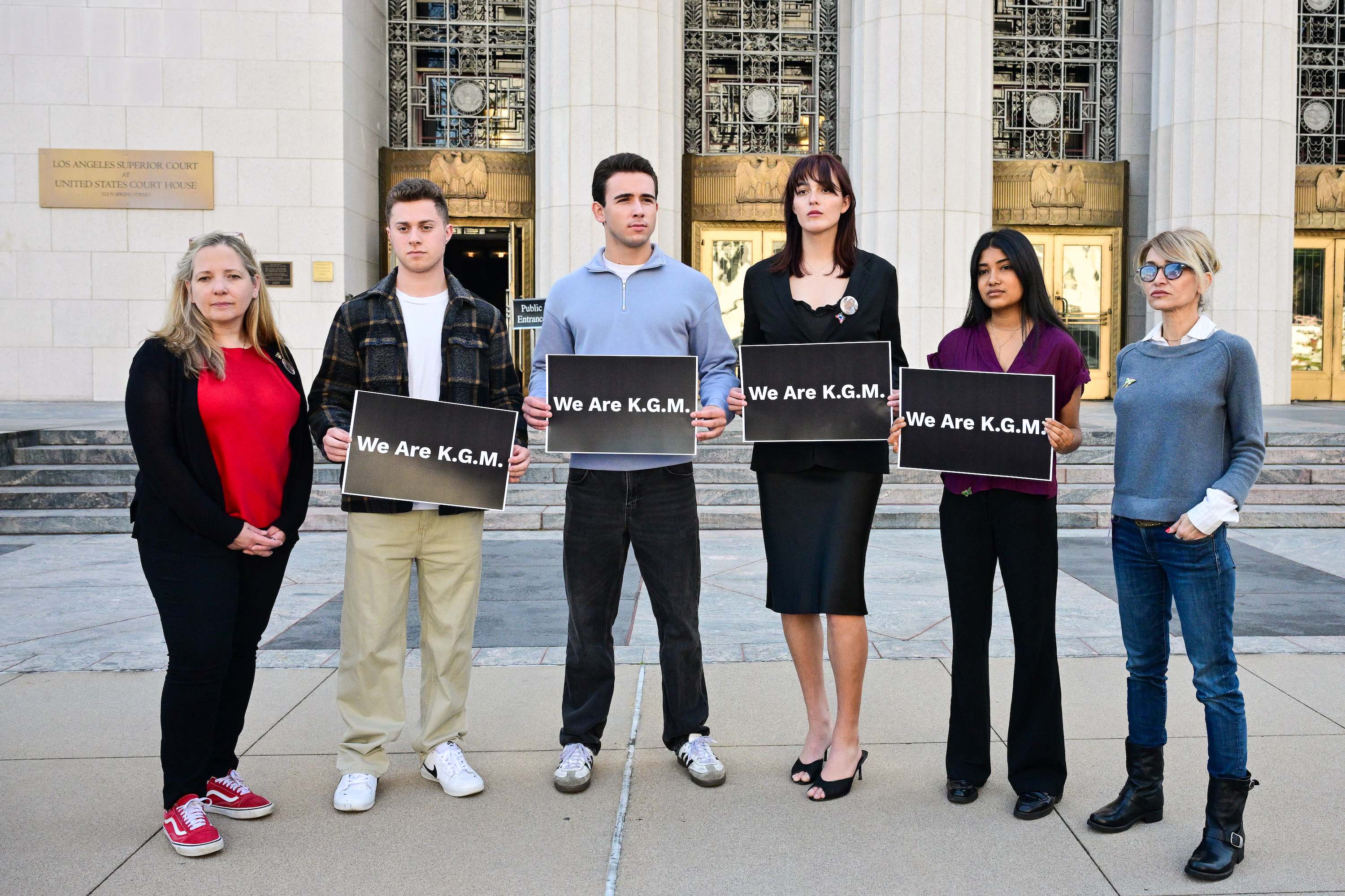

LOS ANGELES—Over the course of four days on the witness stand, Dr. Kara Bagot, a psychiatrist specializing in adolescent addiction, spoke about the addictive effects of social media while testifying in a high-stakes civil trial in the Los Angeles Superior Court.
The plaintiff in the case is “Kaley G.M.,” or “K.G.M.,” as she is identified in court documents, a 20-year-old California woman who says her social media addiction has left her with a host of psychological harms. Bagot gave her testimony from Feb. 27 to March 4.
The lawsuit accuses several social media companies of designing their platforms to be addictive to young people despite known harms. It’s expected to set the stage for a multitude of similar civil complaints.
Bagot told the jury that childhood addiction to social media can begin, like substance abuse, with an unassuming “gateway” experience.
“Addiction looks nearly the same in the brain, regardless of what you’re addicted to,” she said. “It can be a substance; it can be a behavior. The addiction literature is very, very well established. We can look at the literature at what the effects are when it starts in childhood, and it’s not good.”
K.G.M.’s case began innocently enough. At age 6, she said, she discovered videos on YouTube of people playing the child-friendly video game Animal Jam.
At 8, she opened a YouTube account and posted a video of herself playing the game. The next year, she was on Instagram. Soon she had posted more than 200 videos on YouTube and opened nearly two dozen accounts between the two apps, an attempt to fill her need for social validation. At the age of 20, she still cannot extricate herself from the addiction, she said.
Bagot testified that a growing body of evidence and institutional consensus offer support for claims that compulsive social media use is causing or contributing to a range of psychiatric disorders among adolescents.
K.G.M. is a classic example, Bagot suggested.
The case previously named the parent companies of YouTube, Instagram, Snapchat, and TikTok as defendants. Snapchat and TikTok settled privately just days before trial.
‘A Machete Clearing the Jungle’
According to Bagot, YouTube primed K.G.M. for problematic use on other platforms. She likened it to a “machete” cutting through the jungle.
“YouTube is the machete for [K.G.M.]. It cleared the path for her so other addictions could come through and be easier to take hold,” Bagot said. “Social media addiction is broader than an individual platform addiction. Your addiction can transfer from one platform to the next.”
This echoed previous testimony from Stanford psychiatrist and addiction specialist Dr. Anna Lembke, who told the court that all addictive substances and behaviors work on the same common pathway in the brain.
A “gateway” drug is typically the most accessible, and then users graduate to others or jump around. Once you’re addicted to one substance or behavior, Lembke said, you are much more vulnerable to others.
Lawyers for YouTube have argued that its platform does not really belong in the category of social media and lacks many of the allegedly addictive features shared by its codefendants, positioning itself as a benign educational tool and creative outlet for aspiring video editors such as K.G.M.
YouTube was not in the original lawsuit filed by K.G.M.’s mother when she was 17, but it was added months later.
With Bagot’s testimony, the plaintiff’s lawyers argued that YouTube was part of the foundational cause of K.G.M.’s decline and that platform features and operation, not content, are hooking kids.
Landmark Study
Bagot is an investigator in a landmark brain health and development study of nearly 12,000 young people who are the same age as K.G.M.
Starting in 2016, the Adolescent Brain Cognitive Development (ABCD) Study began scanning children’s brains to observe how various childhood experiences—sports, smoking, social media use, and others—affect brain development and related outcomes.
They now have nearly a decade of data offering insight into some of the mysteries surrounding a generation of digital natives who are suffering an unprecedented mental health crisis.
Funded with $440 million from the National Institutes of Health, the study began tracking the kids at the age of 9 or 10.
About 25 percent to 30 percent of this cohort are addicted to social media, according to Bagot.
“In the literature and in the ABCD Study, there are relationships found between social media use, problematic social media use, and most importantly, social media addiction, and the gamut of psychological illnesses,” she said.
Some experiences, including social media, can over time affect both the structure and the function—or physical anatomy and physiological processes, such as cognition—of a child’s developing brain, Bagot said.
“Our brain response can change with repeated exposure over time,” she said. “[With] child and adolescent science, there’s so much happening in that period that really continues until you’re 25. But it also makes you super vulnerable to outside exposures.”
Defense attorneys said the witness had spent only a few hours with K.G.M. and that her opinions contradicted those of other professionals who had spent hundreds of hours with her.
“You are the only doctor in her life who has reviewed her medical records and come to the conclusion she’s addicted to social media,” said Paul Schmidt, an attorney for Meta.
During two days of cross-examination, he suggested that K.G.M.’s medical records showed that her mental health issues resulted from deeply problematic family relationships, not social media use.
Competing Claims
Lembke testified earlier in the trial about how, like substance abuse, social media can rewire the brain by tapping into primitive reward systems that trap people in a vicious cycle of compulsion, regret, and withdrawal.
The surge of dopamine provided by social media platforms’ highly stimulating design features can cause the brain to overcorrect by producing fewer neurotransmitters, dampening dopamine reception and requiring more of a substance or activity to activate the brain’s reward circuit, she said. For young developing brains, the impact can be especially profound.
The question for the jury is whether the defendants have intentionally leveraged this reward system to snare young users and keep them engaged at all costs, despite knowing the risks.
Executives, including Meta CEO Mark Zuckerberg, top Instagram executive Adam Mosseri, and top YouTube engineer Cristos Goodrow, have denied that their products are designed to addict users. Mosseri said he believes that Instagram addiction does not exist.
Defense attorneys noted that social media addiction disorders are not officially recognized in the latest edition of the Diagnostic and Statistical Manual of Mental Disorders, an authoritative guide published by the American Psychiatric Association (APA).
“The APA recognizes social media addiction,” Bagot countered. “Most of these large institutions have resources available and other books as guidance.”
Whether for substances or behaviors, she said, diagnostic criteria are largely the same—excessive use resulting in personal neglect, cravings, withdrawal, tolerance, and negative psychosocial or health outcomes.
“One of the hallmarks of addiction is going back to the thing causing you to be addicted even though it’s causing harms in your life,” Bagot said, pointing to K.G.M.’s own testimony last week that she could not stop using the platforms despite bullying and other compounding harms.
“This is very classically addiction on its face,” Bagot said.
She dismissed outside stressors highlighted by the defense, such as family and peer relationships and educational struggles, as secondary to K.G.M.’s social media addiction.
“I don’t consider those contributing,“ Bagot said. ”Really, what has contributed to the social media addiction is simply social media use in and of itself. But as her social media use progressed, the stressors and social media use interacted over time to worsen the spectrum of her mental health issues.”
“It’s like a snowball rolling down a hill, and after time gets bigger and bigger and feeds off each other,” she said.
Gray Areas
Research assessing the effects of social media use on adolescents’ brains is still emerging, and results are varied.
On Feb. 11, two days after the trial began, researchers published a study based on newly released ABCD data showing that problematic social media use was prospectively associated with a range of mental and behavioral health outcomes—including higher odds of depressive, somatic, attention-deficit, oppositional-defiant, and conduct problems as well as suicidal behaviors, sleep disturbance, and substance use initiation.
A focus on “problematic” use rather than just measuring screen time addresses gaps in data highlighted by the U.S. attorney general’s 2023 warning that social media poses a “profound risk of harm” to children and adolescents, according to researchers.
At the time, the attorney general cited a lack of access to data and a lack of transparency from tech companies as barriers to comprehending the full scope and scale of social media’s effects.
On March 2, Schmidt said Bagot has never diagnosed any adolescent patients with social media addiction in her own practice.
“The term ‘addiction’ tends to be stigmatizing,” Bagot said. “I typically don’t tell kids they have an addiction because I don’t want them to feel stigmatized.”
K.G.M.’s other therapists may not have diagnosed her with social media addiction, but Bagot said her records make it clear enough.
“There are numerous references around problematic social media use and things like depression and anxiety. It’s not a black and white yes or no,” she said. “I haven’t seen those words laid out, but what is in her medical records are the criteria for social media addiction.”