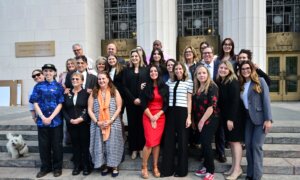

LOS ANGELES—At a private meeting with Los Angeles County officials on May 15, U.S. Health and Human Services Secretary Robert F. Kennedy Jr. praised the county’s “impressive” approach to tackling an unprecedented and deeply intertwined mental health, addiction, and homelessness crisis.
“I wanted to come here because this is the biggest system in the country, and it has the reputation of doing things really well—and I can see why. This is an extraordinary caliber,” Kennedy told a small group of public health officials and community partners at the close of an hour-long meeting at the Los Angeles County Hall of Administration.
Overdose deaths are down, primarily as a result of naloxone distribution, public health officials said, and youth education programs are improving attendance and academic achievement. County leaders have also begun paying attention to the little things, such as warm lighting and matching furniture in treatment facilities.
Dr. Gary Tsai, director of the county’s Substance Abuse Prevention and Control Bureau, described a comprehensive approach to engaging people with addiction—including the 95 percent who say they don’t need or want treatment.
“We try to look at the continuum from the perspective of a person who lives in our community and make sure that all along there are services and support for that person, as opposed to thinking of it as being little pieces,” Tsai said.
He pointed to a 200 percent increase in residential beds since 2017, a 50 percent increase in outpatient services, and a more than 800 percent increase in the department’s recovery-oriented, or sober living, housing.
“Thank you so much for figuring out how to increase all that sober housing,” Kennedy said. “That’s what we’re trying to do, too. That’s very much a priority.”
L.A. County’s dynamic approaches to prevention and treatment warrant nationalization, said Kennedy, who in February announced a $100 million investment in the Trump administration’s “Great American Recovery.”
The project is part of the administration’s seismic shift away from what it calls “misguided” Biden-era policies that enabled substance abuse, homelessness, and a deterioration of public safety, and toward programs that emphasize prevention, recovery, and self-sufficiency, including faith-based models.
This has put it at odds with California, where “housing first” and “harm reduction” policies—which prohibit conditioning housing on treatment, and de-emphasize sobriety and recovery—remain enshrined in state law.
Critics say the Trump administration’s cuts to Medicaid, which overwhelmingly funds addiction and mental health treatment, along with its new homelessness policies, will exacerbate the crisis.
L.A. County Supervisor Kathryn Barger, long an advocate of expanding behavioral health infrastructure, convened the meeting to bridge that divide and galvanize federal support.
“This meeting was a valuable opportunity to foster dialogue between Los Angeles County health leaders and our federal partners. Tackling complex challenges like serious mental illness, addiction, and homelessness requires true collaboration across all levels of government,” said Barger, the lone Republican on the county’s five-member Board of Supervisors.
Often a lone voice willing to scrap progressive orthodoxy on these issues in favor of a range of approaches, including sobriety and faith-based models, Barger said she was proud to highlight meaningful work the county has done.
The supervisor is hoping to secure federal support that will allow California to scale its response to the crisis before she is termed out in 2028, she said.
The IMD Exclusion
Like the rest of the country, California is facing a growing deficit of psychiatric beds and skilled workers. In 2021, a Rand Corporation study estimated the shortage of adult beds in the state was nearly 8,000. In Los Angeles County in particular, the problem is exacerbated by a tangled nexus of mental illness, substance abuse, and street homelessness.
The same integrated approach that so impressed Kennedy is hamstrung, leaders said, by a federal policy that grew out of psychiatric deindustrialization in the mid-20th century.
The “Institutions for Mental Diseases (IMD)” exclusion, an original Medicaid policy enacted in 1965, excluded coverage in mental health or addiction facilities that have more than 16 beds. The idea was to prevent a return to warehousing people in state institutions, and instead engage community care centers.
“The IMD exclusion is highly subjective and unfortunately highly impactful, and has suppressed the growth of the county’s inpatient and residential treatment capacity, especially for that subacute level of care, which is our highest level of need,” LA County Department of Mental Health Director Lisa Wong, who joined the meeting remotely, told Kennedy.
While substance abuse and medical systems are now exempted from the IMD exclusion, any facility that also has mental health patients will be excluded from a federal funding match, meaning local agencies often have to find creative ways to provide care for people with co-occurring needs.
Wong said her department’s programs have significantly reduced reliance on law enforcement for crisis outreach, but face a dead end.
“When we respond to these calls ... the level of care we need is an IMD bed. And with the shortage of beds ... we don’t have anywhere to put a client,” she said.
The IMD exclusion applies to not only locked facilities, but also short-term and permanent residential programs and skilled nursing facilities.
“We want them to provide mental health services on-site because that’s best practice. But when there are more than 16 beds, they’re not able to claim for any of those mental health services,” Wong said.
The director highlighted several case studies: One client was getting annual services at a cost of $1.6 million—including fire department, law enforcement, hospitals, inpatient care, “lots of emergency room visits,” and crisis calls.
After intervention that connected him with community treatment and housing, the cost of his care dropped to $57,553.
“And you can tell the difference, too, just the human cost of this,” she said, showing dramatic before-and-after photos.
“Our beds are now costing typically over a million a bed to build out for IMD.” Wong said, pointing to a new facility where the county had to find five separate providers, five separate elevator banks—“everything built out separately to accommodate the exclusion.”
Others, including Tsai and Dr. Christina Ghaly, director of the county’s Department of Health Services, described how Medicaid funding, and flexibility created by waivers, have allowed departments to better work together, expand coverage, reduce costs, and fund overall growth.
Kennedy, who supports repealing the IMD exclusion, said, “If you look at the overall societal cost, it’s a clear choice.”
But, he added, Congress will be looking at the issue as a series of budget items, and specifically for cost neutrality.
“This is something that’s debated every year in Congress, and we have supporters there, and we have opponents who are very focused on cost,” he said. “You have to get the right congressional leadership on board with this, and if you get that, we’re going to support them.”
Currently, legislation to repeal the IMD exclusion is sponsored by Rep. Salud Carbajal (D-Calif.) in the House, and has support from Sen. Alex Padilla (D-Calif.) in the Senate. Neither responded to inquiries in time for publication.
In addition to a reluctance to return to broad institutionalization, Kennedy pointed to widespread concerns that repealing the exclusion would allow venture capital to swoop in and “create these profit centers all over the place, and that’s going to chase them away.”
Conservatorship
Barger shared a story of a homeless woman in her neighborhood, who used meth and suffered from paranoid schizophrenia, and had been detained on psychiatric holds and released six times in one month.
“We’re talking about individuals who’ve been on the street languishing for years with severe mental health issues, substance abuse issues,” Barger said. “If we can stabilize them and then use the 1115 waiver to build what I call ‘board and care’ facilities—because they’re going to need supportive services probably for the rest of their lives, quite frankly, especially those that are using meth.”
The supervisor advocated for a more compassionate approach to getting people off the street, but historically has not shied away from the idea that severely impacted individuals may need a conservator.
“I’ve heard people say, ‘We don’t want to go back to locking up people and forgetting about them,’” Barger said. “[But] we can put up guardrails to make sure that doesn’t happen.”
In California, where psychiatric commitments are limited to 15 days, alarming increases in drug deaths, homelessness, and mental illness rates fueled reforms of conservatorship laws, which allow involuntary institutionalization, to extend to those with severe substance abuse disorder. However, nearly all counties chose to delay implementation, and local mental health departments pushed back.
Civil and disability rights groups robustly challenge such reforms, citing concerns over disproportionate impacts for marginalized groups, the ineffectiveness of forced treatment, and the primacy of voluntary, community-based treatment.
The result is often defanged laws, as in California’s CARE Court program, which introduced court-mandated treatment that is in fact entirely voluntary.
Shifting Away From Housing First
While L.A. County leaders cited impressive growth in recovery housing, such remains a tiny fraction of overall housing for people at the intersection of homelessness, addiction and/or mental illness. Treatment in the Department of Public Health’s recovery housing is encouraged, but not a condition of residence.
The county has more than 72,000 homeless people, according to the latest Point in Time count. California has more than 187,000, and accounts for nearly half of all the nation’s unsheltered homelessness.
National studies, systemic reviews, and analyses of existing epidemiological research have found that 67 percent to 75 percent of chronically and unsheltered or “street-level” homeless people report high concentrations of mental illness and drug addiction.
According to annual reporting from the federal Department of Housing and Urban Development, the vast majority of homeless people who self-report severe mental illness and chronic substance abuse—more than 90 percent, in each case—are either unsheltered or in emergency shelters, as opposed to in transitional housing.
Nationally, homeless services infrastructure in recent decades moved away from transitional housing—which historically focused on treatment—toward emergency shelters and permanent supportive housing.
Under federal Housing First and Harm Reduction policies, billions in annual funding were almost exclusively invested in permanent housing programs that don’t require mental health or addiction treatment.
That may be shifting, as the Trump administration reverses course and courts faith-based and treatment-focused providers.
Bruce Boardman, CEO of the nonprofit Social Model Recovery Systems, reiterated the need for more housing, but said his organization focuses on getting people into treatment before they are housed.
“It’s really difficult to get somebody who needs treatment into treatment post-housing,” he said, noting the goal is to work with the most disenfranchised in the community and help them become tax-paying citizens.
“This is the hardest job in the world, working with people who are now so far separated from community or society and utterly isolated, utterly hopeless, and have not been able to find any way out of that darkness,” Kennedy said.
“It takes tremendous patience, understanding, and flexibility to be able to go into those communities and pull those people out. And I can see why it’s working, and we have a lot to learn from you today.”