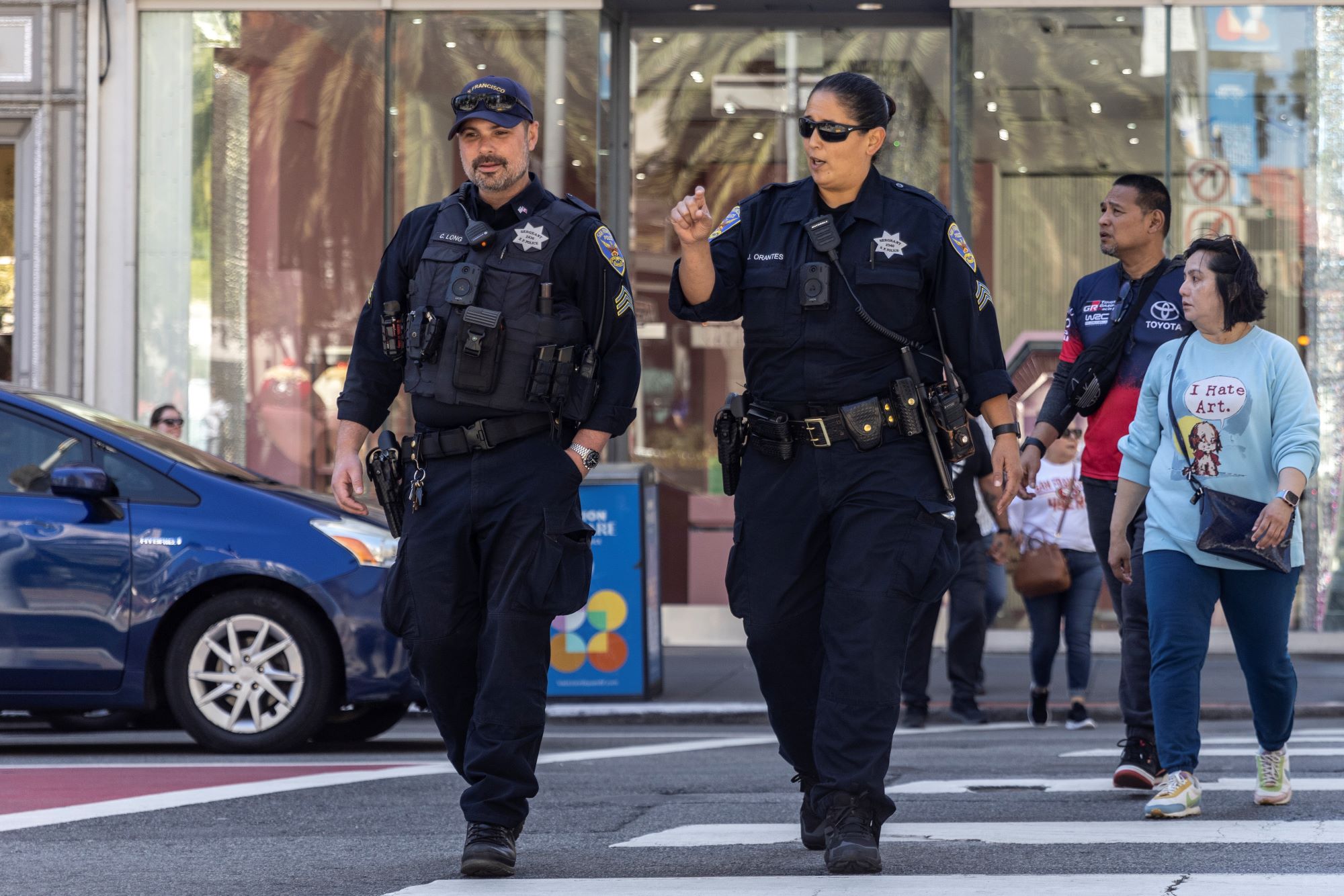

San Francisco Mayor Daniel Lurie recently released a plan to fully staff the city’s police department. Two police officers both expressed support for his plan and shared concerns about some of the details.
The May 13 directive involves several 100-day, short-term actions to address issues such as over-reliance on overtime and a slow hiring process, as the department faces “historically low” staffing levels.
The San Francisco Police Department (SFPD) currently has over 500 fewer officers than the minimum recommended number, and the Sheriff’s Office is short 200 deputies, according to the directive.
Tracy McCray, president of the San Francisco Police Officers Association (SFPOA), told The Epoch Times that the George Floyd incident in 2020 and the riots that followed have caused younger people to look at the profession in a negative light.
Amid the staffing shortage, the department spent $108 million in overtime expenditures in the 2022–2023 fiscal year, according to a performance audit.
McCray said the Richmond station, for example, only has four day-shift officers when minimum staffing is six, forcing them to use overtime to have officers on call.
“That’s kind of happened on every shift, where it’s not fully staffed to the minimum,” she said.
The mayor’s directive calls for a program that would allow recently retired officers and deputies to return to service in certain roles. It also includes a plan to partner with the private sector to support outreach efforts.
McCray said she’s not confident of how many retired officers would want to come back. She recalls a similar program from before in which returning officers would be frozen at their rank, unable to receive promotions while also working with fewer protections than they had while active.
She thinks the focus should be on aggressive recruitment. However, she also expressed concern about potential pitfalls that it could involve.
She mentioned a recent incident in which an SFPD officer was arrested on May 17 and charged with driving under the influence following his involvement in a car crash, less than a week after graduating from the police academy. McCray wondered if the department might have missed a red flag in order to rush the recruit through and “get as many bodies in” as they could.
“It’s speeding up the process, but at what cost?” she said.
A press release from the mayor’s office announcing the plan reported that overall crime is down 28 percent year over year, and the city is seeing a 22-year low in car break-ins and the lowest number of street encampments since 2019.
Despite this progress, McCray said she is still concerned about the open-air drug market and organized retail theft, adding that the SFPD needs to stay on top of crime and can’t afford to back down.
McCray and SFPD Sergeant Rich Cibotti said the improvements under Lurie were largely due to recent advancements in drone and camera technology, something the city plans to expand on.
Cibotti told The Epoch Times in an emailed statement that excessive overtime has led to burnout and injuries. He clarified that he was providing his personal opinions, not speaking on behalf of the entire department.
Like McCray, Cibotti supports the mayor’s initiatives to shorten the SFPD’s hiring process and improve graduation rates in the police academy, but he expressed concern that this could lead to the hiring of underqualified individuals.
He advised against lowering standards just to raise graduation rates.
“Adding members that fail to meet basic standards could lead to disaster in the future,” he stated.
Regarding Lurie’s approach, Cibotti said that “the change is evident, and the cops of the SFPD are working hard, in spite of short staffing, to return San Francisco to the world class City it is.”