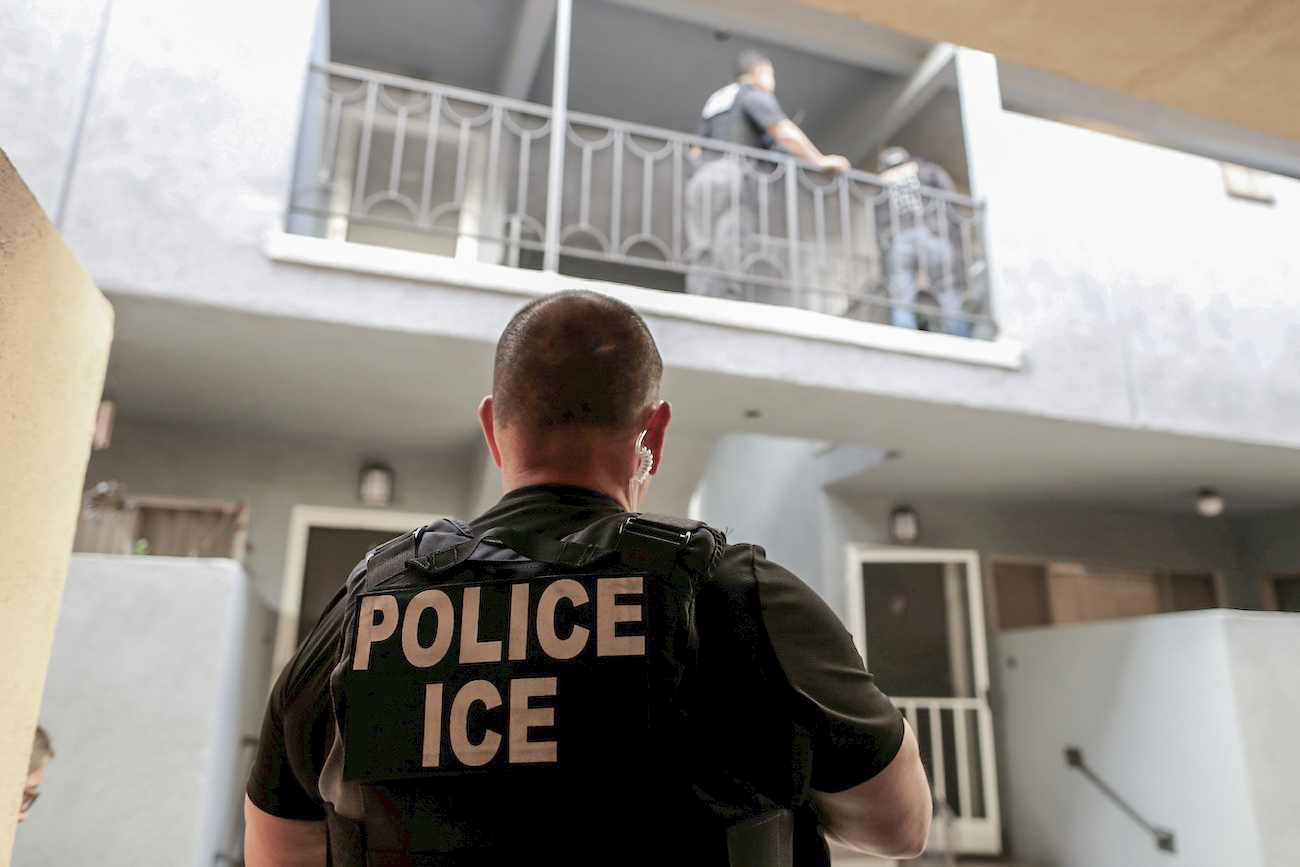

California lawmakers are renewing efforts to ban face coverings for law enforcement officers, including federal agents, operating in the state. Lawmakers say the new bill is in response to the federal court striking down the previous attempt after ruling that the law was applied unevenly.
Senate Bill 1004 seeks to delay the mask ban to Jan. 1, 2027, and to add state law enforcement to the list of agencies prohibited from wearing masks under the No Secret Police Act.
The No Secret Police Act, also known as Senate Bill 627, was a piece of legislation that lawmakers passed and Gov. Gavin Newsom signed in September 2025. The law prohibits local and federal law enforcement from using masks to conceal their faces when carrying out their duties in California. It did not include California state law enforcement officers.
SB 627 provided exemptions to the mask ban, including clear coverings, masks for “active undercover operations,” tactical gear, motorcycle helmets, and face coverings meant for health and safety. SB 1004 would expand the list of exemptions to include sunglasses and face coverings used during training activities.
However, the U.S. Department of Justice sued California to block SB 627 and another law, Senate Bill 805, which requires federal officers to wear identification while on duty. The lawsuit alleged that California’s new laws conflict with federal law and thus violate the supremacy clause of the U.S. Constitution.
It also argued that the No Secret Police Act violates the intergovernmental immunity doctrine, which prevents state and federal governments from interfering with each other. A third argument was that banning masks and requiring federal agents to display identification would put them at a greater safety risk amid increasing violence against federal immigration officers.
Both SB 627 and SB 805 have since been blocked from implementation following court rulings that found the two state-level laws conflict with federal law.
In a Feb. 9 ruling on SB 627, Judge Christina Snyder of the U.S. District Court for the Central District of California found that the No Secret Police Act did not apply equally to all law enforcement officers and “unlawfully discriminates against federal officers.”
However, Snyder stated that the Department of Justice failed to prove that the face covering ban “directly regulates” the federal government in a way that would interfere with its functioning.
In response to the court ruling, lawmakers introduced SB 1004 as a follow-up bill to the No Secret Police Act, broadening its application to cover all law enforcement officers at all levels.
State Sen. Jesse Arreguín, when presenting the bill on behalf of its author, state Sen. Scott Wiener, said during an April 14 Senate Public Safety Committee meeting, “Immediately after this ruling, Senator Wiener introduced this bill to amend state law, which fills this gap and allows SB 627’s prohibition on face masks to be enforced on all law enforcement in the state of California, including state and local law enforcement officers as well as ICE or Border Patrol and other federal officers.”
Arreguín pointed to the court ruling, saying that “there is no cognizable justification for law enforcement to conceal their identities during the performance of routine, non-exempted law enforcement functions.”
However, SB 1004 faced criticism from the state’s law enforcement association.
The bill needs a better balance between accountability and fairness by taking into account the “practical realities of policing,” Shane LaVigne, legislative advocate for the California Statewide Law Enforcement Association, said at the committee hearing.
“There’s a real sentiment right now across the state that law enforcement officers are increasingly being placed in the bull’s-eye of a broader political debate,” LaVigne said. “At the same time, we’re facing a significant staffing crisis.”
He said law enforcement agencies across the state are facing low applicant numbers, high numbers of retirements, and decreasing morale due to public perception of the profession.
“It’s policies like this that contribute to that decline. Our officers are paying attention,” LaVigne said. “When they see legislation that expands liability, removes protections, and fails to account for good faith decision making, it reinforces the perception this is not a profession that people want to get into or stay in.”
He pointed specifically to subsection g of the bill, which states that any officer who commits “assault, battery, false imprisonment, false arrest, abuse of process, or malicious prosecution, while wearing a facial covering” would be denied immunity in court and would be liable for actual damages or a minimum of $10,000 in statutory damages, whichever monetary amount is greater.
“SB 1004 creates real uncertainty around how liability will be applied to officers in the field,” LaVigne said.
The bill is supported by immigration justice group IC4IJ, civil rights organization MALDEF, Prosecutors Alliance Action, and SEIU California, according to the bill analysis.
It is opposed by the Association for Los Angeles Deputy Sheriffs and several other law enforcement associations.
The bill passed the Senate Public Safety Committee on April 14 in a 5–1 vote. It now heads to the Senate Appropriations Committee for an April 27 hearing to review its fiscal impact.