
The Trump administration asked a federal appeals court on July 14 to allow immigration operations to resume without restrictions in Southern California after a federal judge ordered a stop to the government’s activities.
U.S. District Judge Maame Ewusi-Mensah Frimpong issued a temporary restraining order on July 11, stopping the administration from carrying out immigration enforcement actions in the seven-county Central District of California, which includes Los Angeles.
The ruling, based on the Fourth Amendment, ordered the Department of Homeland Security (DHS) to stop detaining people based on their race, spoken language, accent, job, or presence at certain locations such as bus stops.
In a July 16 statement, the White House said the judge lacks the authority to decide immigration policy.
“No federal judge has the authority to dictate immigration policy—that authority rests with Congress and the president,” White House spokeswoman Abigail Jackson said in an emailed response to The Epoch Times.
“Enforcement operations require careful planning and execution, skills far beyond the purview or jurisdiction of any judge. We expect this gross overstep of judicial authority to be corrected on appeal.”
In the department’s argument to the Ninth Circuit Court of Appeals in San Francisco, the lawyers said Frimpong imposed a “sweeping, district-wide injunction” that placed restraints on lawful immigration enforcement that affect every immigration stop and detention.
The judge gave the federal government only two business days to respond to hundreds of pages of submissions by the plaintiffs, and issued an injunction only days later, according to the emergency appeal request.
Justice Department lawyers also said the original court action was filed by three individuals seeking release from immigration detention. However, the action was amended to add a host of additional individuals and immigrant organizations in an apparent attempt to obtain a preferred judge and a broader ruling.
“The result is a sweeping, district-wide injunction that threatens to hobble lawful immigration enforcement by hanging a Damocles sword of contempt over every immigration stop,” the government argued in its appeal.
The government also argued that Frimpong ignored the Supreme Court’s recent June 27 decision rejecting universal injunctions.
Government lawyers are seeking an immediate stay of the restraining order pending appeal.

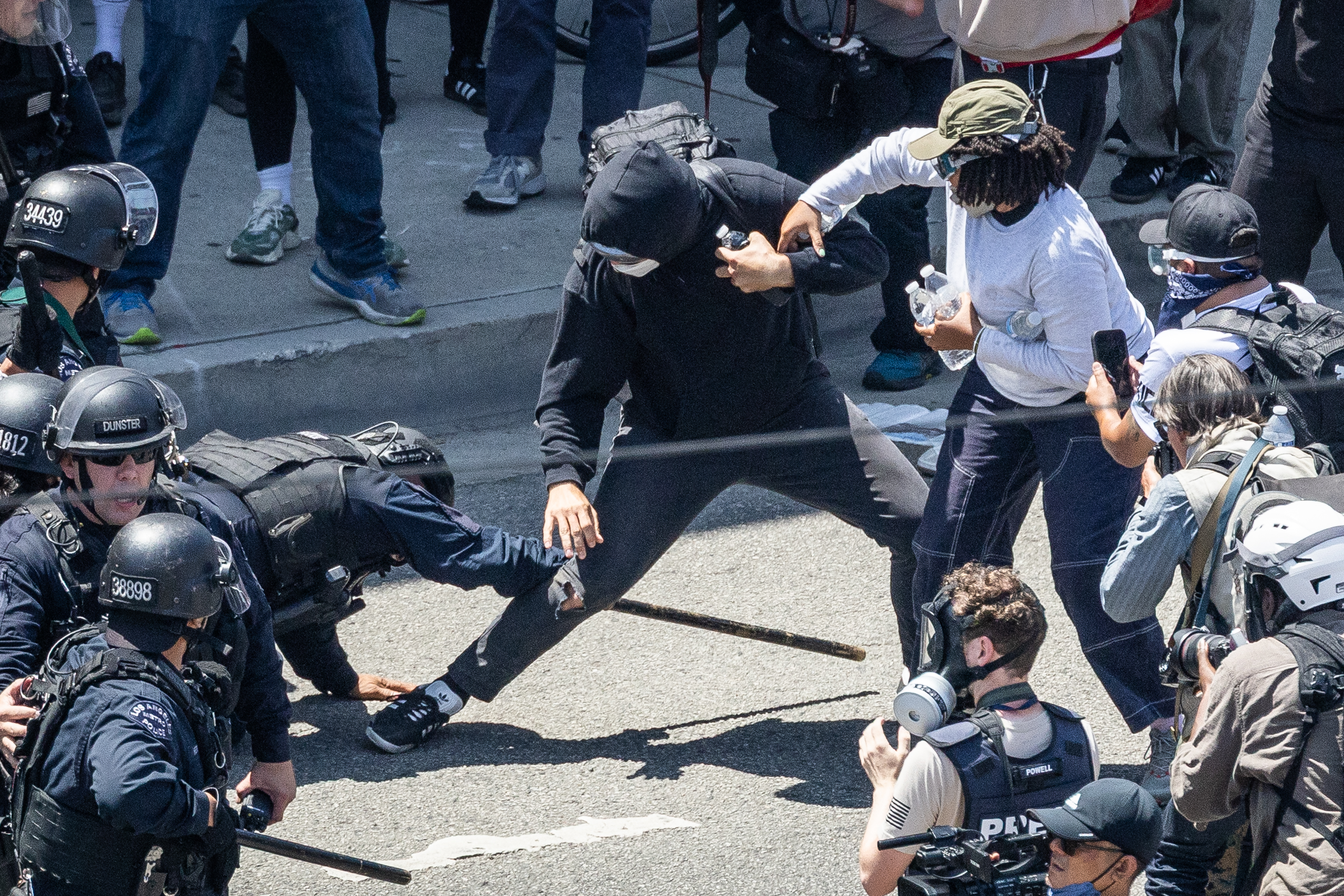
Protesters rally against Immigration and Customs Enforcement operations in Los Angeles on June 10, 2025. (Damian Dovarganes/AP Photo)
The groups suing the Trump administration include five individuals and three illegal immigrant advocacy groups—the Los Angeles Worker Center Network, United Farm Workers, the Coalition for Humane Immigrant Rights, and Immigrant Defenders Law Center.
The plaintiffs alleged that the DHS has unconstitutionally arrested and detained people in order to meet “arbitrary arrest quotas set by the Trump administration,” the ACLU Foundation of Southern California, which is representing the plaintiffs, said in a statement.
“No matter their status or the color of their skin, everyone is guaranteed Constitutional rights to protect them from illegal stops,” Mohammad Tajsar, senior staff attorney with the foundation, said in the statement.
DHS has denied accusations of racial profiling, calling it a “disgusting” smear tactic against law enforcement officers. Homeland Security Assistant Secretary Tricia McLaughlin said on July 3 that “enforcement operations are highly targeted, and officers do their due diligence” before making arrests.
In her July 11 ruling, Frimpong stated that the administration provided no basis for any of its immigration stops and arrests.
The judge also said the plaintiffs were likely to succeed in their lawsuit.
“The factors that defendants appear to rely on for reasonable suspicion seem no more indicative of illegal presence in the country than of legal presence—such as working at low-wage occupations such as car wash attendants and day laborers,” Frimpong stated. “This is insufficient and impermissible, and is the proper subject of an injunction.”
In her ruling, the judge has allowed the organizations a month to prepare a class-action lawsuit.
Aldgra Fredly contributed to this report.