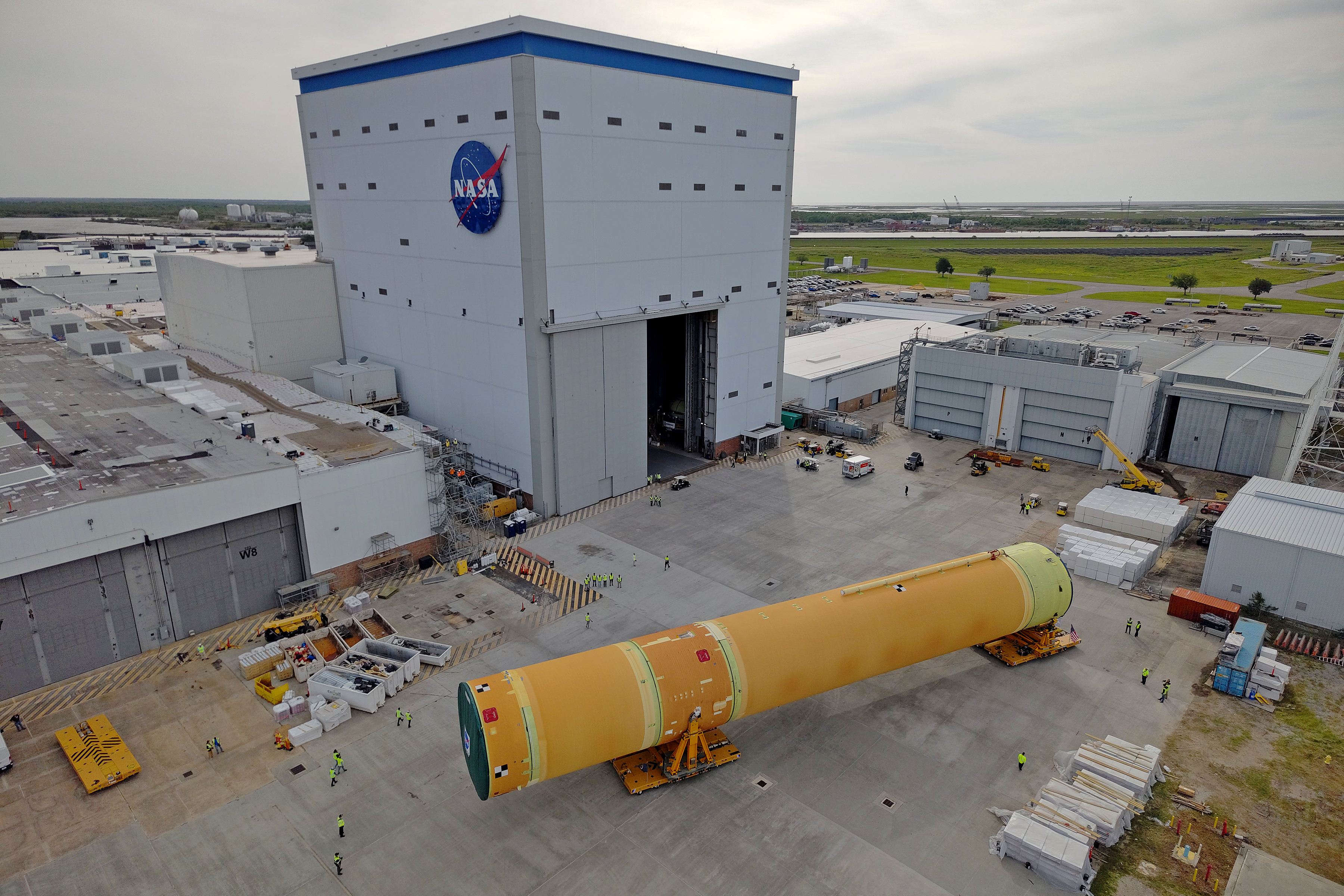

A key component of the rocket destined to carry NASA’s upcoming Artemis III mission into space began its journey to Kennedy Space Center on April 20.
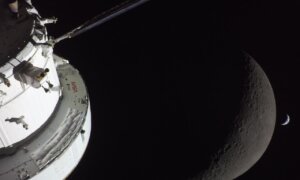
This comes just 10 days after Artemis II made its historic test flight around the moon and back.
NASA astronauts and officials watched as the 212-foot-long orange cylinder, known as the core stage, crawled out of the Michoud Assembly Facility in New Orleans to be loaded on a barge bound for Florida.
Built in a collaboration between Boeing and L3Harris Technologies, it is the largest single section of what will be NASA’s third-ever Space Launch System moon rocket to fly. It represents 80 percent of the vehicle’s entire main stage, hosting liquid hydrogen and liquid oxygen tanks set to unleash more than 2 million pounds of thrust.
Members of the workforce who built the massive component were also on-site to bid it farewell.
Artemis III is not scheduled to fly until mid-2027, nor is it meant to fly to the moon like Artemis II. The core stage’s transfer is seen as a sign of the space agency’s continuing momentum toward the ultimate goal of returning astronauts to the lunar surface before the end of 2028.
“This is the backbone of Artemis III,” said Lori Glaze, acting associate administrator of NASA’s Exploration Systems Development Mission Directorate.
“We are one step closer to testing the critical capabilities needed to land Americans on the Moon, and ultimately, paving the way for our first crewed missions to Mars,” she said.
Once this rocket does its job, the Artemis III crew—still unknown as of April 20—will demonstrate rendezvous and docking with one or both of the lunar landers currently in development at SpaceX and Blue Origin. They will test out those vehicles and the spacesuits destined to be used for future moonwalks.
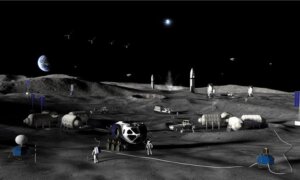
If Artemis III is successful, then Artemis IV will launch in early 2028, take one of those commercial landing spacecraft into lunar space, and attempt to land astronauts on the surface for the first time since 1972.
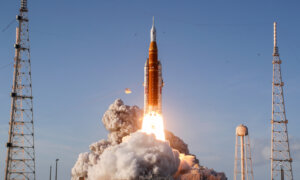
NASA emphasized that its space launch system rocket is the only rocket capable of sending the Orion spacecraft and its astronauts to the moon in a single launch.
The core stage’s final destination is the Vehicle Assembly Building, where NASA teams will put the entire rocket together piece by piece on a mobile launch platform. The engine section is already in Florida, waiting to be connected to the bottom of the core stage. But the four main RS-25 engines are still at NASA’s Stennis Space Center in Bay St. Louis, Mississippi, and are scheduled to be shipped no later than July 2026.
Before NASA approves either lander to carry a human crew on Artemis III, an unmanned test flight must be completed. Blue Origin’s unmanned Mark-1 lunar landing spacecraft recently completed testing at Johnson Space Center in Houston and returned to Kennedy Space Center on April 18.
It’s named Endurance, after the legendary, albeit ill-fated, ship that carried the famous British explorer Ernest Shackleton on his Antarctic expedition. The lander’s target, Shackleton Crater, carries the explorer’s namesake.
Blue Origin still needs to test the Mark-1’s communication system and launch vehicle separation system. The lander must also undergo a wet dress rehearsal, fully loading its tanks with cryogenic propulsion. After that, it will be packaged for launch atop a New Glenn heavy-lift rocket.
Blue Origin has not released a specific launch date for the Mark-1 lander, but it is expected to fly in 2026.