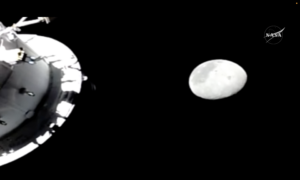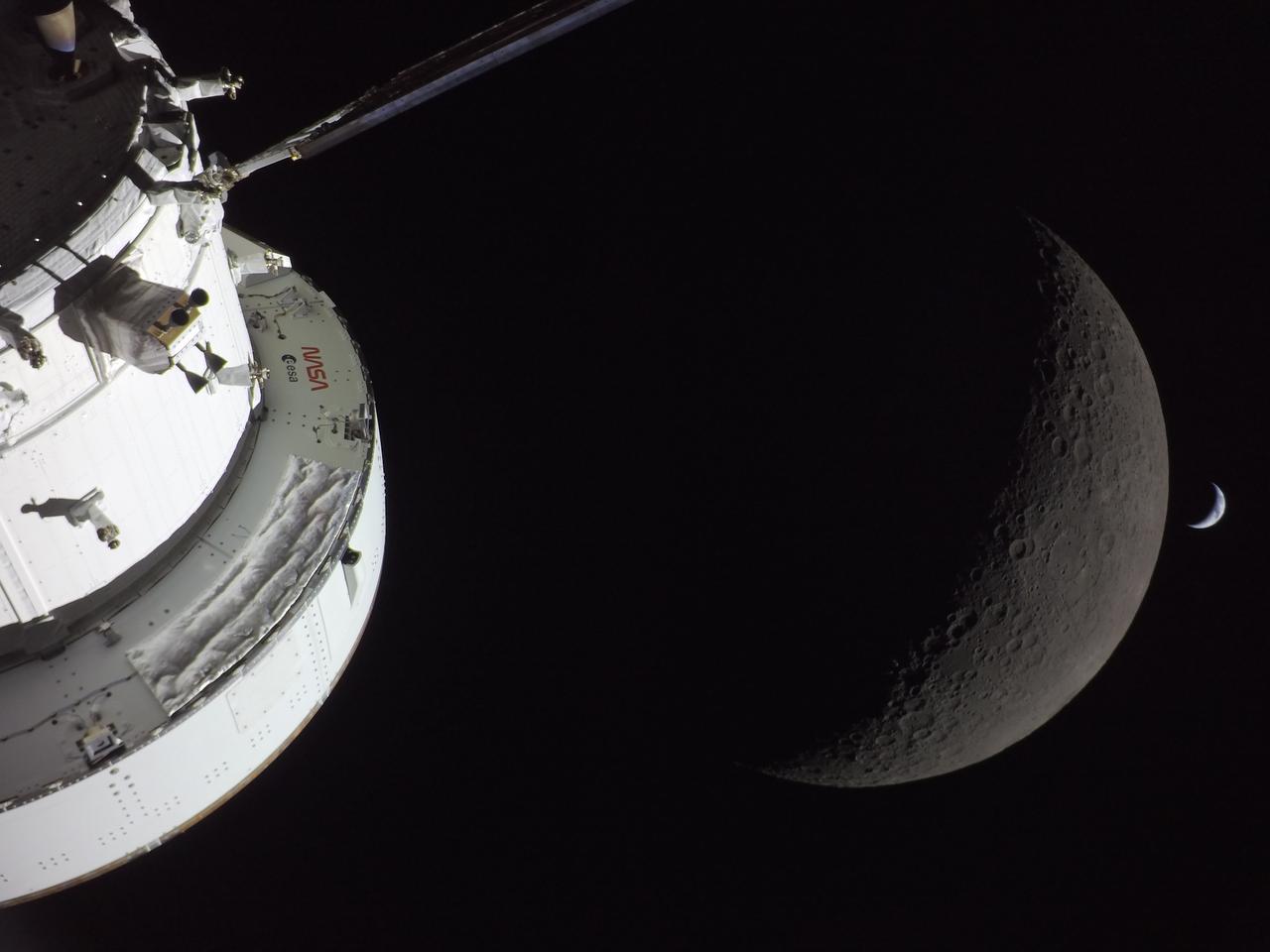

Two weeks after Artemis II completed its historic flyby around the moon, the personal and scientific insights from that historic day continue to be revealed.
Over the course of seven hours, NASA’s Reid Wiseman, Victor Glover, and Christina Koch and Jeremy Hansen of the Canadian Space Agency made detailed observations of the moon’s surface, yet the live stream, reflections, and published images account for only a fraction of the overall information that was collected and has yet to be released.
Approximately 175 gigabytes of images, audio recordings, and other data were brought back to Earth by April 10, via either the Orion spacecraft’s laser communication array or its physical splashdown and recovery in the Pacific Ocean.
NASA lunar scientists have challenged themselves to release all of the data and at least two reports within the next six months.
Here’s a glimpse of the discoveries so far.
First Look
Although the moon’s entire surface has been mapped using telescopes and unmanned spacecraft such as the Lunar Reconnaissance Orbiter, a significant portion of the far side of the moon had remained unseen by the unassisted human eye.
Artemis II’s flight path allowed four pairs of human eyes to see more of the moon than ever before. As the Orion spacecraft made its approach, Wiseman, Glover, Koch, and Hansen had a clear view of a heretofore unseen corner of the far side. That included an impact zone called the Orientale basin, which no human crew had previously been able to observe in its entirety.
“The cool thing was that because of the orientation of the spacecraft, just generally, they could already see the moon before they were scheduled to see the moon,” Jacob Richardson, Artemis II’s deputy lunar science lead, told The Epoch Times on April 8.
Juliane Gross, the Artemis sample curation lead, told The Epoch Times that hearing the crew’s early, excitement-fueled observations ahead of the flyby filled her with even more excitement and confidence in the data that would be relayed back by those four astronauts, who are considered proper members of the science team.
All lights inside the spacecraft that could be turned off were turned off, and shrouds were put around the windows to ensure the best possible visuals of the lunar surface. The crew worked in shifts of two, strapping themselves by the windows and alternating between using a camera and making observations with the naked eye. Meanwhile, the other two logged and radioed in their observations to Mission Control while providing assistance to their fellow crew members.
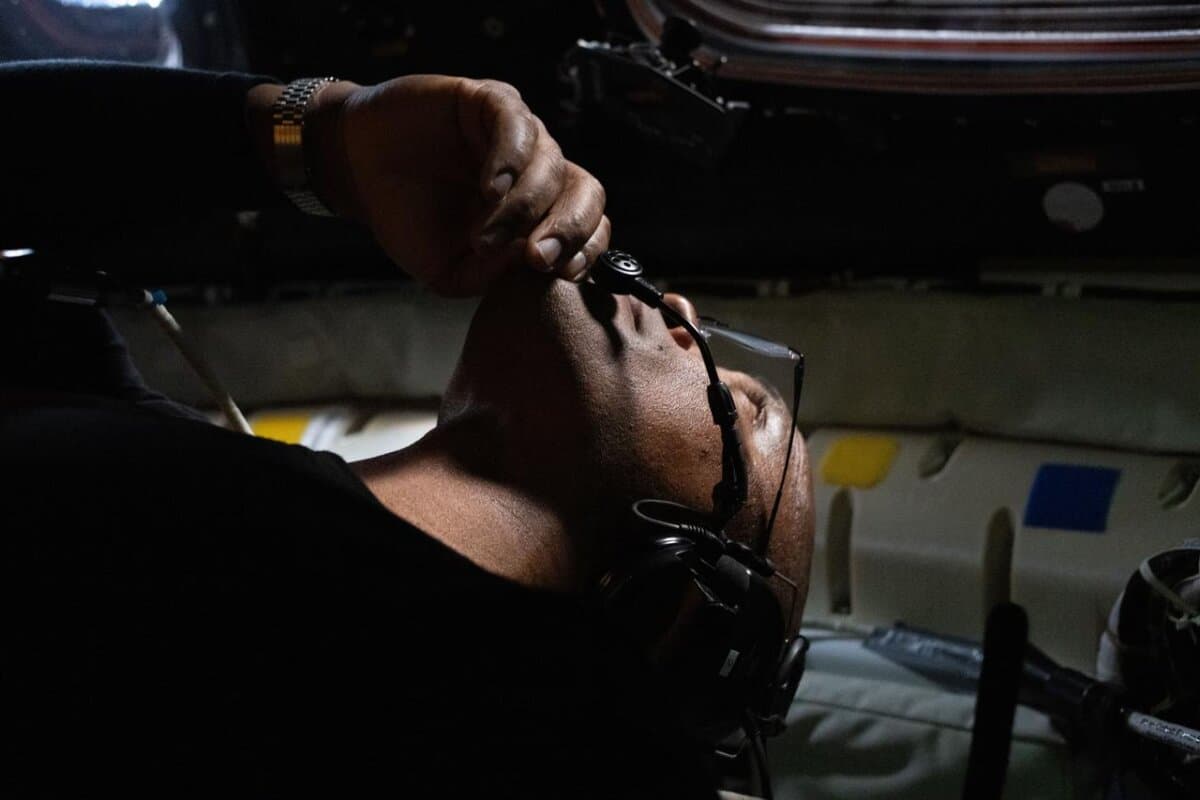
NASA astronaut and Artemis II pilot Victor Glover looks out the window of the Orion spacecraft during the lunar flyby on April 6, 2026. (Courtesy of NASA).
Because of Artemis II’s launch date, only about 20 percent of the far side was visible during the mission. But the timing allowed the crew to be the first humans to witness a total solar eclipse from lunar space. Along with the continued observations of the lunar surface, they were able to observe the sun’s corona and identify other celestial bodies amid the darkness.
At the sighting of the planet Mars, Mission Control remarked to the crew that they were looking at “our future.”
Multiple impact flashes of micrometeoroids hitting the lunar surface were also spotted by the crew, drawing an excited response from the science team.
But lunar scientists also emphasized that the flyby was about more than just first looks. From their unique vantage point at several thousand miles above the lunar surface, the astronauts were able to provide a new perspective on sights previously seen.
Wiseman, Glover, Koch, and Hansen reported seeing a vast array of colors, including browns and greens, as well as stark contrasts in elevation and surface textures that imagery used during their training had failed to fully capture.
“The human brain is so good at looking at a surface and immediately picking out ... those changes in the blink of an eye,” Gross said. “Orbiters and spacecraft, they'll take months and years to get their data.”
After the flyby, Richardson recounted that Glover was especially descriptive when it came to dramatic topography visible thanks to the shadows created on the Terminator line—the line that marks the border of daytime and nighttime on the surface.
Earthset and Earthshine
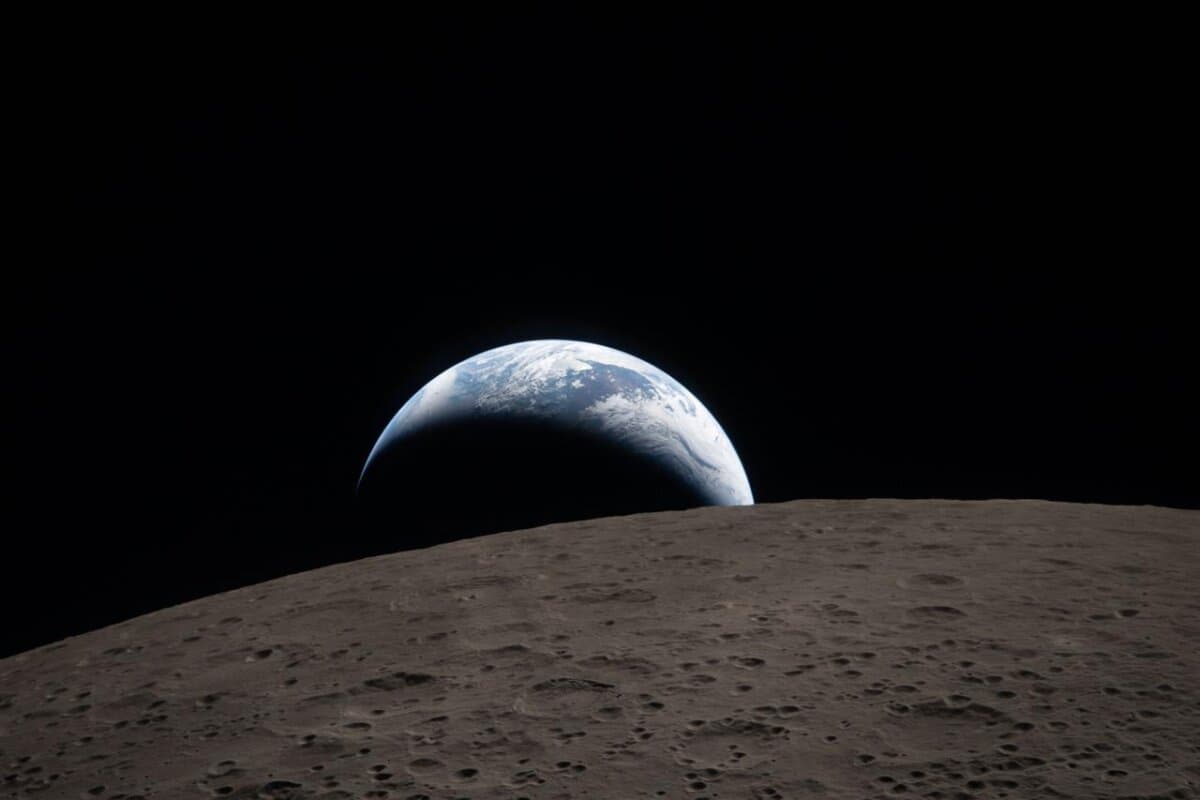
Earthset captured through the Orion spacecraft window at 6:41 p.m. ET on April 6, 2026, during the Artemis II crew’s flyby of the Moon. (Courtesy of NASA)
NASA’s Apollo 8 mission in 1968 gave the world the now-famous “Earthrise” image. Nearly 58 years later, as NASA’s Artemis II mission passed behind the moon, it gave the world a new image: “Earthset.”
The sight of a crescent Earth hanging just above the lunar horizon was beamed back home using a new laser communication array and quickly published by NASA.
On April 20, Wiseman shared an unedited video he filmed on his iPhone while his crewmates were taking “professional” images with their Nikon cameras, once again capturing the internet’s attention.
“Like watching sunset at the beach from the most foreign seat in the cosmos, I couldn’t resist a cell phone video of Earthset,” Wiseman said on X.
“I could barely see the Moon through the docking hatch window, but the iPhone was the perfect size to catch the view. This is uncropped, uncut with 8x zoom, which is quite comparable to the view of the human eye.”
But there were more Earth-based discoveries to be made that day. As the moon completely eclipsed the sun, the total darkness that was expected was interrupted by what the astronauts described as “Earthshine.” Enough sunlight was reflecting off the Earth to illuminate the moon’s surface, and Glover radioed Houston that he was able to see features of the lunar surface very well thanks to that Earthshine.
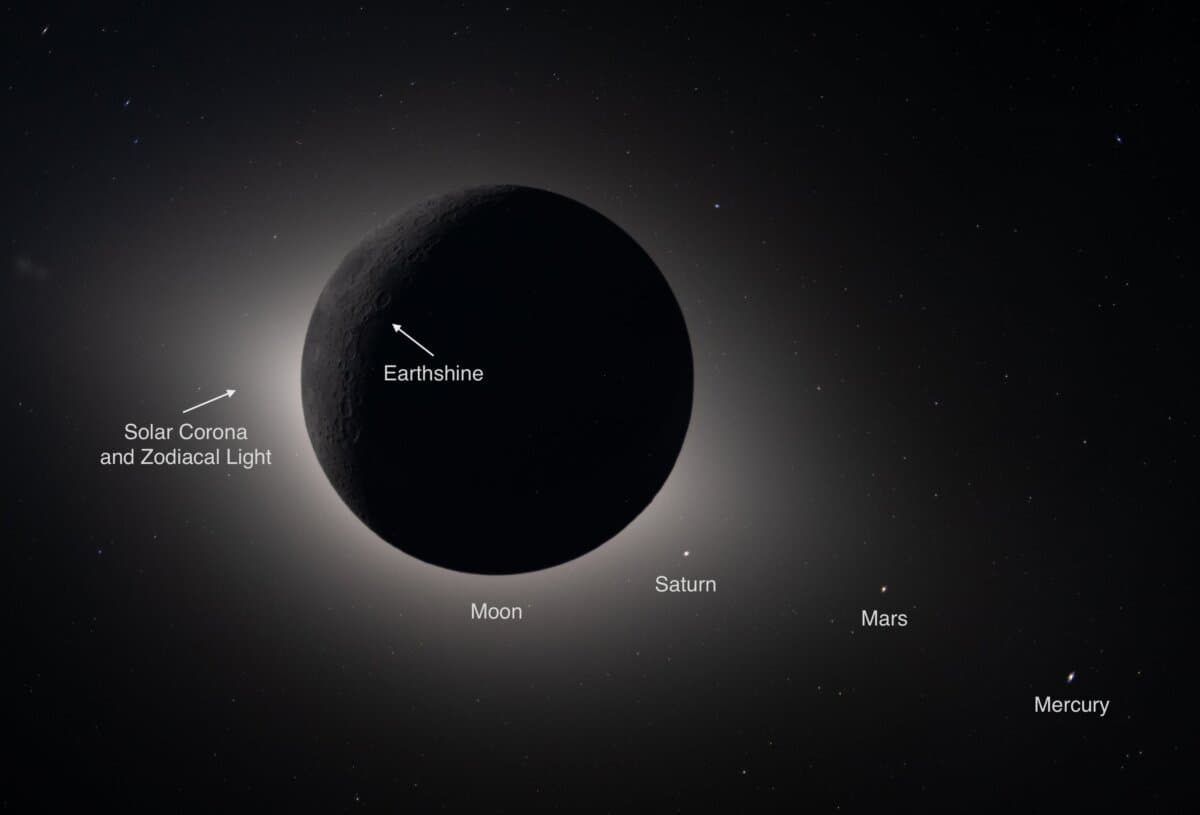
NASA identifies the Earthshine and other celestial features in this image of the solar eclipse taken by the Artemis II crew on April 6, 2026. (Courtesy of NASA).
Scientific Insights to Come
Artemis II’s flyby began and ended with a conference between the astronauts and NASA’s lunar science team. Wiseman, Glover, Koch, and Hansen trained for years in lunar geology and photography so they'd be able to capture the best observational data possible for the scientific community back home.
This mission was also the first time the lunar science team had representation among the flight controllers in Mission Control, and NASA lunar science lead Kelsey Young spoke directly to the crew as they shared observations in real-time. Normally, only the person designated the capsule communicator—CapCom for short—talks to the astronauts mid-flight.
Meanwhile, Richardson and other lunar scientists monitored the flyby from the Science Evaluation Room. They compared real-time video imagery from one of the spacecraft’s exterior cameras with the visuals gathered from the Lunar Reconnaissance Orbiter, and they followed along with the audio updates, ready to help Young answer any questions the crew might have or remind the crew of any objectives.
They were also in a position to adjust their plans based on what the astronauts were observing, and Richardson noted that significant attention was drawn to the terminator line.
But the overriding emotion filling the Science Evaluation Room during that flyby was one of joyous celebration.
“We had no idea that they had been trained so well,” Richardson said. “They soaked it all up.”
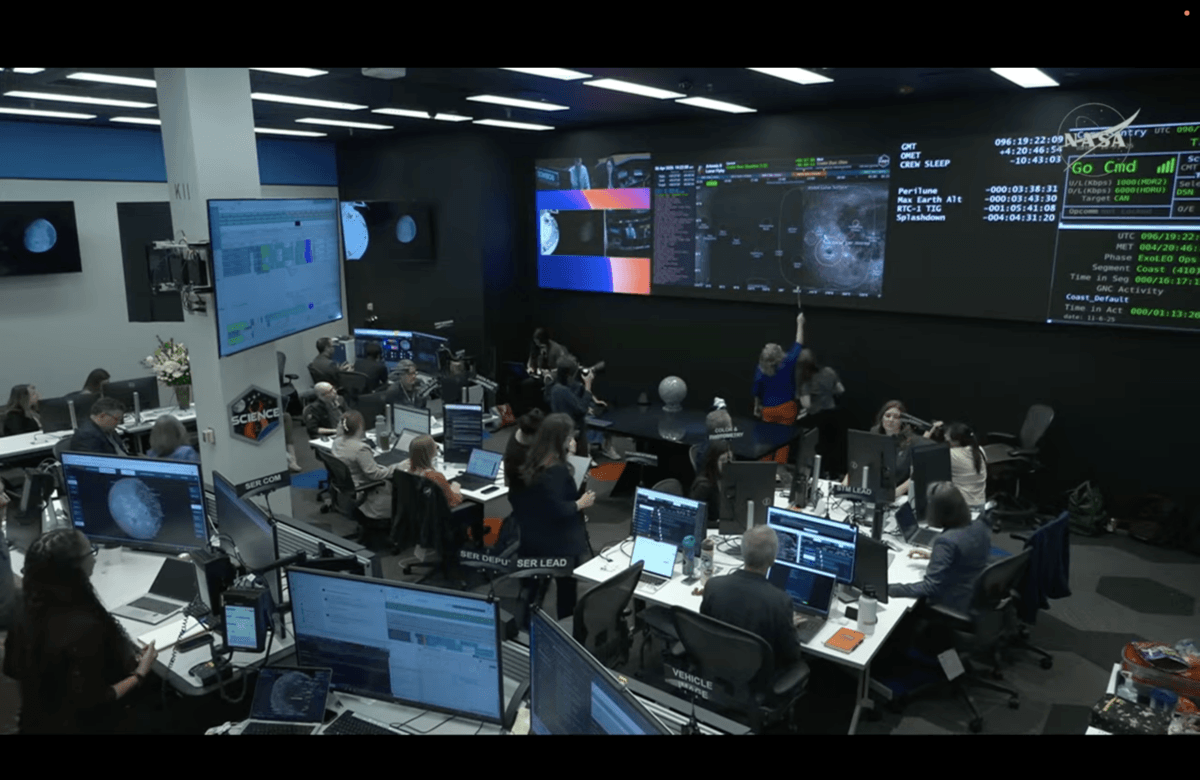
A glimpse inside the Science Evaluation Room, where lunar scientists monitored the progress of Artemis II’s lunar flyby on April 6, 2026. (Screenshot/Courtesy of NASA).
The following day, the team was able to have a post-flyby conference with the crew to address any lingering issues they might have had. These included questions about the Earthshine and confirmations of the exact location of those micrometeoroid impacts. Then their focus turned to analyzing the data as they came in.
The audio updates shared in real-time during the flyby live stream, and the select images published by NASA, represent only a fraction of the 175 gigabytes of imagery and audio loops accumulated by the crew during their day. That includes more than 40 minutes’ worth of data gathered as Artemis II entered a scheduled radio blackout as the moon passed between it and the Earth.
In a post-flyby press conference, Young said that all of the images, audio files, and annotations relevant to lunar science would be made available to the public within six months of the splashdown date, and she said two reports would be released. One will highlight the operational structure of the flyby, analyzing how NASA’s lunar science team was able to work with flight operations and the crew. The other will be a preliminary science report that will be structured in a way that empowers the scientific community at large to analyze the data and help NASA gain further understanding of the moon.
“I hope people all over the world can be inspired by this push away from our planet,” Young said in a news release. “I also hope they remember the Moon, how much we still have to learn about our nearest neighbor, but also the special place it holds to people everywhere.”
The Epoch Times reached out to NASA’s Science Mission Directorate for comment about the current analysis of the lunar flyby data but received no response by publication time.