
HOUSTON—The human race has now flown farther from its home planet than at any other time in history.
NASA’s Reid Wiseman, Victor Glover, and Christina Koch, as well as the Canadian Space Agency’s Jeremy Hansen, flew their Orion spacecraft Integrity beyond the record 248,655 statute miles—which was set by Apollo 13 almost exactly 56 years ago—at approximately 1:57 p.m. ET on April 6.
“As we surpass the furthest distance humans have ever traveled from Planet Earth, we do so in honoring the extraordinary efforts and feats of our predecessors in human space exploration,” Hansen said.
“But we most importantly choose this moment to challenge this generation and the next to make sure this record is not long lived.”
They were to continue on further as the moon’s gravity pulled them closer, undertaking a multihour gauntlet of lunar science observations.
In that realm of deep space unknown to humans, the Artemis II crew saw things no human eyes have seen firsthand without the help of telescopes or unmanned spacecraft.
Spaceflight Distance Record
At 7:05 p.m. ET, Artemis II’s uphill journey peaked at a distance of 252,756 statute miles away from the surface of the Earth.
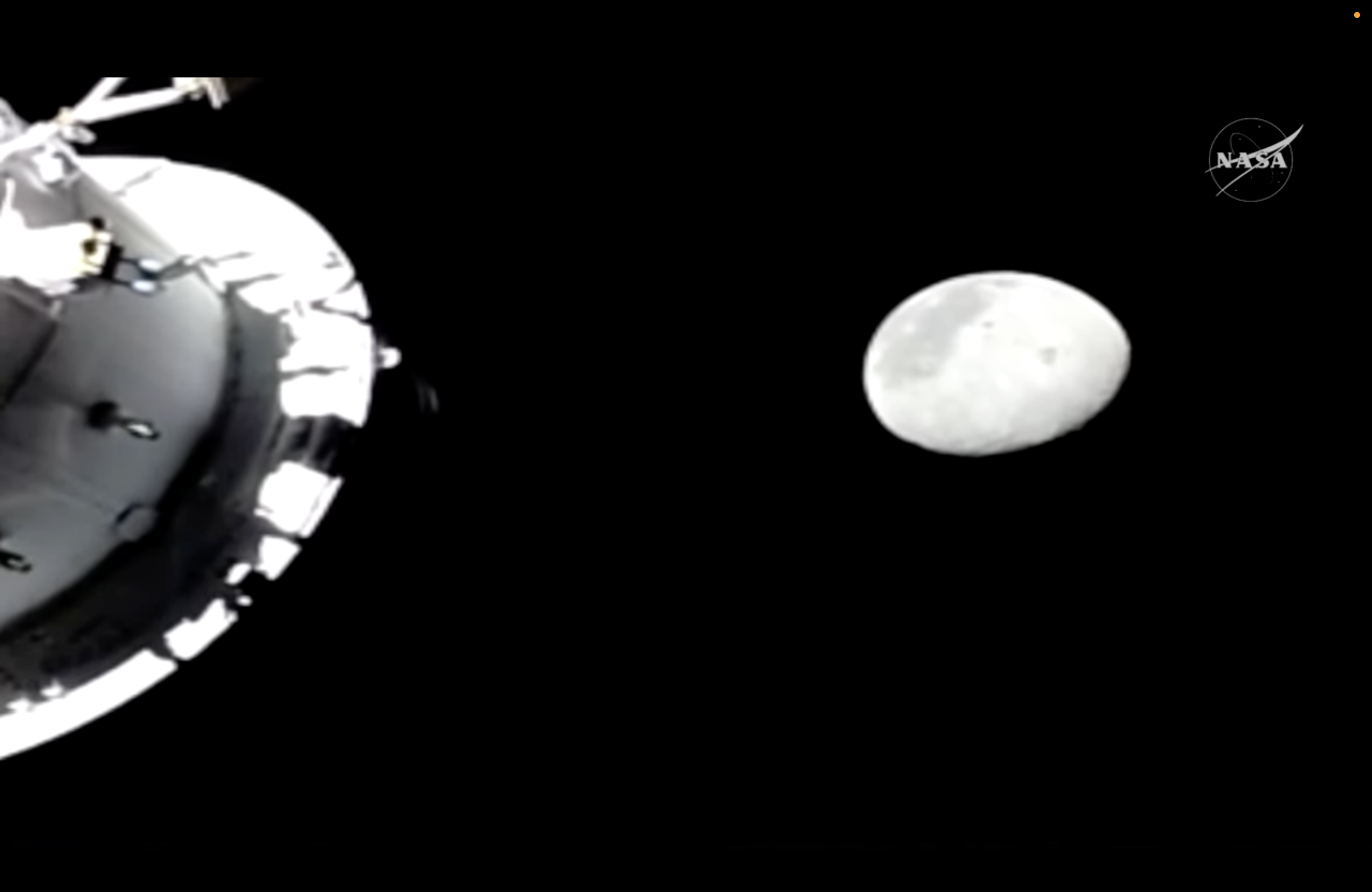
Just before that, around 7:01 p.m., Artemis II made its closest pass to the lunar surface, flying over at an altitude of over 4,000 statute miles. Through Integrity’s windows, the moon appeared to be about the size of a basketball held at arm’s length.
Wiseman, Glover, Koch, and Hansen reached these milestones after they passed behind the moon and entered a planned communication blackout about 40 minutes long.
Artemis II launched on April 1. NASA officials and mission leaders said a April 1–4 launch window came with a trajectory that would exceed Apollo 13’s record distance. But they stressed that such things had no effect on when they were planning to launch and that any record-breaking was purely a coincidence.
Lunar Flyby
Less than an hour after crossing into the deepest space visited by humans, the four astronauts were scheduled to begin the first flyby around the moon since 1972.
All lights in the capsule they could turn off were turned off, and shrouds were put around the windows so Wiseman, Glover, Koch, and Hansen could get the best views and pictures possible of the lunar surface visible along their flight path.
They worked in pairs. Wiseman and Hansen started at the windows taking turns taking photos with the Nikon and iPhone cameras onboard and taking unassisted observations and making annotations. Meanwhile, Glover and Koch served as a support team and took turns relaying verbal reports of their observations back to NASA’s lunar science team at Johnson Space Center in Houston.
Wiseman and Hansen’s shift lasted about an hour and then they swapped places with Glover and Koch.
Verbal reports called out by the crew described different colors, textures, topography, brightness, and albedo, which refers to the amount of sunlight that is reflected off a surface.
As their eyes adjusted, crewmembers called out seeing browns, greens, and whites on the surface amid the greys. They took turns observing the same areas at different angles to see how the visuals changed.
Targets the crew observed at the request of the lunar science team on both the near and far side included Copernicus Crater, Glushko and Ohm Craters, Grimaldi Crater, the Aristarchus Plateau, and the Hertzsprung Basin.
As they flew around the far side of the moon and lost contact with Mission Control, the observations, photography, and verbal recording continued, specifically looking for new impact areas and lofted lunar dust.
They then achieved another milestone, the first-ever human observations of the far side’s entire Orientale Basin, and remarked on the landmark’s grandeur.
The crew also had an opportunity to choose what aspects of the moon they could target on observations. Glover’s choice was the terminator—the bold line between sunlight and darkness. He spent several minutes describing the definition of topography accentuated by the region’s extreme lights and shadows in detail.
After about 40 minutes of loss of signal, the crew came around to their own earthrise, and afterward, a solar eclipse.
Thousands of pictures, and immense amounts of descriptions and data points taken during the hours-long event, will start being downlinked to and shared by NASA in the coming days.
Carroll Crater, Integrity Crater
Another decision made by the crew was announced just after they broke Apollo 13’s distance record.
Opportunities for early lunar observations during their three-day cruise from Earth orbit gave the Artemis II crew time to locate and observe two unnamed craters.
Hansen explained to Mission Control that the first crater was observed on the moon’s far side, about halfway between two of the mission’s primary targets: Orientale Basin and a crater called Ohm. The crew proposed the crater be named Integrity after their spacecraft.
The second crater appeared as a bright spot on the nearside. They proposed that it be called Carroll in memory of Wiseman’s late wife, who died in 2020 from cancer.
“There’s a feature in a really neat place on the moon and it is on the near-side/far-side boundary,” Hansen said. “In fact, it’s just on the nearside of that boundary, so at certain times of the moon’s transit around the earth, we will be able to see this from Earth.”
The crew came together in a group hug and tears were shed for the loss of someone all four of them saw as a loved one and member of the close-knit astronaut family.
Back in Apollo’s Neighborhood
Wiseman, Glover, Koch, and Hansen had crossed into the moon’s gravitational pull at the end of day five—approximately 12:37 a.m. on April 6.
Flight director Rick Henfling and Lori Glaze, acting associate administrator of NASA’s Exploration Systems Development Mission Directorate, told The Epoch Times that this was the point at which they could see Artemis II arrive at the moon.
The moment was acknowledged by the crew as they prepared to go to bed, and Koch noted that the moon was now appearing bigger in the windows than the Earth.
Upon waking, they heard a statement from the late Jim Lovell, the NASA astronaut who took part in both Apollo 8, the first-ever crewed flight to the moon, and helped set the now-broken distance record commanding Apollo 13.
“Welcome to my old neighborhood,” he said. “When Frank Borman, Bill Anders, and I were around the moon on Apollo 8, we got humanity’s first upclose look at the moon, and got a view of our home planet that inspired a united people around the world.
“I’m proud to pass the torch onto you as you swing around the moon and lay the groundwork for missions to Mars for the benefit of all.”
He wished the crew, and all of the ground teams involved, good luck from “the Good Earth,” the way Apollo 8 referred to it during their broadcast in lunar orbit. He also reminded the crew to enjoy the view even though they would be incredibly busy.
Lovell died on Aug. 7, 2025, at the age of 97.
Integrity’s reacquisition of signal upon emerging from behind the moon symbolized the start of its trip home. Reentry and splashdown in the Pacific Ocean is expected to commence just before 8 p.m. ET on April 10.