
[RUSH TRANSCRIPT BELOW]Modern American politics is commonly framed as a face-off between traditional conservative and contemporary progressive values.
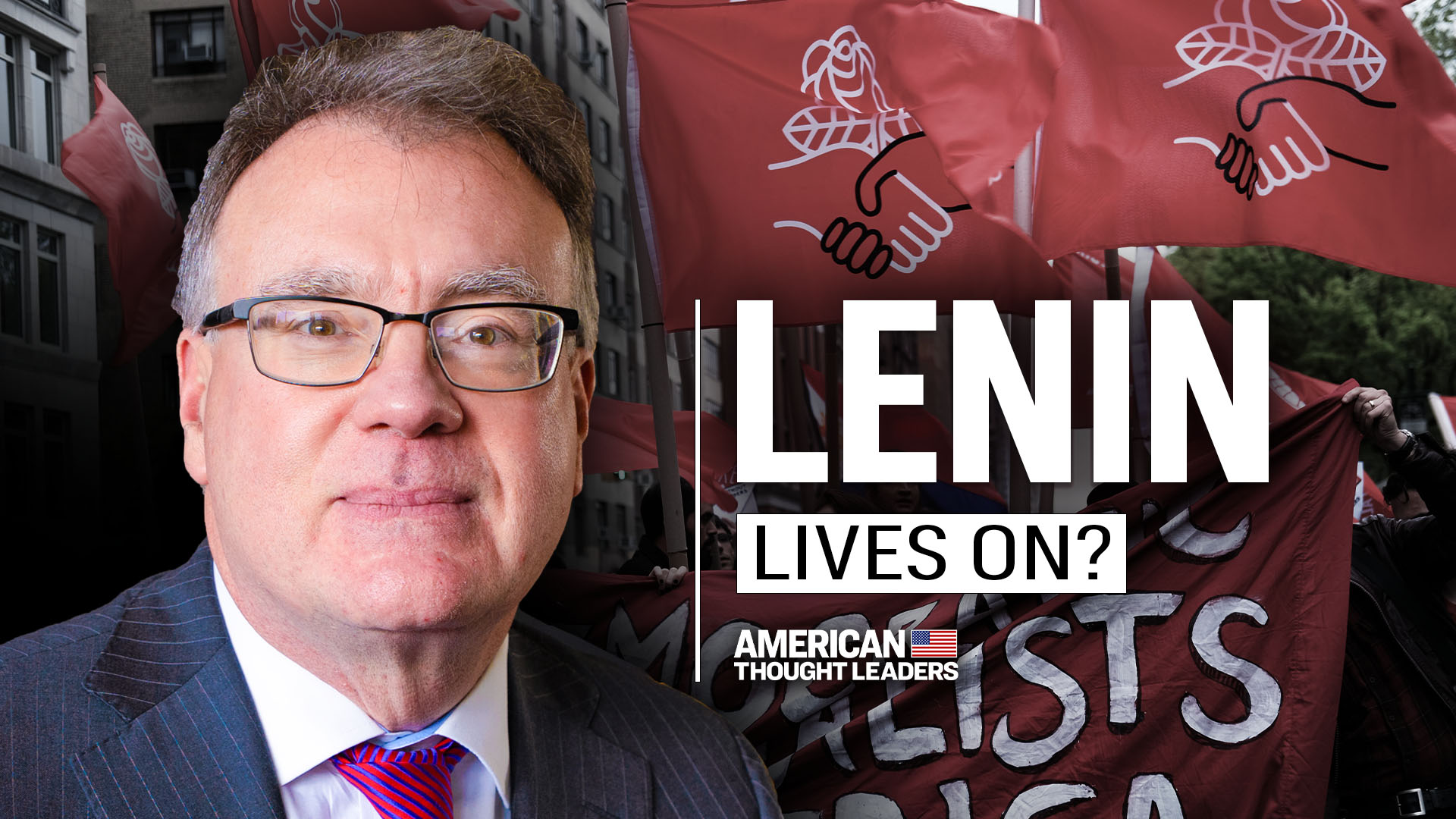
Bradley Thayer, author of “America’s 100 Years’ War,” argues that a closer look at the tactics shaping Western institutions reveals a deeper ideological struggle—one whose roots trace back to Vladimir Lenin.
In this episode, Thayer argues that what threatens America today extends far beyond traditional Marxist economics. He says that neo-Leninist strategies actively work to subvert democracy by hijacking civil society, destabilizing Western borders, and replacing individual rights with group identity.
Thayer addresses a host of critical questions: How did Soviet political warfare evolve into a privatized network operating within the United States? Why is the Chinese Communist Party best understood as an illegitimate colonial export of Soviet imperialism rather than an authentic Chinese polity? And how can Americans draw upon our founding principles to end this century-long war?
Views expressed in this video are opinions of the host and the guest and do not necessarily reflect the views of The Epoch Times.
RUSH TRANSCRIPT
Jan Jekielek:
Bradley Thayer, it’s such a pleasure to have you on American Thought Leaders.
Bradley Thayer:
Jan, it’s wonderful to join you again.
Mr. Jekielek:
So, you argue in your book, America’s 100 Years War, that Vladimir Lenin might just have a greater influence on contemporary American politics than the Founding Fathers. Justify that for me.
Mr. Thayer:
Certainly. It’s a large claim, isn’t it? I think that we can think of America before Vladimir Lenin and after Vladimir Lenin. And my argument is that communism has had an enormous impact on American politics, of course, and the politics of the West more broadly, but certainly American politics since the Bolshevik Revolution in 1917. We’ve seen the growth of communism in the United States, allied with either the Soviet Union during the Cold War or the Chinese Communist Party [CCP] today, working with fellow travelers, for example, Neville Roy Singham, the Soros Foundation, and many other actors who are working to advance what they would call progressivism, not communism, in the United States.
So, if we look at American history, it’s been defined by the ideology of political liberalism, the belief that we have rights that are given by God, and from that we generate, of course, our political institutions, our emphasis in America on liberty and freedoms that are so important for individuals and human rights, as well as the rule of law.
Well, that’s been under assault from the totalitarian Left, from the communist Left, and the genesis of that is in the Bolshevik Revolution in 1917. So, in the scope of American history, the last hundred years, we’ve really seen a growing strength of neo-Leninism in the United States to the point where we have DSA [Democratic Socialists of America] or Mamdani or the flowering, really, of a very hard Left in America.
Mr. Jekielek:
Just very briefly, I don’t want to—I want you to continue your thought, but explain neo-Leninism.
Mr. Thayer:
Well, that would be Leninism updated. And so rather than the emphasis on working class versus the bourgeoisie, for example, the emphasis is on oppressed and oppressor, for example, in a neo-Leninist approach. Lenin didn’t write very much about race, for example, where for progressives, of course, that’s a very important emphasis; diversity, equity, and inclusion [DEI], as well as critical race theory. This is an embodiment of Leninist thought used by progressives or neo-Leninists, as I would call them.
Mr. Jekielek:
Please finish your thought, but I want to kind of dig into that a little bit because I think there are a number of people who would contend that that is not the case. And I just want to get you to explain how your thinking works. But please finish your thought here. So, he’s had more of an influence than the Founding Fathers?
Mr. Thayer:
He certainly has had a very significant influence. And really, the battle today is between the ideas of the Founding Fathers, James Madison vs. Lenin. So, what’s the justification for that? Well, the Bolsheviks were expert at spreading revolution in their attempt to remake everything. The totality of Western civilization, the totality of democratic government, was their intent. Lenin said you could do that in three ways.
First, through a coup d'état, as the Bolsheviks did, and which you immediately had in the wake of the Bolshevik Revolution in Bavaria, in Hungary, and in other German states as well, with the failed Spartacist uprising of Rosa Luxemburg and Karl Liebknecht. Secondly, he said you could have the Red Army spread the revolution. But outside of Warsaw in 1920, the Poles famously stopped the Red Army and were able to eject them and send them back into Bolshevik Russia.
Thirdly, Lenin said the united front was a way to spread the revolution. The united front is a way of penetrating organizations, institutions, your educational system, your political system, your cultural system, Hollywood, our K-12 education, colleges, universities, and media. It was about having communists furtively penetrate those organizations and then, as the Bolsheviks said, bore from within. Gradually over time, it was to spread communist ideas and inject communist ideas into our media, into Hollywood, and into our educational system.
Of course, in the United States, the Left has taken control of our ideas industry, of our culture industry, and so much of American life, to the point where we’re having a debate now about whether communism is acceptable in the United States. Thankfully, President Trump has been touting and identifying that it is unacceptable in the U.S. But with the growing strength of the DSA, a hard left in the Democratic Party, we’re seeing again a flowering of communism, a rebirth of communism in the United States.
Mr. Jekielek:
So it’s very interesting. I mean, you’re basically saying that Lenin had this intent. There was a, you know, a functioning, not just support system, but kind of a revolutionary vanguard that was trying to co-opt all these different countries. China was a great example, but very much the United States being a key target and so forth. Even if it doesn’t look exactly like the original variant today, it’s sort of a product to some extent of those efforts.
Mr. Thayer:
Yes, it is a product of those efforts and of his intent to remake everything. Lenin and the Bolsheviks had an incandescent hatred of Western civilization and of what they would identify as bourgeois democracy, of Western democratic government, whether that was in the US, of course, or in Europe. Their desire was to destroy that, destroy Western civilization and to destroy because they saw it as being oppressive.
But it is a fundamental question why they were so. Why did they have such hatred towards those institutions, towards Western civilization and all that had been created? Well, to a degree, that’s a personal issue for these Bolsheviks, but I would say it’s also more than that. Driven by that ideology of hatred, it is driven by an ideology which seeks to smash what they see as essentially not equitable or being a product of lacking justice.
Mr. Jekielek:
Trevor Burrus, or unfair, maybe, is another.
Mr. Thayer:
Trevor Burrus, unfair. But it would also be, Jan, I think this is the most important point when it comes to the Bolsheviks and their descendants, the children of Lenin. Their desire for power. It is their desire to control, and it is their desire to destroy and their arrogance, their hubris, that they could make something better and will be making something better through their efforts. So, the fact that bourgeois democracy is not a just system in their mind, by destroying it, they’re going to move and create something far better.
Orwell, of course, has in 1984, Orwell’s very famous dystopia novel, he has the protagonist Winston Smith write in his diary that he understood how. He understood how the party operated. In fact, he was a part of it. He was a cog in the wheel in the Ministry of Truth, rewriting history, of course. But Smith writes that he didn’t understand why. Why was the party doing this?
And I think it’s important for Americans to consider this. Why are communists doing this? Why do progressives or neo-Leninists seek to destroy the greatest civilization and the greatest political system that’s existed? To a degree, they think that they can do better. I’m sure that’s an element of it. And it is a hatred of what we have that they seek to destroy. And that should never be underestimated. That incandescent hatred should never be underestimated.
Mr. Jekielek:
You know, one thing that just comes to mind is you mentioned Roy Singham and you mentioned George Soros kind of in the same breath. And I think of Roy Singham, you know, it’s very easy to argue that Roy Singham is deeply aligned with the Chinese Communist Party. You know, his offices are there. He’s kind of got the official support and everything that it means, even though, kind of on the surface, it looks like he’s somewhat independent. Of course, he’s got his own money and so forth. But, you know, his own, the things he said himself kind of reveal that connection quite a bit.
When it comes to George Soros, I think, if I recall, he’s actually on record saying that, you know, actually, China becoming powerful is a threat to us. And so, you know, so someone might say, well, no, these are just kind of competing top-down models. Actually, they’re not working together, as you suggested. Just kind of like unpack that a little bit for me.
Mr. Thayer:
Certainly. The Bolsheviks created the Communist International or the Comintern. It’s also known as the Third International. And the intent of the Comintern was to spread the revolution. The Bolsheviks created the Chinese Communist Party [CCP], as you know, in 1921. And they also worked in the United States to create a Communist Party, a nascent Communist Party, also in 1929.
By the end of the decade, it would be officially known as the Communist Party of the United States of America. The point of the Comintern, of course, was to bore from within, to coordinate with the Soviet intelligence service, to work with fellow travelers, to provide funding, to provide education, to provide leadership and organization, and to ensure that Moscow’s heavy hand controlled everything.
Today, we still have a Comintern. It’s been privatized, and it’s run not by a center in Moscow, obviously, but it is running informally, if you will, or it has been privatized. It’s being run by Soros or Singham, birds of a feather who may be coordinating or who may not, but are still driving towards the same end. Some of them may have overtly closer ties to the Chinese Communist Party, and others may have. They may have furtive ties to the Chinese Communist Party, but they’re driving towards the same end.
Mr. Jekielek:
And by Comintern, do you just mean an organizational body that’s sort of actively seeding ideology, pushing movements, supporting these nonprofits that aren’t really nonprofits? I'll comment on that in a moment, but all of these things.
Mr. Thayer:
Yes. Of the front organization, working with fellow travelers, working with sympathetic media to ensure the CCP is always portrayed in a favorable light, or to ensure that communism is seen as progressivism. It is seen as a wave of the future. And all the cool kids are becoming communists because we all know that it is the wave of the future. And it may have had some unpleasantness in the past, but this time it’s going to work. And so, yes, that is an informal organization, a privatized organization, in strong contrast to the way the Soviets ran it.
Mr. Jekielek:
You mentioned Lenin’s united front doctrine, and I’ve been thinking a lot about the united front recently, especially since I wrote my own first book not a few months back. You know, with the CCP’s United Front Work Department, you can think about it as an institution whose key purpose is to either subvert or destroy, if you can’t subvert, what we would call civil society, which is really interesting, right, because civil society is the thing that de Tocqueville presciently saw as the engine of America, if you will, the thing that will make America grow and flourish.
And this is precisely, and it’s the genuine nonprofits, it’s these institutions that are created organically out of nothing to solve problems and so forth. And, you know, because when we think of NGOs [non-governmental organization] today, for example, NGOs that are funded by government in large part, that’s not really civil society anymore because there’s this kind of top-down direction where civil society is supposed to be bottom-up.
Also, the thing that actually changes dictatorships into democracies, this is its civil society that got Taiwan or South Korea to become the free society that it was. But here, this United Front Work Department, all the way from the beginning, was active, subverting, and when it couldn’t subvert, destroying, whether in country or outside of country. I just want to get you to comment on this a little bit. I want people to understand that the Chinese Communist Party today has this massive institution, the United Front, a whole department, one of the best-funded, that actively does this throughout the world.
Mr. Thayer:
Yes, the CCP’s United Front Work Department and its various front organizations. This is such an important point. This united front doctrine is Lenin’s third way and really the most effective way of bringing about communism in the West. Again, it won’t work by coup d'etat, and it won’t work by the Red Army spreading it, but it will work from that boring from within to penetrate organizations.
For example, the Boy Scouts and Girl Scouts, a key element of civil society. We may have participated in that in our youth. What have the communists done? They recognize that that’s a key aspect of developing American identity and a love of Western civilization, so it has to be destroyed. The United Front and communists more broadly are expert at finding the hinges in your society. What holds your society together?
Civil society in the West has to be destroyed. The father, the family has to be destroyed. So the father has to be attacked. The church holds societies together. So the church has to be attacked. It has to be ejected as well as penetrated from within so that you have the sad state of, for example, the Anglican Church or the Episcopal Church or the Catholic Church, many would argue, in the United States. So targeting civil society, what de Tocqueville identified, is exactly what they want to do.
Now, the United Front Work Department does that, if you will, with the strategy, very much like the Comintern did it originally. And so that’s the closest, if you will, that’s a surviving legacy of the Comintern. But it also works through many front organizations that folks may not even know are affiliated in any way, shape, or form with a united front movement, with a communist movement.
It also works by working with fellow travelers, folks who are sympathetic.They may have concerns about society, they may think that it is not just society, and they want changes to it. And here you have somebody who comes along and says, well, if you show up at this point in time, you'll be able to participate in this protest, and we already have your signs made for you. So you get the numbers in that way. It’s generating resistance.
Lastly, targeting immigration. We had very strong immigration laws in the West, but the neo-Leninists have been. Targeting immigration, right? And the idea of wearing down any barrier to migration into the West, whether Australia, Canada, the U.S., of course, Europe, U.K., all of the same, because they want to destabilize Western governments and Western civilization. So, Lenin’s united front doctrine has been working. It has been working continuously, and it has been supremely effective at penetrating our civil society, our ideas, our culture industry?
Mr. Jekielek:
I want to dwell for a moment longer on this because I just, I find it so fascinating to think that, you know, there’s this, we’ve been thinking a lot about manufactured protests here, right? What’s the difference between a protest and a manufactured protest, right? You mentioned people are, you know, the signs are pre-made, ready for you, right? In some cases, you actually have, you know, protesters.
I remember with the Chinese Communist Party’s recent focus on Shenyun, on subverting and destroying the Shen Yun shows, they actually just pay people who aren’t particularly, because it’s hard to even find anyone who would be against it, I guess. But they just hire people who don’t really know what they’re doing. But it creates even these few people who are not very motivated, right? But carrying on these signs and a petition are enough to kind of get people wondering and get people suspicious. It’s astonishing.
Mr. Thayer:
A sympathetic media would pick up a story, run with it, right? So it would spread, it would magnify, in effect, key aspects of political warfare. And again, the Bolsheviks were expert at political warfare, and they bequeathed that to their children in the West or in the Chinese Communist Party today.
Mr. Jekielek:
I want to talk a little bit about something that’s also my understanding, but you really dig into this in a way where I learned quite a few things: this idea that communism really is a foreign import to China. Because now, these days, we associate communism with China, of course. It’s the largest dictatorship in the world, most ferocious, most impactful, arguing that it’s succeeding, that it’s working, all those things, right? But it’s not Chinese.
Mr. Thayer:
No, it’s not. It’s a product of essentially Soviet imperialism. The Communist Party again was made by the Soviet Union, by the Comintern. It was led by Comintern agents. Mikhail Borodin was probably the most significant, although not the only one, who was very involved, of course, in the 1920s in China, ensuring the survival of the Chinese Communist Party, nurturing it, directing it, instructing it. And then, of course, Stalin understood the utility of the Chinese Communist Party and the role that it would play. And Stalin was involved in every aspect through the Comintern and through other means in the life of the Chinese Communist Party.
In fact, selecting Mao Zedong in 1938 over one of his rivals ensured that Mao triumphed and that he was in lockstep with what Stalin wanted throughout the 1940s, until the success of the revolution and after the revolution of Soviet imperialism, we need to see the Chinese Communist Party as a colonial government ruling the Chinese people. The Chinese people obviously had no history of Leninism before that time. There’s nothing Chinese, if you will, or Han about Lenin and Leninism, and when we understand that it is an import, we understand that it is absolutely illegitimate.
Communism, by definition, is illegitimate because it doesn’t seek any consent from the people. It’s imposed by a Leninist group on the rest of us. But in China, even more so, it’s illegitimate because it’s a product of what Moscow generated through the mind of Lenin and the influence of Western thought on Lenin. So we look forward to a day when the Han, when the Chinese people, are no longer ruled by a colonial government, the last surviving remnant of Soviet imperialism.
Mr. Jekielek:
It’s not typically what people think about communist regimes—that they’re one, imperialist, two, colonial. In fact, that is what every fellow traveler or communist intellectual argues the West is—all those things. Unpack a little more what you mean by that exactly.
Mr. Thayer:
Certainly. China had no interaction, of course, or only a very modest interaction with Marxism, of course, and none with Leninism before it was imposed on China through a very small organization, the Chinese Communist Party. When they were created in 1921, it was a handful of people who came together, again, under Comintern direction to bring about a communist revolution in China. Again, it had no history with this. It is not a Chinese polity by any stretch of the imagination.
It would be as if we were ruled by Taoism, for example, right? We do not have a connection with Taoism except tangentially in the West, but if we were ruled by it, we would say that this is a foreign import. It may have positive elements; it may have negative elements, but it is a foreign element. Well, that is what Leninism is in China, just as it is in the United States or in Canada or in the West. You don’t think of it as imperialism, but that’s what it is, precisely the intent.
The Bolsheviks sought to spread the revolution to every country in the world. Whether they wanted it or not made no difference. It was going to come; it would be forced upon them, just as there was no consent for colonization. Colonization occurred. Whether the indigenous people wanted it or not, it was irrelevant. It was going to happen. Whether the Dutch East India Company or British East India Company or other elements of what we have.
In the Western tradition, we need to understand that very important point. Stalin ran, in every sense that mattered, the Chinese Communist Party. He made the decisions about what the Chinese Communist Party was going to do. Mao Zedong did not have an original thought in his head. He took Bolshevik thought, in particular Left-wing Bolshevik thought, and turned it into what we would know as Maoism. Successes were the revolution itself in 1949. Well, that was Stalin’s doing, coupled with American mistakes that brought about that revolution in 1949. His second contribution, he said, was the Cultural Revolution.
Again, that effort to remake everything, get rid of the four olds as rapidly as possible, and remake everything. Well, that is coming directly from left-wing Bolshevik thought, who did the same thing in Russia and sought to do it in the West to tear down and to destroy everything so that you can remake a new society, starting from a zero hour, obviously, as the Khmer Rouge very famously said.
Mr. Jekielek:
Well, no, that’s great. People typically understand that the Khmer Rouge sought to do that by killing all educated people and really extreme things like that. But that was the idea, a clean slate.
Mr. Thayer:
Yes. And the Bolsheviks had the idea, Left-wing Bolshevism had the idea of proletarian culture.They called it proletkult. And the idea was you need to have the values, the behavior, the practices of working-class people become the dominant culture of any Leninist movement. And so you would take intellectuals and move them to the hinterland, right? Because the idea is that they had never worked, they had never experienced the life of a peasant or the life of a working man, and they needed to do that.
Well, we see, of course, Mao doing the same thing 40 years later, or approximately 40 years later, in the Cultural Revolution, where to punish intellectuals or to punish enemies, they were sent to become re-educated in the hinterland. So we need to see the Communist Party not as they portray it, but the truth of the Communist Party and the absolute truth of the Communist Party.
And we need to understand that Mao and his descendants are really directly tied to Stalin and Lenin. And when we see that, again, there is nothing Han, there is nothing Chinese about this form of government or this polity, and we welcome the day when it is eliminated, when it has been thrown into the ash heap of history, as they would say.
Mr. Jekielek:
And just very briefly, I think a number of people I’ve come across will say something like, well, the Chinese are used to being led by the firm hand of an emperor. They have this strong history for people that know a little more, might say they have a strong history of legalism, among other things, right? Which certainly was adopted. They didn’t destroy all of that part during the Cultural Revolution. So, how do you respond to that kind of saying, no, it’s more Chinese than you’re saying here, Brad?
Mr. Thayer:
It doesn’t make sense in theory or in practice. Taiwan proves that you can have a Chinese democracy and a thriving Chinese society, not just a very dynamic one with an incredible economy. We’re a leader in technology. So the idea that you are essentially condemned to an anti-democratic life in China is, to my mind, absolutely spurious. There’s nothing theoretically that makes sense, and empirically, Taiwan is demonstrating its success every day, which is why the Chinese Communist Party needs to destroy Taiwan and occupy it. Taiwan shows what China can be without the Communist Party, without that Western import, without a Soviet imperialist product and colonial government.
And that, of course, is alarming to them. That really gets to the heart of their fear. This is an identification of their true fear about Taiwan; not Taiwan’s economic success, not Taiwan’s military, or perhaps even its geostrategic space, as important as that is, but the fact that its existence every day shows that the Chinese Communist Party is a lie and is illegitimate, and it should be seen as illegitimate by the rest of the international community.
Mr. Jekielek:
You know, I apologize for asking you all the time to define things, to explain them, but you mentioned some things about which you kind of have a general idea. For example, the Comintern—we talked about this privatized Comintern, so to speak, as like what it does. Explain what that institution actually is, because it’s very central to the whole thing.
Mr. Thayer:
Indeed, it is, yes. So, the idea of the Third International, or the Comintern [Communist International], was to spread the revolution. It was first created in 1919 when Lenin brought together Bolsheviks as well as representatives from around the world to come to Moscow to strategize and to think about, well, how are the German Communists going to bring communism to Germany? How are the French communists going to bring communism to France? How are the British communists going to do that? In America, John Reed very famously showed up.
And so, about every year, at least originally, the Comintern met and strategized. And what they did is they created schools so that they could bring in cadres from China or from India or from Germany or the United States to be trained in how to be a revolutionary, how to bring this about. The Comintern also worked very closely with the intelligence service of the Soviet Union as it existed, working through front organizations.
For example, very famously in Britain, in a front organization, there was actually intelligence collection, and it was supporting revolution in the United Kingdom that came to light and was a major problem in the relationship between Moscow and London; that’s how the Comintern operated. From above, Moscow gave the orders in terms of what would happen. Gregory Zinoviev, the first leader, and then Bukharin took over the Comintern, another very famous Bolshevik who would be killed by Stalin, just as Zinoviev was killed by Stalin in the purges.
Top-down leadership; this is how you’re going to make the revolution. This is what you’re going to do. We will fund you. We will support you. We will train you. We will allow you to work with our intelligence communities to work also to prioritize because the Comintern was also a spy nest. These individuals were there to collect intelligence to help out the Soviet Union and to work with the penetration of labor unions, for example, the penetration of the culture industry, and the ideas industry that you see in the West to recruit spies as well.
The Cambridge Five, of course, of American history, Hiss, and Whitaker Chambers, were also members of the Comintern and considered themselves members of the Comintern. So, Jan, a very important organization. Does that exist today? Well, formally it does not, but it does informally because you still have, if you will, a strategy, a motivation, an intent, a grand strategy that is enacted through a variety of front organizations.
Mr. Jekielek:
Through, I'll use the term, through a number of stakeholders working together, right? I mean, we hear that term often. One idea that’s kind of been scratching at the back of my mind is the idea of the Potemkin village. Most people have heard about these kinds of false facades of economic success in the Soviet Union to show the West that things are going really well when in fact they were not. It struck me that consent itself is a Potemkin village.
Mr. Thayer:
Indeed, yes.
Mr. Jekielek:
But they portray themselves constantly as having this consent. And it’s always, this is the Chinese Communist Party saying, you’ve hurt the feelings of the Chinese people, as if they know what every Chinese person thinks. But that’s the mentality, right? That is our domain. That’s our decision. I guess a complete lack of respect for individual thought.
Mr. Thayer:
Of course, of individualism. In the West, of course, we have liberalism, and liberalism recognizes the importance of the individual to see a human as an individual, not as a member of a class, not as a member of a race, not as a member of a gender, not as a member of any other larger organization, but as a human individual who has rights given by God, and those rights cannot be taken away by any polity or by any individual. And from that, of course, we have the ideas of the American Revolution, the spirit of 1776, the triumph of the first liberal revolution in history that has led to such tremendous success that we enjoy in the West.
For the communist system, of course, there is no individual. You are not an individual. You are, by definition, a working-class individual, or you are an exploiter. You are somebody who’s going to be oppressed, or somebody who is the oppressor. You have no rights. Rights do not exist for communism. You exist to serve the state, to serve the party, and that is your objective, that is your reason for being.
And from that, there’s no liberty, there’s no freedom except what the party gives you as a consequence. Fundamentally different systems that are anti-American and anti-Western. Communism will never lead to greatness. It never leads to art, right? Communist art is almost a contradiction in terms, right? The hideousness of Stalinism, of those forms of what Stalinist realism. There is no flowering of a human spirit, there is no celebration of the joys, or expression of the costs and lamentations of the human condition.
Mr. Jekielek:
Or the connection to God, frankly, which is sort of a central feature of art since time immemorial.
Mr. Thayer:
Right. But a militant atheism as part of the desire to destroy the West and Western governments. So there is no individual for those systems. You see people as groups; you do not see them as individuals. And that leads to such, again, one of the many reasons why you can easily slide into the terrible human rights abuses that you’re going to have with every communist system, by definition.
Americans need to be reminded of this constantly because they’ve either forgotten it or they were never taught it. Because if the communists take over your educational system, what are they teaching? That communism was never tried, and very quickly going over Soviet history, very quickly going over Chinese communist history, identifying really the evil nature of this ideology.
So, we’ve been locked in a hundred years’ war against this ideology, and we’re in danger of losing it. And so, why is Lenin so important? Because this might be the triumph of his revolution in the United States and the West more broadly at this point in time if we are not very careful in terms of what we take.
Mr. Jekielek:
Exactly what you’ve been talking about. The party denied the free will of the individual, and at the same time, it exacted his willing self-sacrifice. The individual was a multitude of one million divided by one million. And that’s from Arthur Koestler’s Darkness at Noon back in 1940. I think this is hard for people to imagine. I mean, people that grew up in a free society where there’s a strong focus on individual liberty, cognitive liberty, free thought, generally speaking. I think this type of an idea is very foreign.
Mr. Thayer:
It absolutely is. I think in the West we do not truly understand the horrors of communism. We have grown up as you identified, and so we have not looked at the brutality of the Khmer Rouge, we have not looked at the brutality of the Vietnamese communists, we have not looked at the brutality of Central and Eastern Europe under the Soviet yoke, or we have not looked at what happened in Russia.
And when we do so, we can see that any individual difference, any celebration of individualism, is absolutely crushed for the grossness, the grotesque aspect of a central party which determines every aspect of your life. When is the heating going to be turned on in your flat, in your apartment, right? When will it be off? What will you eat? How will you be educated? What will you celebrate? What holidays will you have?
And we recognize that this is such a radical break with Western civilization and with, of course, the freedoms that we have in the United States, thanks to the Founding Fathers, to political liberalism folded in, of course, as a part of Western civilization, that we have no idea of what we’re losing. When fools and dangerous—some of them are foolish, they’re the useful idiots that Lenin identified—when we don’t call out communism for what it is and its evil intent, we are flirting with something which is so dangerous and which will remake everything in our lives for the worse. And it will end in blood and it will end in tears, as it has everywhere it has been tried. So Americans have to be conscious of that.
And that’s the warning of the book, really, in the last stage of the book where I’m talking about what needs to be done. We need to be aware of what this is, how evil it is.And it will destroy everything. You may have heard individuals say, well, it hasn’t been tried. We haven’t tried communism yet, or it'll be different in the United States.
No, it will not be different in the United States. It has been tried. In theory, it makes no sense. It’s just made up. It’s just a lie that Lenin basically figured out drawing a little bit from Marx and Engels and adding a hefty dose of his own thought. Empirically, it has never worked and never will work. It will always end in, as Orwell identified, right? The boot smashing on the face of humanity forever.
Mr. Jekielek:
Forever, right.
Mr. Thayer:
And that is something that, as Americans, we reject. President Trump has called attention to this. You can be a communist or you can be an American patriot. You cannot be both because that is the division. Are you going to choose Madison with what he gave us, the society that he gave us, the politics that he gave us, the genius of arranging our institutions and recognizing we are not angels, but by pitting faction against faction, we can work out and dividing powers, we can work out something.
Or are you going to choose Lenin, which is, of course, totalitarianism, inevitable totalitarianism? And we may be closer to that than we think. So it pains me to see individuals say that or talk about the benefits of communism when they have either no idea what they’re saying.They do have an idea of what they are saying, and the future that they want is incredibly bleak for us.
Mr. Jekielek:
Before we continue, you’ve mentioned the Democratic Socialists of America, and you equate them to this essentially communist vanguard. Justify that for me, because I mean, there are some people that accept this, but there are many people that say, no, this is really, there are some commonalities, but this is really something different. That’s much too strong. That’s just political jargon or something like that. How do you respond? Justify it for me.
Mr. Thayer:
Well, certainly. I think fundamentally it’s an empirical question. Folks may join the DSA for a variety of motives because that’s where the good-looking girls are or where the good-looking boys are, that’s what they want to join, or that’s popular. So there could be that element. It could be a very superficial motivation for joining that organization.
Mr. Jekielek:
To be fair, there’s an interest in communism in the youngest generation. There’s a greater interest or a greater positive view than anybody before. So it’s on the rise.
Mr. Thayer:
Indeed. A renaissance, a rebirth of communism in the United States. Yes, that’s an element of it as well. Again, the belief that it hasn’t been tried or it'll work this time or this time it really will solve the problems that we face in our society. But anybody who’s associated with that in the inner party, if you will, and it’s useful to always think about the Bolshevik distinction between inner and outer party.
The inner party was where the decisions were made, these were where the grand strategy of the party was developed, where the direction of the party was developed, and then orders would go out to the outer party. And these would be individuals who know what the public statements of the party are, but have no insight into the debates of Lenin and his Politburo, for example, making the decisions. So, outer party members were far larger, more numerous, and could be quite vicious, of course, as most Bolsheviks were during the period originally of war communism. What you saw in Dr. Zhivago, for example, the audience may be familiar with that.
So, Jan, I think when we’re thinking about the DSA, it’s useful to think about that as well. There’s certainly an outer party where folks may be joining for a variety of reasons. They’re true believers. There are other motivations for why they want to participate, but there is also an inner party to this. So, what really are their aims? Their aims are absolutely indistinguishable, at the end of the day, from what Lenin’s aims were. They want to destroy the West, they want to destroy capitalism, they want to destroy a democracy which they see as false.
They want to destroy Western civilization, which they see as oppressive. Their way of thinking is completely divorced from, if you will, American thought, the tradition of American political thought, and American institutions. And it is a thought of tyranny. These are individuals who are absolutely tyrannical in their approach and in their rhetoric. When you hear what they’re saying, they are no longer furtive. They’re quite open about what they’re saying and what they’re demanding as almost daily reported.
Mr. Jekielek:
What is one or a couple of examples of that which would be so deeply aligned with Lenin’s outlook?
Mr. Thayer:
Ending capitalism, right? Capitalism is illegitimate. It needs to be destroyed. We’re going to smash it because it has led to inequality. So that is Lenin 101. So oppressors, right? There is always the dialectic, of course, that they’re always using. There is the oppressor and there is the oppressed, and they’re fighting for those who are oppressed, to liberate those who are oppressed from the tyranny of our civilization.
The lies of Western civilization or the beauty of Western civilization, they also denigrate, they also attack. So the triumph or the fetishization of colonial rule, right, of essentially those in the global south, they’re to be favored, they were oppressed, and now they need to be celebrated. The attack on language, the attack on speech, again, because those who were oppressed have speech rights. Those who were oppressors do not have speech rights.
Mr. Jekielek:
So that type of, that idea takes us all the way back to Lenin.
Mr. Thayer:
Yes, and very importantly. So there’s so much which is, again, it’s useful to think of it as neo-Leninism, despite what they say, or however they try to put a human face on what they’re advancing, at the end of the day, of course, it is grotesque.
Mr. Jekielek:
And you do develop these ideas quite a bit in the book, by the way, which, you know, congratulations on a really well-done piece. You promised me when we talked earlier that it’s in fact optimistic, despite everything we’ve just talked about. And it is. And so, you know, you started talking about what can be done, we like, and I like to talk about that, but, you know, your optimism goes even a bit deeper than that. So just explain to me why, given the realities that you’ve been describing and we’ve been talking about here, in a sense, this is very much on the rise, not just here, but in other parts of the world. What do you see with your optimist’s hat?
Mr. Thayer:
The threat is great, and it’s growing, but there is the response. I’m optimistic about the response. The response is rooted in Americanism, it’s rooted in the American spirit, the belief and fact that we are a unique people who made ourselves in 1776 without an established church, without a king, explicitly rejecting a king, without an aristocracy. We came together and made ourselves a revolution, a political contract that allowed us to be born politically mature. We didn’t suffer under the feudal yoke, for example, that you had in Europe and that you had elsewhere.
So Americans made themselves and celebrated that spirit of independence, of being entrepreneurial, of truly having a Republican identity. Nobody was better than anybody else, and we could rapidly work in a land that could convert very quickly a village to a town to a city to an even larger urban development.
Mr. Jekielek:
Or at least we made it so. Now, I’m thinking about people who were enslaved. You know, they obviously, at the beginning, and I’ve been learning a lot about these realities. In fact, obviously they didn’t enjoy those rights, but there was a whole Revolutionary War, right?
Mr. Thayer:
But it could correct its flaws.That allowed the United States to become the great society, of course, the great country that it is. Political liberalism, our ideology. Again, as we’ve discussed, we are individuals, we have rights given by God, and from that we have freedom, we have liberty. We need and recognize the importance of separation of power, the rule of law, of free market economics, and we appreciate Western civilization, our church, and our religious beliefs.
From the West, we get our sense of culture, our sense of art, our sense of beauty, our sense of philosophy, of architecture, which we appreciate. We are a part of a bigger, we are unique, but we’re also a part of a larger entity. This makes America Americans. It gives us a national spirit, which is so important and is the antidote to communism, as President Trump has been identifying, has been certainly addressing since the end of May, where he’s turned to this theme very frequently this summer, the summer of 2026.
So, the antidote to communism is our identity and our celebration of Western civilization. And when we have that, we’re able to recognize communism as the negation of all of that. And we should not and do not want to give that up. And I think Americans recognize that. The bulk of Americans recognize that, despite the opposition. Now, they have tremendous power.
The ideas industry, I’m teaching your kids. What am I teaching your kids? This ideology. If I own the media, how am I framing issues? A very sympathetic portrayal towards DSA or towards these issues while denigrating traditional American identity, our American past, our American culture, civilization, even not neglecting it, but negating it. You’re not founded in 1776, you’re founded in 1960.
It’s a communist tactic, you’re always generating new issues, right? You’re always dividing by taking what is a pivot point, what is a hinge in that society, and attacking it expertly. So if 1776 is so important, we‘ll generate new holidays, we’ll generate new dates that will then allow our teachers to say, well, of course, America is evil. It was really founded in 1619. Enough of that.
Americans have recognized that we are a fundamentally good people.We have corrected our mistakes, and we have the best governance, we’re the best polity in the best civilization the world has known by far. And anyone who wants to destroy that, of course, really has a totalitarian impulse. It’s a very dark totalitarian impulse. Why would you want to destroy a polity, the American government, the American way of life, the American spirit, and Western civilization, which allow all to thrive in it, and which have so many supporters around the world, whether that’s in China or Japan or whether that is elsewhere.
So many people appreciate the West and the greatness of it and are tied to it because they see it as either aspirational, they see it as something which is enviable, or they see it as something to which they fundamentally truly believe. So we need to recognize what’s at stake, truly and without exaggeration. Everything is at stake. Because if these totalitarians come into power, they will very rapidly destroy every aspect of what we have enjoyed: our freedoms, our ability to live, our rights, our ability to think.
And we will be in that, as closely identified the Stalin in Darkness at Noon, of course, Stalin, Soviet Union, or Orwell did also expertly, or Solzhenitsyn did also expertly, looking at the true nature of these societies. And we want no part of that. And we should not flirt. And if people are flirting with it, that’s a very dangerous and sinister, even, development which needs to be combated.
Mr. Jekielek:
Brad, this has been an absolutely fascinating conversation. Perhaps a final thought as we finish?
Mr. Thayer:
Well, Jan, thank you for the opportunity to reach your audience on this very important topic. I would just lead you a little bit with an equation, if you will. Western civilization is the weaker communism, and likewise, the stronger communism is the weaker Western civilization and American identity. So, let’s keep that in mind and do our utmost to ensure that our civilization is preserved and strengthened, and the American government, the American way of life, and the American spirit, likewise, are strengthened and preserved from those who would destroy it and lead us into tyranny.
We’re not going to have it, not on my watch, Jan. We’re not going to allow this to occur. So the book goes through and illuminates not only the danger but also what needs to be done to envision a world without communism. Let’s get to that world without communism where it’s defeated once and for all. Thank you.
Mr. Jekielek:
Well, Brad Thayer, it’s such a pleasure to have had you on.
Mr. Thayer:
Jan, thank you.
This interview has been partially edited for clarity and brevity.