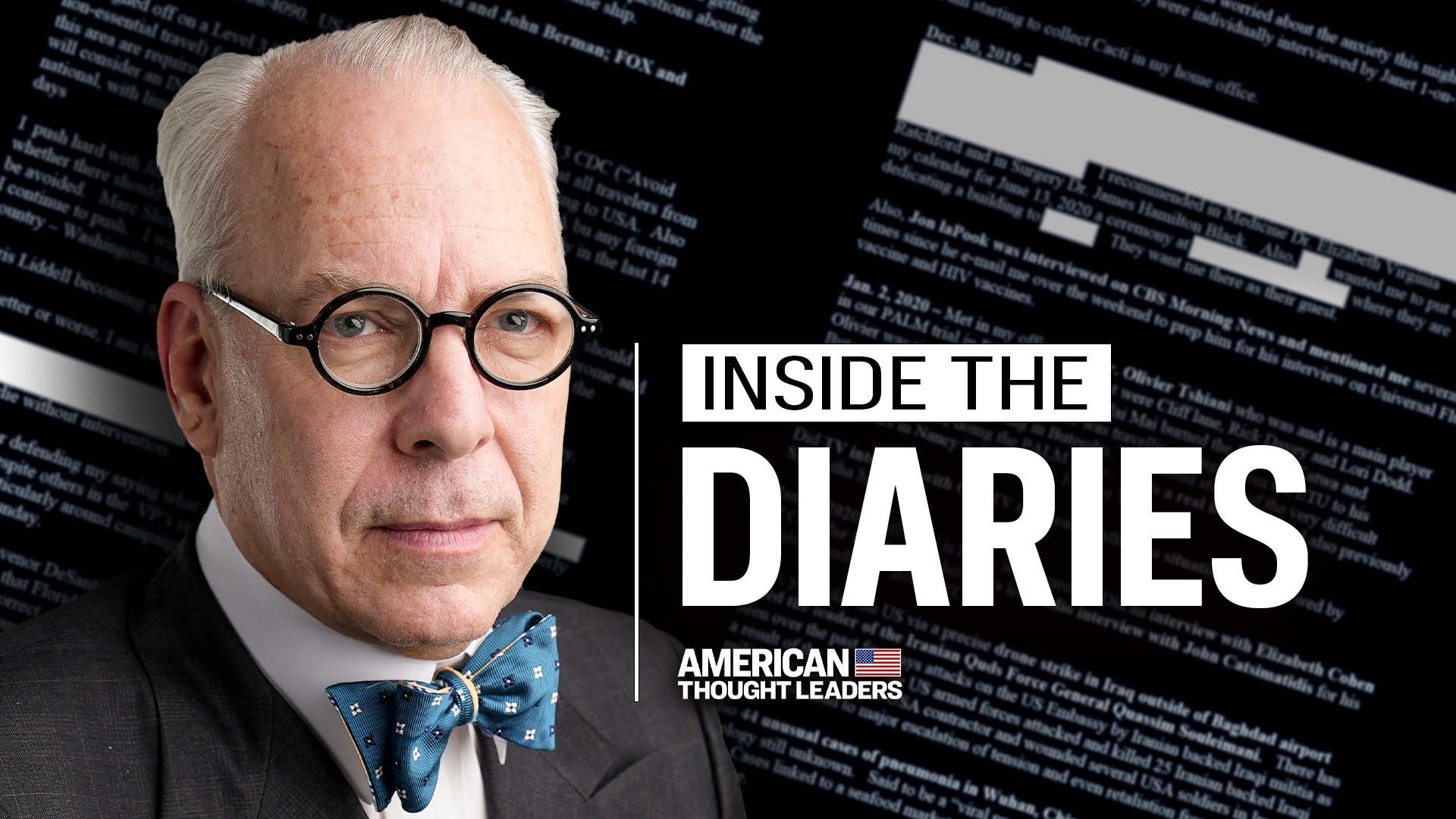
[RUSH TRANSCRIPT BELOW] A trove of newly released documents, colloquially known as the “Fauci Diaries,” offer an unusually revealing window into the decisions and dynamics that shaped the COVID-19 era.
Jeffrey Tucker spent days reading all the documents—over 1,100 pages of materials—which were prepared within the National Institute of Allergy and Infectious Diseases and appear to have been intended, at least in part, as the foundation for an autobiography.
Tucker argues that these records offer key insights into what Dr. Anthony Fauci knew, when he knew it, and how that knowledge influenced public messaging and policy.
We discuss the early push for an mRNA vaccine, the influential WHO delegation to China in February 2020, the origins and consequences of lockdown policies, and Fauci’s relationship with the media.
Why did so many countries adopt elements of China’s COVID response? What do the documents reveal about the debate over the lab-leak theory? And why did the vaccination push intensify even as breakthrough infections became increasingly apparent?
We also examine the clash between Fauci and President Donald Trump, the treatment of dissenting scientists behind the Great Barrington Declaration, and the broader question of how the official history of the pandemic will be written.
Dr. Fauci did not immediately respond to a request for comment.
Views expressed in this video are opinions of the host and guest, and do not necessarily reflect the views of The Epoch Times.
RUSH TRANSCRIPT
Jan Jekielek:
Jeffrey Tucker, so good to have you back on American Thought Leaders.
Jeffrey Tucker:
Pleasure to be here. Thank you, Jan.
Mr. Jekielek:
So, Jeffrey, you’ve described this dump of government notes from Dr. Anthony Fauci, colloquially known as the Fauci Diaries, as perhaps the most impactful or important trove of information since the Pentagon Papers. Now that’s a pretty startling assertion. So explain to me what you’re saying here.
Mr. Tucker:
Well, it’s something we didn’t expect. We have thousands, if not tens of thousands, of documents on the COVID era, many of which pertain to Fauci, but there were so many missing pieces. And what we’ve really lacked is something like a document giving private thoughts. Now, let me be clear about this: private thoughts. I’m pretty sure that this was the notes toward an autobiography. So he was planning his autobiography. He had his staff working with him on this. That much is clear.
So other people within NIAID [National Institute of Allergy and Infectious Diseases] saw it. He had somebody putting daily dumps of data in there, along with somebody chronicling all of his media appearances, which are also thoroughly chronicled day by day. So this is a group project of NIAID. So, we get a really unprecedented look into the unfolding of events through the diaries.
But it’s not sufficient, because you really do need to understand the trajectory of time in order to get a proper understanding of what he’s saying when he says it. But there is so much in here that is so incredibly mind-blowing. I’m not even going to say that I’m the person who understands every aspect of this because I keep finding new bits of information in there that I never would have imagined.
Mr. Jekielek:
So, one thing that comes out right at the beginning, which is something that I just didn’t know, but basically that these mRNA vaccine shots were already being worked on on January 14th, 2020. And this is kind of, I don’t know if this is the starting point, but this is a very significant date that I wasn’t aware of.
Mr. Tucker:
I was not aware of that either. This is much earlier than I expected. And he says rather inauspiciously that he’s got a manufacturer, namely Moderna. He’s got a researcher involved. I think his name is Barney Graham, who, if you look it up, was the holder of the patent for a vaccine that would manipulate the spike in coronaviruses. This thing was given to him, issued to him in 2017, just a few years earlier, and NIH [National Institutes of Health] tagged him to work with Moderna on the shot, a company that never produced any kind of pharmaceutical product, but nonetheless had a very large capital base at the time. So that was January 14th.
So the fact that Fauci puts that in the diary, just one sentence, all right, we’re working on a vaccine, is extremely revealing for a number of reasons. Fauci was telling reporters as late as the third week of February that we don’t need a vaccine to get out of this pandemic. We can get out of it through social distancing alone. That’s what he told Michael Gerson of The Washington Post. So that’s a strange thing. Did he believe in the vaccine or not? Your guess is as good as mine.
My sense is that he might not have had any real strong confidence that the vaccine was the way out, but that he felt like over time he had to kind of rally around it as the method by which he would declare the country cured from this virus of zoonotic release, and that he could take credit for it thereby, and then also kind of put to rest all the immediate suspicions that this virus was a consequence of a lab leak from a lab that he had personally been involved in funding, which I think was his core fear.
Now, that point I just made is something that needs to be understood as you go through the diaries. This is a point that I’ve known since at least the fall of 2021, that very early on, he, Fauci, and others involved, including Jeremy Farrar, were concerned, very concerned, that this might have come from a lab. Farrar knew less than Fauci knew. Fauci, in other words, knew that it very likely did. Jeremy Farrar was not entirely sure.
But it was in the third week of January that they all started going to burner phones and private phone calls and really started to go into full panic mode. So if you read the diaries in that context, what they knew when it started, you can just feel the storm coming from really the second week of January. So, why did this happen? Here, I’m filling in my own interpretive details.
The diary begins with Fauci, first of all, getting news of this virus in China. Okay, so he blasts past that very quickly and goes on to warn about a very serious season of flu. Several entries are going on about flu cases arising. We’ve got a major problem with the flu. So, why is he doing this? And by the way, a week or two later, the CDC [Centers for Disease Control and Prevention] comes to Fauci and says, why do you keep talking about the flu? There’s no justification in the data that we’re seeing that there is going to be a bad flu year. This is ridiculous.
So, my interpretive lens is that Fauci had a plan A, and the plan A was to hope that this virus from China would vanish within the firmament of a bad flu year. That the news about this virus would be buried, and because the gradient of death was so extreme towards the infirm and the elderly, and the infection fatality rate very likely very low, Fauci thought, if the tree falls in the forest. Nobody hears it, that it really falls, you know, maybe not. So this, I think, was Plan A.
But then the news leaks more and more. By the third week of January, you’ve got a major problem: everybody in the world is talking about this virus. He’s being called to go on TV. He realizes there’s no way to just make this go away. So he pivots away from normal flu over to Plan B, which is, okay, first, there are a number of parts to Plan B.
The very first step is to tag top experts to make sure that they can explain to the world that this is a spillover from animals to humans and not a manufactured virus from the lab. So that’s step one. And that one is accomplished pretty early on. By late January, they already have the meeting set up. And by February 1st, we have that famous phone call with the authors of what became the proximal origin paper.
Mr. Jekielek:
You know, the other thing is very, very early on, we’re talking about in my notes, February 8th, 2020. He already has gotten word at this point that the case fatality rate is like 10 times less than what is being brandished about, you know, people were talking before that about two to three per cent, which would be, you know, kind of a catastrophic pandemic. How does that fit in?
Mr. Tucker:
This information comes from the former head of the CDC, and that was the consensus at the time. You can read everything at that time, and all available data says that this is going to be roughly consistent with a severe flu. Now, we don’t have, by the way, this is actually one of the strange things I learned, we don’t actually have precise numbers on the case fatality rate or the infection fatality rate of the flu. So it’s very hard to compare. But it looked at 0.2, 0.3 per cent like it was going to be a bad flu year.
That’s what Fauci was being told, which is incredibly striking because a month later, about five weeks later, Fauci’s testifying in front of the House, House of Representatives, and the Senate. And at both those testimonies, he was floating the idea that the World Health Organization [WHO] had speculated this is a two to three per cent mortality rate. And now, when he says mortality rate. He’s not specifying cases, not especially infections. This is a little bit obscure.
But then he dials it back and says, I don’t think it’s going to be that high. I think it’s going to be closer to one per cent. The Senate is there, and these guys are not infectious disease experts, right? Much less statisticians. And Fauci says a one per cent fatality rate. Now, that’s lower than the World Health Organization thinks, but keep it in perspective; that’s 10 times worse than the annual flu.
At that moment, you could just see the faces go white. You’re a member of the Senate, and you think, well, there are 100 of us Senators. That means two of us, or at least one of us, is going to die. You can just tell that Fauci is just spreading fear throughout the political class at that point, even though he had very credible evidence that he was exaggerating this by 10 times.
Mr. Jekielek:
That’s a very huge exaggeration by any standard, obviously, and obviously it changes how one might react to such a thing as a society and so forth. But you mentioned WHO here, and this is something that you pointed out to me, which I thought was, again, incredibly fascinating: that in Dr. Fauci’s interaction with President Trump in the Oval Office, his one request, like he can ask anything of the most powerful man in the world, and he’s getting to know him. WHO led a junket to China for the President to ask Xi Jinping’s permission to have such an activity. And that is, I mean, I still don’t entirely know what to make of that.
Mr. Tucker:
Thank you for bringing this up. I’ve been trying to focus on this particular point for years. There was this very strange junket that was organized by the, during, while travel restrictions were in place. So we’re talking about chartered flights and that sort of thing. The organization involved officials from the UK, Europe, and the National Institutes of Health [NIH] in the U.S. Fauci sent his deputy Clifford Lane over on this trip. That trip took place starting the second week of February and was sponsored by the World Health Organization.
This delegation was brought to Wuhan and several other cities. We have all their records, all the travel logs and everything. They were being ferried about by CCP [Chinese Communist Party] officials in a kind of what’s called a Potemkin village tour. This is the tour the Soviet Union used to give to visitors to show how many groceries and how well people were living in this Potemkin village. So here you have the CCP giving a delegation from. From the UK and from the U.S. and Europe, showing them how well they did with virus control.
Mr. Jekielek:
And one thing, just to jump in, right, is that it was even worse than a Potemkin tour because they didn’t actually let them into the lab, right? They just kind of said, we'll tell you how it is. And they said, okay, great, thank you. Now we know. That’s all they did.
Mr. Tucker:
They wined and dined them for quite a long time, up to about a week. And so, what was the purpose of this tour? Now, this is where I think it gets really interesting and spooky. Xi Jinping’s message of this tour was we are much better at managing infectious disease than you. With our system of government, which is a one-party state and totalitarian dictatorial rule, we have vast advantages over you people in the West with your human rights and freedom and democracy. Your system is inefficient, and it’s also unscientific.
We, on the other hand, have the science on our side. And so when this virus came along, we knew exactly what to do. We welded people inside their apartments. We told people that you can’t drive. We emptied out all the cities. We issued stay-at-home orders. We did what you in the West would call violated people’s rights. And why do we do that?
Because it was the right thing to do from a public health standpoint, and we can do that because we have the power. You guys don’t have such powers. That shows how much better we are at doing things than you. Now, this is 100 per cent propaganda. Their lockdowns achieved nothing in terms of stopping the spread of a virus that everybody on the planet Earth would eventually be exposed to. So, this was always a lie. It was utterly ridiculous. But somehow, the CCP invited all these useful idiots from abroad to come in and observe the magnificence.
And here’s the question; did it work? Yes, it absolutely worked. They put out a report on February 24th. Coming home on the plane, they’re furiously typing the glories of the CCP and the China model for controlling infectious disease. The Chinese people rallied around their leader. They did the right thing and it’s had a remarkable impact. They’ve controlled this thing and their people are protected. God bless communism with Chinese characteristics.
You can read it online right now. It’s the World Health Organization report from their trip to Wuhan, written by an employee of the World Health Organization who has her PhD from Stanford University. So this report is extremely crucial in causing the rest of the world to copy what the CCP, what they believed that the CCP did.
In fact, one person, I’ve long had the sense that the entire pandemic response would have been different without this World Health Organization Report. But I spoke to a person who’s much more knowledgeable than I am, in a position to know, who told me that, absolutely, that report was a turning point. That’s what kicked into motion the lockdowns in the U.S. and the U.K. and all over Europe. It was this one report. So that’s how important it was.
So the question I’ve always had from the beginning of this thing was, where did the idea for this report come along? Who approved it? And how did it come to be? Well, now, thanks to the diaries, we know. In Fauci’s first meeting with Donald Trump in the Oval Office, Trump had already been told this is a very smart guy, it’s the guy you go to. He’s the best infectious disease doctor and scientist in America.
And Fauci has one request for him; when you talk to Xi Jinping, make sure that he’s okay with the delegation from the World Health Organization coming to Wuhan to observe his genius at managing infectious disease. So Fauci says this in a diary entry, that we’ve got to send a delegation to China to look at their data. Well, they didn’t look at the data. What they did was go on a propaganda tour. So this entry is unbelievably powerful and strange and creepy in ways that I just can’t fathom.
Mr. Jekielek:
Well, and there are two other dimensions that just come to my mind, right? One of them is just perhaps the strange credulity with which everyone was treating the Chinese data. I remember they would show the numbers and look how low the Chinese numbers are. And I mean, rule number one of looking at any data points from communist China is that they have primarily a propaganda purpose.
Whether they’re true or not is a distant other question. Sometimes they might be, sometimes they may not be. And I just, it’s still astonishing to me that people don’t understand this. That’s one thing. But the other part is that the WHO is very heavily influenced by communist China, right? I mean, the head of it is China’s choice, right, for leadership.
Mr. Tucker:
That is exactly right. That is exactly right. And you put all these data points together. There are many ways to interpret the COVID era, many. But one of them is that the entire thing was a master plan hatched by the CCP. I mean, just to put a fine point on it, that’s what we’ve talked about so far, what it looks like to me, and there’s plenty of evidence of that. It was a brilliant master plan to shame the West for its freedoms.
Look, your freedoms are going to make people sick and prevent you from doing the right thing, which is to turn all your countries into a prison state like China and shame the people into doing the unthinkable, which was to override the Bill of Rights and issue stay-at-home orders, abolish religious holidays, close the schools, and destroy businesses. In fact, that is what happened, and it kind of worked.
Meanwhile, China’s lockdowns didn’t last that long, certainly not as long as they'd last in the U.S. and Europe, in Latin America and Africa. Africa had a much more difficult time locking down. But after the lockdowns were lifted in China, there was widespread celebration. Look, we solved the problem. SARS-CoV-2 was bad, but thanks to our great leader, we solved the problem. I don’t know what’s wrong with you guys, but you still have a problem? We don’t have a problem.
Mr. Jekielek:
I mean, absolutely, absolutely crazy. And, you know, the other thing, to use, to kind of look at this the grand conspiracy hypothesis a little further, in my view, during Trump 45 and the first Trump administration, the first tariffs were instituted by the, you know, crafted by the U.S. trade representative. And sort of my own assessment, or, and I think this goes just beyond me here at The Epoch Times, this was possibly the first instance of communist China being forced into a trade position that it didn’t want to be in explicitly for decades, in many, many decades, right?
The status quo had become basically, you know, we get everything we want, right, which has resulted in hollowing out of America and the growth of the world’s largest dictatorship. So that, and just before COVID, right, just before COVID, the first policies were instituted that, I mean, they were trying to avoid this like the plague, and ultimately, of course, reneged on it. And you showed me this amazing, you know, FRED [Federal Reserve Economic Data] graph where you can see immediately after the COVID response, you get this back to the status quo in terms of trade, US-China, which is pretty astonishing.
Mr. Tucker:
Yes, I think that chart is amazing. It’s about China, but it’s also about something even bigger than that: to do with the postwar trading order. As we’re coming out of World War II in the U.S., all the best and the brightest cobbled together these systems: the Bretton Woods monetary system, the International Monetary Fund [IMF], the World Bank, and crucially, the General Agreement on Tariffs and Trade [GATT].
The ideology behind GATT was more trade is always better, more globalism is better than nationalism. We will never go back to a world of tariffs and nations going their own way. So that was the ideology from 1945. Actually, it predates that, but that was sort of the one great victory coming out of the postwar world by the ruling class elites. And I say that because I knew some of these guys, right?
They have good hearts, they’re good people, they have ideals in mind—free trade for the world. And pretty much, if you go from 1945, 1946, all the way up, through the North America Free Trade Agreement [NAFTA] to the World Trade Organization [WTO], we’re building these international institutions with the muscle and the power to kind of force open markets, to continue to lower tariffs, to increase national reliance on each other. This is the one dominant trajectory of world history that we saw from that period all the way up to 2018.
Mr. Jekielek:
If I can just mention one thing to interject, this idea, you know, came from the war, right? The idea was if you develop deep, deep trade ties between all these countries, they’re not going to go to war with each other because it'll just be too damaging. And, you know, that seems like a pretty good idea on the surface.
Mr. Tucker:
Yes. And even more, I don’t want to get too diverted here, but it even traces back long before the war, even all the way to 1932, because there was an impression that the Smoot-Hawley tariffs that were pursued in the U.S. contributed to really causing the Great Depression. So, this whole generation is like, well, if we can just have globalism, we'll get rid of war and depression. What else do you want? That’s the greatest, that’s utopia, right? So, that was the theory.
And Donald Trump came along in 2016 running on the platform that we’ve got to do something about the hollowing out of our industrial base. This whole system is not working for us. Countless numbers of industries during this whole period of time were being ripped off as a nation. We’ve got to fix this.
So vis-à-vis China, 2018 was the biggest step away from this post-World War trading apparatus that we had seen in 75 years. I remember thinking at the time, I’m not sure that this happens without some kind of consequence. And I don’t mean economic consequence, that was always uncertain to me, but like political consequence. What would happen right now?
Well, in 2018, you’re right, this chart shows imports from China plummeting. And that continued up until the very moment of March 16th through March 18th. And why? Why did this turn around? Why did the U.S. suddenly have vast and growing imports from China again? Like, what turned it around?
Well, the U.S. needed PPE [Personal Protective Equipment]. So, we needed masks, we needed robes, we needed syringes, we needed swabs, we needed all these things that we didn’t have. So, Trump’s on the phone with Xi Jinping saying, gee, what do you think about striking up our trade relationship again? No problem, Mr. President. I'll be right on that. And boom, it turns around. This is definitely part of the story.
So, China, if you want to look at it totally, was the winner from this whole slice of time between January and late March. They got everything they wanted, and the U.S. was in many ways fooled into adopting CCP-style tactics of virus control, fake, phony propaganda, and then also reversed Trump’s attempt to reindustrialize the U.S. by finally taming its relationship with China.
Mr. Jekielek:
Well, and this is a somewhat fine point, but the regime definitely benefited. I’m not so sure the Chinese people were the beneficiaries here.
Mr. Tucker:
Of course. When we speak about these names like China and the U.S., more and more in the world today, it’s the people vs. their rulers. That’s probably never more true than it is in China, which is one of the things that disgusted me most about that World Health Organization report. Here you have these useful idiots of the West hanging out at cocktail parties and dinners, wining and dining with the CCP, writing on the way home in their comfy charter jets that the Chinese people united in spirit and rallied behind their leaders.
They’re saying this. It’s just appalling. Oh, I’m sure the people just loved being welded into their homes. It’s just so despicable. But this junket to Wuhan was really the beginning of a great, great calamity for the U.S. and Europe.
Mr. Jekielek:
Something that’s astonishing in these files, in this diary, is there’s this moment on April 23rd, 2020, where Fauci is writing about how the president is very angry at him. So I know that you’ve remarked on this. You know, lay that out for me.
Mr. Tucker:
Okay, so this is much earlier than I thought. This is extremely interesting because Trump was introduced to Anthony Fauci sometime and just heard his name for the first time in February. Then they met, and Trump, you know, had to trust him. For one thing, everybody he knew was telling him to trust Fauci, and Fauci did not have a reputation as being partisan. There’s no reason to think that Fauci was in any sense plotting against Trump at this point.
He reveals this later in the biography, in the autobiography, in the diaries. He said after the November election, only an idiot would have voted for Trump. I don’t know. I can’t believe that people would vote for this guy. So he gets increasingly insulting.
But at this point, in February, March of 2020, Trump had to trust him. And also, Trump was being surrounded by a subject about which he didn’t. Nothing in his life as a CEO had confronted him with the problem of what to do in the case of a pandemic or infectious disease. This was not why he was elected president. So, of course, he’s having to trust people. And also, everybody around him says, trust Fauci, trust Fauci. So he did.
Deborah Birx was also tapped, who’s also a kind of protégé of Fauci making these dramatic decisions, the most dramatic of which was on March 16th. Fauci put out a PDF calling for all bars and restaurants to be closed, for any place where people gather to be shut, and for all people to stand six feet apart from each other. It’s just extreme things you never would have imagined would ever happen in this country.
That happened that day, and they passed it out at a press conference where Trump was presiding. I’m not entirely sure about this. I’ve watched that tape so many times. With the papers distributed to the press, it’s not clear why Trump would not have said, let me see a copy of that? So I’m not sure he had known.
Also, it was in tiny print on page two; all the things I just mentioned to you—close the bars and restaurants, stay apart, close all congregate meetings and everything. It’s in tiny print at the bottom of page two. And when Fauci got up to the microphone and read that to the gathered reporters, somebody had attracted Trump’s attention from the audience, so Trump himself wasn’t actually paying any attention. He was waving to somebody, catching their eye, and saying hello. Fauci read the sentence and sat down. Then Trump was called back up.
So that was March 16th, a really dramatic day, and a catastrophe because the stock market crashed. Obviously, economic activity was falling apart. We divided the workforce between essential and non-essential. This is a disaster for the country, but also for Trump politically. So, the question to my mind has always been, when did he first realize this?
Well, the diaries reveal this. By April 23rd, he invites Deborah Birx into his office and begins to scream, and Fauci quotes this: Tony, you’ve tricked me. You’ve ruined the country. You destroyed everything. I never should have trusted you. What you’ve done is a disaster. Fauci reports this and then says that he told Deborah, don’t worry about it. Everything’s going to be okay.
So why would he say that? Why would he say everything’s going to be okay? We’ve got the President of the United States who has turned ferociously against them. Why did he think they were going to be okay? Fauci had spent the last previous six weeks cultivating very close relationships with the national press and becoming this sort of godlike figure to whom everybody turned for all answers.
The national press and Fauci figured out this funny little quid pro quo relationship; you treat me like a great expert, I‘ll continue to do my work. I’ll be ever more popular, and working from within, I will do everything I can to undermine Trump. There was a wink, wink, nudge, nudge relationship between the press and Fauci that had already been born, and everybody knew was going on by certainly by April 23rd.
So it made it very difficult for Trump to just fire these guys. I mean, he probably wanted, he most certainly wanted to fire them. But by that time, the ethos, the culture, the media, that was happening kind of seemingly made that impossible. Already the press is ready to treat him as some sort of red state, unscientific guy. He doesn’t know anything, he’s not an expert in anything.
If he goes and fires Fauci and Burks at this point, it would seem to confirm everything that the press was saying bad about Trump. So Trump couldn’t really do that. So for this reason, Fauci assures Trump, Deborah, it’s going to be fine. You'll see. Everything’s going to be fine because Fauci knew that he was being protected at that point.
Mr. Jekielek:
And this, explain to me what you mean by this nudge, nudge, wink, wink relationship exactly.
Mr. Tucker:
There are things you say on the record and there are things you say off the record. So Fauci was very good at talking to the press off the record about all the things that he really believed. He was not a fan of Trump. He didn’t like Trump. He let them know this in a way that allowed the national media that didn’t like Trump to trust Fauci.
Okay, then he would go on the record and say nice things about, I think Trump’s a good president. I think he’s letting me do whatever I want. So it’s very crucial that he tells the press over and over again that Trump is an okay guy. He’s never interfered in my capacity to manage this pandemic. In other words, he’s taking my advice. For that reason, I think he’s a good guy.
But the press knew otherwise. They began to treat Fauci as the kind of foil to Trump. Trump is the fool, Fauci is the genius. And so they were playing this game. And really, this game lasted for more than a year. It began in February, but it really lasted up to two years. It just kept going, even all the way up to the time he resigned, this sort of funny relationship.
So you had this consolidation of the press rallying around Fauci and anyone of whom Fauci approved. One of the amusing aspects that comes through later in the diary is something I didn’t know, which is that there’s a group that was meeting, I think, weekly called the TV doctors. This is what Fauci calls them, the TV doctors. The TV doctors invited me in this week so we could coordinate our messaging. The TV doctors.
So let’s just say that’s not your general practitioner. This is not your great-uncle. The people that the national media had decided were going to reflect the science. And Fauci was variously instructing them on what to say. That’s why we had such a unified message.
And I tell you, Jan, I can’t even fathom it. There are days in this diary where he lists 10, 11, and 12 media appearances in one day. Now, if there were ever a day in my life where I woke up and I saw on my calendar that I had 12 media appearances, I don’t know what I would do. I would panic. If I have three, that takes me away from all work.
This is pretty much all Fauci did. And he would not go, and we also know this from other emails to his own staff, he would not go on any unfriendly media venues. He would not go anywhere that he thought would ask him a hard question. He would only go to those people who would pitch him softballs.
This was every day for Fauci. It wasn’t reading the science, which is another thing you get from the diaries. There’s very little, almost nothing in the diaries that suggests he’s reading preprints of studies or having any consultations with any serious scientists, much less practitioners on the ground that are trying to do something about COVID. This was not part of the way he was thinking. It just didn’t even figure into it. So the whole time he’s talking about the science this, the science that, he was paying little or no attention to any data or any opinions from any experts.
I remember talking to Martin Kulldorff from Harvard, and this is one of the things that stood out to me from one of my very first discussions with him. This would have been in August 2020, and he later had to leave Harvard. A tenured full professor was fired from Harvard, and he told me this was before he left.
I asked, why is there such a consensus for lockdowns? How is it possible that all the epidemiologists and public health officials and scientists in this country seem to agree that we need to throw the Bill of Rights in the trash in order to confront infectious disease? How did that happen?"
He looked at me and he said, you’re not going to believe me, but I don’t know anybody who agrees with these policies. I don’t know anybody in my profession, people from my vantage point, all say that this is crazy. This is nuts. There’s nothing that would ever justify these kinds of school closures, business closures, travel restrictions, all these things. Nothing would suggest this. This pandemic response is crazy. It’s without precedent, and Martin told me that none of his scientific colleagues really agree with it. But Fauci didn’t want to hear from those people. He only wanted to hear from his people.
Mr. Jekielek:
Yes, I mean, indeed, he calls the signers of the Great Barrington Declaration, like Martin Kulldorff, the Three Stooges.
Mr. Tucker:
That was a particularly vicious thing that comes out in the diaries. We had known before that Francis Collins, the head of NIH, called the three signers of the Great Barrington Declaration the fringe epidemiologists, which is a fairly amusing term, fringe epidemiologists. But that was an email sent by Francis Collins to Fauci. And Collins adds to it, to do a quick and devastating takedown of these guys. Okay? But Fauci doesn’t respond. He’s too smart for that.
In fact, he was very surreptitious throughout his entire emails because he always assumes they’re going to be subject to FOIA [Freedom of Information Act] requests. And the diaries, on the other hand, are another matter. I don’t think he ever intended them to get out in any other form other than his autobiography. So he calls them the Three Stooges, which is, I think, significantly more vague than fringe epidemiologists.
Mr. Jekielek:
Well, so, you know, looking in my notes here, you know, in early 2021, we know that from the diaries that, for example, David Ho, a very prominent scientist, is basically saying that the Delta variant, this new mutation, could render the vaccines useless.
Mr. Tucker:
Yes. So, plan A, I think, was to bury COVID within a bad flu season. Plan A didn’t work. So we move on to plan B. Plan B. First was to deny the lab leak. The second was to deliver unto the population the great inoculation. So by the end of the year, another thing that comes out is that Fauci knew it was going to have to wait until after the election. He said, we can get you a vaccine at the earliest in November. Okay, so already we know in March that he had every intention of seeing this come out after the election. So, there’s a political element here. So, the vaccine comes out.
All right, so now we’ve got the savior vaccine. Now, keep in mind that this virus is of a particular sort. It’s not like chickenpox, measles, or mumps or smallpox. It’s not a stable virus against which you can easily vaccinate. It’s a mutating respiratory virus that is widespread with a relatively low infection fatality rate. So these kinds of viruses, we’ve known for generations, for a very long time, that they mutate. That’s why we don’t have a vaccine, for example, against the common cold.
Okay, those are the sorts of things that people knew in the past. So Fauci surely knew this. The only question is, you know, at what point he would kind of have to reveal this. So he gets this note from David Ho in the UK on January 9th, telling him that there is a new variant, and it is, of course, the Delta variant. We’re no longer in the world of wild type; we’re no longer in the world of alpha, the spike protein of which had already been used as the formulation of the preferred shots by Pfizer and Moderna.
Now we’ve got a new variant, and it’s Delta, and according to David Ho—and he’s a very good researcher—this new variant is evading the immune protection of the shots. So he knows this already. And as you point out, a few weeks later, he’s more and more convinced of this. Of course, the Delta variant begins to take over from the Alpha variant.
So now you’ve got a problem; the great inoculation is not going to protect the population from COVID. It’s not going to stop the spread. And Fauci definitely knows this already by the middle of January and even confirms it. He says, we’re going to have to get a new formulation. We’re going to have to reformulate this vaccine, which reminds me of that scene from Jaws: we’re going to need a bigger boat. It always comes to mind. So he knew this already.
So the question is, okay, you know this, but are you going to tell anybody and be transparent with people? And the answer is that he didn’t tell anybody. He didn’t know it. He didn’t announce it. Instead, we went straight towards mandates on the military, on hospital workers, and—I assume this is a policy that Fauci himself had something to do with—a policy that vaccinates everybody in private companies with more than 100 employees.
That was later rejected by the Supreme Court, but already HR departments and all major companies in the U.S. had reconfigured their operations to mandate these vaccines. So, students, universities, every large corporation in America, all healthcare workers, and everybody in the military are being forced to get these shots that it turns out, in a technical sense, have no public health benefit. So, what do I mean by that?
What I mean is if it doesn’t stop infection and doesn’t stop spread, the shots themselves never made any contribution to the achievement of herd immunity, which is the sole goal of any kind of vaccination program: to contribute to herd immunity and therefore endemicity or making life go back to normal.
So Fauci knew from the second week of January 2021, long before you and I had access or anybody really had access to these shots, that they would not make that critical difference in what we’re allegedly, supposedly trying to go for, which is the obtaining of herd immunity. So instead, what we got was just a wild demand to get as many shots in arms as possible.
In other words, to sell as much of this product as we possibly could to as many people as we possibly could. They became fanatical. And it’s at that moment when Fauci should have said, we’ve got a problem with this shot. We don’t think it’s going to work like it was supposed to. He should have said that. Instead, he became a kind of full-time vaccine salesman for Moderna and Pfizer.
Mr. Jekielek:
You know, one thing that was talked about was that, yes, it became clear over time that these things were not stopping transmission or infection, obviously. But they were—this is what was being said—they were reducing the severity of the disease. So that was their value.
Mr. Tucker:
Yes, this was very common. By the way, they used to say this in the 19th century all the time. Anytime there was a lot of injury, sickness, or the shots weren’t working, they always said, well, don’t worry, it would have been worse without that. That’s always the kind of fallback line. You know, the papers, even at the time, were coming out, were very mixed on this. That was true.
In fact, it’s actually extremely difficult to statistically prove what amounts to a counterfactual. And this counterfactual has always been advanced by, remember, celebrities at the time who said, well, I’ve got COVID. I’m really under the weather. I’m so grateful for the vaccine. It would have been worse without it. Well, that’s actually, again, it’s a counterfactual. You don’t know that for sure. So that was never demonstrated that this was true with any degree of scientific confidence.
Mr. Jekielek:
But we were told that through quite powerful messaging across society.
Mr. Tucker:
Yes, and I'll tell you something else that really alarms me that I’ve heard very little comment about, except in The Epoch Times. People forget that five cities in this country during this period, and as we approach the end of the year, came to be segregated by vaccine status. So it was New York, New Orleans, Washington, D.C., and San Francisco, Chicago, Boston—maybe six cities.
But they all closed any public accommodations to the unvaccinated, which would include libraries, museums, bars, restaurants, theaters, anything. And by implication, too, of course, that would have been churches, but that’s one thing they didn’t actually enforce. Actually, most of the churches themselves adopted this strategy, this very cruel division of urban centers between the clean and the unclean.
To back up slightly, keep in mind, we know that the vaccine did not stop the spread, that it did not stop infection. And yet, we’re segregating five cities, urban areas in this country, and telling the unvaccinated, you can’t eat in a restaurant, you can’t go get a beer at a bar. No, you have to use food trucks, go to the liquor store, and drink at home. This actually happened in this country, and there was a brief experiment in New York with digital vaccine passports.
Fortunately, they didn’t work, so those didn’t last long. But this actually happened, and the entire time—this is what the diaries prove—the entire time Fauci knew that there was no basis, no underlying basis for this at all. In fact, as we approach the fall of 2021, there is a strange moment in the diaries that comes out: Fauci figures out that he can further divide the country politically because he notices that the red states are getting vaccinated at a much lower rate than the blue states.
So the strategy now is obvious. It’s just presented to you on a silver platter; we’ve got a pandemic of the unvaccinated. It’s because you’re not accepting the shot that this pandemic is being prolonged. And who are the red states? These are the people that voted for Trump. The unclean are keeping the country in a writhing state of disease-ridden sadness. The pandemic is being prolonged by the people who are not complying with Fauci’s dictates.
So this line comes along in the late summer, early fall of 2021. And sure enough, like clockwork, the national media picks up on it: This is a pandemic of the unvaccinated. And then they would put up a map showing, See, most of the places that do not have high levels of vaccine uptake, they’re the same places that voted for Trump. So you see how this works. It was very, very impressive.
Mr. Jekielek:
Kind of getting to the middle of 2022, there’s this very interesting moment in the diary. Well, basically, it’s Rochelle Walensky that actually wants to kind of move on, I guess, you know, kind of say, okay, here’s where we’re at. But it doesn’t quite work out. And maybe you can also give me a sense of how we actually exit.
Mr. Tucker:
There’s this accidental comment that Biden makes in some interview; he says that the pandemic is over. And people surrounded Fauci and said, oh, is the pandemic over? Well, not really. So they all had to kind of reverse him on that because they wanted to prolong this as long as possible. Yeah, but you’re quite right. It’s very late. Walensky always had a difficult relationship with Fauci. And that emerges in the diaries where he defends her, but he’s very critical of her. He doesn’t like that he keeps wanting to tell the truth to the American people.
And the entry you’re talking about, he specifically says, you cannot go to the American people and say the shots are not going to protect you against COVID and say that the breakthrough infections are not unusual. They are the norm. They are what you can expect. You cannot do that because that would undermine our attempts to force people to take these shots. So, no, you can’t do that.
So they kind of muzzled her. It’s strange, but this is one of the things I would not have expected from the diaries; that Rochelle Walensky in this period emerges as kind of, I guess you would say, a relatively sane voice, an actual decent human being, as compared with the author of this draft of the autobiography.
Mr. Jekielek:
So, where does this take us next? Johnson has said that he’s obtained Fauci’s phone, that they’ve actually been recovering significant material on it. I haven’t seen any details yet, but just that there is considerable email. Are you expecting this will be something similar, in a similar vein?
Mr. Tucker:
Yes, I think it will just confirm everything I’ve seen so far. I’ve been following this case for six and a half years now, trying to figure out what’s what.Thanks to the diaries, I have a clearer picture than ever of what transpired. And Fauci’s relationship with Bill Gates, it becomes very obvious in these diaries. It was very tight. He just used Bill Gates as his automatic teller machine, is what he did. He just felt like he had to give him a call and get all the money he wanted.
I think we’re going to see more of the main takeaway that the press was making fun of in the diaries. Which is Fauci’s own obsequious relationship with celebrities. So he collects celebrity endorsements. This wasn’t just because he’s got an ego or he’s vain; that may be part of it, but mainly it was kind of job protection for him.
It’s the same thing with the awards that he was pressing his staff into applying for himself. It wasn’t just the money; he was seeking credibility. A wall around himself that would make him invulnerable, sort of an impenetrable wall of protection, so he could continue to do what he was doing, which I think is ultimately explained by his desire to avoid accountability for the lab leak. He was concerned he was going to be called a villain.
Well, he wants to be called a hero. He wanted to be valorized instead of being villainized. And he felt maybe if he felt shame for what he had done and working with EcoHealth Alliance to fund this lab to gain a function in research, well, he was going to convert that into fame and valor with his shots. I think that’s the right way to understand. I think it’s the best explanation. And so I assume that if we have the cell phone information, we’re going to get more of this. This is more confirmation that this way of looking at the whole COVID era from Fauci’s point of view is the right one.
Let me add something, Jan. I could see a person criticizing my presentation here, saying, look, you’re putting too much on Fauci. There’s big machinery here; there are large pharmaceutical companies; there’s big tech involved in censoring people; there’s a media that just inexplicably rallied around violations of a free press and was locking poor people in their homes and segregating cities.
How do you explain this? There are clearly more actors. We’ve got the NSC [National Security Council] involved. We’ve got BARDA [Biomedical Advanced Research and Development Authority] involved. We’ve clearly got the military at some level involved in this pandemic response. So I’m not saying that this is all Fauci.
In fact, it’s the strangest feature of this whole thing to remember that he didn’t actually have a position as the COVID czar of a fairly large coronavirus task force. But he took it upon himself to develop this media relationship. So his power was soft, what they call soft power, right? But it was in many ways the hardest soft power you can ever imagine. What he said was just very significant in crafting the pandemic response and what we did.
There’s another thing among hundreds and thousands of things that comes through in the diaries, as if we needed to know this. Fauci has since those days denied that he ever favored lockdowns, that he never did anything to cause the schools to close, that he himself wanted the schools to open, and so on. He says these things.
Okay, that claim is belied by these diaries, just again and again and again. There weren’t enough lockdowns for him. Anytime a state would reopen, he would work with Deborah Birx to try to figure out a way to delay the reopening or make it more complicated or put things in the way of going back to normalcy. You know, you get the sense of a guy who just becomes, in a strange sense, in love with his power, and the power he had was his protection against too much looking into the question of the lab leak.
And for him, the only endgame he really had in his mind, the only endpoint, was vaccinating 80 to 90 per cent of the population. And when he could get to that point, then he could declare that the shots had saved the country. And he was really, in many ways, the father of the shot. So he can protect his image for all of history. I think that was the objective from the beginning. And with that being proved impossible, he couldn’t get to those levels because of the variants, because of the mutations, because every time a new booster would come out, people were growing in skepticism.
In fact, it’s really interesting, Jan, when you get into the fall of 2022, you'll see that Fauci starts reporting that more and more people are claiming that he’s such a divisive figure that his influence is not translating into more shot uptake, but it was actually having a reverse effect. So he started getting pressure from people who wanted more uptake for the boosters for the first booster, the second booster, the third booster.
Maybe you need to leave the spotlight because you have grabbed so much of the spotlight and you’re the main voice for vaccination. A lot of people are starting to really doubt your credibility. So maybe you need to be kind of showing off to the side. So I think this is one of his motivations for turning his resignation at the end of 2022. I think there’s this element, and you get this slight hint that he might have been pushed off the scene.
Mr. Jekielek:
So, one thing that just strikes me here is there was this time, you know, when the Delta variant was coming out and they were realizing that the variants were outrunning the ability to produce the correct vaccine. So they start, you know, doing the boosters, right? The sort of modified boosters. And this has to be done with haste or at speed. And I’m wondering if one of the routes, at least from people I’ve interviewed, of the vaccine injury was that some of the impurities within some of these shots, like the endotoxin and things like that, remain.
This hasn’t been measured terribly, terribly well yet, but that was one of the sources of the injury that happened. That stuff should never have been in vials in the first place. There would have been less injury without it. I’m wondering, listening to this, it made me think it was this kind of breakneck speed that needed to be achieved that perhaps contributed to just this imperfect manufacturing component.
Mr. Tucker:
It would make perfect sense. A book about the history of smallpox vaccination and how we ended up eradicating that virus. It’s a book about the mistakes they made in manufacturing and in distribution. It’s extremely difficult to administer a clean vaccine. And he talks about this at great length. So imagine doing this at, as you say, breakneck speed. It would be incredible if there weren’t grave errors in the manufacturing process. But he just had really no concern for that at all.
I'll tell you something else that really shocked me in the diaries, among so many things. By the way, one of the reasons it’s difficult to talk about these diaries is there are so many disparate points, and we are looking at a kind of a narrative history from the point of view of a single person. I’ve described it elsewhere. It’s like reading Dr. Jekyll and Mr. Hyde, but only getting Mr. Hyde’s point of view. It’s a strange read.
But one of the things, I guess, maybe I should have known this, but I don’t think I knew that when the very first booster came out, the FDA opposed it. And this is where you get the resignations of the top two vaccinologists, that’s right. And that the CDC opposed it. And so there wasn’t anybody in favor of this. Everybody was worried on a number of grounds.
How do you know this one is not going to be outrun by the new variant? In fact, it was, of course. How do we know that more of the same shot is not going to drive the mutations? What if shot after shot after shot actually ends up creating what’s called original antigenic sin, which rewires your immune system to be maybe resistant to this one spike? You do show some antibody titers from that shot, but now the rest of your immune system has been sort of disabled to all kinds of other dangers. Like, how do we know this? It was not tested. It was just dumped on the world.
Fauci makes it very clear that it was kind of an industrial policy, and he was involved with this, overriding the scientific experts, even in the agencies themselves, the CDC and the FDA. They didn’t want this. They thought this was reckless. But Fauci wouldn’t be stopped. One thing after another. One of the points you did not mention, Fauci for the first time reports that he had a blood clot leading to a pulmonary injury, infraction. That’s brand new. And there’s every reason to assume that this was a vaccine injury. So remarkable, just remarkable that he himself was vaccine injured. He reports this in the autobiography, but nobody knew about that.
Mr. Jekielek:
He didn’t portray it that way.
Mr. Tucker:
No, but there’s no reason for him to think. There’s no reason for it. I mean, I’ve talked to doctors who deal with these things all the time. There’s nothing in Fauci’s health history that would have indicated that at that moment he would have suddenly had a pulmonary infraction. There was a tremendous amount of injury, especially with people in high stress situations, like sports, people on camera a lot. Really hard and has been in some sense injured by the shot, then it gives out.
At the time, I myself was unwilling to recognize the possibility. I didn’t ever think the shots would be effective. That was just kind of what I learned from my reading of virology, but I never imagined they would turn out to be actually dangerous. But none of us wanted the shots to be dangerous. We all wanted to believe otherwise.
I was asking myself about how many sports stars were just dropping all over the place and how many very prominent people were at the same moment just seemingly injured with the same kind of descriptions of injuries. Then I asked myself, do you think this has anything to do with these shots? And the answer came back to me, I’m afraid so. I remember when I heard that answer, it just sent chills down my spine. I thought, wow, that’s remarkable.
Mr. Jekielek:
So, Jeffrey, as we finish up, let’s go back to the Pentagon Papers and how this is such an unbelievably important information trove, a set of documents in your mind, and just kind of the bigger picture, pulling it out from Dr. Fauci himself and these types of things. Justify that for me.
Mr. Tucker:
We need to understand what might have been the orthodox history of this calamity in our lives. And let’s just be clear: it was a calamity. Everybody, you know, has a story of division within the family, within their communities, their shattered businesses, the learning loss, the workforce disruption. It was a period of great calamity. And when you have something like that, the question is what is the story behind it?
I think the official story for a number of years has been something like this: As a result of industrialization, too much business or whatever in the world, climate change, I don’t know what you want to call it, that led to a virus getting out. China dealt with it well. The U.S. tried to copy, but we had too much resistance at home to the compliance. But fortunately, the shots came along and enough people took them. And eventually, the pandemic ended thanks to the pharmaceutical product and thanks to the lockdowns copied from the CCP experience with the virus. And thanks to the experts and the science.
That is the story that we have been told by the mainstream media, by major medical journals, by all the commanding heights who have wanted us to believe that. This diary makes that story impossible. It’s utterly inconsistent with everything that the loudest and strongest and most compelling voice in the English-speaking world during the pandemic response was saying in his own autobiography. He tells a very different story that utterly shreds that orthodox historiography. And it forces even people who want to keep telling that story to tell a different story.
That’s why I think it is so significant. It utterly shatters what I think the establishment, the story that the establishment wanted to tell, and makes that impossible, which is why I’m so desperate for everybody to read these things. I want people to sit down and go entry by entry and enter into the mind and world of Anthony Fauci, to follow him day by day, to get a much clearer picture of what actually happened. I’m not even sure I know the full story about exactly what happened.
I think I have a greater sense of it as a result of the diaries, but that’s why I think it’s so important. It has changed the story completely. It makes the old version of the pandemic orthodoxy an impossible fairy tale that’s not rooted in any, even the firsthand accounts, of the most famous, most trusted scientist of the time, who was Anthony Fauci.
Mr. Jekielek:
Well, Jeffrey Tucker, it’s such a pleasure to have had you on.
Mr. Tucker:
So good to be here, Jan. Thank you.
This interview has been partially edited for clarity and brevity.