
Frank Bisignano has been called a turnaround specialist, but he prefers to think of himself as a builder, focused on improving organizations and delivering value to clients.
During a nearly 40-year career in the financial services industry, Bisignano helped improve operations at big names such as Citigroup and JPMorgan Chase, providing critical leadership during turbulent times, including the aftermath of the 9/11 terror attacks and the 2008 mortgage crisis. Later, he helped steer the merger of First Data and Fiserv, creating the world’s largest payment processing and financial technology company.
In 2025, Bisignano brought that managerial and leadership expertise to the Trump administration.
President Donald Trump described Bisignano as “a business leader with a tremendous track record of transforming large corporations” when announcing his nomination as commissioner of the Social Security Administration.
Trump later asked Bisignano to also serve as CEO of the IRS, a new role created to manage the agency’s daily operations.
In both roles, he has applied the same leadership and drive for efficiency that made him successful in business. Both of those traits, he said, were formed at home.
Bisignano is the grandson of immigrants from Southern Italy. He grew up in a working-class family in Brooklyn, New York, where he learned the value of hard work from a young age.
“My dad was an orphan, one of 15 children,” Bisignano said in an interview with The Epoch Times.
His father served in World War II and later spent 46 years in customs enforcement, which was then part of the Treasury Department. He received the Albert Gallatin Award, the Treasury’s highest career service honor.

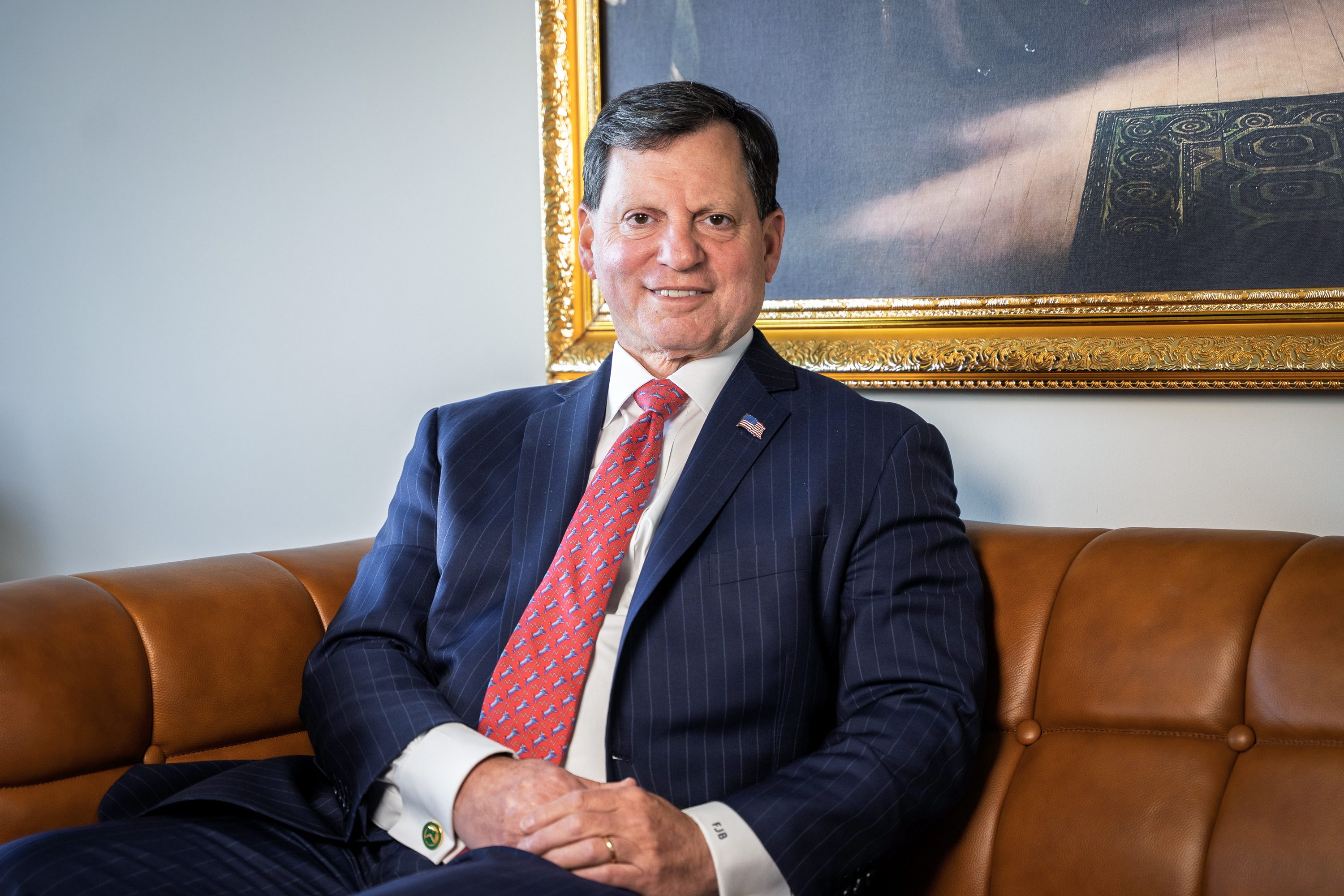
J.P. Morgan in New York City on July 30, 2025. During a nearly 40-year career in the financial services industry, Bisignano helped improve operations at big names like Citigroup and JPMorgan Chase, providing critical leadership during turbulent times. (Madalina Kilroy/The Epoch Times)
“He was an unbelievable role model in so many ways,” Bisignano said. “I like to say I was the beneficiary of my dad being an orphan, because he was so focused on how to make things better for other people, how to care for other people.”
At 14, Bisignano got his first job at a milk-and-egg store, an early gig that helped him develop the work ethic for a successful career in financial services.
Wall Street and 9/11
Bisignano began his career on Wall Street in the late 1970s, starting with a summer internship at Bear Stearns. At age 25, he became the youngest senior vice president at American Express.
He later served in multiple leadership positions at Citigroup, including chief administrative officer. At the time, Citigroup was the largest tenant in 7 World Trade Center—also known as Building 7—occupying 39 floors in Lower Manhattan.

A view of Citibank’s corporate headquarters in New York City on May 20, 2015. As chief administrative officer, Bisignano led the relocation of more than 16,000 Citigroup employees displaced after the Sept. 11, 2001, terrorist attacks. (Mike Segar/Reuters)
On Sept. 11, 2001, the building was heavily damaged by debris from the collapsing North Tower of the World Trade Center. It collapsed later that day.
Bisignano, as the chief administrative officer responsible for technology and operations at Citigroup, played a key role in managing the crisis. He led the relocation of more than 16,000 displaced Citigroup employees.
The bank lost 1.3 million square feet of office space. Despite that, most of the bank’s telecommunications systems were restored within an hour of the North Tower’s collapse. Within 10 days, all operations, except those at the disaster site, were fully functional.
Bisignano remained in Lower Manhattan to help restore market operations.
“There’s nothing more important than taking care of your people, and at that moment, nothing became more important than also getting the markets up and running while keeping the financial systems,” Bisignano said.

People flee as the World Trade Center collapses after two hijacked planes struck the towers in a terrorist attack in New York City on Sept. 11, 2001. (Spencer Platt/Getty Images)
Nearly a decade later, Bisignano faced a personal health crisis as a result of his time at Ground Zero.
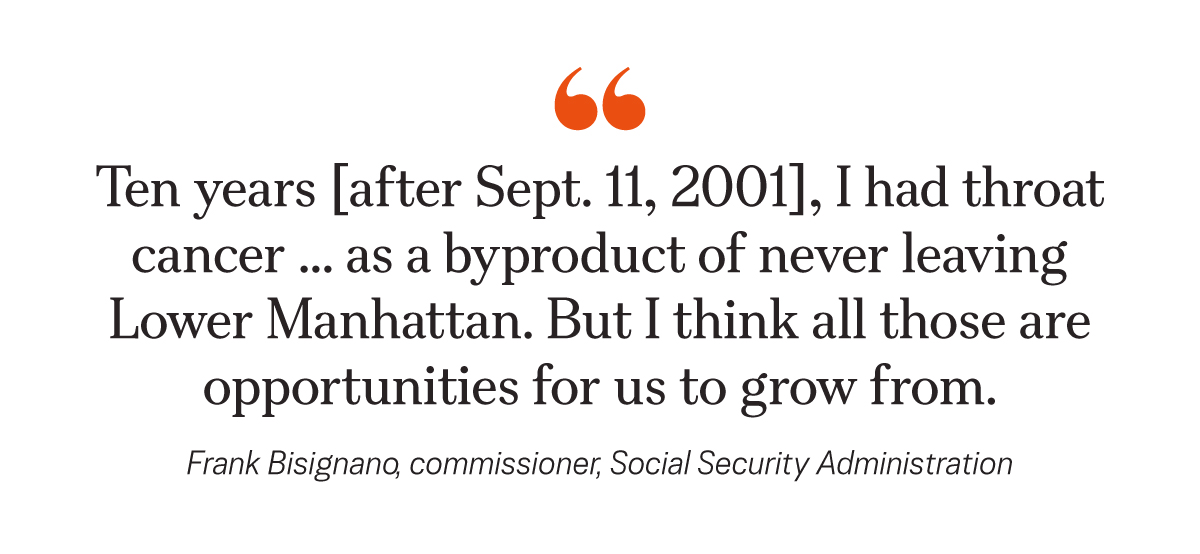
“Ten years later, I had throat cancer—and that was a clarifying moment—as a byproduct of never leaving Lower Manhattan,” he said. “But I think all those are opportunities for us to grow from.”
In 2005, Bisignano joined JPMorgan Chase as chief administrative officer, overseeing operations, technology, and real estate under Jamie Dimon’s leadership.
He later became CEO of the mortgage banking unit, where he helped the bank recover after the 2008 financial crisis. In 2011, he led negotiations for the nation’s five largest mortgage servicers in a $25 billion housing settlement to address mortgage and foreclosure issues, a role that helped reset the housing market.
A year later, he was named co-chief operating officer, a role he held until leaving for First Data in April 2013.
A Turnaround Story
Bisignano became CEO of First Data at a time when the company faced slow growth and heavy debt. The company mainly processed payments and operated much like a utility.

First Data CEO Frank Bisignano (C) looks around the New York Stock Exchange after ringing the opening bell to mark the company’s $2.56 billion initial public offering in New York City on Oct. 16, 2015. Bisignano led the company through a period of slow growth and heavy debt and later played a key role in its merger with Fiserv. (Yana Paskova/Getty Images)
Under his leadership, First Data evolved into a broader technology and solutions company. Within two years, it returned to profitability. In 2015, he led its $2.56 billion initial public offering, the largest one in the United States that year.
Bisignano played a key role in the merger and integration of First Data into Fiserv. Completed in 2019, this merger expanded Fiserv’s scale and product reach, creating the world’s largest financial services and payment technology company.
As chairman and CEO of Fiserv, he oversaw a financial giant that processed more than 250 million payments, totaling more than $2.5 trillion, per day.
Social Security and IRS
At his nomination hearing, Bisignano promised to bring to these agencies the same strategy that he has used throughout his career.
At the IRS, he inherited a department plagued by customer service complaints. During the prior tax season, the inspector general reported hundreds of taxpayer complaints citing dropped or disconnected calls, long wait times, and discourteous service.
“We’ve implemented dramatic change, and we are issuing bigger refunds, servicing the clients faster, with refunds getting out faster,” Bisignano said.

IRS CEO Frank Bisignano (C) prepares to testify before the House Ways and Means Committee in the Longworth House Office Building on Capitol Hill in Washington on March 4, 2026. (Chip Somodevilla/Getty Images)
The IRS also implemented major changes occasioned by the Working Families Tax Cut and hired more than 2,200 new customer service representatives before the start of the 2026 tax season.
“The team in IRS really responded,” Bisignano said. “I think we’re looking at the largest refund season ever, with greater technology than ever before.”
The agency’s budget for fiscal year 2027 calls for continued modernization of its information technology portfolio.
The Social Security Administration introduced its “Digital First” initiative to improve service by meeting people where they choose to engage, whether online, by phone, or in person.
The agency rolled out a new phone system in 70 percent of field offices and made changes to the 800 number system that allow 90 percent of calls to be handled through automated options or agency callbacks.
“We’re getting fewer phone calls this year than last year because of the online capabilities that we built,” Bisignano said.

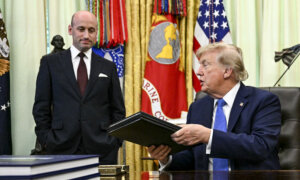
President Donald Trump holds up a proclamation with his signature, with Frank Bisignano (L), administrator of the Social Security Administration, in the Oval Office on Aug. 14, 2025. (Andrew Harnik/Getty Images)
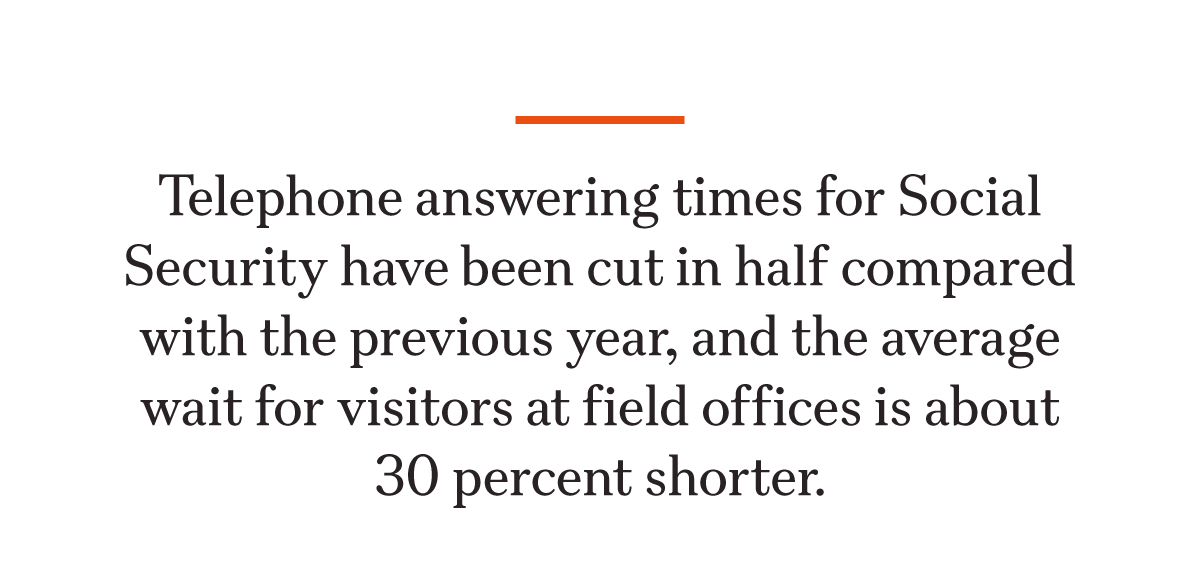
Telephone answering times for Social Security have been cut in half compared with the previous year, and the average wait for visitors at field offices is about 30 percent shorter.
“I want transformational change that is here for generations,” Bisignano said. “And to do it in a manner that the people that are in the agency grow and learn from.
“I had very strong leaders who put faith in me.”
Now, with the president’s support, his sole focus is to deliver outstanding results at both agencies.
“I came here to serve the country, and I feel that I’m doing what the president expected of me in terms of making change for the benefit of the federal government and the American public,” he said.