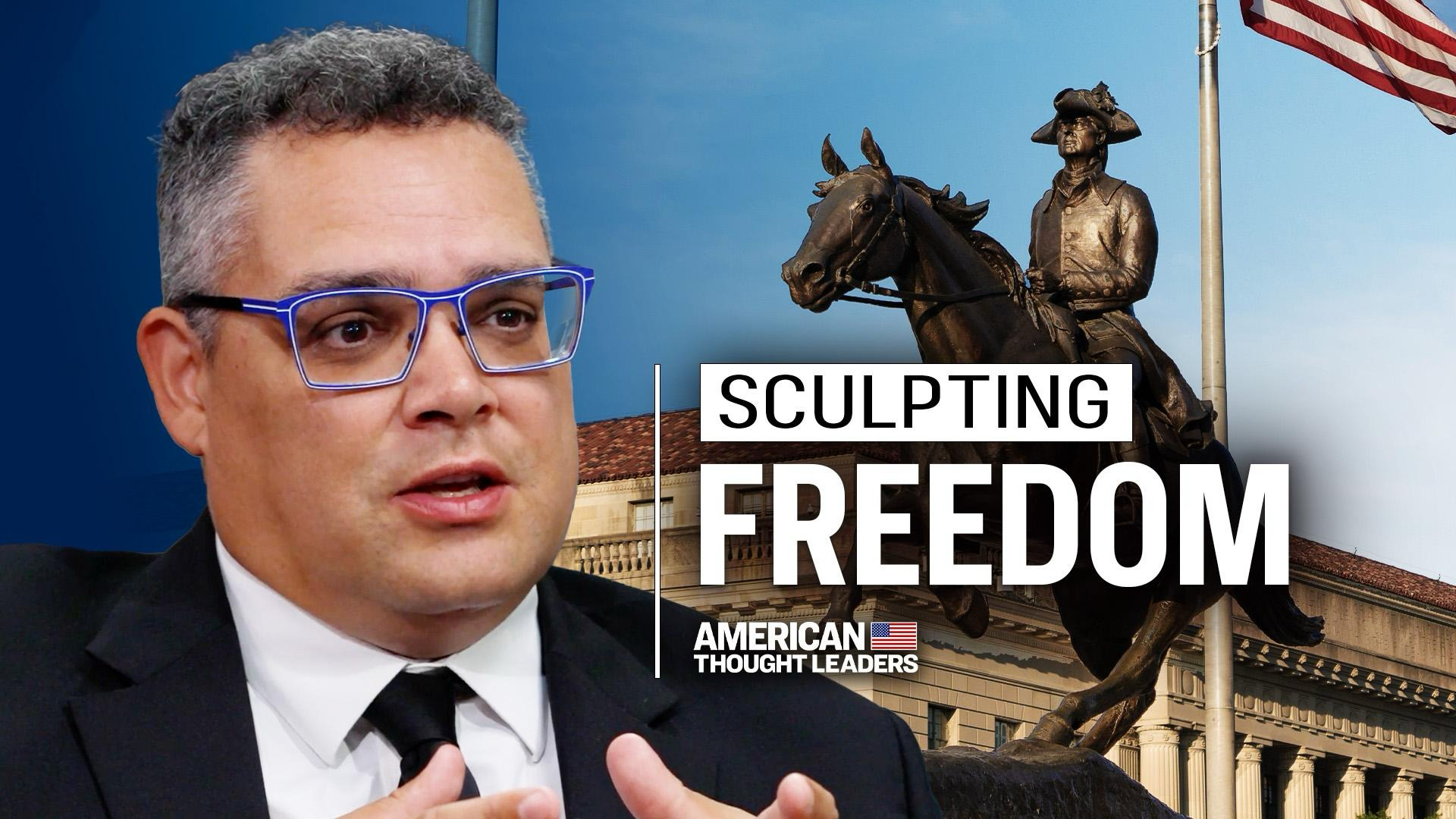

[RUSH TRANSCRIPT BELOW]It’s rare to see large-scale bronze installations built today. In Washington, D.C., as part of America’s 250th anniversary celebration, Matthew Taylor has transformed the long-neglected Freedom Plaza with a beautiful new memorial celebrating Revolutionary War heroes. He is an artist, filmmaker, and senior adviser at the National Endowment for the Humanities.
Among those featured in the new Spirit of ‘76 installation is Samuel Whittemore, who was 78 when he decided to join the Revolutionary War effort against the British.
“They bayoneted him 13 times. They shot him in the head and left him for dead, and yet he lived another 18 years to the age of 96,” says Taylor.
“The great thing about these soldiers is most of these people either don’t have statues [or] are not very well-known, and this shows that this is the common citizen,” he says.
These were “ordinary people doing extraordinary things to help create and build this nation,” he says.
The equestrian statue of Caesar Rodney—which had been taken down in Wilmington, Delaware, during the 2020 Black Lives Matter protests—is now also on display on a new pedestal in Freedom Plaza.
He epitomizes the extraordinary determination of those who secured American independence.
“He had facial cancer and emphysema, and he rode 80 miles overnight in a storm to sign and … be the tiebreaker, Delaware, which would ultimately create the Declaration of Independence,” Taylor says.
Views expressed in this video are opinions of the host and the guest, and do not necessarily reflect the views of The Epoch Times.
RUSH TRANSCRIPT
Matt Taylor:
Welcome to Freedom Plaza, right in the monumental core in Washington, D.C. The primary part of the plaza right here is actually a giant map of Washington, D.C. You see, it’s marble and granite. There are quotes all over. This has all been restored by the National Park Services. This whole park was a complete disaster. You couldn’t read the reliefs; you couldn’t see anything. It was plagued by skateboarders. Then they came in and cleaned every single piece of the park.
Jan Jekielek:
And this is astonishing. And I didn’t realize that this was kind of a scale map.
Mr. Taylor:
It’s a time map. It’s really cool. You obviously have it lined up with the White House to the Congress. And you have, you know, again, all of these beautiful lines and movements and places like that. So, yes, it’s really, really beautiful. So, right here we have a fountain that has not been on for 17 years. The park services, of course, have been all over the city cleaning up parks, turning on fountains.
So we go from the fountain here, and we enter into the British prison ship martyr exhibition or installation. What this is, is this is a giant ship. These are panels that are similar to, say, pieces of the Berlin Wall. As you can see on one side, these are the external parts of the ship.
Mr. Jekielek:
So pieces of the Berlin Wall, as in, you know, pieces of the ship as a kind of memorial now?
Mr. Taylor:
Is that the idea? About this, I’ve gone all over the world and seen these pieces of the Berlin Wall that represent the horribleness of communism.
The prison ships were British hulks that sat in the harbor around New York, and they had all the patriot prisoners in them. More people died in the prison ships than died in combat. So now you could give up the cause, and you would be allowed to return as a British citizen, but the people on these ships did not. They decided to hold to their cause, and they died for it.
I think almost 12,000 people died on these prison ships. Of course, the most notorious one is the HMS Jersey. We wanted to memorialize these prisoners of war and show you what it was like to be inside the ship. On these reliefs, it’s the story of all of the prisoners, and there are various reliefs at various heights. As you can see, they’re suffering and dying in these horrid situations.
Mr. Jekielek:
And so, where does the artwork come from? Like, where do these scenes come from?
Mr. Taylor:
So, I drew them. I drew them by hand. I drew how the bases would be designed, all the colonnades, all these kinds of rope details. And yeah, and then they were fabricated in bronze in France. And then, of course, we had these beautiful bases made that match the beautiful plaza. Actually, a really interesting feature is that there’s a time capsule for Martin Luther King that will be opened in 2080, which kind of extends the reason the plaza exists in the first place—to commemorate Martin Luther King.
But as you can see, all these different things, it’s great because as the sun comes up, it starts to illuminate the various reliefs. And this one here shows faith within a situation that’s terrible. And the nice thing is, you can come and you can feel them, and they’re very. So once you leave the prison ship, this brings us to our main attractions here.
One of the most amazing parts of the Spirit of ‘76 is Caesar Rodney. Caesar Rodney was a statue that was actually taken down by the government of Delaware in 2020 during the summer of love. And he was put in a box. And the question is always, well, who’s Caesar Rodney? He was extremely critical to how the Declaration of Independence would come to be.
During the formation of the Declaration, there was a deadlock in the Delaware delegation, and it had to be unanimous. He had facial cancer and emphysema, and he rode 80 miles overnight in a storm to sign and break that, to be the tiebreaker, Delaware, which would ultimately create the Declaration of Independence. He is absolutely critical to the formation of the United States.
This statue was in Rodney Square in Delaware, and they took him down and put him in a box. I went out and found him with the help of some amazing local officials in Delaware who also support Caesar Rodney. And we brought him here, we built this beautiful pedestal for him. The Park Service has actually built this pedestal, and we put him up. He’s 3.7 tons, he’s 14 feet tall, 14 feet long, and six feet wide.
He’s an equestrian statue that’s a very technically designed statue because you have to counterweight towards the back because the front hooves are up. So it was wonderful that Caesar Rodney could ride again. I wish I was actually there when he was riding down the highway on the flatbed down 95 to come to us. Then he was installed in April by a giant crane. He is the beginning of this, of the major part of the Spirit of ‘76 exhibition because his ride right here starts the story.
That brings us to the main part here. We have 12 soldiers of the Revolution. There are six black patriots and six White patriots, representing an actual massive number of African Americans who participated in the Revolutionary War for the state of independence. And what’s great about these soldiers is most of these people either don’t have statues or are not very well known.
This shows that this is the common citizen, right? Ordinary people doing extraordinary things. Things to help create and build this nation. And so we have some stories over here, right over here. One of my personal favorites, Samuel Whittemore.
Samuel Whittemore was 78 years old and a retired veteran. And of course, the British showed up and he got his weapon and he decided to face off against them. They bayoneted him 13 times, they shot him in the head, and left him for dead. And yet he lived another 18 years to the age of 96 years old. I’m afraid to bang my knee on the coffee table. One of the cool things about a lot of these statues is that they’re in action and in movement. A lot of statues tend to be very serious.
Mr. Jekielek:
He’s pulling his sword out.
Mr. Taylor:
He’s getting ready for combat. That’s one of the nice things is that you have these panels that we designed, which tell their entire story for each of these soldiers. One of our youngest folks who joined, this is Simon Knowles, and he joined at 15. He would go through all the major conflicts with George Washington. He enlisted at the age of 15 and served through the entire American Revolution.
He fought in the Battle of Bunker Hill, crossed the Delaware, saw combat at Trenton, Princeton, Saratoga, and endured the bitter winter of Valley Forge. And so he went all the way until 1783. And of course, he would only inherit this one from his father, this heifer, and that’s what we like to show. He’s the youngest soldier we have here.
We also have, again, a number of amazing black patriots who are here. We have Salem Poor. He was born enslaved. Poor purchased his freedom before the war. He is remembered for his heroism at the Battle of Bunker Hill, which was so exceptional that 14 officers signed a petition requesting that Congress grant Salem an award for his actions, stating that he, an enlisted man, quote, behaved like an experienced officer and a brave, gallant soldier. Poor later fought at White Plains, Saratoga, and Monmouth, and then endured the winter at Valley Forge.
It’s really wonderful because if you actually look at the various details, you‘ll see flint on the rifles. You’ll see all these bits and pieces when you come and see the statues. They’re very, very detailed, and they’re very, very heroic. As you go through, there’s a real reason to go to each statue and pause and ponder these heroes who, again, were ordinary people doing extraordinary things. The 1700s were not kind to anybody. It was a very difficult time to be in. There were diseases and all sorts of other things.
One of my personal favorites over here is this gentleman with the rifle, Naphtali Daggett. When the British unexpectedly attacked New Haven, Connecticut, in 1779, Daggett, a professor at Yale College, grabbed his musket and advanced with 100 students towards more than 2,000 British soldiers. They fired on the British, delaying them until New Haven residents escaped to safety. The British eventually overpowered Daggett and tortured him with bayonets. More than a year later, he died of his wounds, a citizen soldier to the end.
This guy was just a professor facing 2,000 British soldiers. He and his students grabbed their guns. Remember, it would take, what, 10 minutes to load a rifle at the time. That is an extreme amount of bravery when you’re facing off against the most sophisticated, most deadly army in the world. As you can see, he’s in action. You can see the flint in the rifle. You can see he’s about to pull the trigger. This is a wild story, and the thing is, you know what? They’re all wild stories. These are all crazy stories of people who just had to step up.
Then you finally come to the pinnacle piece, and this is the Spirit of Liberty. The Spirit of Liberty is essentially a 21st-century icon that follows in the tradition of the Statue of Liberty and the Statue of Freedom, which is actually on top of the Capitol right over there. She holds an exact copy of the Declaration of Independence in her hand. It’s exact—all the signatures, all the language, everything. She holds a sword out, showing that this was the battle we had to fight for freedom.
The base of this statue starts with, of course, the title, the Spirit of Liberty, and a quote by George Washington: “The preservation of the sacred fire of liberty and the destiny of the Republican model of government are justly considered as deeply, perhaps as finally staked on the experiment entrusted to the hands of the American people.
As we walk this way around the base, we get to see and experience the entire Revolutionary War in relief. First, we have the signing of the Declaration of Independence, and then as we move to the back, we have the famous crossing of the Delaware. So, the beginning, the middle, and then finally we have the surrender at Yorktown. She embodies all of the principles for which all of these soldiers fought. She is that icon.
And so I really wanted this icon to inspire the next generation. I also want to show that we can build things like this again. We can do this. You know, it’s been long thought that America’s building days are behind it. It’s all about everybody else. China and Dubai can do all these things. This is just the beginning of what is an amazing era of returning to large scale sculptures, large scale installations. And that’s really what this whole entire plaza represents.
Mr. Jekielek:
So, my understanding is that you were trained in sculpture, but this is actually your first production.
Mr. Taylor:
Yes, it’s actually really interesting because when I went to art school, I had already, I always built things as a kid. I mean, I built, I designed giant buildings out of foam core and I always made things with clay. I was very active in making my own toys and things like that. When I went to art school and I decided to become a sculptor, because sculpture does not have a real definition of what sculpture is, it can include many mediums.
Usually, when you’re a painter, you’re following up on applying paint to something in some way. Sculpture could be anything, it can be conceptual. It can be physical. It can be all these things. So while in art school, I was actually trained to MIG weld, TIG weld, and build things.
One of the projects I did do was, with my roommate at the time, a two story tall replica of the St. Louis Arch with a knot at its apex out of steel and concrete. We did actually build that. It was about 1,500 pounds and nearly two stories tall. We dug the holes, created sonotubes, welded all the steel together and built this giant structure.
I had all the principles of understanding how to actually do the physics part of it and do the structural engineering part of it and building things. And so I would eventually kind of turn into filmmaking, but filmmaking is sculpture. I did a lot of work with algorithmic art in the late 90s, but it was all sculpture.
Mr. Jekielek:
What is algorithmic art?
Mr. Taylor:
We would write algorithms that would actually make art or would convert one type of data to another type of data. So I was very interested in these things as sculpture. And I was interested in cinema as sculpture. I mean, to me, sculpture implements time. And so if you have a static object as you move around it, that expresses that narrative, right? It changes from your perspective.
For me, film was the inverse, where you actually stay in one place and the camera moves. It just flips the relationship. It’s just an inverse of sculpture. And so, a lot of my film work tends to follow these rules. There’s a lot of kind of movement, as if you were thinking of it sculpturally. So, ultimately, I consider myself a sculptor above every other title and job that I’ve ever done. And so, yes, I sit down and I still build everything by hand.
In a lot of my movies, I make my props by hand. I like pulling out the glue and the scissors and the printer paper. And I just have loads of art materials, and foam core is my favorite material. And I just love pulling out the X-Acto blade and cutting and putting things together. And so, yes, I am a sculptor, 100 per cent all the time.
Mr. Jekielek:
You say that everything for you is sculpture. Are political campaigns sculpture? Because this is obviously something that you’ve been involved in quite deeply.
Mr. Taylor:
That sculpture is a mindset in space in some ways. It’s your building. You’re building things. Some people, I’m sure a painter would think of it as a painting, and a sculptor would think of it as a sculpture. But the thing about sculpture, again, is it’s very broad. I’m a big Duchampian. This is one of those things that’s well known about me. I made one of the definitive movies on Marcel Duchamp. And Duchamp’s core, one of his core theses, was everything is available as art, right? Everything’s available. It can be this material, it can be an interaction. Of course, it would spawn the entirety of the 20th century and into the 21st century.
So I think that there is always an artistic and creative element to how you kind of like assemble things. And I think campaigns can have that aesthetic rhythm, and that you have different days where you put out this press release and you do this thing, and you have the candidates say these things. It becomes a symphony. It becomes a structure, you know, and a very good structure wins elections.
Mr. Jekielek:
You know, we haven’t ever talked about this, but let me tell you what struck me, right? I have this visceral dislike for that viewpoint of art, in a sense, right? And, like, for example, you know, the famous Duchamp’s urinal, right? I find that piece mildly offensive, okay? Now, but here, and of course, you said you’re this Duchampian. On the other hand, I find the spirit of ‘76 installation unbelievably beautiful and fascinating and inspiring. And it’s just incredible to me. And of course, I’ve known you personally for quite some time now. So I find it hard to reconcile these things somehow.
Mr. Taylor:
Yes, well, you know, it’s funny. I hear this quite a bit, actually. Duchamp said, I contradict myself to avoid conforming to my own taste. So, I think the point is this: Duchamp’s purpose for the fountain piece was to test liberal ideology. How liberal are you? Are you willing to put this offensive thing in an art show? And they were not. That’s the story, right? The story is told in my movie, actually, really succinctly. And I think for Duchamp, you know, I think a lot of people think...
Mr. Jekielek:
So, it was almost performance art, actually.
Mr. Taylor:
Well, he is performance art. I mean, he’s testing the system, right? Saying that this is what we think and these are the rules, and we’re very open. So he said, how open are you? So he put a urinal into the art show, which at the time was the most offensive thing he could find. And the system broke.
And so I don’t see that as any different than how our revolutionary soldiers broke the system. He’s testing the system. He’s a both/and guy. He loves classical, and he loves contemporary. Don’t become either/or. You can appreciate both. You know, you can like both vanilla and chocolate ice cream. There’s not just one ice cream.
Duchamp, I don’t even think, really thought of the pieces as pieces. He even says it himself. You know, his sister went in and cleaned out his apartment and threw away all the ready-mades because she thought they were just junk. And he appreciated that, you know. So there’s a humor to the work.
This is a man who’s growing up in 19th-century, 18th-century, into 19th-century and 20th-century France. When you’re surrounded by all this beauty, you are probably looking for something different. I think with what we’re doing, it’s no less rebellious today. How is the spirit of ‘76 any less rebellious? If you’re tearing down statues in 2020, that is the establishment. This is the urinal. This is what it is. We’re defiantly saying, no, this is the beauty.
Mr. Jekielek:
But it’s reclaiming the tradition. It’s reclaiming the beauty. That to me is profoundly different, if I may, right?
Mr. Taylor:
Yes, but I think the spirit is similar. I think that the beauty of an artist like Duchamp is that he liberates creative people, but he also lets the market determine whether it survives. It was very important to him. He said the audience is just as important as the artist. That is what is missing from the contemporary art world today.
They say, we make the art and you’re the audience and you’re dumb. Duchamp wrote in his 1958 Creative Act essay that the artist is just a medium, and the audience completes the work, which means if the audience doesn’t like your work, you’re out. That’s a free-market capitalist for all intents and purposes.
Mr. Jekielek:
Well, no, and I also understand where some of your love now comes from it because he’s effectively democratizing.
Mr. Taylor:
Yes, he’s democratizing. And I’m very pro-democratization of artwork, you know, and I think the market will determine who lives and who dies in the space. I think architecture is a little bit different because architecture is much larger scale, and it operates on a public space level. But I think a lot of smaller artworks, and, you know, a lot of people just like what they like. They don’t know why they even like it, you know? So, and I don’t always like it. You know, I’m not like a huge country music guy, you know, but my wife is. And if she likes country music, then I think that’s wonderful.
Mr. Jekielek:
So, you’ve really had a very broad career. And I alluded to it earlier, you’ve done sculpture, you’re trained as a sculptor, you’ve made films, you’ve done modern installation art of a variety of sorts. Just chart that course of your life here for me and how we get to today.
Mr. Taylor:
Well, I grew up in a really creative family. My mother was a fashion photographer, working in New York City in the 80s and 90s. My sister and I were child actors and models in the city doing things. And I grew up in a very creative household. My family would move to St. Louis in the 90s, so my dad could go to seminary.
I was just very creative. I was just making things. And my parents tended to buy me more art supplies than toys as a kid, so I had to do a lot of making my own things. Eventually, I would go to art school, and that’s where I kind of fell in love with art history. And it turns out I’m just in art school at this moment where you have the internet and the democratization of filmmaking and all of these things happening. 9/11 happens while I’m still in art school. Everything is intersecting at this moment where things are, the old guard is being wiped out.
You’re really seeing the same thing happen today with AI. It feels exactly the same. And Duchamp resonated with me at that moment in time because at his moment in time, in the early 20th century, you had non-Euclidean geometry in the fourth dimension of space and World War I. You had all these things that were shifting paradigms and shifting things around. So I’m in my early 20s where the whole world is being reprogrammed. And so I would move back to my home area.
I was born in Alexandria, Virginia, but I moved back and was hired by the Bush-Cheney campaign as a librarian because I needed a job. I found this job just kind of shuffling tapes and making sure B-roll got to, you know, I didn’t know much about campaigns or anything like that. But it was this job, and I had an office on K Street. I ended up making two very famous TV ads that year. One of them is John Kerry’s windsurfing, and I edited that together. That became so fascinating to me.
By 2006, I had interns who had started studying my work at Harvard, and I thought, this is totally wild. I found the political space really fascinating and kind of liked the effects that these almost small things could have globally. So eventually I would get into filmmaking. I did a show for the Discovery Channel on the Military Channel called Battlefield Diaries. I felt that I kind of really liked long-form, so eventually I would kind of move into long-form, and I went to work at Citizens United and made many movies with them. I really learned a lot there and, of course, worked on Citizens United vs. FEC [Federal Election Commission], that notorious case, which kind of changed everything. But I never stopped making artwork.
I made short film after short film, mostly with ballet dancers and fashion models, and continued to make tons of art projects. So I had these two dual tracks where I worked in art constantly. I was in a band. I did performance work with motion sensors. I used to wire myself up and perform in local places with a band in Washington, D.C., wearing an English bowler. I would go under the name Dr. Bacon, and I would mix video by moving in motion. I made all these just wild short films and big performance pieces. So I would do that at night, and then I would work on K Street during the day.
But the art always informed everything else. It always informed; the creativity always informed all the other day job work. And I actually think, I have this kind of view that corporate work is important. People say, oh, it’s soul-sucking and soul-crushing. I actually think it’s really important because it puts boundaries on your creativity and it tells you when something needs to stop. Because you can work on a piece indefinitely, forever.
You can work on a documentary for 50 years. There’s always another interview. You can always do more editing. At some point, you have to be able to release the piece. And I think for a lot of artists, that becomes very difficult because as long as it’s not finished, it can be perfect because it’s in limbo. It can be perfect because it resides in the mind. Because once you release it to the public, it’s in the public’s hands, and they will tear it apart or they'll ignore it. People just go, oh, that’s cool, after you’ve poured all your soul into it.
So I think that, like, you know, when you work in the corporate space, it gives you the opportunity to understand, when you work with clients and deadlines and things like that, how to not make perfect the enemy of the good. So, yes, I would just continue doing that for many, many years. I’m a sculptor and I’m an artist first. I’ve done 150 short films, I think, that are, you know, they range from completely non-objective to comedy shorts and things like that. So there’s a lot of different things that I’ve worked on and done.
Mr. Jekielek:
And then, you know, The Creepy Line, where we met, which was an absolutely fascinating film.
Mr. Taylor:
Yes, The Creepy Line. The funny thing about The Creepy Line is it had more support from the Left than the Right on that one. You know, like it’s really interesting to see. You know, The Creepy Line was one of those interesting films because I love technology. Like, I love it. It’s going to hate me. I’m a big pro-AI guy. I think it’s really fascinating. I see it as a tool. And again, I see it as democratizing for many reasons. But on the other hand, there’s always a dark side to technology. It’s a double-edged sword. Nuclear energy is great, and nuclear weapons are dangerous. But there are a lot of the same things.
Mr. Jekielek:
Is there something about The Creepy Line? The Creepy Line is, of course, about that place where basically manipulation is what the creepy line is.
Mr. Taylor:
Well, it’s funny because now it feels quite quaint compared to what we’re facing.
Mr. Jekielek:
That’s exactly what I was going to say. But at the time, we’re talking about where is the point at which Big Tech is starting to manipulate people? Where is that point? And now you’re thinking to yourself, it’s all manipulation.
Mr. Taylor:
Yes, I mean, we were just looking, and a lot of people had talked about privacy and things like that. We were looking at whether you could tip elections, whether Google or Facebook could have an effect on elections. We were early, we were in 2018, and I just remember people saying, well, who cares if they know how much soda you drink? Literally in an interview, they’re like, what’s the big deal if Facebook knows how much soda you drink? And I was like, it’s a huge deal. These are metrics that you can use in a campaign to affect people’s opinions.
At the time in the film, we said that these companies were collecting your data to model something. We didn’t know what it was; it’s in the film. We were like, they’re modeling something forever. And here we are now. It’s been eight years or ten years maybe, and we know what they’re modeling. It’s these AI models; it’s what they’ve been working on for many, many years. And we were studying the effect of how these companies were affecting teenagers and people’s opinions and the lack of transparency. And again, at the time, it was terrifying, and now it’s like we’ve arrived at some of the dystopia that we were talking about, that people thought we were crazy back in 2018.
Mr. Jekielek:
So, given this whole kind of varied run, how is it that you end up working, basically, on the beautification of Washington, D.C., I guess would be a way to put it?
Mr. Taylor:
I’m at the National Endowment for the Humanities, and it’s the 250th anniversary of the United States, and I was actually very excited to participate in that. I was in and out of D.C. for 17 years. It’s my home. D.C. is unique in so many ways. It’s a very kind of European-style city. It’s very beautiful. It has a monumental core. I’ve lived in New York and Boston and all these other places, but there is something distinctly unique about Washington, D.C.
It’s really a great honor to be able to come here and build things in the core and build and add to the beauty of Washington and the narrative of D.C., especially in this way. There are not a lot of places where you can do this, where you can just kind of merge into traffic these large-scale, kind of classical sculpture pieces. And again, I’m a both/and guy. I love modern art, and I love classical art. I love both.
I think that this city is a classical city in many ways. New York City is a more modern city. There are more Le Corbusier glass boxes. Here, it’s more the L'Enfant-McMillan plan and things like that. So, it’s really cool to be able to come here and participate in the 250 and participate in building things. We are in an era right now under this administration of building big things. Building big things is something that people have forgotten we can do in America.
Mr. Jekielek:
Right. And I was thinking, I mean, not that I had forgotten, but I wasn’t necessarily expecting it because we haven’t, it hasn’t been done much.
Mr. Taylor:
And I look to defy that. That’s my Duchampian attitude. Defy these things. I don’t believe that. I don’t believe that we aren’t going to build big skyscrapers anymore. I don’t believe that we’re not going to build coliseums or gardens or these things that are beautiful, modify our public spaces to be amazing. I defy that, and I decided I would like to participate in building those things and bringing those things back.
Mr. Jekielek:
I understand this whole installation, from conception to implementation, was a pretty tight timeframe.
Mr. Taylor:
It was. It had to be done before the 4th of July, and so we had to come up with ways to do it more quickly. But again, we use technology. You know, this is why I think technology is wonderful. We use technology, we use democratized technology, to build classical statues. To make a statue, typically, it’s 8 to 18 months. But with things like 3-D printing, CGI models, and Form-Z software, you can realize these large structures in a much quicker timeframe, and that was so fascinating to me.
A lot of what we did for Freedom Plaza was, in some ways, the first of its kind. It was experimental; it was just as sophisticated and forward-thinking as any other forward-thinking technology. We just happen to be doing it in classical statues. We’re using the latest, greatest, cutting edge. As we move forward, we'll continue to look at the new technologies. You know, you can build a statue as fast as they tear them down now, which is something you could just never imagine. The whole act of destroying a statue is a statement that you cannot replace this.
That is no longer true. They can be replaced, and they can be built, and they can be structured. You know, we’re in an amazing era right now of building things, building big things, and building what you can imagine. The beauty of being an artist, you know, I imagine something in my mind and then I can make it. And I think that, you know, as we move forward, as we democratize these technologies, more people will make more statues. So they‘ll make more things. They’ll make what they can imagine, and I think that’s good for everybody.
Mr. Jekielek:
What’s the most important thing people need to know about the spirit of ‘76 as a whole piece, and especially your conception of the spirit of liberty?
Mr. Taylor:
People need to be inspired by what they see, that these are ordinary people doing extraordinary things. Like, that’s what it is. You know, we always make statues to General Washington and Alexander Hamilton. It’s always like these amazingly massive, almost mythical people. What we did, we have a mythical person, but even he’s a lesser-known Founding Father. There are a lot of signatures on there.
We took all these guys who you may not have heard of, you may never have seen, and we said, they’re just like you. Like, they’re just like you. They were just like, we got a teacher, and we got another guy who’s like, you know, worked on a boat or whatever, and they are inspiring people to be extraordinary. That’s what statues should do.
I hope when you walk out of Freedom Plaza and have seen the Spirit of ‘76 exhibition, you’ve come away educated. America is democratizing freedom. I mean, that’s the theme through this whole conversation, right? The democratization of freedom, of rights, and all these kinds of things. They were done by regular people who had an idea in their mind and then brought it into the world. That is a beautiful thing, and that’s why these statues exist.
Mr. Jekielek:
So, bottom line, how did this piece come to exist? There were a few approvals that were needed, let’s just say.
Mr. Taylor:
Given how much we know about Washington, D.C., well, this is the brainchild of Vince Haley, who had domestic policy and counsel in the White House. He is the champion of this whole project. He really had a vision to resurrect Caesar Rodney and to do the 12 soldiers of the revolution and to do something on the prison ship. He called me up and said, these are the things, like in Freedom Plaza. And then he let me as the artist run with it.
And that’s what was amazing. He was very supportive. I’m eternally grateful to Vince Haley for allowing me to sit there and take my drawing pad and draw things up and be like, this is what I think it should be. And he’s like, that looks great. He’s like, now go build it. And so we did.
Mr. Jekielek:
Well, Matt Taylor, it’s such a pleasure to have had you on.
Mr. Taylor:
Oh, I love coming. I can come anytime you like. It’s great to be here.
This interview was partially edited for clarity and brevity.