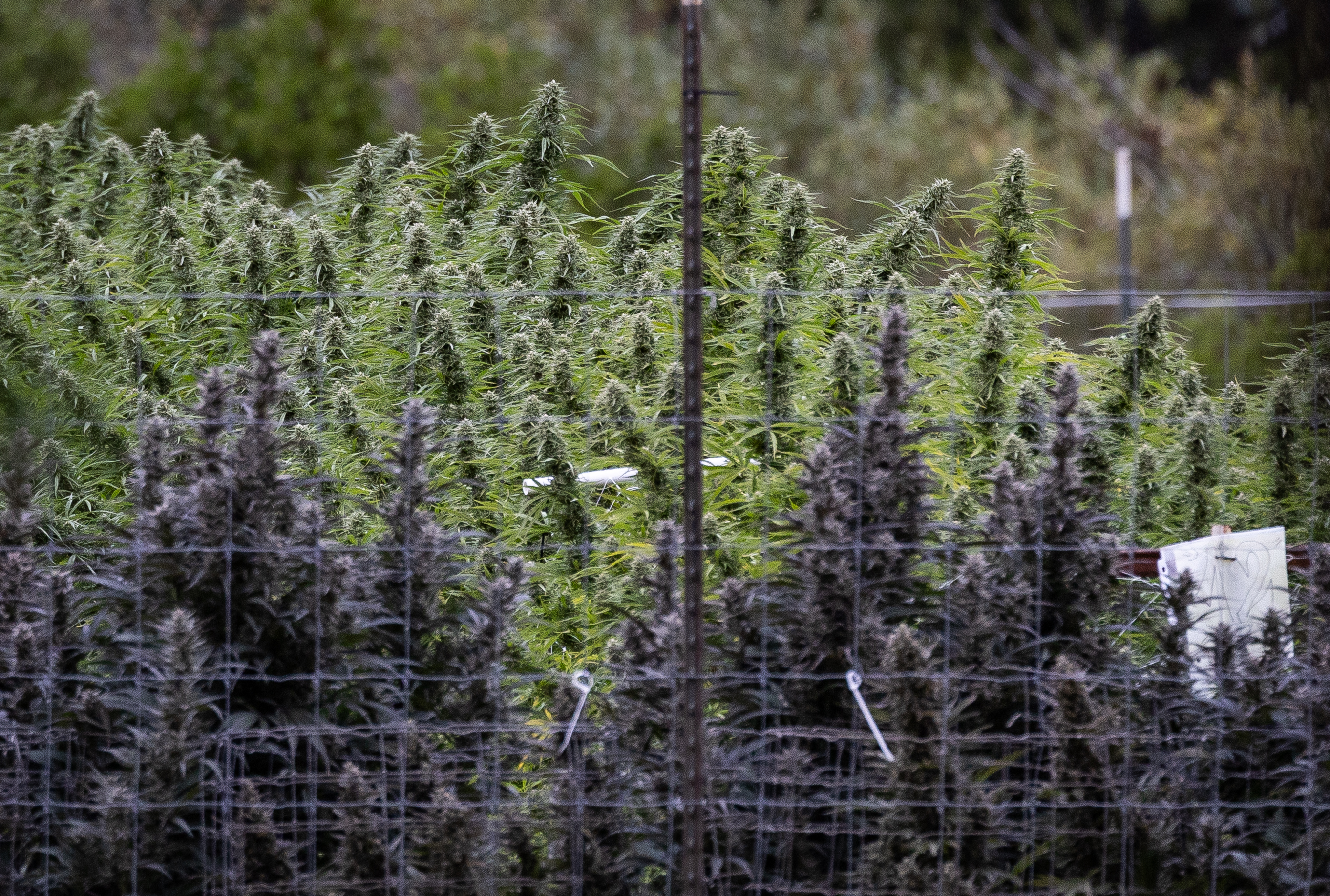

Cannabis legalization in the United States has been associated with increased hospitalizations due to cardiovascular issues, including heart attacks, according to a recent study.
The peer-reviewed study, published in the journal BMJ Open on Oct. 22, looked at data from more than 50 million hospital discharges between 2012 and 2018 in the western region of the United States, where by 2018, 98 percent of the population lived in or bordered a state where cannabis use had been legalized.
It found that the legalization of recreational cannabis sales in the region beginning in 2014 was linked to an increased rate of hospitalization for heart failure, myocardial infarction (heart attack), and atrial fibrillation, compared with regions whose states did not broadly legalize cannabis. Atrial fibrillation is an irregular and rapid heart rhythm.
Specifically, each year of legal cannabis sales was associated with a 2.3 percent increase in hospitalization rate for atrial fibrillation, a 3.1 percent increase for heart attack, and a 3.7 percent increase for heart failure, the study said.
The western region includes Alaska, Arizona, California, Colorado, Hawaii, Idaho, Montana, Nevada, New Mexico, Oregon, Utah, Washington, and Wyoming.
Individuals admitted to hospitals in this region were a median age of 51, compared with a median age of 55 for other regions. The people from the western region also tended to identify more as Hispanic, Asian, or Native American and less often as black or white compared with other regions.
“Our findings support a cautious approach to legalisation laws accompanied by data collection on CV outcomes,” the study said, referring to cardiovascular (CV) issues. “Specifically, we believe our results support the proposed US federal reclassification of cannabis from Schedule I to the less-restrictive Schedule III to allow for research clarifying the CV effects of cannabis.”
Schedule I and III are two of the five categories of drugs and certain chemicals under the United States’ Controlled Substances Act. Schedule I contains drugs with high potential for abuse. The Trump administration is exploring rescheduling marijuana from Schedule I to Schedule III. In April, Food and Drug Administration-approved marijuana products and cannabis items regulated by a state medical marijuana license had already been shifted to Schedule III by the administration.
“As legalisation progresses globally, future investigations might include prospective policy experiments to obtain precise estimates of the magnitude and timing of the CV outcomes associated with legalisation and whether cannabis formulation modifies its impact,” the study said.
In an Oct. 22 statement published at EurekAlert, the BMJ Group, which owns BMJ Open, said that before cannabis legislation was passed in the western region, hospital discharge rates for illnesses analyzed in the study were lower than in regions without the legislation.
“These rates rose faster after legislation,” the statement said.
The project was funded by grants provided by the National Institutes of Health to two authors, who declared that they did not have any conflicts of interest.
A total of 40 states, the District of Columbia, Guam, Puerto Rico, and the U.S. Virgin Islands have policies allowing medical marijuana use. Recreational use is allowed in 24 states, the District of Columbia, Guam, and the Northern Mariana Islands, according to a March report from the Congressional Research Service.
Other Research
In addition to the United States, an increase in cannabis-related hospital admissions has been observed in Australia.
According to an Oct. 11 study published in the journal Addiction, looking at 40,000 cannabis-related admissions in Victoria’s public and private hospitals, there was a 49-percent jump in such admissions in the decade ending 2022–2023. Psychotic disorders, which can involve hallucinations, made up 40 percent of the hospital admissions primarily linked to cannabis.
Meanwhile, rising cannabis use has been linked to increasing cases of cannabis use disorder (CUD) among American adults, according to an Aug. 19 study published in JAMA Psychiatry.
The study analyzed data from a health survey conducted between 2021 and 2024. Among men aged 18 or older, past-year CUD prevalence jumped to 9.3 percent from 7.3 percent across that period, in parallel with a reported rise in cannabis use during those years. A similar trend was observed in women.
According to the study, the findings “repudiate conventional assumptions that cannabis carries a low addiction risk and that most young adults with CUD have mild symptoms.”
A Sept. 28 study from the journal Epilepsia found that frequent use of cannabis among people with hard-to-treat epilepsy was associated with greater severity in the illness and other related health burdens.
Among frequent cannabis users, the time taken from onset of epilepsy to epilepsy monitoring unit admission was five years, compared with more than 18 years among nonusers.