
When Santa Monica business owner John Alle was attacked in September 2023 by a homeless man in Pacific Palisades Park, he was there to document the city’s homelessness crisis. Alle’s jaw was broken and his phone stolen.
Nearly two years later, the homelessness crisis remains. But now Alle and fellow business owners in the Los Angeles County city have taken the problem into their own hands, launching in June a voluntary family reunification program through the Santa Monica Coalition, a group of residents, business owners, and locals who organized to address the city’s homelessness and rising crime. Alle is a cofounder of Safe Cities at the Santa Monica Coalition.
The coalition offers one-way travel to reconnect homeless people with their families outside California.
“We’re helping people in the system that really want it,” Alle told The Epoch Times on July 17.
“They must want it. They must want to go on their own volition.”
The program focuses on early intervention. That means dealing with individuals who have been homeless for less than a year and want a one-way ticket home. The coalition specifically helps reunite individuals with families in their hometowns, so they can receive the support they need to get back on their feet.
The program launched in June and has received 500 phone calls, assisted by a hotline using artificial intelligence to address incoming requests.
To qualify, one must have an ID to travel through the airport and a family member or friend for pickup on arrival. The coalition verifies the details, and all participants must sign a waiver stating they agree to the arrangement. Funds for the trips come from donors among the coalition’s 7,000 supporters.
So far, 10 people have been reunited with family or friends via Greyhound bus rides or plane tickets, Alle said.
Many people are eager to go back home, he said, because “they don’t feel safe.”
Alle estimated that 30 percent to 35 percent of the applicants are women.
“They’re accosted,“ he said. ”They’re approached at night, during the day, they’re encouraged to get involved with the sex trade, and they don’t feel safe here anymore.”
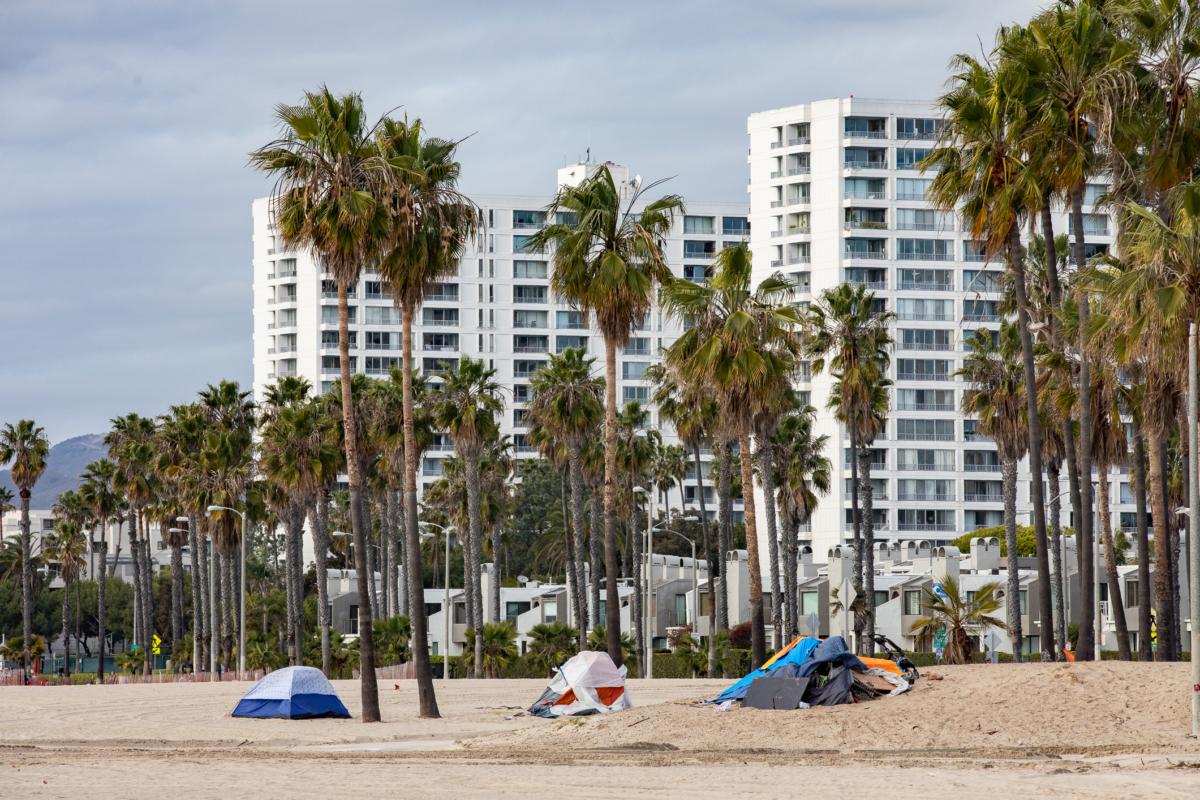
A homeless encampment in front of luxury hotels in Santa Monica, Calif., on Jan. 27, 2021. (John Fredricks/The Epoch Times)
Los Angeles’s homelessness crisis is one of the worst in the nation. The city has been under increased scrutiny, especially as an independent audit released in March showed that city officials lost track of billions of dollars allocated for housing and support for the homeless.
Los Angeles County recently reported that the number of unsheltered homeless people in 2025 fell by 9.5 percent from the previous year. The count pertains to those who are living on streets, in encampments, or in vehicles.
It was the second straight year in which Los Angeles County’s homeless total fell, dropping by 4 percent to 72,308, according to the Los Angeles Homeless Services Authority.
At the state level, billions in spending have not alleviated the problem, which led Gov. Gavin Newsom to propose a reorganization of the state’s homelessness services, set to be completed in 2026.
The coalition believes that family reunification is an improvement over Los Angeles City’s Inside Safe program and the county’s Housing First strategy.
According to Los Angeles City Controller Kenneth Mejia’s Inside Safe dashboard, the program has served 4,316 individuals and, by the end of April, had spent $450 million. That makes the program’s approximate cost per person $104,000. Mayor Karen Bass has acknowledged the high costs.
Alle compared those costs with the price of a plane ticket or a bus ride. He’s also finding that many of those living on Santa Monica’s streets can’t wait to go home.
One U.S.–Mexico dual citizen said he believes he will be safer in Mexico, according to Alle.
“One prospect yesterday told us his dad was a gang member, and his mom belonged to a cartel, and he hadn’t spoken to them in five months,” Alle said. “They’re looking for him. They’re not happy with him, but he wants to go to Mexico to be with other family members.”
People are lining up to go to Arizona, Chicago, Cleveland, Michigan, and other places, Alle said.
He said the coalition can process 500 requests in a week. Meanwhile, he said the city is more interested in dispersing information about what it can do than solving the crisis.
He said that when someone calls the city’s number for homelessness services, they must navigate an automated system that does not appropriately categorize calls—by, say, minors and adults.
“We’ve tried it over the last two weeks, and we haven’t gotten any calls back,” Alle said, adding that a call to the coalition is returned within 15 minutes.
Alle suggested that 20 percent of the local budgets should go to reunification. He is offering to work with local municipalities to show them how the Santa Monica Coalition is reuniting people with families and a fresh start, but he said he is not hearing back from officials.
“We want it used because if the city and the county uses it, everybody benefits—the homeless residents, business, everybody,” he said. “That’s our goal.”