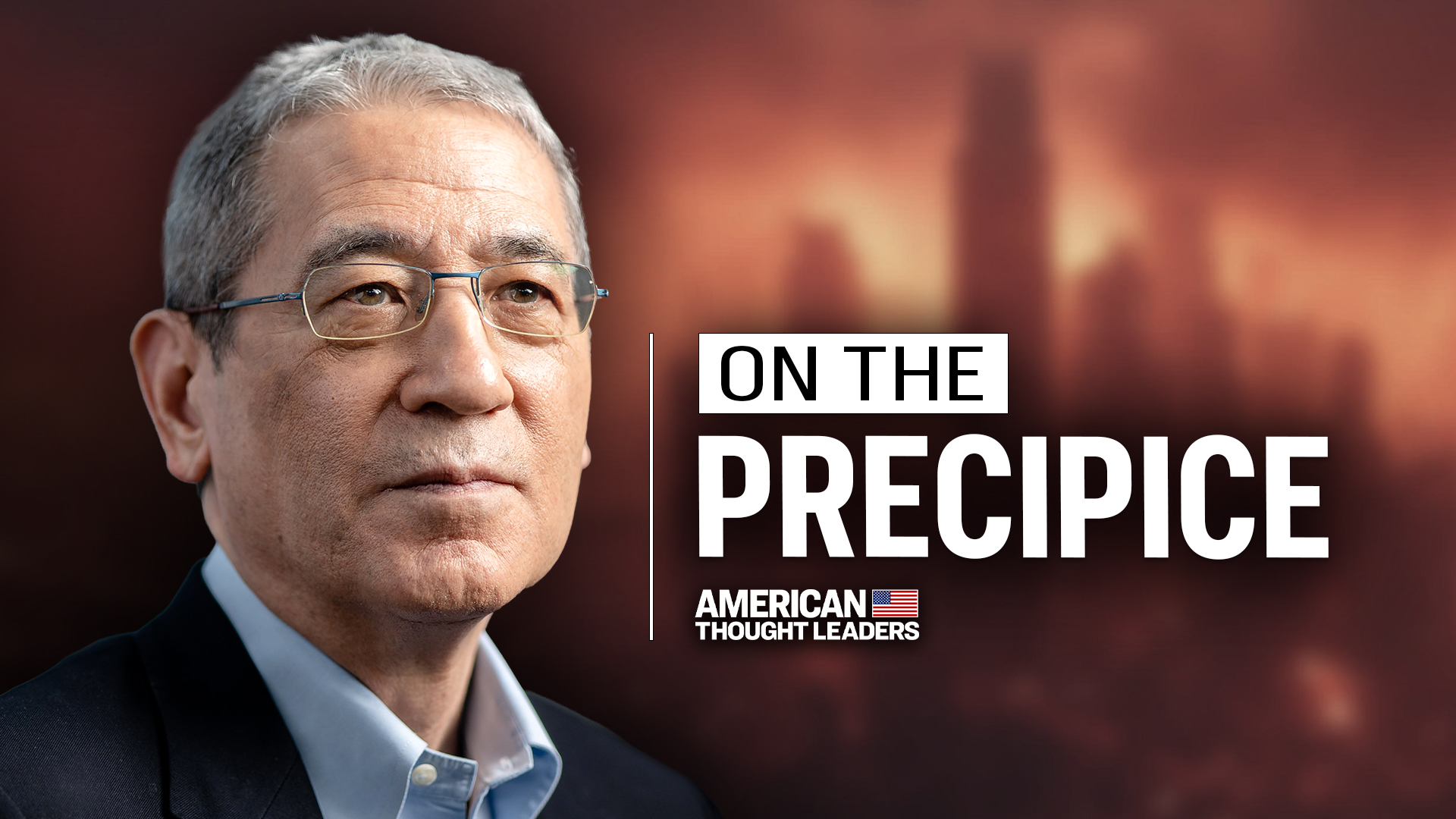

[RUSH TRANSCRIPT BELOW]Is Beijing trying to meddle in the 2026 midterm elections in America? How has Beijing’s strategy against America changed in recent months? How have China’s economic woes and military purges altered the political landscape in Beijing? And will these change Xi Jinping’s calculus around Taiwan?
In this episode, I sit down again with China analyst Gordon Chang, author of “Plan Red” and “The Coming Collapse of China.”
From Chinese biolabs found in California and Las Vegas to increasing Chinese provocations in the South China Sea and East China Sea, Chang believes the world is growing more dangerous—and Americans are not prepared.
Follow Gordon Chang on X: @GordonGChang
Views expressed in this video are opinions of the host and the guest, and do not necessarily reflect the views of The Epoch Times.
RUSH TRANSCRIPT
Jan Jekielek:
Gordon Chang, such a pleasure to have you back on American Thought Leaders.
Gordon Chang:
Thank you so much, Jan.
Mr. Jekielek:
Gordon, there’s been a lot of reporting recently about Chinese Communist Party [CCP] interference in the 2020 election. And, you know, we’re just about at the midterms right now. And I wanted to see, you know, what you think of that reporting and also, like, what you think the Chinese Communist Party is up to and whether this is a concern for the midterms.
Mr. Chang:
In 2020, as the election was proceeding, we knew the Chinese were deeply involved in trying to influence the outcomes. For instance, in the Democratic Party primaries, they were clearly on Joe Biden’s side over Bernie Sanders. And during the general election, they were supporting Biden over Trump.The New York Times was reporting China’s use of bots and text messages to try to disrupt the Trump campaign. They were floating those false rumors that President Trump was going to invoke the Stafford Act and basically try to take over the country. Clearly, he wasn’t going to do that, but they were there.
Now, in 2024, it appears that the Chinese really weren’t involved in the presidential contest, but they were heavily involved and they deployed their resources for state and local races. Right now, in these midterms, we’re only going to know later on, but I think that they’re involved because they’ve been consistently meddling in our elections because they realize how important they are in terms of determining American policy towards China. So I’m sure they’re there, but we'll only know a little bit later about exactly what these guys were doing this time around.
Mr. Jekielek:
There’s been a whole bunch of different questions I’ve had, both about what’s happening in China, the reality of the Chinese economy and its impact on us, and actually some of the U.S. policies that have emerged over the last while. The Marinara Islands, that was the only place where Chinese nationals could travel to the U.S. without a visa. And that loophole has now been closed. Quick comment from you on this.
Mr. Chang:
That loophole has been closed only because there was a Canadian who continually pointed this out to the American public and to Congress. And eventually she prevailed, and that’s Cleo Paskal. If it weren’t for her, that visa exemption would still be there. The story is not that they did this, that they closed it, which is great, of course, but that it took so long. And clearly, we’ve got a political system that is not moving with the vigor and determination necessary. So, bravo to Cleo, and not so bravo to Congress.
Mr. Jekielek:
What about the current realities of the Chinese economy? It’s actually quite concerning to me at many levels. I have a few things we could bring up, but why don’t we just start there? I mean, the impact on America could be significant.
Mr. Chang:
The impact is significant because there are two Chinese economies right now. There’s an internal one, which is imploding, and there’s the external export machine, which is doing very well right now. Overall, China did not grow at 4.5 per cent in the third quarter, as was reported. It was probably somewhere around zero, maybe a little bit above, maybe a little bit below. But that’s an average of two very different Chinese economies.
The reason why this is important for Americans is because Xi Jinping has turned his back on the property market, which once was the core of the Chinese economy. He’s turned his back on consumption. Consumption contributes something like 38 per cent, or maybe even less of the Chinese economy. That’s among the lowest in the world, and it’s getting lower. The only way Xi Jinping can maintain China is to export more, which means he is flooding the U.S. and other markets with his goods. China’s export performance has been nothing short of stellar.
Last year, the export surplus as officially reported was 1.19 trillion. It was really smaller than that because of Chinese export subsidies; exporters were faking sales, but nonetheless, it was a world record. And that means China has sold to save itself by decimating everybody else’s economy. President Trump gets credit for identifying the problem. His execution has been botched, as we all know. And Trump is going to have to do a lot more to protect the American market from these predatory and criminal trade practices.
Mr. Jekielek:
There is quite a bit less export, though, now than there was even a few years ago, from what I’ve seen, unless I’m wrong here, I mean, to the US. They’ve been flooding other markets, though.
Mr. Chang:
Yes. It’s declining. Our trade with China is declining. They’re no longer our number one trade partner, which is a good thing. But the decline in USA-China trade is less than is officially reported because China is washing its sales through other countries. And I don’t mean Chinese factories in Vietnam. That’s a real Vietnamese export. I’m referring to fake invoices, which show stuff coming from other places, in fact, manufactured in China with false invoices, all of that. So, yes, there is progress, but there needs to be a lot more.
Mr. Jekielek:
You know, I’ve seen some developments in particular in U.S. policy. For example, a very significant one is the FCC [Federal Communications Commission] banning the Chinese lab testing of U.S. electronics. It’s kind of astonishing, you know, to your point earlier, how long that’s been allowed to happen, but it looks like they’re actually stopping that now.
Mr. Chang:
Yes. And another hero here is Brendan Carr, who’s chairman of the FCC. He has been at this even before he was named chairman. He’s been working on these issues all the time. And he’s been working on Huawei and Chinese equipment in our telephone and telecommunications networks. So he’s really great on this. And the Trump administration at the agency level has been doing some really, really important things.This has been good.
Mr. Jekielek:
But maybe just, Gordon, maybe just explain to us what was happening.
Mr. Chang:
For those that might not be familiar, the FCC has banned Huawei equipment in America’s telecom networks. Now, it’s taking a long time to get all the equipment out, especially because in these local rural networks, there’s a lot of Chinese equipment and it takes a long time to sort of manage that transition.But the FCC has been very clear that this has got to happen. And then, you know, China’s been testing our electronics.This is just insane.
Mr. Jekielek:
Like, we’ve been sending our electronics to be tested there, right?
Mr. Chang:
And a lot of stuff is actually manufactured there, so they don’t actually have to send it there. But the FCC has recently ruled that China may no longer do this. So, this is important as well. These are going to be painful transitions. They can’t be done all at once, as we know from the transition rules that the FCC has implemented. But we’re moving in the right direction and we’re moving as fast as a government can. So, Brendan Carr is a real hero on this.
Mr. Jekielek:
And the Pentagon, so we’ve talked about over the years the Confucius Institutes a number of times, and they’ve been kind of removed from a whole lot of universities in the past. Then some people said they just renamed themselves and went into other institutions. That also happened. Now we have the Pentagon designating the Confucius Institutes as a national security threat. What is the significance of that?
Mr. Chang:
The significance really is a signal; it’s more symbolism. At their height, there were maybe about 118 or 120 Confucius Institutes on college and university campuses. These were basically very small operations, but they were bases of operations for Chinese agents, from all that we can tell. The most important thing was that by their presence, they were getting U.S. college administrators to actively discourage and in some cases prohibit activities on campus that offended the Communist Party.
So, you get rid of the Confucius Institute, you remove that pressure on colleges and universities to restrict First Amendment rights. That’s the important thing, and here, what you have the Pentagon saying is that if you take Pentagon money, you’re not going to host a Confucius Institute. As you just pointed out, China, under pressure, has rebranded a lot of these institutes, and they now appear in different forms on college and university campuses.
But the issue here again is going to be China’s influence in secondary schools with Confucius classrooms, because while there were, as I said, at most 120 Confucius Institutes in our country. At their height, there were 518 or 519 Confucius classrooms in our secondary schools. And that’s even more important in my book. So these are things that we have to remove.
The question is not so much the direction of Trump’s policy, but its failure to really move with the determination that’s absolutely necessary. Because, yes, we know these problems. Yes, the government’s working on them, but it’s working on them too slowly and at a point where I’m really worried about the remaining Chinese network in our country of agents, operatives, soldiers, and fellow travelers.
It’s there, and the Trump administration is not doing what it needs to. And people can say, well, he’s doing more than Biden. But the point is, the risk right now is much greater than it was during the Biden era. So we need a more appropriate response.
Mr. Jekielek:
Why is the risk greater now?
Mr. Chang:
The risk is greater now because I think China’s becoming a little bit desperate. We are seeing much more provocative Chinese activity, not only in the South China Sea and East China Sea against Taiwan, but we’re also seeing China being more open in support of Iran and Russia. I'll just give you an example.
Targeting data that Iran used to kill six American service members on March 1st in Kuwait came from a Chinese satellite. Now, I’m sure that after that, there were intense discussions with the United States, but we know 100 per cent that on July 17th, Iran used Chinese targeting data to kill three more Americans, this time in Jordan. And then we had the president of the United States saying he didn’t think that China was helping Iran.
Well, I’m sorry, but there’s a lot of evidence that they have been during the course of this war. The Wall Street Journal reported that from January to June of this year, there were 1,300 shipments of dual-use items, which were war materials. We have all of these images of Chinese military transport planes landing in Iran during the course of the war. We have a government that is not willing to tell the American people the truth of what’s going on. All of this untruth-telling has emboldened Xi Jinping to do much more. We have a much more aggressive China, which means that the urgency of removing China from our country is that much greater.
Mr. Jekielek:
I often think about how, really, the most powerful weapon that the Chinese Communist Party has is its propaganda, information warfare, and the tools it uses to effect that. And how, I guess, poor we are at responding to that. And maybe that’s part of why it’s so powerful and effective, so to speak. I know, maybe comment on that a little bit.
Mr. Chang:
China, because it’s a totalitarian state, knows that information warfare and cognitive warfare are absolutely critical to the survival of the regime.And we have, in the first months of the second Trump term, unilaterally disarmed by taking down Voice of America, but more importantly, Radio Free Asia. And that means Chinese narratives, not only in the United States but around the world, which are ludicrous, are actually gaining traction because we are not combating them.
So, this was really wrong. In general, as a society, we don’t listen to the propaganda of our enemies. We didn’t listen to Osama bin Laden, for instance. We’re not listening to the Chinese. China declared a people’s war on us, which is a phrase that had great resonance in Communist Party thought.
People’s Daily, the most authoritative publication, carried a landmark editorial in May of 2019 declaring such a conflict. And in March of 2023, PLA [People’s Liberation Army] Daily, which is the main propaganda organ of the Chinese military, helpfully defined people’s war as total war. Though we should not have needed that definition, we got it.
So, the Chinese regime is telegraphing its punches, as our late great ambassador James Lilley said. We’re just not listening. We didn’t listen to Osama bin Laden. China is much more powerful than Al Qaeda ever was.
We are a society that is not defending ourselves. And while the Chinese are aggressors and criminals, we’ve allowed them to do that. So, history is going to look at us and say, who were these Americans? Why didn’t they defend themselves? This was inevitable, and of course, it occurred.
Mr. Jekielek:
Well, there are different approaches to trying. When I look at the, you mentioned the tariff response, given that the Chinese economy, I kind of frame it like the Chinese economy is basically mainly an export economy now. And, you know, this tariff, the tariff approach is obviously created to directly address that, right, but without being perhaps as direct as, and it strikes me that a lot of, as you’ve pointed out, there hasn’t been a lot of communication about the reality of what communist China is doing from the American side. But that doesn’t necessarily mean there hasn’t been any action, which I think there has been quite a bit.
Mr. Chang:
Yes, there’s been action, but is the action appropriate for the circumstance that we now face? I'll just give you an example. There’s a lot of forced and essentially slave labor in China, and not just Uyghurs. We’ve got the Tariff Act of 1930, which bars the importation of goods made with forced labor into the United States. We’re somewhat enforcing it, but there’s a lot more that we must be doing because it’s not just the genocidal program against Uyghurs. It’s also about forced labor across China, and no administration has enforced this law. So, this is on us. We’re not enforcing our own laws.
The Chinese banks, to give you another example, have been laundering fentanyl profits. We know that. But the Chinese money laundering gangs in general have also taken over the money laundering business this decade from others around the world, and they dominate this. The Chinese gangs do this with Chinese banks. Most of this money laundering is in dollars. Every dollar transaction in the world clears in New York City among New York banks, except, of course, for paper currency, but that’s a minor question.
And yet, we know this is going on. Section 311 of the USA Patriot Act gives the Treasury Secretary the right to invoke that provision and to unplug any financial institution that is, quote, of primary money laundering concern, unquote. We’ve allowed the Chinese to launder money through our banks, including for fentanyl profits. So, we know this is going on. It’s going on in our own country. We have the power to stop it. We don’t stop it. And the question is, who are we?
This is just a fundamental failure of our governments, whether they’re Republicans or Democrats, liberals or conservatives. This is a fundamental failure of our government to enforce laws against the Chinese. It is not much of an exaggeration to say that there are two sets of laws in the United States. There’s one that applies to Americans and everybody else in the world but the Chinese, and the second set applies to China. And the second set is basically we don’t enforce our laws against China.
Mr. Jekielek:
Is it because they’ve made themselves too big to fail, i.e., we go down, we take down the global economy?
Mr. Chang:
I don’t know what it is. I’m sure people are worried about that, but we’re Americans. And if we don’t have laws, we don’t have a country. So I’m sorry, but I don’t buy any of those arguments. The Soviet Union once looked like China, too big to fail, that everyone was talking about how this was, you know, the Soviets would march on in the world. But they weren’t. They were far weaker than they actually appeared to be. And you remember in the 1970s, you had Kissinger and Carter and Nixon all promoting detente because they said, we absolutely have to get along with the Soviet Union.
Well, guess what? A guy named Ronald Reagan came around and said, My policy is simple. Some would say simplistic. And my policy is, we win, they lose. Those are Reagan’s words. We did win because we decided we would win. Right now we have decided not to win.
Mr. Jekielek:
So, Gordon, to your point, the Chinese Communist Party is engaged in one of the biggest military buildups, basically in the history of the world, from what I can tell. I see that we’re investing in shipyards, for example. The Navy is one huge example of that. I see we’re investing in some shipyards. It’s the beginning, right, so to speak. Your thoughts?
Mr. Chang:
Yes, Trump deserves a lot of credit for moving the Navy along. The Navy is, of all the services, the one that was the most in trouble. It couldn’t build ships. It was doing all sorts of things. And it was not just Clinton with the peace dividend, in other words, reducing the size of the Navy. But you had a Navy which was making, and you can tell from the outside, really bad decisions.
Now, Trump has come in, and Secretary of War Hegseth has come in and really started to mix things up. That’s good. The Navy’s moving in the right direction right now, but it still has issues. And that’s the issue with the Pentagon as well. A lot of people complain that Hegseth has been firing general officers. That is not the criticism.
You remember General Marshall, just before World War II, came in and started firing officers, even his friends, because he knew they were not war fighters. And we benefited from that. The American military performance in the beginning of World War II was atrocious. But nonetheless, Marshall put in place the formation of an officer corps that was willing and able to fight.
So, I can’t speak to whether Hegseth has fired the right officers or not, but in general he is doing the right thing and getting the Pentagon ready to fight because we have a military establishment that was in deep trouble. When you looked at it, you could say that only the Marine Corps was ready to fight. The Navy, the Air Force, and the Army were in trouble because of their leadership.
Mr. Jekielek:
And then there’s, I’ve been thinking specifically about this $6 billion odd shipyard that Palmer Luckey of Anduril Industries is looking to build. I mean, basically engaging the private sector here.
Mr. Chang:
This is a very important development, and it shows why the United States is a stronger society than China. Because, you know, for all the problems in the Pentagon, you have forces that will shake it up. And Palmer Luckey is one of them. And you have others, other private entrepreneurs who are, you know, being able to build the infrastructure for war much faster than the Pentagon. And it’s good that the Trump administration has recognized that and is bringing in the private sector more than in the past.
So, this is a very important development because these guys, the entrepreneurs, know what to do and they can do it. And I think we’re going to have, for instance, that new shipyard in Sparrows Point, Maryland, that Anduril has just got the contract for. So I’m optimistic in that sense. I tend to believe that war is coming. I tend to believe that it'll be a little bit later than many people say, and that will give us the opportunity to get ourselves in much better shape.
Mr. Jekielek:
Now, I want to talk a little bit about intelligence, Chinese intelligence operations here. One thing that caught my eye, in particular, was that report from Anthropic, I guess about a month ago, where they showed that they reported that Claude was basically being used by the CCP to build intelligence dossiers on all sorts of dissident groups, Falun Gong practitioners. I mean, I think they were looking at The Epoch Times and any kind of institutions that they were, a number of institutions and groups that they were unhappy with, basically. How much of this do you think is going on? And what are the implications of that?
Mr. Chang:
Of course, the Chinese are going to use every weapon against us. So that’s not surprising. AI is developing at a very fast pace. Our enemies are going to use it against us. We just have to assume that’s the case. When he hosted Xi Jinping in September for that three-day summit, President Trump said, the Chinese are our friends. Well, no, they’re not.
And Trump needs to change his tune. Right after that, after Xi Jinping leaves, he drops this video about America Will Never Be Communist, just after he honored the world’s number one super communist. This does not compute. This is a real problem for us, because how can you complain that young Americans are communists or socialists, when you honor communists and socialists at the White House?
Mr. Jekielek:
Again, it comes back to the public messaging, the U.S.’s abilities to kind of explain its values effectively and its sort of plans effectively. That’s what you’re talking about here.
Mr. Chang:
Yes, we’re on the eve of the midterm elections. And if the political prognosticators are right, the Republicans are going to lose control of the House. They may lose control of the Senate. It looks like, you know, a blue wave. And I look at this and I say, well, why should we be surprised? Because, for instance, the price of gas is high; there’s been persistently high inflation. American people don’t like this. But the American people are willing to sacrifice. We have sacrificed when we know that there is something to sacrifice for.
The problem here is that the President of the United States has not spoken to the American people in realistic tones about the situation in the world. He has not explained the Iran war very well. I think Iran poses a far greater threat to the United States than Trump explained in his primetime address to the American people in April.
So, of course, the American people are saying, well, why should I pay more for gas? Well, they‘d be willing to pay more for gas, they’d be willing to get along with less gas, if there was a reason to do so. And the president of the United States needs to do that, largely because the Chinese are here. They are a clear and present danger to us, not only elsewhere around the world, but in the American homeland.
But the president won’t say that. So, of course, the American people are blaming him. And so I think when they look back at the midterms, if they turn out as people say—I don’t do domestic politics, but if they turn out as people say—it’s just a natural result of a failure of the government to explain to the American people where we are.
You know, Jan, in the last couple of weeks, we’ve had all these governments around the world telling their citizens to stockpile food and water. Well, why is that? It’s because the world is increasingly dangerous. But we don’t hear that from the President of the United States. So I think it’s, first of all, an abrogation of his number one constitutional duty, which is to protect us. But we’re going to see the election of socialist, communist, rabid anti-Semites. And that’s largely because we have a failure of our government to protect us.
Mr. Jekielek:
How?
Mr. Chang:
First of all, President Trump needs to talk to the American people about how dangerous this world is right now. We’ve got China and Russia fighting in Ukraine; we’ve got China and Iran fighting in the Middle East. We have China embroiling North Africa with insurgencies that look like wars. We have these malicious propaganda campaigns that are being waged against us.
We have China engaging in crimes against humanity. And we have these Chinese networks of agents, operatives, and soldiers in our country that are ready to strike and kill Americans in large numbers. And yet, we have no hint of that from the President of the United States.
Let me give you an example. In December 2022, an alert building inspector sees a hose connected to a building that should have been abandoned. She looks inside and finds a secret Chinese biological weapons lab which, according to the official count, had at least 20 pathogens, many of them for fatal diseases—including Ebola, by the way—and almost 1,000 mice that had been genetically engineered to spread disease.
On January 31st of this year, Las Vegas SWAT and the FBI raid a home in Las Vegas, and they find more than a thousand vials of a reddish substance that the housekeeper, who had tipped off authorities about this, said was making her and somebody else in the house deathly ill.
Now, I think that that reddish substance could not have been manufactured in the Reedley biolab, because Reedley was discovered more than three years before. The house in Las Vegas had refrigerators and freezers, but it didn’t have facilities to make that reddish substance. And by the way, they found human tissue samples in Las Vegas.
So, the question is where was that reddish substance made? And then we have the FBI special agent in charge of the raid on Las Vegas telling the American people not to worry, that there’s nothing here to be concerned about.Well, I’m sorry, but the evidence points to a third Chinese biological weapons facility in the United States, which I believe is a full-blown lab, because where was that reddish substance made?
And the FBI has been completely missing. Reedley was not found by federal authorities. Las Vegas was not found by federal authorities. These facilities were found by concerned Americans who saw something that was out of place and then talked to authorities. So, we have an FBI which is missing, and it’s worse than an FBI trying to lull the American people and say, oh, nothing’s wrong.
Well, they should be saying to the American people, this is an emergency. If you see something, say something, because clearly the Chinese are planning mass attacks on Americans with weapons of mass destruction.
Mr. Jekielek:
You know, I do see an increase in FBI action on the China side. I do see quite a number more indictments regarding intelligence, spies, and so on and so forth. I mean, significantly. Perhaps you might say it’s too little, but it’s a significant increase from what I can tell.
Mr. Chang:
No doubt a significant increase, but also no doubt that it is just scratching the surface. And what happens to the people that we get? Well, we give them, we charge them with minor crimes, and they get suspended sentences. So, the Chinese look at this and they must be saying, well, there’s really very little cost for us to send in more spies into the United States. So, what we’re not doing, Jan, is we’re not breaking up the networks here. Kudos to the FBI for more arrests, but this is clearly insufficient.
Mr. Jekielek:
Gordon, I want to switch gears a little bit here because one issue that we’ve covered on the show quite a bit with you and others is this forced organ harvesting in China. Obviously, an issue I focused on for a very long time. There’s a new report out by a wonderful China researcher, a great China researcher, Sarah Cook, basically looking at, it’s the first of a series, and it looks at how much Chinese Communist Party involvement there is in the actual transplant industry itself. Can you just kind of comment on this development, its significance?
Mr. Chang:
Yes, of course, the Communist Party is involved in the grisly, grotesque campaign, program of forced organ harvesting. Remember, China is a near total or total surveillance state. 700 million surveillance cameras. They use 1.69 billion cell phones as surveillance devices. They’ve got the infrastructure there. Organ harvesting is not an adventure by one or two surgeons in China. It’s across the country. It is a campaign of murder for hire, basically.
So, yes, I’m not surprised that Communist Party members are embedded in that infrastructure. They would have to be because you can’t have even, you know. Everything except for the smallest crimes are known by the Communist Party and authorized by them because they couldn’t have occurred without the knowledge and the acceptance of the party. So I’m glad she documented it.
Americans should be looking at this. We should be doing much more than we see out of Congress.This is a campaign of murder. This is state sanctioned murder. We need to do a lot more things. One of the things we need to do, among others, is to make it illegal for Americans to go to China and get Chinese organ transplants.
Mr. Jekielek:
You know, as a first step, we do have one bill, S. 4009, the Falun Gong and Victims of Forced Organ Harvesting Protection Act, that for the first time is a bill of this nature. It has passed the Senate. It was modified. It’s been sent back to the House. But the House could send it to the president’s desk in short order. And it would be, I mean, in my mind, a pretty significant first step.
Mr. Chang:
And it’s a really important first step, but it’s just a first step, and it’s still not law.
Mr. Jekielek:
What do you hope Congress will do then?
Mr. Chang:
First of all, we need to make it illegal for Americans to go to China to get organ transplants. We’ve got to stop the source of funding. But there’s more than that. The CCP is a criminal regime. It’s forced organ harvesting, it’s money laundering, it’s drug peddling. We just need to understand the nature of the regime and not deal with it. We need to cut off its contacts with our society because they use every contact to take us down, and we’re being overwhelmed at this point.
We need to know that Communist China is not a competitor, as Biden called it. It’s even more than an adversary; it’s an enemy. And until we speak in those terms, we’re not going to defend ourselves. So, whether we’re talking about organ harvesting or fentanyl or whatever you want, our measures are clearly insufficient.
Mr. Jekielek:
Yes, and on the fentanyl front, I was just discussing this with an official. It really is, as Xi Jinping could turn that off very easily. The manufacturing of money precursors, money laundering, pill presses, all of that stuff. Obviously, you know, he has a lot of control over such things.
Mr. Chang:
The story here, though, Jan, is not Xi Jinping. The story here is about the United States. Xi Jinping promised President Obama in 2016 to stop the flow of fentanyl. He promised President Trump in 2018 the same thing. He promised the same thing to President Biden in 2023. And he promised the same thing to President Trump in his second term. So, the issue here is not the Chinese.
Yes, of course they’re criminals. They’re criminals of the worst sort. But the issue here is that we have allowed them to be criminals because we have not been willing to face the fact that it is the Communist Party that is behind fentanyl. So, we have accepted these promises. We have tried to cooperate with China where we have not imposed those costs on China to stop this. Now, fentanyl deaths last year were down 48,000 vs. 72,000 in 2024, but that’s not because the Chinese stopped selling this stuff.
This is because President Trump sealed the southern border. So, of course, now the stuff’s coming across the northern border. But we know that the Chinese have not improved their behavior on fentanyl because President Trump’s own drug czar, Sarah Carter, in Geneva in May of this year, talked about this, about how the Chinese were continuing fentanyl.
Look, we know what the Chinese are doing. We can see these series of promises, and we don’t take effective measures. What have we done? A 20 per cent tariff on fentanyl at its height, now reduced to 10 per cent. And we still have tens of thousands of Americans dying from a program that the Communist Party deliberately wants to kill Americans. I’m outraged at the Chinese, but I’m more angry at American presidents, starting with Obama.
Mr. Jekielek:
Gordon, you mentioned earlier that you think that the Chinese sort of kinetic military activity is something that’s further than some people believe. And I don’t know, is that because of what we’re seeing in terms of the military purges, for example, the lack of replacement of the leadership? Why is it that you think that?
Mr. Chang:
The Chinese military looks great on paper, but its leadership has been decimated by the continual purges. And so, for instance, the Communist Party Central Military Commission, which controls the People’s Liberation Army, has seven members. Now it has only two. It has Xi Jinping himself, who’s not a military officer, and it has a general. But that general is a political commissar. There are no operational officers on the Central Military Commission.
Now, if China were to launch hostilities with an invasion of the main island of Taiwan, it would be a combined air, land, sea operation, something that China has never done in its history. It would be difficult for any military to invade the main island of Taiwan, including ours. I think Xi Jinping understands that the Chinese military is not ready to do that.
Can China grab some of Taiwan’s offshore islands, which are no more than three miles away? Of course they can. But they can’t do what we’re all worried about, which is the main island of Taiwan. Of course, China can, with its very provocative activities against Taiwan, Japan, and the Philippines, easily create an incident which spirals into war, especially because I don’t think China can act constructively or de-escalate.
The other thing, Jan, that people don’t focus on is, I think, Xi Jinping’s very grave concern about the Chinese military. In order to launch an invasion of the main island of Taiwan, Xi Jinping has to give some military officer, some general, some admiral, almost complete control over the Chinese military. And that makes that figure the most powerful person in China. Xi Jinping, even in his best days, wasn’t willing to do that. I don’t think he’s willing to do it now at a time of evident turmoil in the Chinese military.
I think we worry about the wrong things. We worry about a deliberate Chinese attack. I think what we should be worried about is, as I mentioned, these incidents that can spiral out of control because those could trigger region-wide war in Asia. So, this is something where China can blunder into a war very easily.
Mr. Jekielek:
Well, to your point, right, these ever-increasing overflights on Taiwan, I think there are over 50 naval vessels, Chinese naval vessels, in and around Taiwan itself, and the Coast Guard moves against the Philippines. It’s true in a volatile scenario. Something could go wrong and just kind of spiral. And that is a huge concern.
Mr. Chang:
Yes, it'll spiral because, first of all, Xi Jinping is not going to let his good friends Vladimir Putin and Kim Jong Un sit out of a war in East Asia.The other thing, though, is that for China, you know, let’s say I’m wrong, let’s say they invade Taiwan. For them to invade Taiwan successfully, they need to declare a blockade around Taiwan.
For that blockade to be effective, it’s got to be big enough to include sovereign Japanese territory, specifically the island of Yonaguni, which is only 58 nautical miles from the main island of Taiwan and is actually south of Taipei. So that gets Japan involved. Well, we have a treaty obligation to defend Japan, so this just spirals into war.
And also, I think that Chinese doctrine—I don’t know this, but I suspect it, or at least we have to be prepared for it—is to hit us as the opening shot in the war. So, a war in East Asia doesn’t necessarily start in East Asia. It can start on American soil with those agents and soldiers that I referred to. So, I don’t think that we’re prepared.
And one other thing, Jan, people may say, you know, I believe it’s absolutely critical for us to defend Taiwan. But even for people who don’t believe that, imagine what the Chinese have done this year. In early June, it established these patrols in waters east of Taiwan beyond the 12 nautical miles that Taiwan is entitled to as territorial waters. And then Chinese propaganda declared them to be sovereign Chinese water. I
In other words, China is annexing part of the Pacific Ocean. So China’s not stopping at Taiwan. And we know that it has territorial ambitions elsewhere. And it’s now trying to take the global commons beyond the South China Sea, East China Sea, and Yellow Sea and declare it to be Chinese. Where is this going to stop? And where are we going to stop them?
Mr. Jekielek:
Well, that’s just the question, right? Are we, meaning, let’s call it the Alliance of Free Nations, ready to say no?
Mr. Chang:
Well, obviously, we’re not. So, you know, we have not been willing to talk to China in the terms that are absolutely necessary in the face of aggression.
Mr. Jekielek:
Okay, Gordon, so in your mind, what’s the bottom line here?
Mr. Chang:
The bottom line right now is that we have a world that’s on the precipice. We’ve got conflicts in Ukraine, Iran, North Africa, and clearly people say, well, these are just regional conflicts. What do they have to do with us? Well, they’re not regional conflicts.They’re not regional conflicts because there’s no such thing as a regional conflict these days.
These days, we have China and Russia fighting either directly or indirectly around the world. So, every conflict has global implications. We’ve got to go back to the 1930s where there were separate wars that merged into what we now call World War II.
The issue is, are today’s conflicts going to merge as well? Well, they won’t merge if we have strong American leadership.We’re far stronger than the Chinese. We’re far stronger than the Russians. We’re far stronger than the Chinese and the Russians combined. But we can lose our country because we don’t understand what is occurring, and we’re not taking those measures that are absolutely necessary at this moment with the speed that is necessary.
The United States will have great difficulty defending itself until the President of the United States talks to the American people about how dangerous the world is and what the United States must do on an emergency basis to protect itself. Until we get that type of direction from the top, we are not going to have the elements of American society mobilize to protect ourselves. So if we have that, then we'll get it done because we know that when Americans are determined, when they know what they have to do, we do get it done.
But we’re not going to get it done if we think we’re at peace and everything is fine and we can just get along. This is wrong. We can’t manage China and Russia; we can’t manage Iran and North Korea.We have to oppose them. We won the Cold War when Ronald Reagan said, we win, they lose.
Mr. Jekielek:
Well, Gordon Chang, it’s such a pleasure to have had you on.
Mr. Chang:
Thank you, Jan. I really appreciate it.
This interview was partially edited for clarity and brevity.