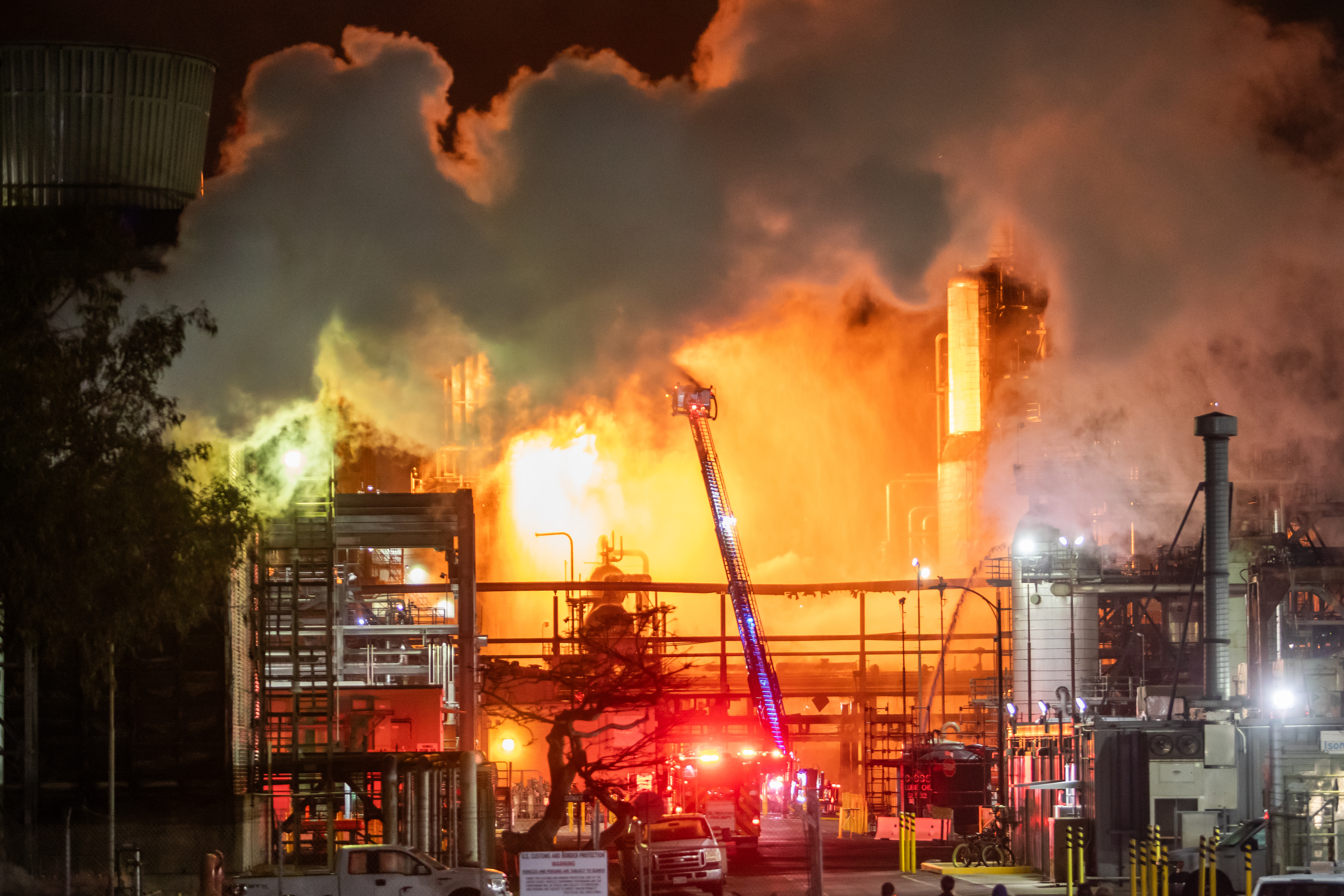

Chevron’s oil refinery near Los Angeles continued to produce gasoline for transportation as workers slowly restarted equipment halted by a recent fire, officials said on Oct. 6.
“We extinguished the fire Saturday [Oct. 4] morning and are working to restart some of the process units which were shut down during the fire and response,” Ross Allen, a Chevron communications advisor, told The Epoch Times in an email.
An explosion at about 9:30 p.m. on Oct. 2 at the company’s El Segundo Refinery lit up the night sky for miles.
The fire started at a process unit that produces jet fuel, one of eight process units at the facility. Flames were confined to that area of the facility, company and fire officials reported.
The incident caused concern among city and state officials about the possible threat to jet fuel supplies for the Los Angeles International Airport (LAX). The plant supplies about 40 percent of the jet fuel needed in Southern California and employs about 1,225 people.
Built in 1911, the refinery also produces about 20 percent of the region’s gasoline supply, with an output of 110,000 barrels, or about 4.62 million gallons, of gasoline per day.
That production has decreased since the fire, but Chevron has continued to meet customer needs, according to the company.
“We have been able to meet our customer commitments throughout the incident and anticipate continuing to do so as we move toward a fuller recovery,” Allen said. “The refinery continues to operate and create transportation fuels, although at diminished rates.”
Restarting the equipment that was shut down requires the use of intermittent safety flaring—a process that allows the plant to prevent equipment from being exposed to excessive gas pressure, according to Allen.
An investigation continues into the cause of the explosion and fire. Chevron and California workplace safety officials have launched probes into the matter.
“Chevron is cooperating fully with all regulatory agencies and is committed to understanding the root cause of this incident,” Allen said.

The Chevron El Segundo Refinery (background) near Los Angeles, Calif., on June 4, 2025. (John Frediricks/The Epoch Times)
Impact of Other Closures
Some energy experts have speculated that the unexpected refinery shutdown could impact California’s high gas prices, making gasoline even more expensive for drivers.
The state’s gasoline supply has been notably low at times over the past few years, which has contributed to high prices.
However, Chevron said transportation gasoline supplies in the region are higher than usual.
Professor Michael Mische from the Marshall School of Business at the University of Southern California wrote in an Oct. 6 article that regardless of how much damage was done to the Chevron refinery, the closure of two other refineries in the state are expected to have an immediate impact on prices.
Phillips 66, located a few miles away from Chevron’s El Segundo Refinery, received its last oil shipment on Sept. 30 and will cease all production on Oct. 16, Mische told the Epoch Times.
Chevron and Phillips 66 together account for about one-fourth of the state’s daily production capacity.
A refinery in Northern California—Valero’s Benicia plant—also plans to close in April 2026.

The Valero logo is displayed on a tank at the Valero Wilmington Oil Refinery adjacent to the ports of Long Beach and Los Angeles in the Wilmington neighborhood of Los Angeles on April 10, 2025. (Patrick T. Fallon/AFP via Getty Images)
Adding to the state’s gas crisis, the San Pablo Bay Pipeline, operated by Crimson Midstream LLC, is losing $2 million a month and faces severe financial distress, according to the company. The pipeline transports oil from Bakersfield to Northern California refineries.
Without a rapid state approval of a rate increase and other measures, the pipeline could cease operations within months, forcing two San Francisco-area refiners to import more oil from Asia.
Considering the closure of at least two major refineries and the potential loss of a major pipeline, Mische estimated that the lowest possible short-term gasoline price through Oct. 31 would reflect an increase of $0.03 to $0.08 a gallon.
A longer-term increase of up to $0.23 a gallon through the end of December could happen in the worst-case scenario, he said.