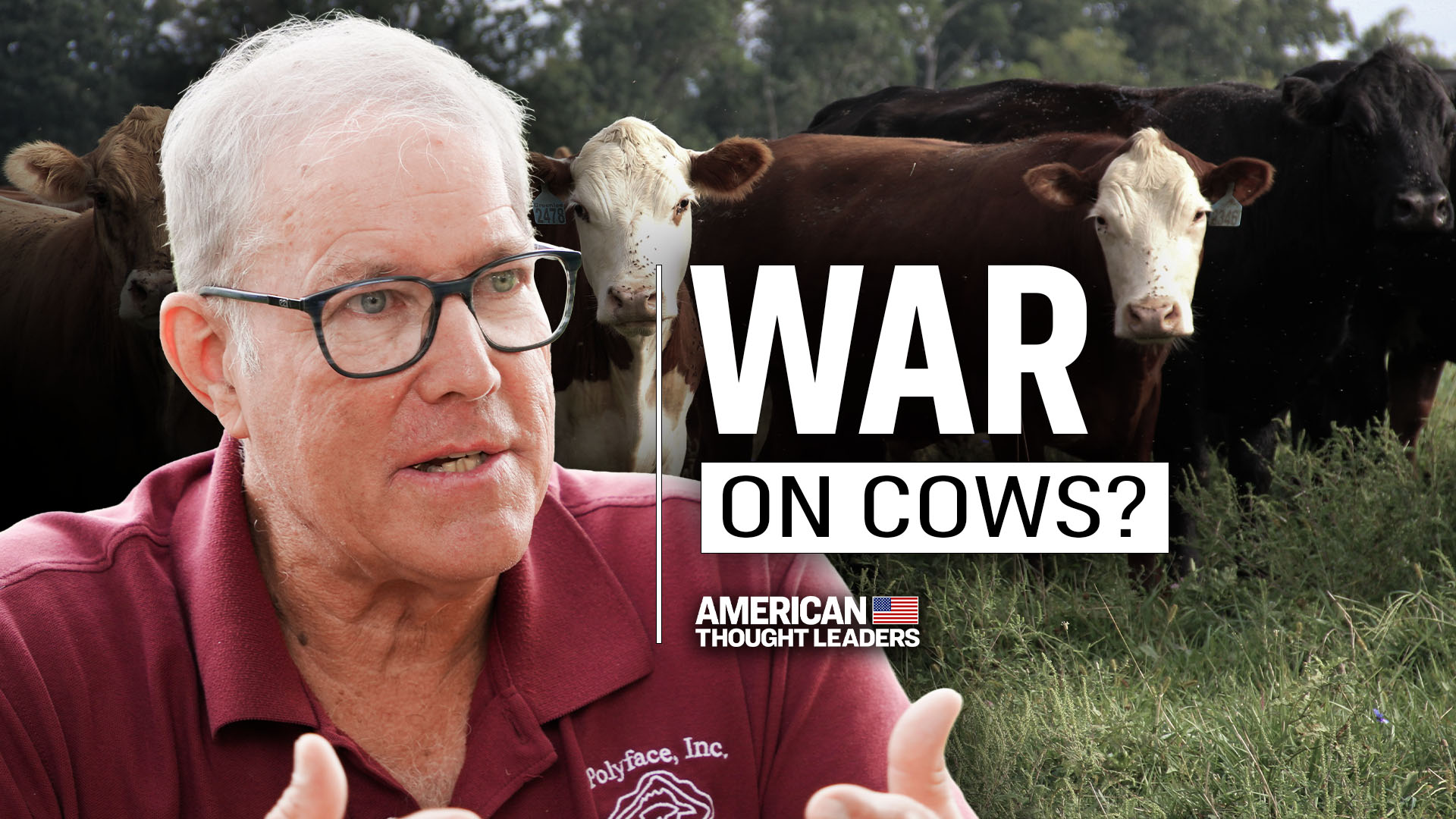

[RUSH TRANSCRIPT BELOW]Centralized agriculture insists that strict federal oversight is essential for food safety and market stability. Joel Salatin, co-owner of Polyface Farms, argues that a close look at soaring beef prices, local meat production, and farm economics reveals regulatory hurdles that destroy small slaughterhouses and distort true free-market prices.
Salatin addresses why high beef prices persist, noting recent droughts, aging farmers, the length of the cattle cycle, and the closing of Mexico’s borders. Far from opposing market efficiency, he argues that resilient, local production would respond more accurately to market fluctuations and supply shortages.
In this interview, Salatin answers critical questions: How do massive corn and soybean subsidies skew beef prices and drive small cattle operations out of business? What do USDA inspection exemptions like the Prime Act reveal about intrastate commerce and food safety? And why is nature’s model of scaling through duplication far more effective than industrial centralization?
Views expressed in this video are opinions of the host and the guest, and do not necessarily reflect the views of The Epoch Times.
RUSH TRANSCRIPT
Jan Jekielek:
Joel Salatin, so good to have you back on American Thought Leaders.
Joel Salatin:
Thank you. It’s a privilege and an honor to be with you.
Mr. Jekielek:
I love being at Polyface Farms. I mean, I just come to sit at this table, cameras or no cameras, and have some of your amazing food. So, we’re in this bizarre situation when it comes to beef. It’s expensive to the point where there’s an executive order saying we’re going to make an exemption for imports to lower the price of beef. So, explain to me why this is.
Mr. Salatin:
So, why are we short of beef?
Mr. Jekielek:
Yes. Why is it expensive? I mean, okay, you’re already answering the question, right?
Mr. Salatin:
There are several reasons. This doesn’t just happen. It started about five or six years ago in the tremendous droughts in the southern tier of the U.S. in Georgia, Louisiana, Mississippi, Texas, and Oklahoma. That southern tier of the U.S. back in 2020, 2021 was drought devastated. Well, cows are herbivores; they eat grass. If you don’t have rain, you don’t have grass. And grass, you know, you can make hay, but it’s way too bulky. It’s bulky and expensive to transport long distances. It’s not as concentrated as corn or soybeans or something like that, or gold. So transport becomes difficult.
So what happened is a lot of these ranchers and farmers just liquidated; they didn’t have feed. I well remember I was in Mississippi doing a conference in, I think it was 2021, and met several farmers there. And I mean, it’s horrible. They lost cows that the ground had cracked open so far that cows were stepping in it and breaking their legs. Then they'd have to put the cow down because you can’t put a splint on a cow’s leg. And I mean, it was just horrible. So that started this liquidation.
Then, as if to add insult to injury, we have the aging farmer, and the average livestock farmer is about 65-years-old. The average American farmer is about 60, but you can do cows pretty gently into old age, and so livestock farmers tend to be a little bit older. There comes a point in your life when if you can get out, you don’t want to get back in. You’re ready to go do other things like sit on the beach and visit the grandkids.
Then we had the rise of the whole protein movement: keto, paleo, carnivore. These are huge movements. They do conferences. I mean, I’ve been to Meatstock in Tennessee. I mean, the thing is wild: 1,200 screaming people that have never eaten carbohydrates for 20 years.
Then most recently, the screwworm that came in from Mexico. And so they shut down the border with Mexico. Well, that shut down a million head of beef, which is generally considered about 5 per cent of the beef slaughtered in America. It originates in Mexico and comes into American feedlots. So you have this perfect storm of things happening. You have the aging farmer that doesn’t want to start, expand, or start up. You’ve got the drought, and you’ve got the Mexico border closed.
The cattle cycle is a long cycle. You know, a cow has a calf. If you’re going to expand your herd, a cow has a calf. It’s got to be a heifer calf. That’s a female. Then in a year you can breed it. In a year she gives birth. In another two years, you can butcher it. You’re in this long cycle.
It’s not like chickens. You know, you hatch an egg. Eight weeks, you’ve got a chicken. You know, you can butcher a chicken. No, no, it’s a long cycle. And so when you get into a difficult situation, you can’t just snap your fingers and get out of it. And so one of the things that’s happening right now, even as high as the beef price is right now, it has not kept up with the increase in labor, land costs, input costs, equipment costs, and building costs. The price of beef right now has not even kept up with all those other costs.
Mr. Jekielek:
From the perspective of the farmer.
Mr. Salatin:
From the perspective of the farmer.
Mr. Jekielek:
Right. So, let’s just do we really need beef? You know, all these people are saying, hey, well, you know, this takes a long time, it’s cost-intensive, let’s keep the energy in the ground, maybe chickens will work.
Mr. Salatin:
Oh, well, the beautiful thing about the herbivore is that it doesn’t require tillage to grow it. Tillage or chemical herbicides to kill the grass or whatever. The point is if you’re going to raise omnivores, chickens, turkeys, pigs, if you’re going to raise omnivores, they can’t live on perennials. They require annuals. Annuals are things that you have to plant all the time. Watermelon, squash. You know, you think of your garden vegetables, wheat, corn, soybeans, those are annuals. You plant a seed, you get a crop that year.
Perennials are like your lawn, okay? You plant it one time and it lasts forever. And so, so nature doesn’t actually have very many annuals. It’s mainly perennials because nobody’s around to till the sod and plant the seeds, all right? There are annuals, but there aren’t, there aren’t that many of them. And so here we are.
In my view, if you really want to cut to the chase on our current beef problem, the problem is the subsidies to corn and soybeans. Half of the soybeans America produces are exported. We don’t even use them. Almost half the corn we produce goes into ethanol. We don’t even eat it. Even animals don’t even eat it. And half the alfalfa Americans produce on these big center pivot irrigation systems goes to Japan and Saudi Arabia to feed racehorses.
I don’t know what the percentage is. I don’t know if it’s 30 or 40 per cent, but it is a huge percentage of American agriculture that is not in the food business. That’s striking to the average person. I thought farmers produced food. No, most of them, a lot of them, don’t produce food.
And so here we have this, you know, most recent $12 billion bailout to the soybean farmers who supposedly, the average soybean farmer lost $100 an acre last year in 2025 growing soybeans. And instead of having to face the reality, you know, the world doesn’t need my soybeans. What normally happens in the marketplace if you overproduce? Well, the price goes down, and then you say, either I’m not going to produce as much or I’m going to produce something else. Where is there a need? And you move around to wherever the market is needed.
No, the soybean farmers have this idea that I’m a soybean farmer, by golly, and I’m important. I’m an important person because I grow soybeans, and the taxpayers should make sure that I can grow soybeans. And they’re not looking at the flush of soybeans in the world market. In fact, China has a 2030 target to eliminate dependency on imports. They have historically purchased over 25 per cent of the American soybean crop.
Now, Trump just strong-armed the Chinese and got them to take some. Last year, after they got mad about the tariffs and said, we’re not going to take any more American soybeans, Trump was able to talk them into taking some. But this problem is not going away. And bailing out the soybean farmers and the corn farmers, bailing them out with U.S. taxpayer subsidies just because we want to honor our farmers, is ridiculous. What we need is beef.
I actually did a very in-depth economic analysis because I do this kind of thing. I don’t grow crops, but I grow animals. So I know, I have a good sense of what it costs to put in a livestock operation. What if we have a thousand acres of Nebraska soybeans and we convert that to grass to grow cows? That thousand acres, my hypothetical thing, one thousand acres cost $300,000 to convert it from soybeans to grass. That’s fencing, waterline, seeds for grass, okay? That’s exactly what it costs annually to grow soybeans.
So here you have $300,000. Now, you know, that’s not just pocket change, but think about growing a thousand acres of soybeans, it’s going to cost me $300,000 of annual expense to put that crop in and harvest it. I can do a once-in-a-century $300,000 investment and return it to perennial prairie polyculture with herbivores, cows, not bison, but cows, they work fine, under intensive good grazing management. And suddenly, in my analysis, instead of losing $100 an acre, you make $1,000 an acre. But why doesn’t anybody want to do that?
Well, number one, with cows, I’ve got to be there. I can’t just plant it and go to Bermuda. Number two, there’s no crop insurance for your crop. So if they fail, I don’t get a check. If soybeans fail, I get a check. But the economic and ecological, and I would even suggest the emotional incentives are all there. I mean, let me tell you, you can walk out in your wheat field; you know, it’s nice, or your soybean field. Yes, they can brush your knees, but they don’t.
You go out with your cows, and they lean into you, and they respond to you. You know, to the livestock element, too, that I would argue. But the biggest enemy right now, keeping beef prices high, in my view, is the subsidies to the corn and soybean farmers that are letting them live with rose-colored glasses, thinking we don’t need to look at the market.
Mr. Jekielek:
So it skews the market, you are arguing, massively.
Mr. Salatin:
Yes. Imagine half a dozen soybean farmers sitting, and I know I’m hitting on soybean farmers, and I’m sorry, and I don’t hate them, but I really don’t like bad farming, and I don’t like my hard-earned taxes going to stupidity. Okay? And so can you imagine six soybean farmers, and they’re sitting around, and they say, you know, we really like electricians. Electricians are important for our country. We should make sure we have electricians. Now, there’s a big construction project going on up the road here that takes 20 electricians. They’re going to use 20 electricians. But let’s go up there and demand that they use 30 electricians because we like electricians, and we need electricians. And I know it only takes 20 to do this project, but we think you should do 30 because electricians are important. No soybean farmer would say that. And our taxes certainly aren’t going to help you pay for another one, two, or three extras just to have extra electricians. That’s the way they’re looking at the soybeans. They’re looking at themselves, and they’re saying, I’m a soybean farmer, you know, and the world should honor me and respect me, and it doesn’t need me, doesn’t need me, but I’m an important person, and I like soybeans, and I want to grow soybeans, and you should make sure that I grow soybeans. This is the mentality.
Mr. Jekielek:
Well, two thoughts. One is, you know, in effect, the government is saying we need soybeans by providing the money, right? In effect, that’s the skewing that you’re talking about. The other part, though, is that if I may, right? I mean, you’re a beef farmer, and you think beef farmers are important.
Mr. Salatin:
I do, but we don’t get a dime of subsidy. We don’t get any insurance.
Mr. Jekielek:
And you’re not asking for it either.
Mr. Salatin:
No, I’m not asking for it. I’m not asking for it. I’m suggesting, you know, let the market speak and let the people that are in that market respond to market forces. That’s all I’m asking. And every time the government steps in and puts their finger on this side of the scale, it inherently apes and manipulates what the market would just do.
Adam Smith’s invisible hand of the market, it moves things. It moves people out of surpluses. It moves people into innovation. It just does that. It doesn’t require government intervention. And if beef prices go down, then eventually, if too many people come in, eventually it'll drop enough that then some people will get out. And I’ve watched that in my lifetime.
Historically, there’s been about a 10-year beef cycle. If you look back to like 1860 when they started measuring these things, a 10 to 12-year fluctuation. It’s a long cycle. And this one is aberrant. And I think it’s because of the confluence of the aging farmer and then you have the issue of young people not getting into farming. That’s another whole discussion. When young people can’t get in, old people can’t get out. And so we have land costs, we have introductory costs, things like that, of getting in. There are lots of ways to get in.
We just had a conference here at the farm last weekend, actually, launching young farmers. We had eight that were, the slogan was, I was 20-years-old, no land, no money, and I’m full-time farming at 40 without government help. And eight of them told their stories, and it was fantastic.
So you can still bootstrap, but you don’t have to own land. You can rent. Right now, 47 per cent of America’s farmland is leased. That means whoever’s managing that land doesn’t own it. 47 per cent is close to half. That’s indicative of the aging farmer that can’t get out because young people can’t get in.
Here, we’ve provided entrance ramps that actually work that young people can bootstrap their way in, involving buying land. Where I am right now on that issue, is that land ownership is now more and more toward people who have money and want to keep it as an economic defense. I’ve got money, I don’t want to lose it. So I buy land as an economic defense. Land management is an economic offense.
I’m not rich, I don’t have enough to buy land, but I can manage it as an economic model, and that’s what we promote here, an economic offense to be able to actually make a living, earn money by managing a farm. And we do it very differently than conventional thinking, but it works.
Mr. Jekielek:
And the crazy thing is, as you’ve told me, if I am raising beef or some other animal, I can’t actually sell that to my neighbor next door. Like, there are actually laws that prevent that. There needs to be some big, expensive government inspection that happens before.
Mr. Salatin:
It really started in 1906 when Upton Sinclair wrote The Jungle and exposed the corruption and the animal abuse and filth in the Chicago meatpacking industry. But it progressed until 1967 with the Wholesome Meat Act which really shut things down. At that time our county had a dozen small abattoirs, small slaughterhouse operations. Many of them were located on farms, and it was just a farmer who enjoyed doing this, or somebody in his family enjoyed doing this, and they would just do it for the community.
But this has all been shut down. You can’t sell meat. You can sell a live animal. You can sell a live animal and process it, but you can’t sell a cut, you know, a T-bone steak, a ribeye, a pound of ground beef from an animal—beef, pork, lamb, goat—unless it’s processed under federal inspection. So, this has come in over the states.
Numerous states have tried to do workarounds and things. The most recent one is in New Hampshire. And the legislature actually passed a bill saying in the state of New Hampshire, we’re going to allow neighbor-to-neighbor meat sales. The governor vetoed it. And so they had an override session, but they couldn’t get the votes to override.
But the whole goal of that legislation in August of 2026 was actually to force the federal government into court to go to the Supreme Court and determine that intrastate meat commerce is not covered by the Constitution. That’s not a constitutional proclivity of the federal government. You know, it didn’t pass, of course, that’s not going to happen. But it‘ll come back. They’ll be back next year and they'll be loaded, you know, loaded to go.
But this is what all of the, you know, numerous states like Wyoming, Utah, Indiana, and Maine have these wonderful cottage food laws, you know, for neighbor-to-neighbor commerce that allows a person to take food and turn it into convenience food, processed food, without onerous government inspection. You can do it in your kitchen. The problem comes in the meat. Dairy, but primarily meat has to be inspected, has to be legal.
Meat has three things. You can have it custom processed. That is, I have a steer and I take it to a butcher and ask, would you kill this, slaughter it, fabricate it, put it in a package? That’s called custom processing. In other words, I’m asking for custom work to be done.
For example, if you want to remodel your kitchen, you‘d have somebody come in and custom remodel your kitchen. So, in this respect, the custom work is me taking an animal to a professional saying, I want you to get this animal, you know, edible for me, okay? That’s custom work. Now, the loophole that many farmers have used is that they’ll sell an animal live. In fact, they can even sell it to four, even up to eight individuals.
That animal, steer number 32, is owned by Jane, Mike, Bill, and Amy. And that can go under this custom exemption because it was, it is technically not selling meat; it’s selling a live animal. Anyone can sell a live animal to anyone, anywhere, without any inspection. And so that’s the loophole that many small farmers have used for a long, long time.
Many people don’t want to get a quarter or a half. They don’t have a freezer for it. They don’t have enough money for it at one time. And so they want two pounds of ground beef. They want three ribeye steaks. They want, all right, and they want a rump roast. And so this loophole is onerous in that the quantities a person has to buy are, you know, a minimum of $1,000. So this creates a very narrow customer base.
So that is why Congressman Thomas Massie, ever since he went to Congress, has been trying to get what he calls the PRIME [Processing Revival and Intrastate Meat Exemption] act. The PRIME Act would allow a state that if a state wants to allow custom processed meat to be sold by the cut, by the piece, that it’s a state prerogative. We want to do this.
The federal government says, we‘ll step aside then. We’ll let you do this intrastate, not interstate, but intrastate. It still has not passed, but it is gradually gaining strength. See, the problem is that the money in food is actually not in production. Today’s farmer only gets 5.8 cents of the retail dollar. That means 94.2 cents.
Mr. Jekielek:
It’s like a cattle farmer, a beef farmer.
Mr. Salatin:
Now, fortunately, beef is higher than that. But you’ve probably heard, well, there’s more money in the cardboard to the Wheaties box than there is to the farmer that grew the wheat to make the Wheaties. And that’s primarily true. So, you know, the average spread, the average take of what we call the farm gate value of food is 5.8 per cent. I mean, just imagine this, Jan. That means we can have a national policy tomorrow. From now on, we’re not going to pay farmers anything. They just do it for free. It would only change the price of food 5.8 percent.
So, where does it all go? Eighty years ago, it was 40 cents. Where does it all go? It goes to the processors, the distributors, the marketers. Lest anybody think that it’s evil corporations that have done this to us. No, the American people have moved from primarily domestic culinary arts, you know, fixing stuff from scratch, to now 75 per cent of what we eat as a nation is prepared, preserved, and packaged outside the home. It’s convenience food. And so that carries not only a hefty price tag, but the more that’s done to food after it leaves the farm gate, before it enters the consumer’s plate, the more money is involved in that, what’s called value adding, in value adding that product.
And so if we’re going to preserve farmers, and if we’re going to preserve market options in the marketplace, what we desperately need is the ability of farmers to be able to value add this product and for consumers to be able to buy from their neighbors, you know, without wrapping it in a $2 million federally inspected facility. This is the problem. And over the century, the number of processors has dropped and dropped.
In 1906, people were accusing the meat industry of being an oligarchy, and at that time, seven companies controlled 50 per cent of the meat supply. Seven companies controlled 50 per cent. That was considered an oligarchy. Today, we have four companies controlling 85 per cent of the meat market, and we say that’s, you know, free enterprise. Well, it’s not free enterprise, it’s actual capital cronyism. They have ensured that the regulatory climate is prejudicial to small operators and not larger ones.
Mr. Jekielek:
Talking about this PRIME act, right, which I understand is tucked into a farm bill that is just sort of never passing, but that’s a whole different discussion. But it’s there. It’s there.
Mr. Salatin:
Yes, and it hasn’t been taken out. And it passed the House.
Mr. Jekielek:
This could really open things up for selling beef, right? That weight of the cost of beef, tying some things together here. Is that right? Explain how that would work.
Mr. Salatin:
Okay. So I happen to co-own a small federally inspected slaughterhouse up in Harrisonburg. Complying with the inspection requirements, creating a Hazardous Analysis Critical Control Point [HACCP] plan with all that licensing, adds 30 to the cost of processing. Not only that, but the HACCP plan in our plant, where we do 50 beef a week, is exactly the same as a Tyson plant that does 5,000 a day. So it costs us $600 what Tyson can do for $150.
Mr. Jekielek:
And if I may jump into something, it just strikes me as you’re saying this, right? On the one hand, if you were doing 5,000 a day, I think there’s some real case to have that regulated.A high level because all sorts of things can be, yes, kind of sucked through. But if you’re doing 50, what is it? Oh, did you say a week? Basically, if you’re doing something wrong, the people buying it are going to give you a piece of their mind, and that'll be fixed pretty quick, right? So, that’s part of the difference, right?
Mr. Salatin:
Absolutely, scale makes a difference. I mean, whether it’s classroom size per teacher, whether it’s uh, keeping your kitchen clean versus, you know, Jolly Green Giant green bean factory or an abattoir that’s doing 5,000 a day versus, you know, 10 a day. All right. Yes, scale does have an effect here. The pushback, of course, in these things is always food safety.
It’s interesting that under the Freedom of Information Act [FOIA], people have asked the Food Safety Inspection Service [FSIS] how many registrants have they had since 1968 that got sick or had a pathogen, had any problem with custom-processed beef? So, this is beef produced with no inspector. There’s no inspector on site. There’s nobody, you know, poking at the liver and, you know, and looking inside or anything. And guess how many?
Zero. Not 10, not 100. Since 1968, zero incidents of pathogens, recalls, sickness, or whatever from custom. That affirms your point. These small outfits that do a few and not many, it’s easier to keep them clean, and they don’t have the protection of federal regulators to hide behind. What’s the first thing that happens whenever there’s some, you know, recall?
Mr. Jekielek:
There’s, I think, lettuce recently.
Mr. Salatin:
Yes. I’m thinking meat primarily, okay? Whether it’s rat pee in the peanut butter down in Georgia, or a meat recall, the first thing the CEO calls a press conference, he stands in front of those microphones with all those microphones, and he says, we have complied with all the government food safety regulations. That’s their first defense. A custom operator can’t do that; it’s their reputation, it’s all on them. And so, that personal responsibility—this is what I call uberizing the food system.
Okay, when you uberize the food system by putting personal responsibility on the players, both the consumer to find their producer and the processor, they don’t want to have something bad coming out of their facility. They don’t want to irritate one of their clients that brought them stuff. They don’t want to irritate the possible consumer. So there’s a real interconnected, relational, entwined intimacy in that transaction when you go to Costco or Walmart and get food.
Mr. Jekielek:
And that’s why you get zero. I mean, that’s actually astonishing, right?
Mr. Salatin:
It is astonishing. And so the whole food safety, what are we going to do if, you know, is simply nonexistent.
Mr. Jekielek:
It’s like a canard, basically. That’s what you’re saying.
Mr. Salatin:
Yes, it is.
Mr. Jekielek:
Interesting. So, if this legislation passes that allows this intrastate sale of cuts, right? Let’s say. It doesn’t immediately open things up because people basically have to start up their businesses. But are people actually going to do that, given the realities that you explained to me earlier?
Mr. Salatin:
Yes. Congressman Thomas Massie told me, he said that he knows that within just weeks, if the PRIME Act passed, that within weeks, he said, I have a list or something. He knows a thousand community abattoirs would either reopen or start new because you can open a custom house at a fraction of the cost of a federally inspected facility. So there would be ones who have closed, who have just gotten tired of onerous regulations, and new ones that would be built that would start, but a thousand.
Now, if those thousand did, let’s say they averaged 20 a week, that’s 20,000 beef a week at 50 weeks, that’s a million a year. And somebody can say, but that’s small potatoes. Well, when Big Ag says scale, they’re thinking consolidation, centralization, and concentration. They are thinking of a bigger plant, a bigger cannery, or a bigger slaughter. It’s bigger.
But that’s not the way nature scales. If nature wants more oak, it doesn’t make a great big oak tree, it makes acorns. If nature wants more milk, it doesn’t make a great big cow, it makes calves.If nature wants more tomatoes, it doesn’t make a great big tomato plant. It plants seeds and makes tomatoes. Nature scales by duplication.
So this whole notion of scale by consolidation, concentration, and centralization that we have in big industrial agriculture is a completely anti-nature philosophy. It’s an anti-nature mentality that doesn’t appreciate the duplication of nature, like with babies or seeds. This is the way nature scales.
Mr. Jekielek:
It must be really expensive, relatively speaking, for you to produce your beef here in this very unique, regenerative way that you do, vs. the factory farm.
Mr. Salatin:
We substitute management for subsidized corn and soybeans, essentially. So, again, when you look at cost comparisons, we produce it cheaper, but it’s not much because when the feedlot beef goes, it’s getting subsidized corn, subsidized soybeans, and often questionable labor. We pay an extremely high salary here for our folks, and we don’t import them from outside the U.S. We grow them here at home, and we want so we have an extensive labor component, exchanged energy intensity, and pharmaceutical intensity.
Our cows don’t do drugs; we don’t vaccinate, we don’t medicate, we don’t do any of those things. They’re eating grass. There are no plows, no seeds, no herbicides, and no chemical fertilizer. You know, when Putin invaded Ukraine and fertilizer went up 400 per cent, and all the farmers were saying, with fertilizer, it didn’t affect us at all because we don’t use any of it.
Interestingly, when that happened, our steaks—ribeye, tenderloin—or pork chops from pork, our prices were lower than Costco. We had people coming into our farm store saying, how can this be? Well, it’s because we are resilient. We are not subject to those yo-yoing ups and downs of sociopolitical, geopolitical, and economic stuff. The average farm in America spends 50 per cent of its expenses on diesel fuel. Our percentage is 5 per cent. So diesel could double, and we'd be okay.
What we put our money into is people. All of that pharmaceutical, energy, capital intensity, concrete, fans, all that stuff, we exchange it for management. That is why we can’t necessarily do it cheaper, but we can do it much more resiliently. And resilience is as important as short-term efficiency today. It’s the difference between efficiency today and long-term effectiveness.
Mr. Jekielek:
So, the bottom line is it’s a bit more expensive, but it’s a lot more durable. Is that the bottom line?
Mr. Salatin:
Yes, that’s a good way to say it. We’re not nearly as subject to the ups and downs, and we’re certainly not asking Trump for bailouts.
Mr. Jekielek:
And, you know, I think by many means, so let’s talk about this. I mean, I’m biased here. I buy beef from you for a whole reason, because I know how you make it, and it’s a quality issue, right? It’s not just that the animals are treated well. I know that unusually well because of this people component, because of the philosophy. Explain to me why people on the carnivore diet—you go to these giant conferences—first of all, why they pick beef, beef as their number one kind of protein. I know that that’s their kind of the main thing that these carnivore people eat is beef over everything else. And number two, from that kind of quality perspective, how the beef that would be grown here, those cows, how that’s better than what you get off the feedlot.
Mr. Salatin:
Great questions. So I would like to, I know you love history. So let me go back a little bit in history to help us all realize that antiquity diets, diets of antiquity, the protein was primarily either herbivore or seafood. If you lived next to the ocean, next to a lake, you know, you fished, all right? But if you lived away, then it was the herbivore, whether it was, you know, kangaroo, wildebeest, bison, llama, alpaca, goat, lamb, camel, okay?
Historically, what has been eaten hasn’t been chicken or pork. Now, there have been chicken and pork around, okay? I mean, chicken kind of developed in the jungles and the tropics, and pigs came along, especially in Europe and Italy. But what was early on was both milk and meat from the herbivore. Why? Well, because the herbivore didn’t require tillage or grain production.
In Thomas Jefferson’s Farm Book, if we had the same spread of prices today as Thomas Jefferson had in his day, corn and wheat would be $30 a bushel instead of $3.59 or $4 or $5. Well, as soon as grain becomes expensive, the omnivore becomes expensive, the chicken and the pork, because they can’t just live on grass. And so the diets of antiquity were either seafood or herbivore, because that’s what didn’t require planting grains.
Grain has been the holy grail of civilization because it was always expensive. The idea of cheap grain that we’ve enjoyed in the last century in this country is because we’ve had cheap energy and mechanics, and we’ve come to a land that had legacy soil built from herbivores and perennials for millennia, okay, that we are still exploiting today. So that was such a huge resource bank account that we still haven’t depleted it all. We’re trying, but we haven’t depleted it.
Mr. Jekielek:
And some technological innovation, to be fair.
Mr. Salatin:
Absolutely. I said equipment, and cheap energy. Absolutely. All that has enabled us, for the first time in human history—I mean, literally, this is a blip in geopolitical time—to have cheap grain. It’s never been possible in human history, but now we have it.The carnivore diet is going back to antiquity. What they’re saying is we are far closer to our ancestors of 5,000 years ago.
Mr. Jekielek:
Metabolically.
Mr. Salatin:
Metabolically than we are to Spock in Star Trek drinking, you know, some sort of little, you know, artificial lab-synthesized nutrients. And so that’s why the herbivore features so strongly in this, because it is the herbivore, the nutrient-dense component of all these diets of antiquity. Now, what’s interesting is, so, what’s the difference between one steak and another steak depending on how it’s raised? The Bionutrient Food Association, founded by Dan Kittredge up in Massachusetts, has now spent almost a decade looking at nutrients in various foods.
What they’re trying to do is come up with a handheld wand using light that you could wand over food and it would give you green light, yellow light, red light, you know, with different relative amounts of like 150 nutrients, okay? The first one that they did was, I think, carrots. And they found that in order to get the nutrition of the best carrot, you would have to eat like 50 of the poorest carrots.
Mr. Jekielek:
So it’s a massive range that we don’t expect, basically.
Mr. Salatin:
You couldn’t tell it by looking at them. In fact, it was so different, they thought something was wrong with their machinery. So they did broccoli. Let’s try broccoli. Same thing. A 50-fold difference. The next one they did was beef, around 500 samples of beef. Again, there are huge, huge differences.
But here’s the interesting thing out of all their data. They asked the question, what is the single most consistent litmus test for whether this steak is better than this steak, nutritionally? It had nothing to do with breed. All the breeds—oh, Angus is better, Shorthorn is better—they all had nothing to do with breed, nothing to do with climate, nothing to do with age. The only consistent factor in making this steak more nutritional than this steak was how many different plants did the animal eat. And so on our farm, we haven’t planted a seed in 65 years.
We haven’t planted a seed. We let grow whatever’s going to grow. We love to see this variety of plants in our fields, and the cows will select, like they’re at a smorgasbord; they will select different things at different times of the year. And at different times, every plant has a palatability moment, and then it maybe gets too mature. And so we move the cows every day to a fresh, what we call a salad bar, which indicates this variety that they get. And they get to choose that salad bar in what we call mob stocking, herbivorous, solar conversion, lignified carbon sequestration, and fertilization.
Mr. Jekielek:
That’s farming, basically. Yes, okay. Listen, this has been a wonderful conversation. I can’t wait to eat some of your beef. A final thought as we finish?
Mr. Salatin:
Generally, all the things that we find frustrating, people step up and solve, fix those, fix those issues, and they fix them sooner when the government doesn’t pick the winners. And people are actually able to exercise their freedom of choice as voluntary participants in the great drama of life to be able to bring to whatever the frustration is their own innovation, their own ideas, and their own free thoughts. That’s the way they get solved.
Mr. Jekielek:
Well, Joel Salatin, it’s such a pleasure to have had you on again.
Mr. Salatin:
It’s a pleasure to be with you. Thank you.
This interview has been partially edited for clarity and brevity.