Commentary
The first big story with the fiscal disclosure of the nation’s 50 states is that some states take a long time to complete their annual audits and to post their annual comprehensive financial reports.
Illinois and Nevada finally concluded their audit work in August for the fiscal year ending on June 30, 2023, and we can finally compare the nation’s states based on audited balance sheets, or statements of position.
The second big story is that California provided its financial statements before two other states, Illinois (which previously held the title of last state to submit its report) and Nevada (the new titleholder). This is the first time that California beat them in years.
The third big story, as can be seen in the chart below, is that only 10 percent of the states moved three or more places. Nearly one in five, 18 percent, moved two places. Forty percent moved only one place and 32 percent stayed in their 2022 positions.
The goal for a municipality’s fiscal transparency should be to complete and release the annual audit within six months of the close of the fiscal year. The goal for proper fiscal stewardship is to have a positive unrestricted net position (UNP). And the goal for financial leadership is to be moving up the rankings with each passing year.
From the 30,000-foot level, one observes that all the states combined were able to improve their UNPs in total by $180 billion. Four states moved into positive territory and one dropped below zero. If your state saw its UNP decrease or its unrestricted net deficit grow, it may be time to ask your elected state representatives to provide an answer. One can also see the population movement among the states, with Florida and Texas showing significant gains.
The rankings are rather simple in construction. Reviewing the statement of net position, take the UNP for governmental activities and divide it by the state’s population. This provides the state’s fiscal temperature, using a per capita figure. Being higher in the rankings is admirable. Being in the middle is average. But being near the bottom means that there are serious fiscal concerns to monitor and improve on.
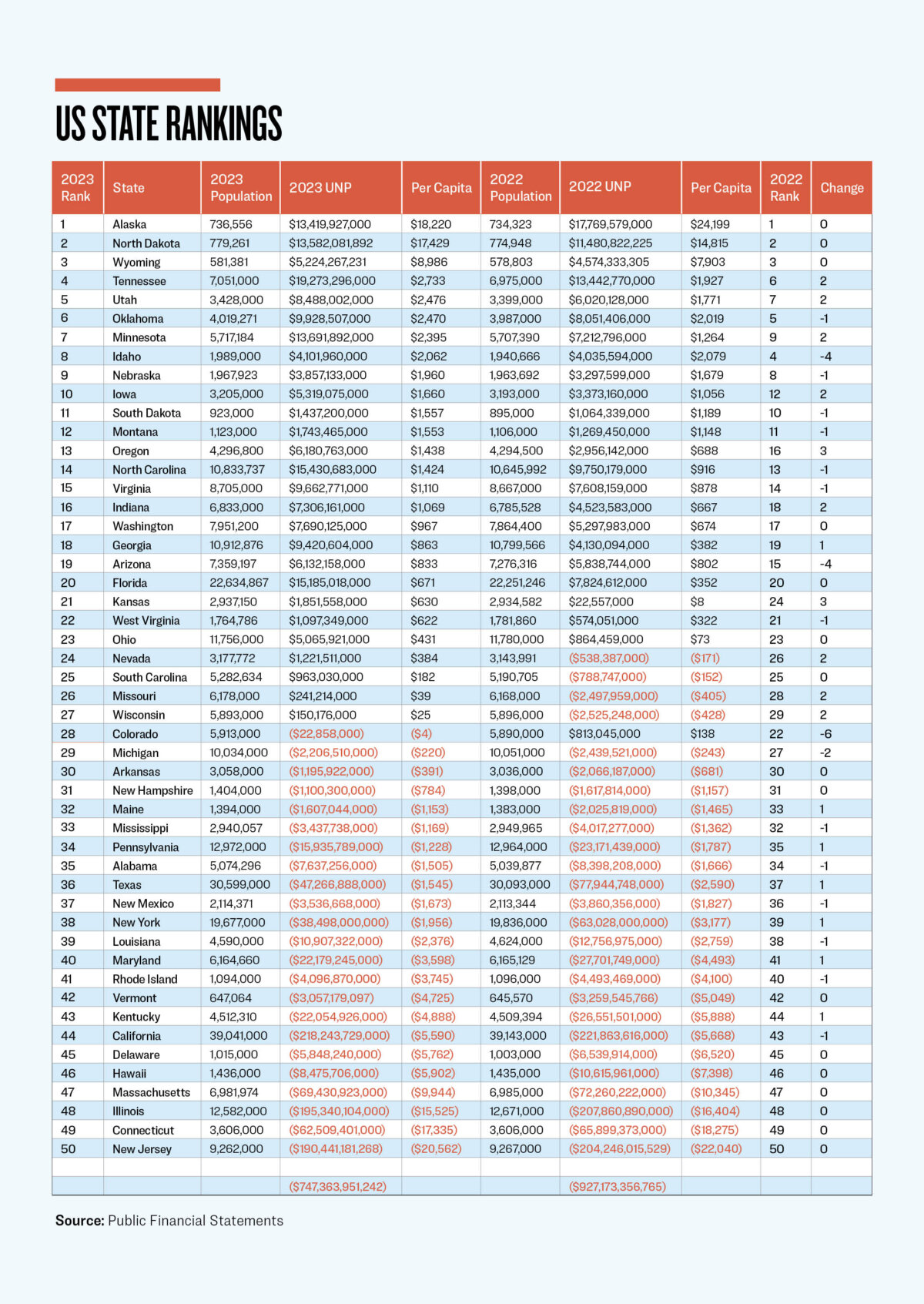
The rankings may become very helpful when a major business wants to find a state suitable for its corporate headquarters: It would be advisable to select a higher-ranked state. This would be wise from a potential financial risk standpoint. The last thing a business needs is a state tax rate structure that is constantly increasing because its governor and legislature refuse to reduce spending and debts and dote on public employee unions. These states will always default to raising sales, income, gas, or property tax rates.
I reside in what I think is one of the most amazing states in the country, California, because the weather is great. But it keeps raising taxes, losing residents, and dropping in the rankings.
With that said, let’s look at the five states that moved the most from 2022 to 2023 and find out why. Let’s start with those that dropped multiple places.
The state of Idaho had revenues in excess of expenditures of $687.3 million, explaining the increase in its UNP of $663.7 million. But because Tennessee, Utah, Oklahoma, and Minnesota had a better year, it caused the Potato State to drop four positions.
Arizona had revenues in excess of expenditures of $1.9 billion, which helped increase its unrestricted net assets by $293 million. But because Indiana, Washington, and Georgia had a better year, the Grand Canyon State also fell back four positions.
Although Colorado had revenues in excess of expenditures of $877 million, its UNP decreased by $835 million. It increased its restricted assets by $567 million and invested $1.2 billion in capital assets. The Centennial State dropped six places.
The state of Oregon had revenues in excess of expenditures of $4.5 billion, explaining the increase in its UNP of $3.2 billion. It restricted half of the difference, $621 million, and the other half, $641 million, was directed toward capital assets. The Beaver State moved up three places.
The state of Kansas had revenues in excess of expenditures of $2.1 billion, explaining its $1.8 billion improvement in its UNP and how it moved up three positions.
Let me conclude by reviewing the promptness of financial transparency around the nation. Audit work was concluded on or before Dec. 31, 2023, by 21 states. By March 31, 2024, this was accomplished by another 20 states. Here’s how the final nine placed: New Mexico (April 25, 2024), Montana (May 3), Massachusetts (May 28), Oklahoma (Sept. 4), Mississippi (Oct. 11), Arizona (Nov. 7), California (Dec. 5), Illinois (Aug. 7, 2025), and Nevada (Aug. 15, 2025).
I had the opportunity to discuss Nevada’s situation with its new state controller, Andy Matthews. We talked about the lateness. He informed me that his department was affected by the COVID-19 pandemic, as the governor at the time had a very strict lockdown. Obviously, when you shut down Las Vegas and Reno, state revenues will suffer. He also had three key senior officials retire, a common reason for municipalities reporting delays.
Nevada is also run by the public employee unions, and Matthews inherited a department with no managers who were non-union, non-classified, or at-will. This meant asking staff to work overtime, but since there wasn’t the necessary funding in his budget, it was ruled out. At-will managers do not get overtime pay.
Matthews has gone to the Nevada Legislature, which only meets briefly every two years, for reforms to improve his office. He also faces the common problem of certain state departments dragging their feet, a reason also commonly cited by California and Illinois. He has at least contacted the governor’s office to “lean on the agencies.” After all, a delinquent audit reflects poorly on those at the top of the organizational chart.
Matthews assured me that he has “rolled up” his sleeves and that he is “turning the corner” on this “interesting saga.” And he is getting support from the governor and state Legislature. He knows that it is a “real challenge” and hopes “to get back” to where Nevada is supposed to be by completing the audits sooner with each subsequent year.
For Nevada, Illinois, California, and the other regularly delinquent states, one can only hope.