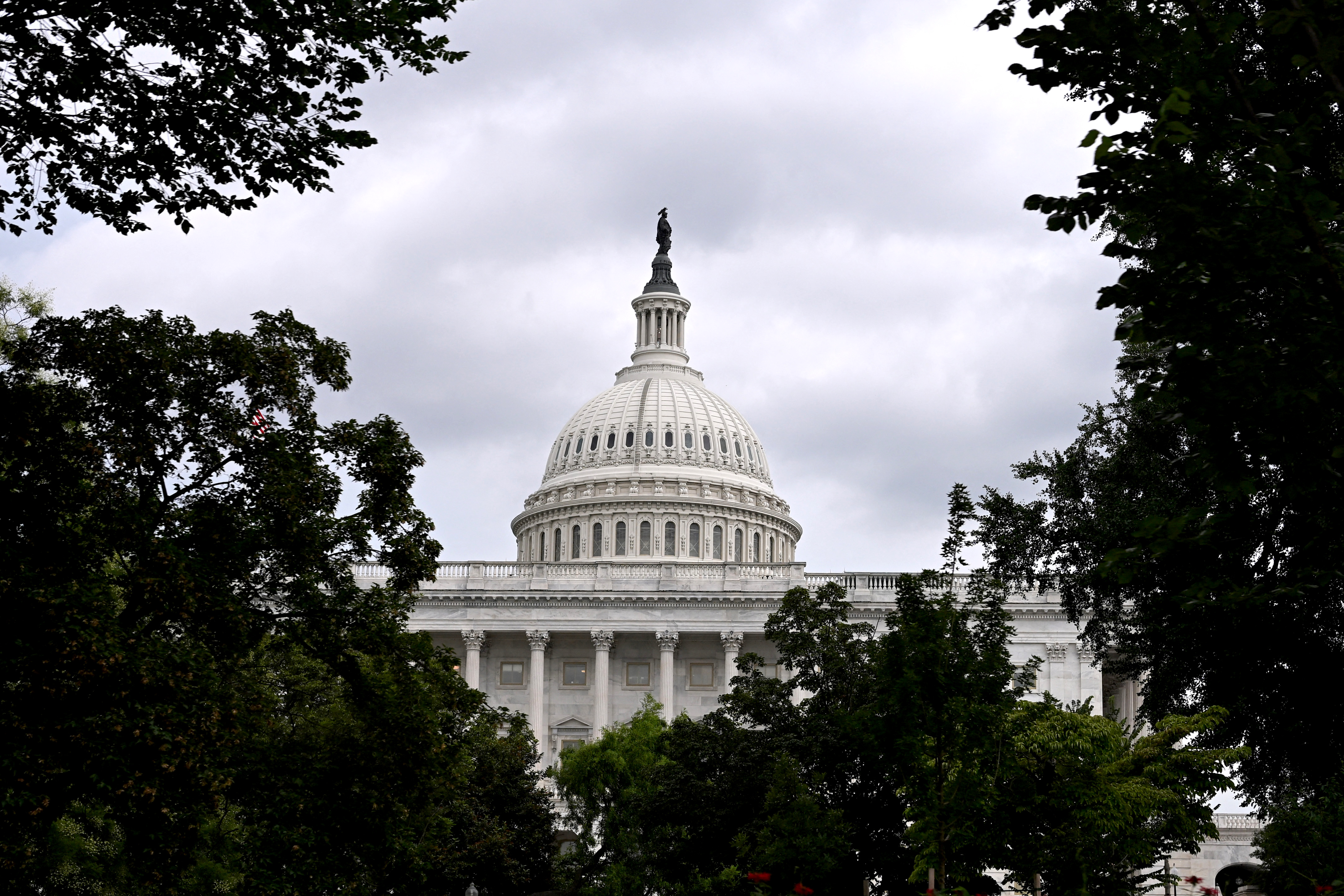
WASHINGTON—The House passed an $831.5 billion defense appropriations bill early on July 18 in a 221–209 vote, largely but not entirely along party lines.
HR 4016, the Department of Defense Appropriations Act of 2026, funds U.S. defense spending through Sept. 30, 2026, with certain allocations extending into fiscal years 2027, 2028, and 2030. The bill covers costs for new naval vessels, next-generation aircraft, space capabilities, and President Donald Trump’s “Golden Dome” missile defense program.
Three Republicans voted no: Reps. Thomas Massie (R-Ky.), Marjorie Taylor Greene (R-Ga.), and Tim Burchett (R-Tenn.). Five Democrats voted yes: Reps. Don Davis (D-N.C.), Jared Golden (D-Maine), Vicente Gonzalez (D-Texas), Adam Gray (D-Calif.), and Marie Gluesenkamp Perez (D-Wash.).
In a video posted to X after the vote, Burchett said he voted against the budget because, although it was unchanged from the previous year, it added to the $157 billion already allocated to the Pentagon for 2026 through the “Big, Beautiful Bill,” which passed on July 3. That brings total defense funding for the fiscal year close to $1 trillion.
“We’ve got a lot of members that own a lot of stock, and war is good for business,” Burchett said.
On July 17, House Minority Leader Hakeem Jeffries (D-N.Y.), who voted against the budget, told The Epoch Times that the price tag shows Republicans are “not the party of fiscal responsibility.”
Greene offered a series of amendments to the budget to strip foreign aid funding from the bill. All of them failed in recorded votes.
On July 17, Greene told The Epoch Times that she was concerned about funding foreign aid through the budget because “we’re $37 trillion in debt.” She questioned Jeffries’ claim that Republicans lack fiscal responsibility, drawing attention to his support for Ukraine funding.
“Tonight all of my amendments to cut $1.6 billion of foreign aid out of our Defense budget failed because both Republicans and Democrats refuse to stop sending your hard earned tax dollars to foreign countries,” Greene wrote on X after the vote.
Rep. Steve Womack (R-Ark.), who supported the bill, wrote on X after it was passed that the trillion-dollar funding for defense in fiscal year 2026 “must be increased in the coming years to protect our national security.”
Funding Armed Forces
The legislation allocates nearly $55.7 billion for Army operations and maintenance; $71.7 billion for the Navy and Marine Corps, including an additional $9.9 billion specifically for the Marine Corps; $61.6 billion for the Air Force; $4.9 billion for Space Force; and $15.3 billion for the Army and Air National Guard.
Nearly $53.5 billion is allocated for expenses deemed “necessary for the operation and maintenance of activities and agencies of the Department of Defense” outside the military departments, provided that $70 million is spent on searching for and securing new military contracts. At least $500 million will be available through Sept. 30, 2027, for risk reduction and modification of national security systems.
More than $148 billion is allocated to military personnel across the Army, Navy, Marine Corps, Air Force, and Space Force, with approximately $12 billion for their respective reserve personnel.
Billions for New Ships, Planes, Weapons
Together, the Army, Air Force, Navy, Marine Corps, and Space Force were allocated more than $130 billion for the procurement of aircraft, missiles, ammunition, tracked combat vehicles, and other necessary purchases such as vehicle parts and modifications, leases, and facility expansions. Each branch’s funding is expected to remain available until Sept. 30, 2028.
The bill outlined an additional multibillion-dollar shipbuilding budget, which included more than $10.4 billion for two new Columbia-class ballistic submarines, more than $11 billion for two Virginia-class fast-attack submarines, $225 million for a medium landing craft, and more than $3.2 billion for two new aircraft carriers: the USS Enterprise (CVN-80) and the USS Doris Miller (CVN-81).
The bill also states that carrier refueling overhauls will cost more than $1.8 billion.
The House Appropriations Committee recommended in its report that more than $174 billion be allocated for procurement of new materials across all branches, including nearly $3.8 billion for the new B-21 Raider stealth bomber; more than $8.5 billion for 69 F-35 fighter jets; nearly $508 million for three unmanned, carrier-based aircraft; and nearly $37 billion for 28 new naval vessels.
The committee noted the Navy’s continued lack of a next-generation fighter jet to replace the current F/A-18s, the F/A-XX. The Air Force’s F-47 program is not interchangeable with the Navy’s carrier-capable program, unlike the F-35.
“Failure to pursue Navy’s F/A–XX program risks leaving the U.S. dangerously outmatched in a high-end conflict,” the report stated. “The Committee is dismayed by recent actions within the Department to pause or delay progress on this critical program, despite strong bipartisan and bicameral congressional support.”
It recommended that fiscal year 2026 include $971 million to continue development of the F/A-XX and directed the secretary of the Navy to submit a report on the program’s progress to the congressional defense committee no later than Aug. 12.
The committee recommended allocating $938 million for the Army’s future long-range assault aircraft, nearly $3.2 billion for the Air Force’s Next Generation Air Dominance program, and $1.6 billion for the Space Force’s space technology development and prototyping.
An amendment from Rep. John Joyce (R-Pa.) was adopted on July 17, moving $30 million from the development of the Future Tactical Unmanned Aircraft System into the Army’s procurement budget.
Golden Dome, Other Foreign Matters
Several hundred million more dollars were allocated towards the Golden Dome project as part of a larger defense agreement with Israel.
A total of $60 million was allocated for the defense secretary to purchase the Iron Dome defense system from the Israeli government to counter short-range rocket threats. Another $100 million was allocated to purchase the upper-tier component of Israel’s Missile Defense Architecture, all of which will be used to produce Arrow 3 upper-tier systems in both the United States and Israel, and another $173 million will be for the Arrow System Improvement Program.
The legislation also stated that half a billion dollars was to remain available for the Taiwan Security Cooperation Initiative until Sept. 30, 2027.
The “Counter-Islamic State of Iraq and Syria (ISIS) Train and Equipment Fund,” which supports the two countries’ operations against the ISIS terrorist group, will have $357.5 million available through Sept. 30, 2027.
The bill does not include funding for Ukraine. Greene’s amendments targeting funding allocated for Taiwan and Israel cooperation were struck down.
What Can’t Be Funded
The bill outlines what the proposed funds cannot be used for and who cannot receive them.
That list includes “any member of Hamas, Hezbollah, the Houthis, or the Taliban,” the United Nations Relief and Works Agency, any direct or indirect support for the Wuhan Institute of Virology, and any lab owned or controlled by a country deemed a foreign adversary by the secretaries of Defense and State, including China, Iran, North Korea, Russia and Venezuela.
Funds also can’t be used to take control of oil resources in Iraq or Syria, or used by Northern Command to carry out any activity with Mexico except for activities directed by Trump’s executive order “Clarifying the Military’s Role in Protecting the Territorial Integrity of the United States.”
COVID-19-related mandates and the transfer of any foreign nationals or terrorism suspects held at Guantanamo Bay, Cuba, to foreign countries are also prohibited.