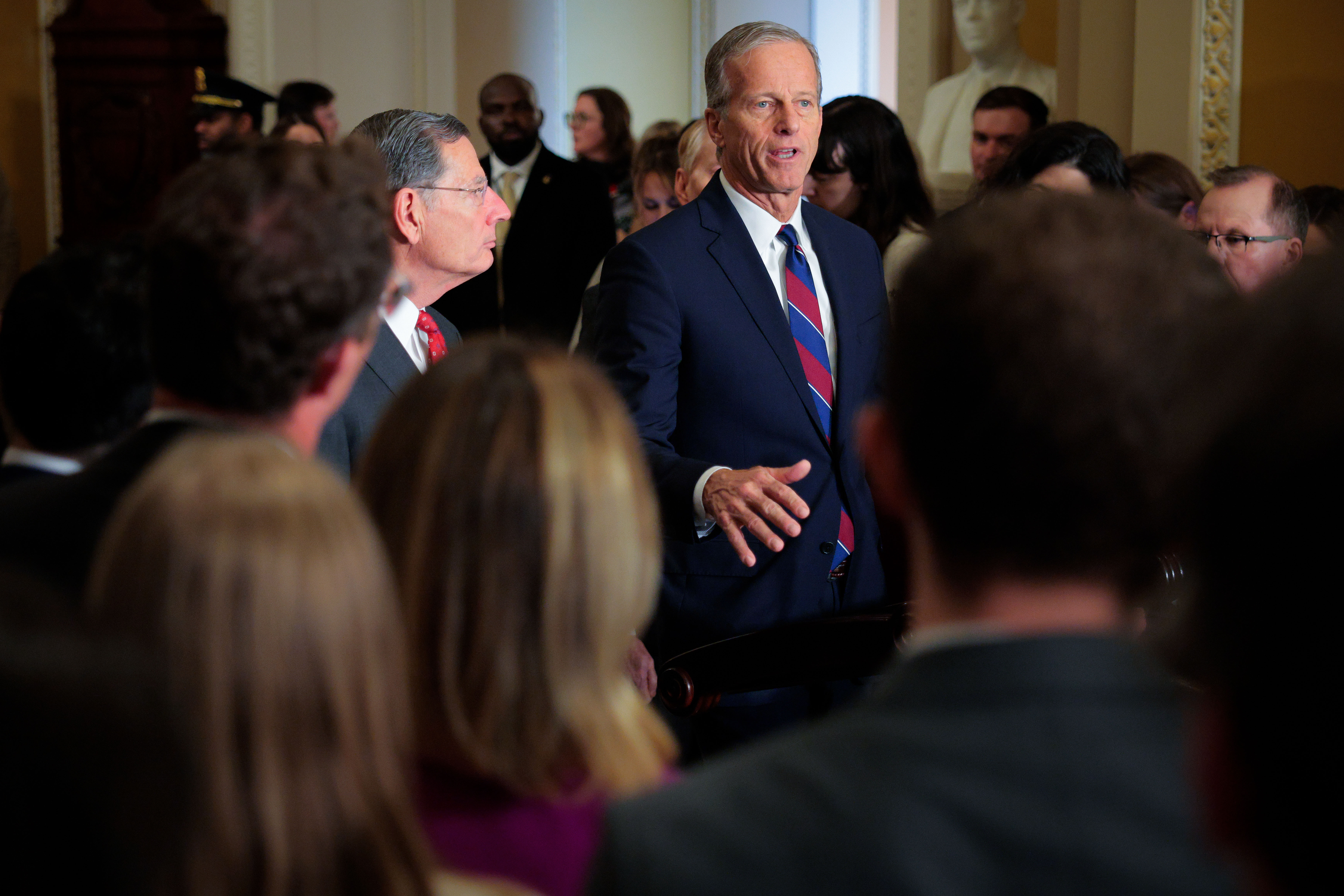
The Senate said on Dec. 9 that a vote will come later this week on a GOP health care proposal intended as an alternative to extending the enhanced Obamacare subsidies set to expire after this year.
The Senate will vote on the proposal on Dec. 11, Majority Leader John Thune (R-S.D.) told reporters on Tuesday.
The plan, put forward by Sens. Mike Crapo (R-Idaho) and Bill Cassidy (R-La.), would fund Health Savings Accounts for individuals to empower choice and promote competition in the insurance market.
Republicans introduced it on Monday alongside one put forward by Sens. Bernie Moreno (R-Ohio) and Susan Collins (R-Maine), both aimed at reducing federal spending and driving down the cost of health insurance.
Senate Minority Leader Chuck Schumer (D-N.Y.) called both plans a “non-starter.”
The top Senate Democrat told reporters that the plans don’t lower health care costs and don’t extend the Affordable Care Act “one day, which is what the American people are asking for.”
“The burden is on 13 Republicans to vote with us,” Schumer said when asked about the impending expiration of premium Obamacare tax credits.
Sen. John Hoeven (R-N.D.) defended the Crapo–Cassidy plan, telling reporters it’s “about providing assistance using [healthcare savings accounts], so you’re not sending the money to insurance companies.”
Cassidy said the Democrats’ extension plan still retains a $6,000 deductible before “the insurance kicks in.”
“Nobody should want that. We should actually meet people where they are,” he told reporters on Tuesday.
Schumer had accused the Crapo–Cassidy plan of increasing costs, adding “tons of new abortion restrictions for women,” and funding cost-sharing reductions “permanently.”
Sen. Josh Hawley (R-Mo.), describing health care as a “complicated thing,” said lawmakers should “do everything, explore every option” to bring down costs.
“I think we ought to do what I propose: no taxes on health care, no taxes on premiums, no taxes on deductibles, no taxes on co-pays. So I'd love to see us do that,” he told reporters.
GOP Puts Forward 2 Plans
The Dec. 8 announcements were made three days ahead of a Senate vote on a measure promoted by Democrats that would extend the expiring enhanced premium tax credits for Obamacare plans.
Crapo and Cassidy each chair one of the Senate committees that oversee health care spending.
The Moreno-Collins plan would extend Obamacare’s enhanced premium tax credits while addressing larger issues in the program.
The enhanced tax credits, expiring this month, have been a point of contention for months, as Democrats have pressed for another extension of the temporary credits that have shielded many Obamacare users from rising premium costs for five years.
Many Republicans have resisted an extension of the subsidies, which they say are riddled with fraud and have contributed to increased costs for the program.
However, some Republicans seek to avoid the economic fallout of the expiring subsidies on their constituents without allowing the status quo of rising premiums to continue indefinitely.
Health Care Freedom for Patients Act
The Crapo–Cassidy plan, dubbed the Health Care Freedom for Patients Act, would deposit payments into Health Savings accounts paired with the Bronze and catastrophic Obamacare plans for 2026 and 2027.
Crapo and Cassidy said the expiring enhanced tax credits account for only 4 percent of the increase in Obamacare premiums for 2026, but funnel billions of dollars to health insurance companies, with 20 percent taken as overhead payments or profit.
People who qualify for Obamacare and earn less than 700 percent of the federal poverty level would receive $1,000 or $1,500, depending on their age.
The Crapo–Cassidy plan would open catastrophic health plan enrollment to everyone starting in 2027, reduce federal Medicaid payments to states that provide health coverage to illegal immigrants, and require proof of legal immigration status to enroll in Medicaid.
The plan would prohibit Medicaid or Obamacare funds from paying for gender transition services.
CARE Act
The Moreno–Collins plan, named the Consumer Affordability and Responsibility Enhancement (CARE) Act, would extend the enhanced Affordable Care Act (ACA) premium tax credits for two years, gradually phasing out the COVID-era provisions, which were introduced in 2021 and later extended to run through 2025.
The bill also eliminates zero-premium plans, requiring a minimum monthly premium of $25 and capping eligibility for subsidized health insurance at $200,000 in household income.
Collins said the plan would help families weather the transition to lower or no subsidy when buying insurance through the Obamacare exchange.
“We need to pursue practical solutions that increase affordability without creating sudden disruptions in coverage,” Collins said in a Dec. 8 statement.
Moreno blamed Democrats for the rise in premiums since Obamacare was instituted in 2014, but said, “I am willing to work with anyone to finally bring down costs for all Americans and hope my colleagues across the aisle will commit to doing the same.”
Other Republican Ideas
Republicans have
suggested other solutions to the cost of health care.
President Donald Trump raised the idea of sending payments directly to patients to be used for health care only, rather than paying health insurance premiums. That idea appears to be the basis for the Crapo–Cassidy plan. Sens. Rick Scott (R-Fla.) and Roger Marshall (R-Kan.) made similar proposals.
Sen. Rand Paul (R-Ky.) proposed changing federal law to allow consumers to buy association health plans through vendors such as Amazon, Costco, or Sam’s Club.
Democrats Propose Extending Subsidies
Senate Democrats originally proposed making the enhanced subsidies permanent, refusing to fund the government until Republicans negotiated over their demand.
After a record-breaking 43-day shutdown, eight Democratic senators joined Republicans in passing a stopgap funding resolution to reopen the government on the condition that Democrats be granted a Senate vote on extending the subsidies.
Senate Minority Leader Chuck Schumer (D-N.Y.) has now proposed a three-year clean extension of the enhanced tax credits, which he said will be a test for Republicans.
“Every single Democrat will support it,” Schumer said on Dec. 4. “That means Republicans have only one week to decide where they stand.”
That Senate vote is expected on Dec. 11.
Sen. Mike Rounds (R-S.D.) told reporters on Dec. 8 that he hoped Republicans would agree to vote on the Crapo–Marshall plan as well.
Correction: A previous version of this article misstated the voting date of the GOP health care proposal. The Epoch Times regrets the error.