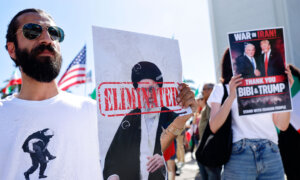

WASHINGTON—President Donald Trump on March 1 praised the joint U.S.–Israeli military operation that killed Iranian leader Ali Khamenei and said combat operations would continue until U.S. objectives are achieved.
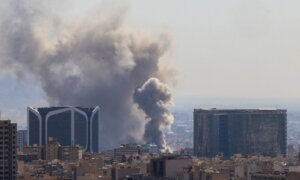
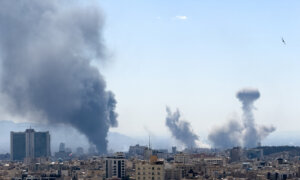
The coordinated strikes began at 1:15 a.m. ET on Feb. 28, targeting key sites inside Iran.
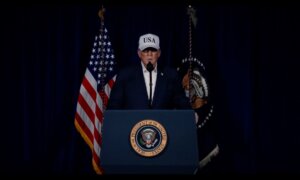
“Combat operations continue at this time in full force, and they will continue until all of our objectives are achieved,” Trump said in a video message on March 1. “We have very strong objectives.”
He said that Iran’s top military officers have been eliminated and that remaining officials are seeking immunity.
“Many of them want to surrender [to] save their lives,” Trump said. “They want immunity. They’re calling by the thousands.”
Power Shift in Tehran
The deaths of Khamenei and other regime leaders have changed the country’s political structure.
The regime quickly filled the power vacuum by forming a temporary council of three men to lead the country. The members of the new council are President Masoud Pezeshkian, Chief Justice Gholamhossein Mohseni-Ejei, and cleric Alireza Arafi. The council will hold power until Khamenei’s successor is chosen.
Saeed Ghasseminejad, a senior Iran adviser at the Foundation for Defense of Democracies, told The Epoch Times that Khamenei’s death has complicated the regime’s operations, as Khamenei had concentrated enormous power in his own hands.
“This places the regime in a weak position regarding decision making and the loyalty of various factions,” Ghasseminejad said. “Different factions in the country will try to consolidate as much power as possible.”
Khamenei led Iran for nearly 36 years, becoming the longest-serving supreme leader in the country’s history. He came to power after Ruhollah Khomeini died in 1989.
The supreme leader of Iran holds the highest authority in the country’s Shiite rule, exercising absolute and unchallenged power over all state matters, including the military, judiciary, and foreign policy.
Khamenei served as commander-in-chief, appointed key officials, and ensured that the country remained aligned with Islamic principles in areas such as education, culture, and social freedoms.
Meanwhile, the president is often considered a ceremonial figure, as his authority is limited by the supreme leader.
On March 1, Trump indicated that the new leadership is willing to hold talks.
“They want to talk, and I have agreed to talk, so I will be talking to them,” Trump told The Atlantic.
He didn’t provide more details about when the talks might happen.
Trump said the regime should have initiated talks with him sooner.
“They waited too long,” he said.
Is Regime Change Possible?
Trump has often said he does not want U.S. troops on the ground in other countries. In recent messages to the Iranian people, he suggested that he has helped create conditions for regime change but will not lead the effort himself.
“I call upon all Iranian patriots who yearn for freedom to seize this moment, to be brave, be bold, be heroic, and take back your country. America is with you,” Trump told Iranians in a video message on March 1. “I made a promise to you, and I fulfilled that promise. The rest will be up to you, but we'll be there to help.”
In an earlier video message, on Feb. 28, he said: “Stay sheltered. Don’t leave your home. It’s very dangerous outside.”
Trump’s allies have also made it clear that it is now up to the Iranians to decide their future leadership.
Sen. Tom Cotton (R-Ark.), chair of the Senate Intelligence Committee, told CBS’s “Face the Nation” on March 1 that Trump “has no plan for any kind of large-scale ground force inside of Iran.”
Sen. Lindsey Graham (R-S.C.) echoed those comments during an interview with NBC News’s “Meet the Press” on March 1, saying that it’s not the United States’ job to pick Iran’s next leader.
“The goal of this operation is to change the threat, not the regime,” he said.
Some political commentators have expressed concern about whether Iranians can overthrow the regime without U.S. support.
“In Venezuela, Trump was fully prepared to continue to work with the same regime, having removed Maduro, and that has so far proven to be a pretty effective short-term strategy, at least,” Eurasia Group President Ian Bremmer said on “TED Explains the World.” “But in Iran, Trump isn’t prepared to work with the existing regime, understandably.”
However, he said that the path to achieving a true “government of the people” remains uncertain and that it is unlikely that the Iranian people currently have the capacity to achieve this outcome.
Strikes Continue
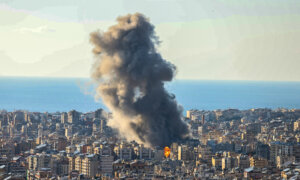
Late on Feb. 28, the Israeli military stated that it had initiated another wave of attacks against Tehran, hitting the nation’s ballistic missile array and aerial defense systems.
Israeli Defense Minister Israel Katz told Tehran on March 1 to prepare for a “nonstop air train” of attacks as the Israel Defense Forces (IDF) planned a second day of strikes on Iran.
The IDF is looking at multiple targets, including military-industrial sites in Iran, according to Israeli military spokesperson Lt. Col. Nadav Shoshani.
The Pentagon said on March 1 that U.S. B-2 stealth bombers dropped 2,000-pound bombs on Iran’s hardened ballistic missile facilities overnight. These reinforced structures, sometimes referred to as “missile cities,” are often underground and designed to protect ballistic missiles.
Trump said at about midday on March 1 that the U.S. military had destroyed and sunk nine of Iran’s naval ships and, in another attack, obliterated the nation’s naval headquarters.
The U.S. Central Command said on March 1 that it had struck more than 1,000 targets during the joint U.S.–Israeli mission, dubbed Operation Epic Fury by the United States and Operation Roaring Lion by Israel.
Airstrikes Wipe Out Top Iranian Leaders
Operation Epic Fury targeted military sites, compounds, air defense systems, missile and drone launch sites, military airfields, and command centers of top Iranian officials.
The following day, the IDF said it had struck and eliminated seven members of the top Iranian security leadership in Tehran and 40 senior commanders.
An IDF spokesperson said that the Israeli and U.S. militaries were able to kill Khamenei and other top Iranian officials by seizing on an operational opportunity and “striking simultaneously two different gatherings of senior regime officials.”
The IDF struck a meeting of senior officials who had convened at the Iranian Defense Ministry compound in Tehran and a second meeting of the “top echelon” of Iran’s Ministry that served as the nation’s central intelligence office.
Trump justified the operation during his video message on March 1.
“These actions are right, and they are necessary to ensure that Americans will never have to face a radical, bloodthirsty terrorist regime armed with nuclear weapons and lots of threats,” Trump said.
3 Americans Killed, 5 Seriously Wounded
Iran was quick to retaliate, immediately firing back at targets in Israel and its neighboring Gulf states, including U.S. military bases.
The regime also struck airports in Abu Dhabi and Kuwait and damaged Dubai International Airport.
Four were injured after an Iranian missile hit a luxury hotel in Dubai’s man-made Palm Jumeirah island complex, and the city’s famous Burj Al Arab hotel sustained damage in retaliatory strikes.
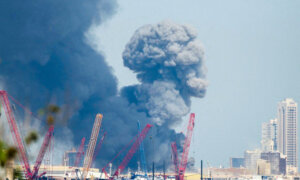
A video on Feb. 28 showed a large explosion near the U.S. Navy base in Bahrain after it was struck by an Iranian missile.
The Kuwaiti Health Ministry said on March 1 that Iranian attacks in Kuwait killed one person and injured 32.
Iran targeted the UAE with 541 bomb-carrying drones, of which the nation’s military managed to destroy 506. The remaining 35 wounded 58 people and killed three from Bangladesh, Nepal, and Pakistan.
Israel’s rescue service said early on March 1 that the death toll in Iran’s attack on central Israel had risen to six and that another 23 were injured.
As of the afternoon of March 1, three U.S. service members had been killed in action, and five others were seriously wounded. Additional details will be released 24 hours after next-of-kin notifications, the U.S. Central Command said.
Trump told NBC News on March 1 that U.S. officials “expect casualties” as the conflict with Iran unfolds, but he said that “in the end, it’s going to be a great deal for the world.”
Troy Myers, Jacki Thrapp, Savannah Hulsey Pointer, Sam Dorman, and Jackson Richman contributed to this report.