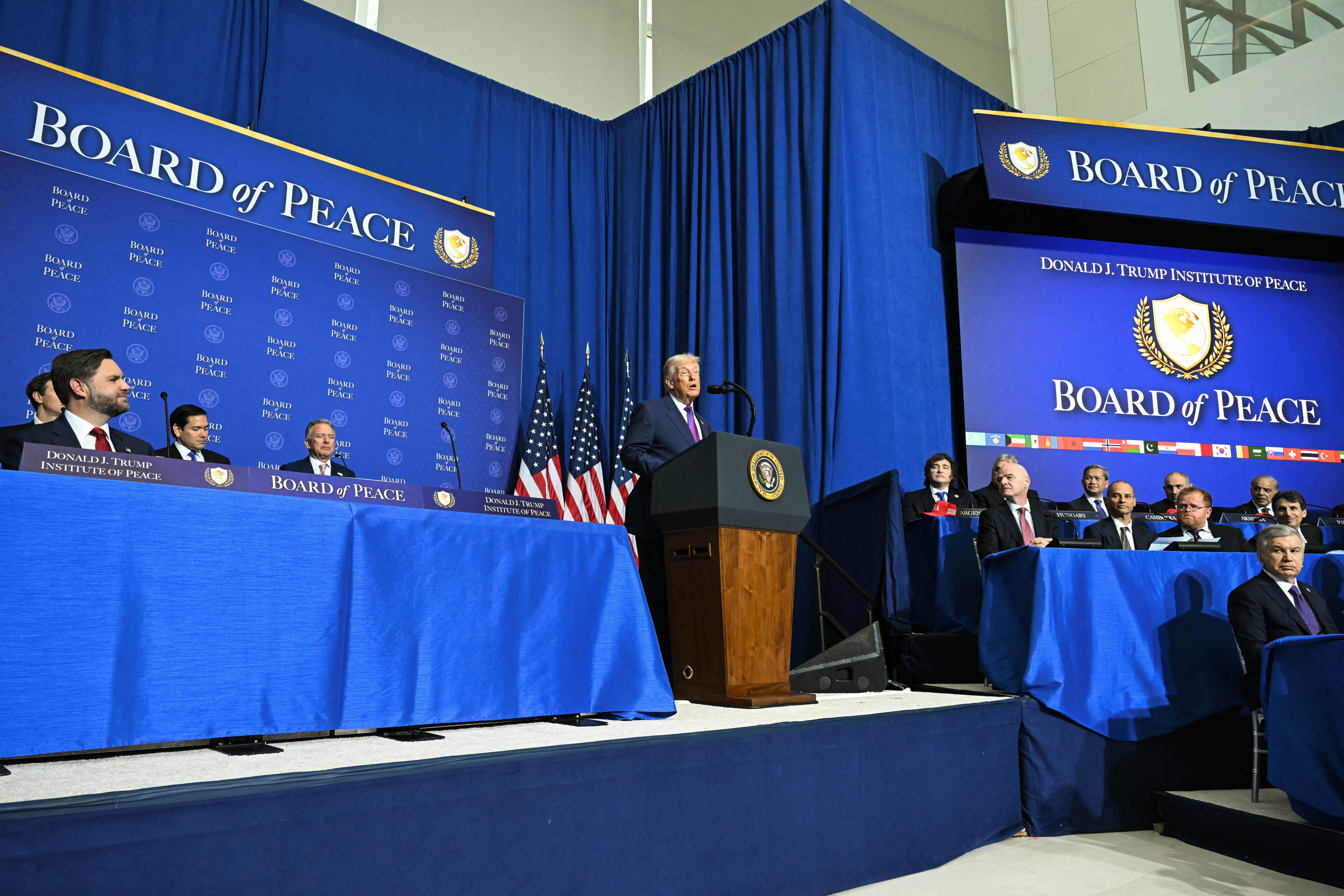
WASHINGTON—President Donald Trump announced a $10 billion U.S. commitment to the newly formed Board of Peace on Feb. 19 during its inaugural meeting in Washington. The new board will ensure that the United Nations “runs properly” and lives up to its potential in resolving conflicts, Trump said.
The meeting, hosted at the Donald J. Trump Institute of Peace, brought together heads of state and representatives from more than two dozen countries to discuss the U.S.-backed peace plan to demilitarize and rebuild the Gaza Strip.
“This is the most prestigious board ever put together—and I’ve seen some great corporate boards,” Trump said, praising the members of the new international organization. “It’s peanuts compared to this board.”
As he opened his speech at the event, Trump emphasized unity and collective resolve to achieve peace in the Gaza Strip.
“We work together to ensure a brighter future for the people of Gaza, the Middle East, and the entire world,” he said.
He also said that “there’s nothing more important than peace.”
He commended leaders from Kazakhstan, Azerbaijan, the United Arab Emirates, Morocco, Bahrain, Qatar, Saudi Arabia, Uzbekistan, and Kuwait for contributing more than $7 billion collectively to the effort.
Trump formally launched the Board of Peace on Jan. 22 in Davos, Switzerland, signing its charter and establishing the organization to oversee the peace process between Israel and the Hamas terrorist group, as well as address other global conflicts.
Trump will chair the board, which will be tasked with overseeing the Gaza Strip’s reconstruction, security, and governance during the transition.
The board currently has more than 20 members who have pledged financial support for this new initiative but have also committed thousands of personnel for security in the Gaza Strip.
During his nearly 45-minute speech, Trump mentioned the wars that have come to an end since he took office and suggested that the Board of Peace could eventually expand its mandate to further support global peace in the future.
Trump said that the U.N. has not fulfilled its potential in resolving conflicts and that the new board will oversee the U.N. and make it “viable.”
“The Board of Peace is going to almost be looking over the United Nations and making sure it runs properly,“ he said. ”But we’re going to strengthen the United Nations. We’re going to make sure its facilities are good. They need help, and they need help moneywise.”
Amid rising tensions with Iran, Trump also issued a fresh warning to Tehran during the event.
“Now is the time for Iran to join us on a path that will complete what we do,” Trump said. “They cannot continue to threaten the stability of the entire region, and they must make a deal.”
He told the leaders in the room that they might find out over the next 10 days whether a deal is possible or not.
If a deal is not reached, he said, “bad things will happen.”
Trump also announced that Norway has agreed to host a future Board of Peace event. FIFA will help raise $75 million for projects in the Gaza Strip, while the U.N. Office for the Coordination of Humanitarian Affairs is mobilizing $2 billion in humanitarian assistance, he said. Japan has also committed to hosting a separate aid fundraiser.
The White House on Jan. 16 named several administration officials and international leaders to positions within the Board of Peace. They will be tasked with providing strategic insight, mobilizing international resources, and ensuring accountability during the Gaza Strip’s transition and reconstruction.
During his speech, Trump acknowledged several attending leaders, occasionally mixing praise with jokes. He first mentioned the peace deal between Azerbaijan and Armenia after a decades-long conflict. He recalled his first meeting with Armenian Prime Minister Nikol Pashinyan and Azerbaijani President Ilham Aliyev in the Oval Office.
“These are two tough cookies,” Trump said. “You think that was easy. It wasn’t easy.”
Trump also mentioned Argentine President Javier Milei and Hungarian Prime Minister Viktor Orban. He said some leaders, including Milei, won by landslides after receiving his endorsement.
“Not everybody in Europe loves that endorsement, but that’s OK,” he said of Orban.
Trump also praised Qatari Prime Minister Sheikh Mohammed bin Abdulrahman Al Thani, calling him “a great man” and a strong ally.
“I always say he needs a public relations agency,” Trump said. “You do so much good, and they have you down as evil—and you help us so much.”
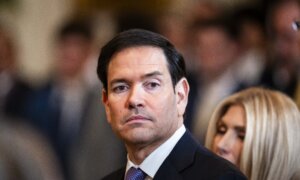
He also teased U.S. Secretary of State Marco Rubio and mentioned his recent speech in Munich—where he received a standing ovation—saying, “Marco, don’t do any better than you did, please, because if you do, you’re outta here.”
The White House said on Feb. 18 that more than 40 nations and the European Union agreed to send representatives to the board’s first meeting, including some that have declined Trump’s invitation to join the board as member states.
In addition to the EU, the countries that sent representatives are Albania, Argentina, Armenia, Austria, Azerbaijan, Bahrain, Bulgaria, Cambodia, Croatia, Cyprus, the Czech Republic, Egypt, El Salvador, Finland, Germany, Greece, Hungary, India, Indonesia, Israel, Italy, Japan, Jordan, Kazakhstan, Kosovo, Kuwait, Mexico, Mongolia, Morocco, the Netherlands, Norway, Oman, Pakistan, Paraguay, Poland, Qatar, Romania, Saudi Arabia, Slovakia, South Korea, Switzerland, Thailand, Turkey, the United Arab Emirates, the UK, Uzbekistan, and Vietnam.
No representatives from Western Europe attended the signing ceremony in Davos. Several countries, including France, earlier refused to join the board, citing concerns that the new organization would be a direct competitor to the U.N.
Rubio, special presidential envoy Steve Witkoff, Trump’s son-in-law and adviser Jared Kushner, and former UK Prime Minister Tony Blair are among those tapped to serve on an executive board for the Board of Peace.