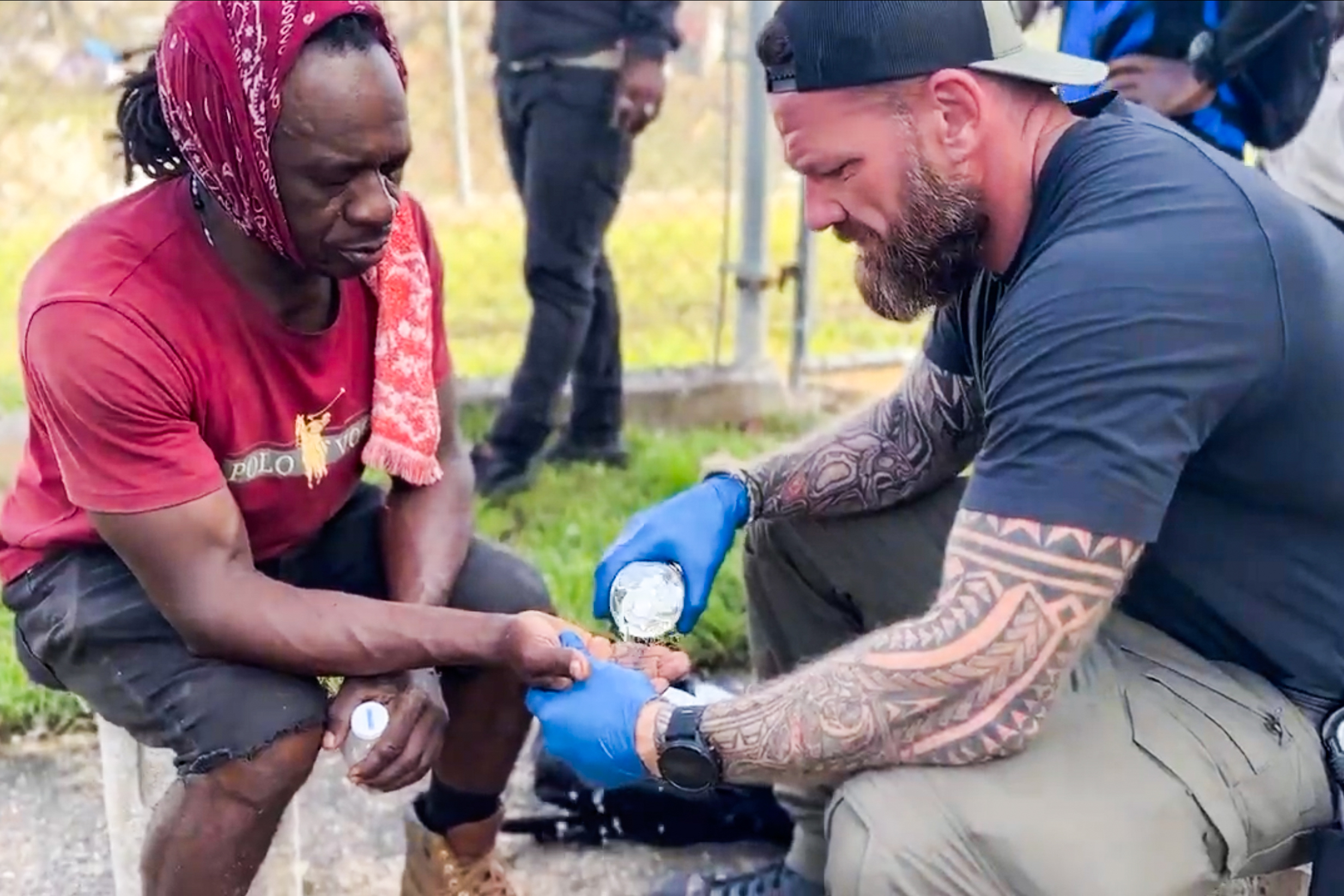

Former Green Beret Jeremy Locke returned to Kingston, Jamaica, around 6 a.m. on Nov. 6, in an ongoing effort to bring humanitarian aid to survivors of Hurricane Melissa.
The co-founder and COO of Aerial Recovery and his team of volunteers spent the entire night blazing a trail through the mountainous, hurricane-ravaged parishes of western Jamaica to establish contact and deliver drinking water to a small convent of nuns and a home for children with special needs.
The convent at Blessed Sacrament Cathedral—operated by three sisters and a mother superior named Mother Joy—had lost its roof and was serving as a clinic. Locke and his team pushed through previously impassable roads to deliver two pallets of water and assess the situation. They made contact with the convent at around 11:30 p.m., and then moved on to the hilltop West Haven Children’s Home for the Disabled, which housed 96 kids.
“It took a while, but we found the route and got up to the very top,” Locke said, noting that a helicopter mission had failed to reach them beforehand. “We didn’t show up until about a little after 1:30 in the morning.”
This was one of countless missions undertaken by multiple government and nonprofit organizations to reestablish contact with the island’s inhabitants after the Category 5 hurricane caused widespread destruction, power outages, and flooding two weeks ago. Their aim is to deliver the first supplies of fresh water and hot food, and begin the long road to helping survivors rebuild their livelihoods.
The aid coalition includes Global Empowerment Mission, the United Cajun Navy, and World Central Kitchen. But even after nearly 10 days, volunteers told The Epoch Times they were still only scratching the surface of initial recovery efforts, like first-contact, damage assessments, and meal distribution.
United Cajun Navy Incident Commander Josh Gill told The Epoch Times that the entire effort was “a week behind” in terms of the usual disaster recovery process.
“We’re now providing hot meals, and, you know, shelf stable means,” he said on Nov. 8. “Typically in the U.S., that’s some of the first things to happen. But we don’t have a whole ton of aid that’s coming through here.
“I don’t want to downplay what other people are doing, but you know, we’re just trying to get it to as many people as possible,” he said, adding that it’s a culmination of loss of infrastructure, logistics with international deliveries, and lack of communication.
Reestablishing Contact
Aerial Recovery reported having received more than 80 direct requests for information on friends and family believed to be in cut-off communities. As of Nov. 6, about 25 have been fulfilled. At that point, every person had been found alive.
Meanwhile, the United Cajun Navy had set out following reports from local government leaders to reestablish access and communication with those communities, reaching 15 as of Nov. 8.
“We go with the local elected officials for the districts and the divisions, and they’re telling us who in their community hasn’t been reached, and we do a lot of planning with them,” Gill said. “And then we just get their chainsaws, boats, whatever we can use.”

Supply vehicles push through the mountains of Jamaica on Nov. 4, 2025. (Courtesy of Aerial Recovery)
“We used freezers yesterday to traverse some water with supplies,” he said. ”We put supplies in freezers and floated them across the water.”
Both organizations said they have made extractions, but have also found people who did not want to leave their homes, or what’s left of them, and asked for supplies to be sent their way.
“The majority of the time I talk to people, I say, ‘How are you? How are you doing?’ and I’ve heard so many times, ‘Thanks to God, I’m alive, and my family’s alive. I have my health, thanks be to God,’” Locke said.
“Their house is completely open, everything is thrown about—their livestock is nowhere to be seen, their crops are completely gone,” he said. “But they’re still sitting there… giving thanks for their ability to still be alive, and it’s really inspiring.”
Locke said he made contact with one group in particular, the Maroon people in their town, Accompong. Descended from enslaved Africans who escaped and successfully formed their own nation in Jamaica’s mountains and jungles, which earned recognition from the colonial British forces, they maintain a level of autonomy and self-reliance.
Examples of that self-reliance witnessed by Locke included using mainly machetes to cut out a path eight kilometers long.
He also said the chief asked for building materials, and emphasized that his own people had the skills, work ethic, and heart to rebuild their homes.
After their first visit, teams transition from rescue to distribution, bringing fresh water, food by utilizing trucks and helicopters, and even Starlink.
The United Cajun Navy established a distribution center in Savanna-La-Mar in Westmoreland Parish, to which World Central Kitchen has begun flying in hot meals from Montego Bay. Together, they’ve sought to launch at least six helicopter missions and expeditions using high-water vehicles.
Mental health services were also reported to be in high demand, as many struggle with the trauma of surviving the cataclysmic storm.

Aerial view of Black River, Jamaica, on Nov. 1, 2025, after the devastation of Hurricane Melissa. (Courtesy of Aerial Recovery)
‘A Week Behind’
Gill told The Epoch Times that in his 20 years of experience across more than 120 deployments to disaster areas, Jamaica’s devastation was the worst he had ever seen.
“The entire western end of the island is damaged,” he said. ”It’s trashed. It’s gone. It’s catastrophic. There’s not a word in my vocabulary that I can use that describes this level of destruction. You know, we talk about floods of biblical proportions? This was of biblical proportions.”
Gill recalled meeting a 75-year-old woman who rode out the storm in her home and said she thought it was the rapture.
“She said, ‘I thought this was the end of the world,’” he said. “To hear that really set me back.”
Locke estimated that 60-70 percent of the homes on the western half of the island were uninhabitable.
“They’re missing their entire roofs, or they’re blowing off their foundation, or they’re missing at least part of the roof, and the people that live in them are just, are getting soaked,” he said.
Gill said he needed half a million tarps to cover the damaged homes across the region, illustrating the enormity of the challenge ahead of them.
Locke, meanwhile, emphasized the impending food crisis that is expected to arise.
“[Melissa] went right through the bread basket, too,” he said. “So this is just something that when the crops [harvests] come around, it’s going to get, unfortunately, worse before it gets better.”
But on top of the widespread damage to infrastructure and the nation’s food supply, Gill mentioned that teams were also facing issues getting supplies to the island as the Federal Aviation Administration’s flight restrictions were causing shipments to be delayed.
The Epoch Times reached out to Global Empowerment Mission for confirmation of the FAA restrictions’ impact on supply shipments.
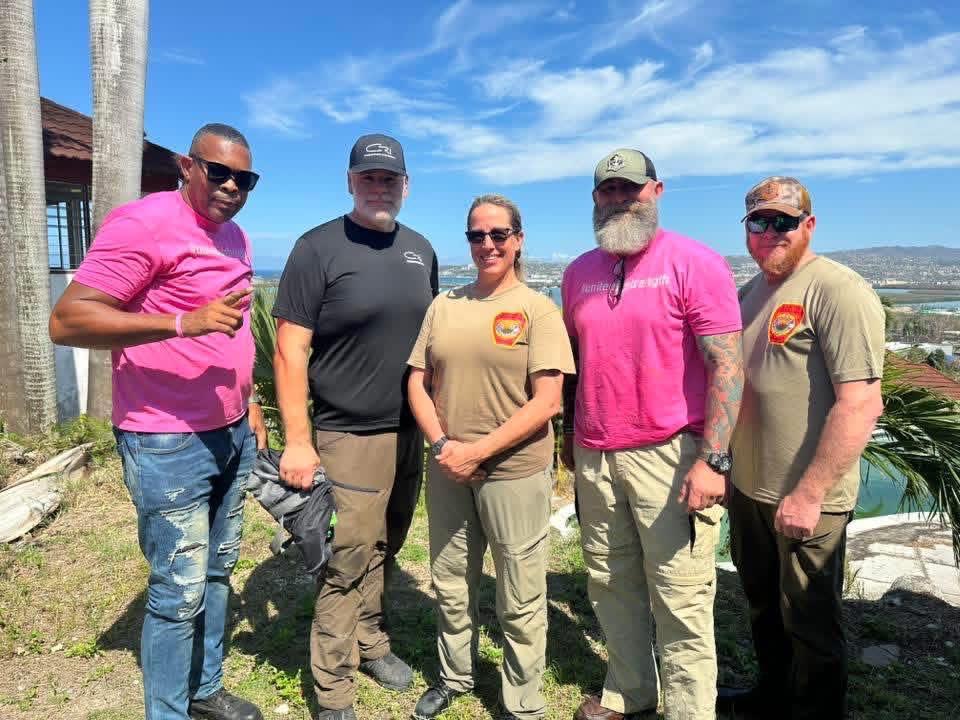
United Cajun Navy Incident Commander Josh Gill (2nd R) and other volunteers on the ground in Jamaica after Hurricane Melissa on Nov. 9, 2025. (Courtesy of the United Cajun Navy)
Until the Job Is Done
For Gill, Nov. 8 was Day 3 of his ground assignment, with no immediate end in sight.
“I'll be here for the unforeseen future until I’m very comfortable knowing that my team has, you know, done everything we could possibly do to help the community get back on their feet,” he said.
Eventually, several of these groups will establish teams of locals on the ground to continue the work they started on a more permanent basis.
“We’ve developed some community groups where the community starts getting involved in our operation, and then what they do is they come in,” he said. ”We make them successful in their own communities. We let them basically take over, and we just provide the resources.”
Aerial Recovery will pass the baton to local teams as well.
“It makes way more sense for us to be able to work with ... Jamaicans that have been affected by it to work alongside them,” Locke said.
“Let’s give the opportunity for Jamaicans out here to do it.”
Meanwhile, Locke’s ground team consists of several veterans who are a part of his “Heal the Heroes” program, which seeks to heal, restore, and repurpose veterans struggling with anxiety and suicide.
“God gave you these skills through your time in the military, the first responder community,” he said. “Let’s continue to use those and go out and help people.”
They join ground teams from several countries. Gill highlighted one group from Mexico called Los Topos that was on the island working to quickly reopen a school.
When asked if he felt like his team was making an impact, Gill turned the question over to Parliament Member Andrew Morris, who represents the northwest of St. Elizabeth Parish.
Morris told The Epoch Times that in just two days, about 6,000 people were fed, and for many of them, it was their first hot meal in days.
“Can you imagine in a week what we can do?”