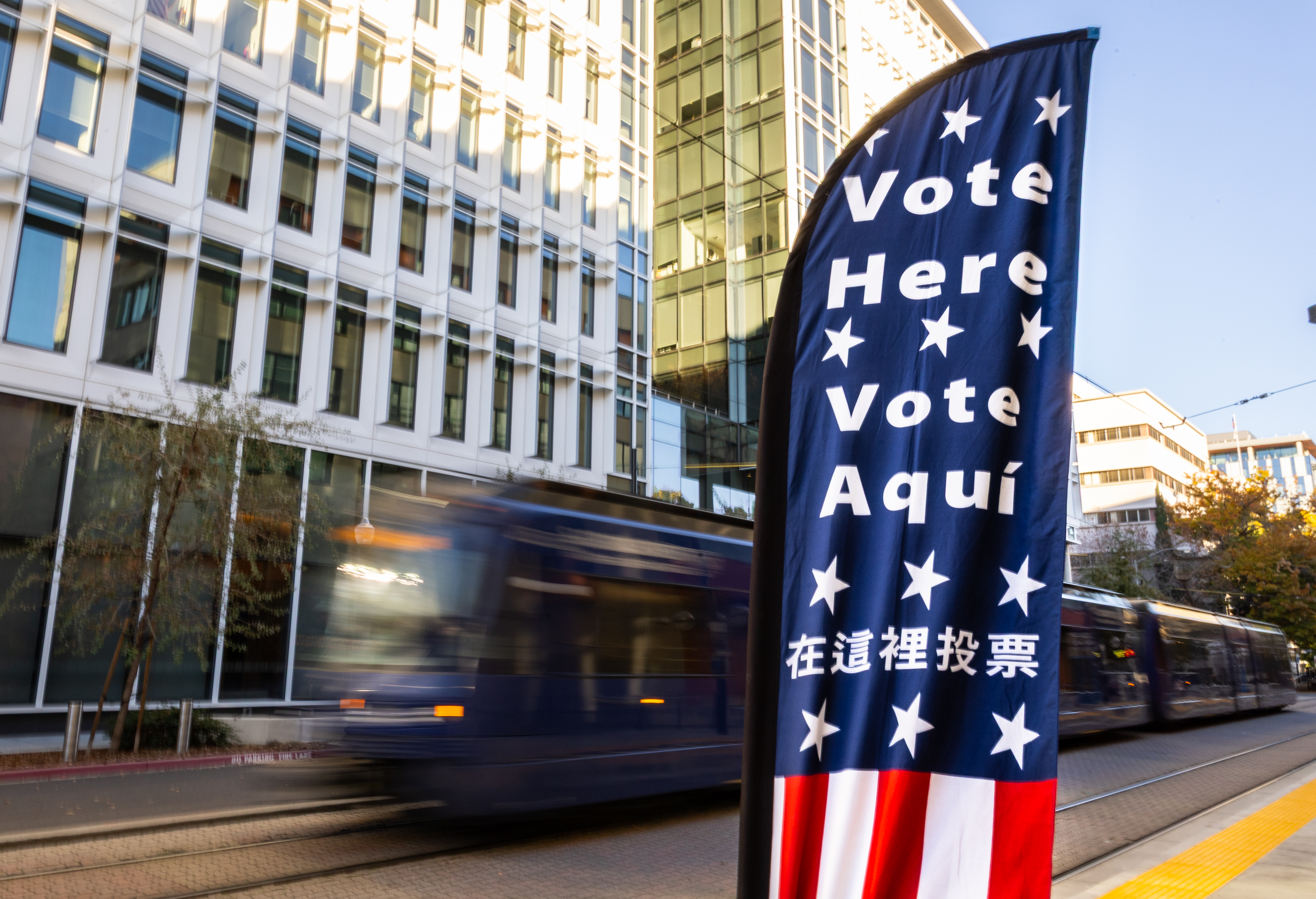

SACRAMENTO, Calif.—Voters across California approved a ballot measure on Nov. 4 to redraw congressional maps, giving members of the Democratic Party an advantage in U.S. House races in 2026.
Party leaders celebrated the passage of Proposition 50, dubbed the Election Rigging Response Act, after the “Yes on 50” campaign raised nearly $172 million, compared with about $84 million raised by opponents.
“This was not just a victory tonight for the Democratic Party, it was a victory for the United States of America, for the people of this country, and the principles that our Founding Fathers lived and died for,” California Gov. Gavin Newsom said during a victory speech at the California Democratic Party headquarters after the election result was called.
He thanked supporters and the millions of Californians who came out on Election Day to support his plan.
“We organized in an unprecedented way, in a 90-day sprint,” Newsom said. “We stood tall and we stood firm in response to [President] Donald Trump’s recklessness.”
The governor rejected President Donald Trump’s comments and social media posts alleging that California’s special election was rigged and suggesting that criminal inquiries were possible.
Newsom commended supporters’ determination and resolve, saying that the electoral victory sends a message to the rest of the country.
“I hope it’s dawning on people, the sobriety of this moment, what’s at stake,” he said.
Five seats in Congress currently held by Republicans are now up for grabs, as the redistricting maps approved by voters will carve up many rural districts and merge them with politically left-leaning cities and counties.
Voters Divided
Support for the proposition was widespread, totaling more than 60 percent of the vote, although opinions regarding the proposal varied across the state.
About 84 percent of San Francisco voters approved of the ballot measure, the most lopsided result statewide.
Central-eastern rural Inyo County’s tally showed a separation of 67 votes, as of Nov. 5, with opponents slightly edging those in favor of the proposition.
Fresno County was separated by approximately 0.2 percentage points, about 150 votes, with residents narrowly approving the measure.
More than 80 percent of voters in rural Lassen County in the northeast voted against the proposition, representing the proposition’s biggest percentage-wise opposition statewide.
Low turnout, about 35 percent of registered voters, worked in favor of the proposition, based on state election data and The Epoch Times’ observations on turnout in November 2024.
‘No Common Ground’
Most voters seen at polls in Northern California on Nov. 4 were registered Democrats who said they were casting their ballot to oppose the sitting president.
“I 100 percent think this is saving democracy,” Brandon Garcia, 31, of Sacramento, told The Epoch Times after voting on Nov. 4.
“There are a lot of things going on in our democracy that we don’t really feel like we have a lot of control over, and it feels like we have to wait until an election to do something.”
One rural voter from Mendocino County was disappointed in the outcome, saying that the loss of representation could force her family out of California.
“It’s hard to imagine living someplace else, but now I can’t imagine staying,” Kathy Kinney, 53, of Potter Valley, Calif., told The Epoch Times on Nov. 5, saying that she was “frustrated” and looking for an “exit plan.”
“It saddens me that the state’s politics has gotten to this. It’s really ugly; there’s no common ground.”
She lamented the loss of what she described as the “voice of rural America” in “portions of the state that are already underrepresented.”
“Now, the whole conservative voice has basically been ripped from California,” Kinney said. “It baffles me where the state is heading and that people can’t see it yet.”
Other critics, including farm bureaus and agricultural advocacy groups, echoed similar concerns in arguments against the proposition.
National Leaders Respond
Trump told a group of Republican senators during a breakfast meeting on Nov. 5 that lawmakers should pass federal voter identification laws and restrict mail-in voting to counter the passage of Proposition 50.
“We should ... make our election secure and safe because California is a disaster,” Trump said. “Mail-in ballots make it automatically corrupt.”
In a Nov. 4 post on Truth Social, the president renewed his criticism of mail-in voting and suggested that criminal investigations were underway.
Supporters of the proposition, including one senator representing the Golden State, said the redistricting plan was a direct response to Texas’s move to redraw maps earlier this year.
“When we knew what Texas was going to do, a midterm partisan redistricting, Californians knew right away that enough was enough,” Sen. Alex Padilla (D-Calif.) said in an address to the Senate on Nov. 5.
“And that’s what yesterday was all about: leveling the playing field.”
He called on voters to participate in the coming elections, emphasizing the importance of turnout to the democratic process.
“We need Americans to keep showing up each and every election, and show up in overwhelming numbers, just as they did yesterday, just as they did for hundreds of years prior, and make clear that it will be the people and only the people who will determine the future of our democracy,” Padilla said.
Looking Forward
Critics of the measure, including state representatives, launched legal challenges questioning the legitimacy of the election and asking a judge to halt implementation.
Another lawsuit filed by Republican gubernatorial candidate Steve Hilton in September also seeks to derail the redistricting plan.
Hilton’s lawsuit alleges that Proposition 50 violates the equal protection clause of the U.S. Constitution, which requires that electoral districts be roughly equal in population size.
California state Sen. Tony Strickland, a Republican, told The Epoch Times that the Democratic Party’s attempt to grab congressional seats will backfire when Republican states respond with similar redistricting plans. He estimated that the GOP will gain as many as 30 seats nationwide.
Lawmakers in Florida, Virginia, North Carolina, and other states are debating redistricting options.
“This is nothing more than an excuse for them to do a big power grab, which is bad for Democrats, independents, and Republicans, and it’s going to be bad for Democrats moving forward when other states do this,” Strickland said.