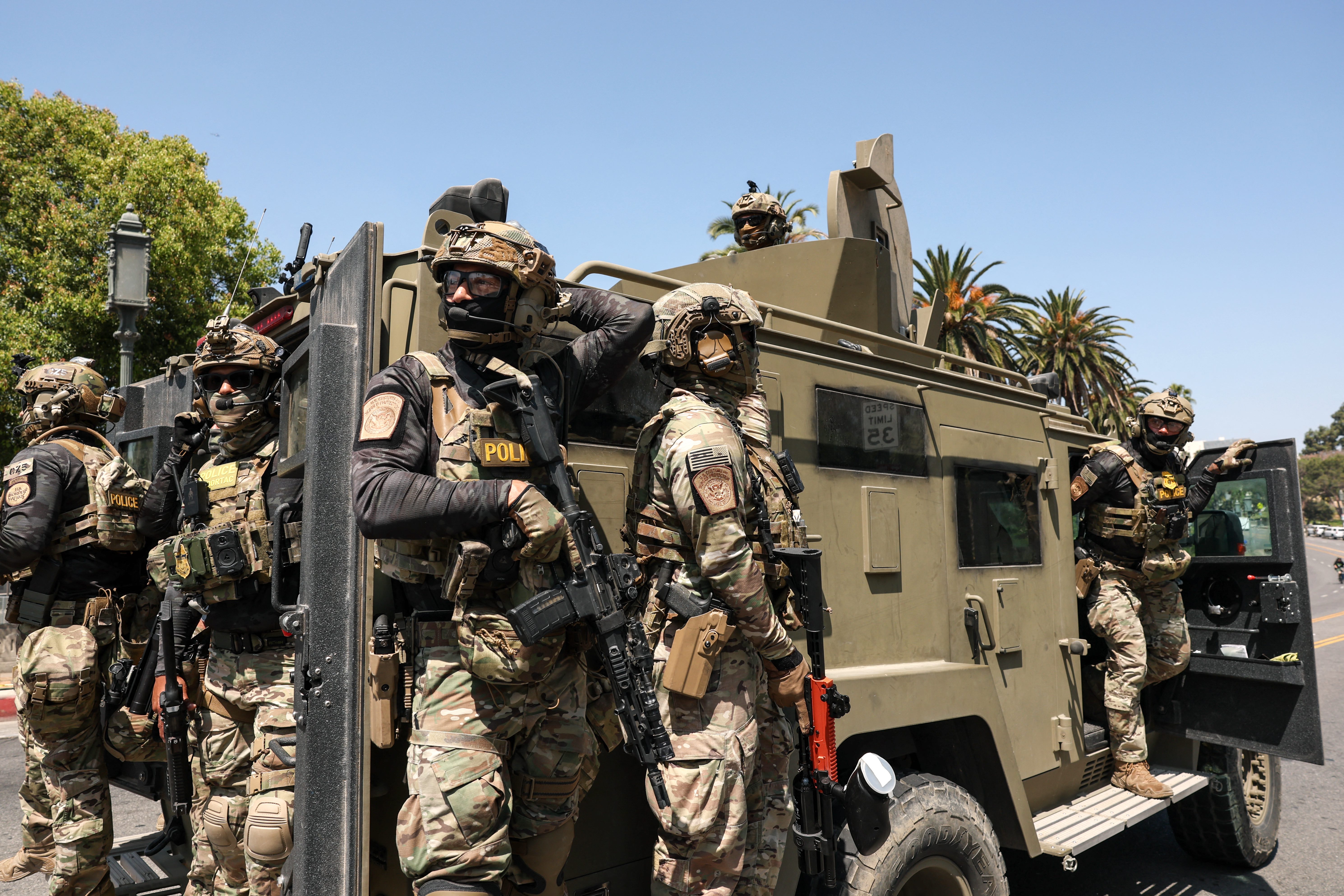

A federal district court judge partially blocked a California law barring law enforcement officers from wearing masks in a Feb. 9 ruling, finding that the law discriminated against federal officers.
Judge Christina Snyder of the U.S. District Court for the Central District of California ruled in favor of the Trump administration, prohibiting the state from enforcing its No Secret Police Act—which was scheduled to go into effect earlier this year—against federal law enforcement officers.
The federal government sued California, challenging that law and another law, the No Vigilantes Act, which requires federal officers to wear identification. Snyder ruled that the second law was not discriminatory.
California had agreed to pause enforcement of the laws, which went into effect on Jan. 1, while the Trump administration challenged them in court.
Attorney General Pam Bondi praised the court’s decision on Feb. 9.
“These federal agents are harassed, doxed, obstructed, and attacked on a regular basis just for doing their jobs,” Bondi posted on X. “We have no tolerance for it. We will continue fighting and winning in court for President [Donald] Trump’s law-and-order agenda—and we will always have the backs of our great federal law enforcement officers.”
California Gov. Gavin Newsom signed both bills into law in 2025 in response to federal immigration enforcement operations in the state.
The No Secret Police Act prohibited any law enforcement officer from wearing a facial covering while performing official duties unless the agency employing the officer has a policy regarding the covering. Some exceptions were made for SWAT teams and in other cases.
The No Vigilantes Act requires any law enforcement officer operating in the state to visibly display identification indicating his or her agency and name or badge number when working.
The U.S. Department of Justice (DOJ) argued that the two state laws violated the supremacy clause of the U.S. Constitution, which mandates that if state laws conflict with federal laws, the federal law takes precedence. The department also argued that the laws violated the intergovernmental immunity doctrine, which prevents federal and state governments from interfering with each other’s operations.
The DOJ argued that prohibiting facial coverings and requiring identification put officers’ safety at risk because violent crime against federal immigration officers has skyrocketed in recent months.
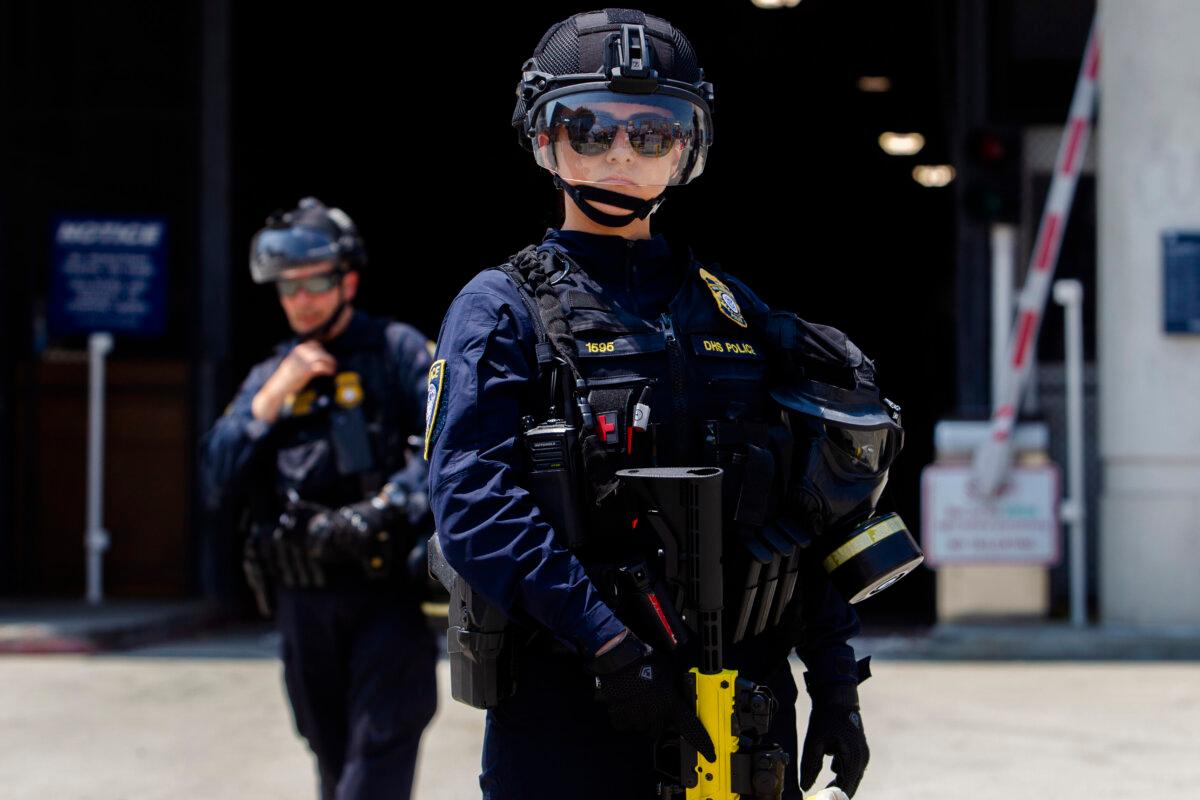
Department of Homeland Security officers stand guard in front of the Edward R. Roybal Federal Building and Detention Center while demonstrators protest in Los Angeles, on Aug. 2, 2025. (Apu Gomes/Getty Images)
Snyder found that the No Secret Police Act did not apply equally to all law enforcement officers in the state, and therefore it “unlawfully discriminates against federal officers,” according to her ruling.
“Because such discrimination violates the Supremacy Clause, the court is constrained to enjoin the facial covering prohibition,“ she wrote. ”California may not enforce the facial covering prohibition of the No Secret Police Act, SB 627 ... against federal law enforcement officers.”
The judge denied the federal government’s other challenges.
The state’s law was already receiving pushback by the largest metropolitan police agency in the state. Los Angeles Police Department Chief Jim McDonnell said his officers would not enforce it.
“The reality of one armed agency approaching another armed agency to create conflict over something that would be a misdemeanor at best—or an infraction—it doesn’t make any sense,“ McDonnell said during a news conference on Jan. 29. ”It’s not a good public policy decision and it wasn’t well thought out, in my opinion.”
California Attorney General Rob Bonta did not return a request for comment on the ruling.