

Three years ago, Tracy Paquette landed in a Southern California jail for petty theft and resisting arrest.
“No big deal, I’ve got a litany of criminal cases,” he thought at the time.
“I was in the holding cell, plotting how I might get another drink and some drugs. I had advanced into methamphetamine by then.”
Paquette told The Epoch Times that he was also thinking about what he could steal and where to sell it.
“I’ve got networks everywhere. So I had a plan. But then, something amazing happened,” he said.
“From the time I stepped out and got the fresh air outside of the jail, something inside of me said, ‘You’re done.’”
Paquette said he asked the police department’s homelessness liaison to refer him to a place he’d heard about, a Christian rescue mission offering a more intensive program than the temporary shelters and outpatient treatment he’d cycled through.
“We don’t refer there because it’s faith-based,” the liaison told him. Instead, they offered a city shelter. He’d already been to a few of those and watched several people overdose on fentanyl.
For two decades, billions of federal dollars flowing to local governments and nonprofits on the front lines of the homeless crisis have prioritized programs that follow “housing first” and “harm reduction” models.
This means, in part, that housing cannot be conditional—on sobriety, treatment for addiction or mental illness, or work requirements—and that people who use even the most dangerous drugs cannot be coerced into treatment.
Christian missions, some of which have been serving the homeless for more than a century, have been sidelined from federal funding, as the vast majority of these funds are earmarked for permanent housing subsidies to the near exclusion of transitional housing that focuses on recovery.
That is set to change following an executive order issued in July by President Donald Trump. As the federal government rescinds these policies, organizations that have subsisted on the margins, often faith-based and privately funded, may soon have a much bigger stake in the future of the response to homelessness.
For Paquette, the transitional, recovery-focused model worked where others had failed.
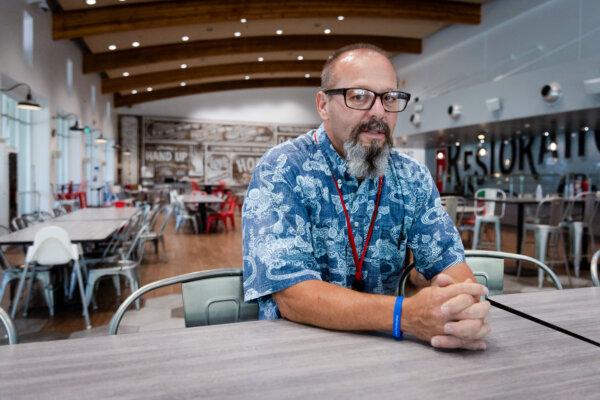
Program member Tracy Paquette, 58, in the Orange County Rescue Mission's dining area in Tustin, Calif., on Aug. 18, 2025. (John Fredricks/The Epoch Times)
He landed at the Orange County Rescue Mission for an initial interview, and there was a follow-up a month later; he had to be clean and ready. So he camped out in a park across from the police department that had arrested him and kept a low profile.
“I knew I’d be safe there,” Paquette said. “The hooligans I’d associate with weren’t in that area. I could charge my phone; there’s a restroom.”
When he finally arrived at the rescue mission, he relished the creature comforts he’d gone so long without: a warm bed, clean clothing, and three good meals. But he also dove headfirst into the counseling it offered, getting to the gnarled root of his addictions and childhood trauma.
There were rules: no cellphones, no unaccompanied off-campus visits for the first several months, no fraternizing with the opposite sex, structured days, job training, volunteer work, an 18-month commitment—and a sobriety founded on zero tolerance.
“It wasn’t hard,” he said. “I could’ve gotten loaded for that whole month I was [in the park]. ... But I wanted a better life.”
At that time, he wondered how he would ever get a job, given his long rap sheet and the fact that his upper teeth had been knocked out in a fight.
It took more than two years, but legal aid volunteers at the mission helped him get dozens of criminal records expunged. He got his teeth fixed, trained for a new career, and saved money to move out.
Although it doesn’t pan out this way for everyone, faith was another pivotal part of Paquette’s experience. The mission preaches Christianity, offering people an opportunity to hear the teachings, but it doesn’t force people to accept them.
“I wasn’t really looking for faith, but I found it,” he said.
“I had a lot of bitterness toward God, because of things that happened in my life, and erroneously, I figured he didn’t care about me. And that [has] since changed because I saw the hand of God working in other people’s lives.”
Bryan Crain, president of the Orange County Rescue Mission, said a focus on vocational training and preparing “students,” as the mission refers to them, to live self-sufficiently after they leave—as well as a slow, meticulous approach to helping people restore their lives—sets it aside from government-funded models.
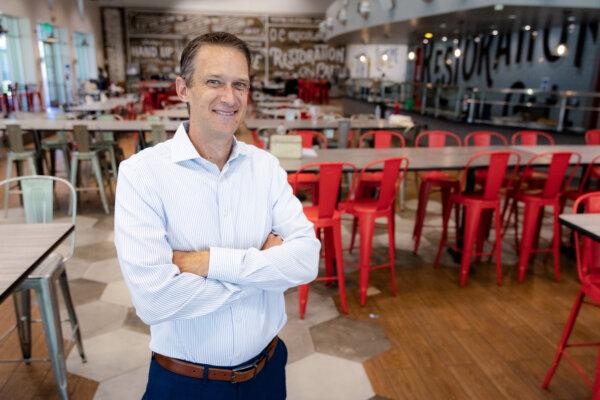
Orange County Rescue Mission President Bryan Crain stands in the mission's dining hall in Tustin, Calif., on Aug. 18, 2025. With the Trump administration changing federal homelessness and addiction policies, faith-based and privately funded groups may soon play a larger role in addressing homelessness. (John Fredricks/The Epoch Times)
“That’s sort of what distinguishes a program like us from the traditional ‘housing first’ model, which is to just sort of warehouse people and put everybody in an apartment and hope for the best. This sort of care and love and restoration takes time,” Crain said.
The organization’s five-acre campus in Tustin, California, also has an on-site medical clinic and provides a range of free services—from therapy and church to vocational training, legal help, mentoring, child care, and education.
“It takes resources, it takes people pouring into people and helping them to see their value and their dignity and their worth, and their ability to earn a living,” Crain said.
“And that’s more intensive than what has typically been the approach that has been funded for almost 20 [years] by the federal government almost exclusively.”
‘A Huge Opportunity’
The Department of Housing and Urban Development (HUD) is actively courting faith-based organizations, hoping to make things easier and more attractive for them to apply for grants as it prepares to issue a new Notice of Funding Opportunities.
“We want to see more sub-grantees, and this would be a huge opportunity for faith-based organizations,” Soledad Ursua, a senior adviser to HUD, told The Epoch Times.
HUD’s Continuum of Care grants, the main source of federal homeless housing money, are typically administered by one organization that coordinates services and allocates funding to nonprofits and local governments in its region.
In Los Angeles, nearly all grants in recent years have gone to “renewal” projects, not new ones. But new applicants are being told that they will get technical assistance, and will be able to submit their projects directly to the federal government if previously denied by Continuum of Care.
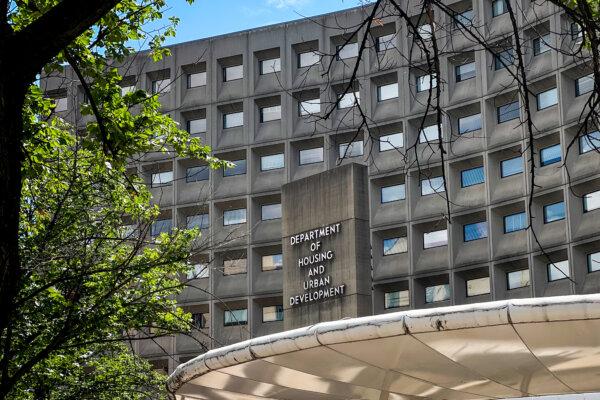
The Department of Housing and Urban Development in Washington on July 13, 2024. The agency is actively courting faith-based organizations by making it easier and more appealing for them to apply for grants. (Madalina Vasiliu/The Epoch Times)
“This has always been [possible] under the regulations,” Ursua said, “but what we’re being told now is that this will be a larger role.”
Through executive order, Trump established the new White House Faith Office, charged with developing policy initiatives, and a Commission to Eradicate Anti-Christian Bias, which Ursua said may affect how funding is allocated.
The department also plans to overhaul the language that drives “housing first” and “harm reduction” strategies, as well as other policies.
In an email sent to Continuum of Care grantees in early July, HUD noted the shift, inviting the organizations to “prepare for an application focused on treatment and recovery, reducing unsheltered homelessness, reducing returns to homelessness, and increasing the earned income of participants.”
Until now, grantees have had to demonstrate that at least 75 percent of all project applications use “housing first,” and were scored according to metrics including “racial equity” and “environmental justice.”
“Why would environmental justice be in homelessness policy?” Ursua asked, adding that she expects such language will be stripped.
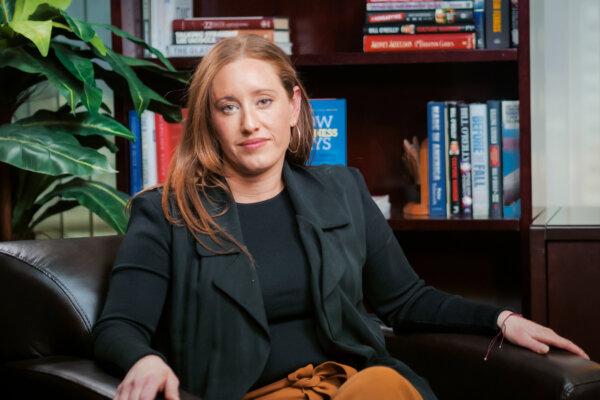
Soledad Ursua, Venice Neighborhood Council board member, speaks with The Epoch Times’ “California Insider” about the homelessness situation in the Venice Beach neighborhood of Los Angeles in 2021. (Hau Nguyen/The Epoch Times)
Mixed Reaction
Not all faith-based organizations are happy with the Trump administration’s approach.
In an email to The Epoch Times, Megan Katerjian, CEO of Door of Hope, a Christian homeless housing provider in Pasadena, California, criticized what she sees as the president’s concurrent criminalization of homelessness and “dismantling of services and affordable housing that can end it.”
“We would have welcomed an executive order that loosens requirements tying federal funding exclusively to ‘housing first’ and ‘harm reduction,’ while also opening up funding for other models like ours that combine housing with required participation in supportive services,” she said.
Door of Hope hasn’t applied for federal funding because it doesn’t strictly adhere to “housing first” and “harm reduction,” and it has long been critical of the policy, but neither does it believe in a one-size-fits-all approach, Katerjian said.
The “pivot toward punitive approaches,” and a budget that cuts Section 8, known as the Housing Choice Voucher Program, and other affordable housing programs “will cause great harm—especially for the chronically homeless individuals these models are designed to serve,” Katerjian said.
Greg Anglea, CEO of Interfaith Community Services in San Diego, a faith-founded organization that provides both sober living options and receives federal grants for programs that incorporate “harm reduction,” considers the federal shift an “inhumane” response that will make it harder for people to get off the streets.
“We disagree wholeheartedly with the executive order,” Anglea said, noting that it characterizes the vast majority of homeless people as mentally ill, suffering from addiction, or being criminals.
“And we know that’s just not the case.”
In a recent op-ed in The San Diego Union-Tribune, Anglea said the top reason that people fall into homelessness, according to a 2023 study by the University of California–San Francisco, is that they cannot afford housing, and the most “common characteristics” among people experiencing homelessness are unresolved childhood trauma and poverty.
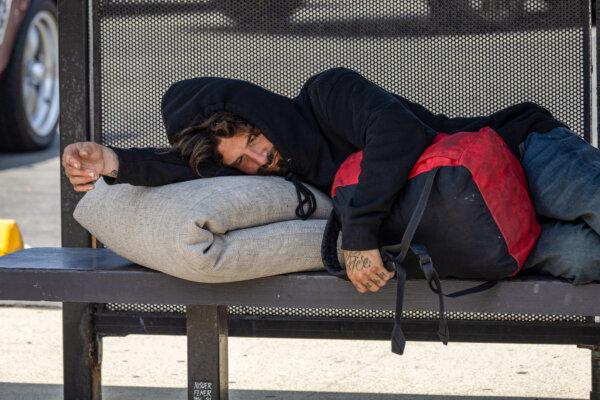
A man sleeps at a bus stop in Los Angeles on June 27, 2025. (John Fredricks/The Epoch Times)
However, numerous studies have found high rates of mental illness and drug addiction among the chronically homeless and unsheltered or “street-level” homeless—specific subpopulations that the order appears to address.
Researchers in perhaps the largest study ever conducted on street-level homelessness, by the California Policy Lab, a co-project of UCLA and UC–Berkeley, found that three-quarters of people have untreated mental illness.
That 2023 study surveyed homeless individuals across the country and found that unsheltered people were nearly three times as likely as sheltered people to report mental health conditions contributed to loss of housing (50 percent compared with 17 percent), and more than eight times as likely to report that drug or alcohol use contributed to their loss of housing (51 percent compared with 6 percent).
In the UC–San Francisco report that Anglea cites, which surveyed a few thousand people in California, 82 percent reported having had a serious mental health condition, and more than half had been hospitalized for that reason prior to being homeless. And 65 percent reported having regularly used illicit drugs.
Anglea contends that mental illness and substance abuse are results, not primary causes, of homelessness.
Crain said he “didn’t blink” at seeing the reference to two-thirds of homeless individuals having substance abuse or mental health issues in Trump’s executive order.
“The number I always come back to is 85 percent of the people that come to us are struggling with a drug or alcohol addiction, or a mental health issue, or both. That number fluctuates at any given time. But in a six-month period, I don’t think I’ve ever seen it dip down to below 70 percent,” he said.
“And there’s something to be said about the fact that we want people to be forthright and honest with us upfront, because I think sometimes maybe those numbers can get skewed because people aren’t being totally straight.”
‘The Streets Were Calling Me’
“I’ve been in the garden for a month, and I’ve already done so much,” Stephanie Blaylock said, surveying the peppers, tomatoes, melons, pumpkins, herbs, and coffee shrubs that she planted in the Orange County Rescue Mission’s community garden.
Blaylock, 40, ended up at the mission a year ago, after her father’s illness and death sent her spiraling.
“I had to stay high to deal with my dad because I couldn’t deal with losing him,” she said.
Before that, Blaylock said, she’d been out of prison and “doing good” for seven years.
Jovial even in the punishing midday heat, Blaylock told her story as she walked through the garden.
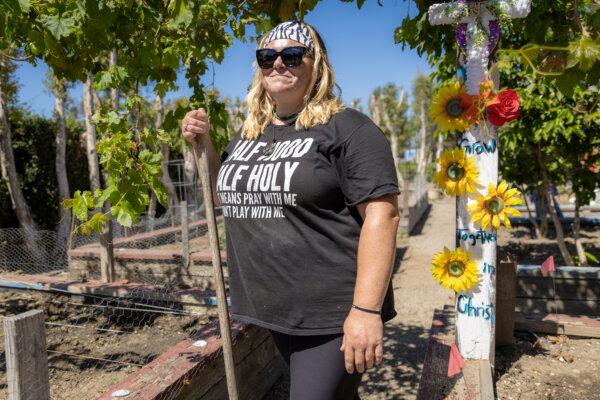
Program member Stephanie Blaylock, 40, stands in the Orange County Rescue Mission's garden area in Tustin, Calif., on Aug. 18, 2025. (John Fredricks/The Epoch Times)
“See the butterflies? They’re all coming in; there’s just everywhere here,” she said.
“I kind of lost everything, gave up on everything. I moved into a house with someone, and it wasn’t a good spot for my kid, but I stayed there because I was still using.”
Blaylock recalled people around her dying from fentanyl overdoses.
The day that she was admitted to the mission, Child Protective Services (CPS) took her son, who is now 10. Volunteers helped her get him back.
“It was a battle,” Blaylock said. “It took like five months.”
Now, he’s living with her on campus and “loves it,” she said.
As painful as it was, Blaylock said she thanks God that CPS took her son and she ended up at the mission.
“I think everything that happened was for a reason, you know?” she said.
Blaylock said she got clean by herself—cigarettes were the hard part—and now wakes up at 5:30 a.m. four times a week to train for a half-marathon.
For Amin Abdi, 31, the trauma of witnessing the violent deaths of close family members led him to the streets and, eventually, to the mission.
“I was really super depressed, dealing with alcohol, cocaine addiction,” he said.
“I couldn’t sleep, and it caused me to basically disappear from everybody. I felt like I didn’t want to be a burden. ... I didn’t want to keep explaining to people why I’m in this place. So I just felt like the streets were calling me.”
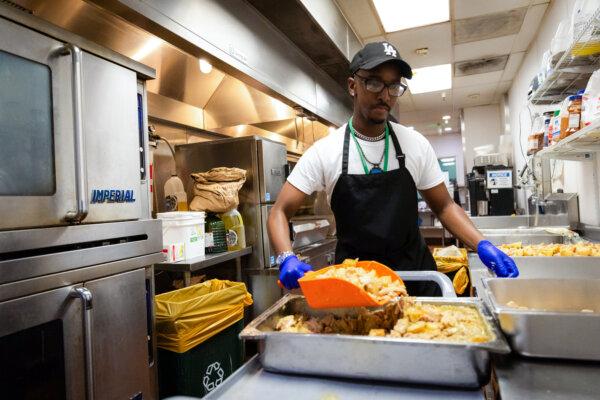
Amin Abdi, 31, prepares meals for hundreds of people at the Orange County Rescue Mission's campus in Tustin, Calif., on Aug. 18, 2025. (John Fredricks/The Epoch Times)
Abdi, who now works in the kitchen and coffee roastery at Orange County Rescue Mission, said he would panhandle the $5 that he needed to ride the bus during the day and drop into food banks; he was sleeping on benches. Needing a blanket one night, he said, he ended up at the mission by accident. He said he did his first interview and had a month to wait until the second one.
“That whole month I was thinking about it. ... And the bus driver was pushing me to do it,” Abdi said. “He said, ‘I’ll give you a day pass for free every day until the second interview if you go.’”
Inside, he’s getting therapy and grief counseling, learning new coping skills, and training for a new career, he said.
“The rules and commitment might scare some people off, but you’re free to leave at any moment,” Abdi said.
“So having that in the back of your head is nice because it shows you can choose to stay here and choose to do these things.”
For Otis Ray Smith, 43, a painful divorce led to a bout of homelessness with his teenage daughter. He said he’d tried to get help—calling the 211 helpline every day, and landing in a city-funded motel and a 90-day program. Smith said he was grateful for all of it but couldn’t get the stability that he needed to rebuild their lives.
Smith said: “I think for me personally, it just came to a point: Did I want my daughter to remember me in the hardest trial of her life, did I want her to remember me as a selfish dad that just did what he wanted and kind of put her on the back burner? Or did I want her to remember me as the dad that stepped up and got us through it and provided change for her?”
Orange County Rescue Mission’s comprehensive program has allowed both to flourish, he said.
“Being able to pivot and having this place, because there are no bills, and they’re not rushing you—you can work and save money [has changed everything],” Smith said.
One of the best parts, he said, is seeing families reunited.
“You see somebody come in by themselves, off the streets, and then you see three-hour visits [with loved ones] down here with the social worker, then eight-hour visits, then overnight. And then they get their kids back, and the transformation is awesome,” Smith said.
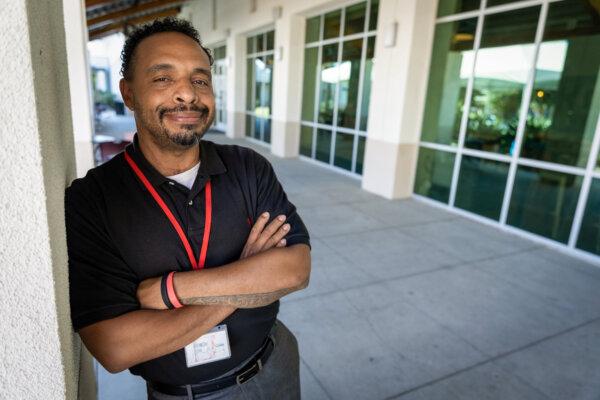
Otis Ray Smith, 43, stands within the campus of the Orange County Rescue Mission in Tustin, Calif., on Aug. 18, 2025. Smith and his teenage daughter became homeless following his divorce. (John Fredricks/The Epoch Times)
No Strings Attached
Faith-based organizations have long been wary of restrictions that come with government funding.
“Oftentimes, accepting that federal funding will mean that you have to make concessions on what you teach and don’t teach, and what you allow on campus,” Crain said.
“We want to be able to freely share our sincerely held religious beliefs with the people we’re serving, and generally, accepting that federal money can be in conflict with that.
“And you may not realize it when you sign it, or something bubbles up down the road, and then you wish you hadn’t done it.”
Mark Hood, CEO of Union Rescue Mission in LA’s Skid Row (Central City East neighborhood), now in its 135th year, said he’s encouraged by Trump’s executive order and by the first signs of potential partnerships with both federal and local governments to reach more people with its model.
“The one caveat we have as we begin to look at different relationships and different opportunities to collaborate, is we’re not going to change who we are,” he said. “We are a faith-based organization. And we very much believe that the path toward ending homelessness is sobriety.
“We have never just focused on getting people into a shelter. ... I think we’ve seen that those models don’t have long-term success because oftentimes, we’re not addressing the root cause of what caused a person to be in a state of homelessness to begin with.”
However, Hood pushed back against what he sees as a pervasive stereotype—that every person who is homeless somehow chooses that lifestyle.

A classroom area at the Orange County Rescue Mission's Double R Ranch facility in Silverado Canyon, Calif., on July 23, 2025. (John Fredricks/The Epoch Times)
“That’s certainly not what I’ve found. I’ve not met anybody [whose] dream was to be homeless someday. I certainly have met people who came through the doors in a very addictive state, but you hear their story and understand it,” he said.
Although Hood is optimistic about the sea change at HUD, he said he attributes the shift that he’s seeing to something else.
“I think the biggest influence is there’s just a lot of people in all areas of our government and our community and our business world that want to see bigger and better outcomes toward the end of homelessness,” he said.
Hood points to a partnership with Los Angeles Mayor Karen Bass’s Inside Safe program, which provides interim housing, largely in motels across the city, and adheres to a “housing first” and “harm reduction” approach. Union Rescue Mission currently provides 53 beds for the program.
Inside Safe, like nearly all city- and county-administered homeless programs in Los Angeles, has been plagued with scandal, lackluster results, and a lack of transparency. As of August, the program had spent more than $450 million to serve fewer than 5,000 people; the vast majority of those people who exited the program returned to homelessness.
Still, Hood is optimistic about the fact that the city recognized his mission’s success and opted to offer it as an option to people on the street, as well as outreach from HUD and the county.
“There’s a pretty big community out there that we are a pretty good solution for,” he said.
Hood said he is still cautious.
“Listen, it’s not that any of those relationships have turned into true partnerships yet, but it feels like we’re walking in that direction together,” he said.
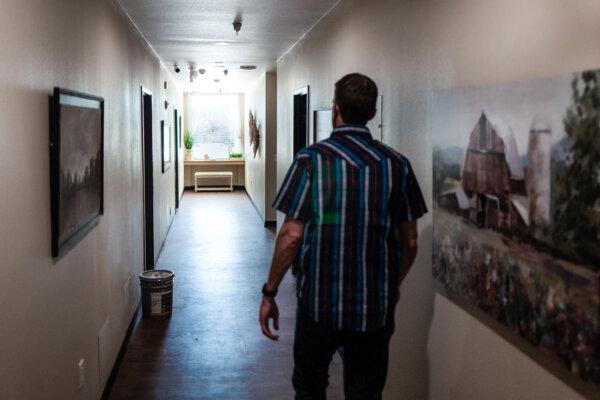
A dorm area at the Orange County Rescue Mission's Double R Ranch facility in Silverado Canyon, Calif., on July 23, 2025. (John Fredricks/The Epoch Times)
Scaling Up
As a model, Crain said, he suggests that Christian missions may offer a better, more efficient use of taxpayer money in the long run.
“People come in, and maybe they’re not given an apartment for life, but they’re given a room, food, clothing, shelter, three very nice meals a day. They’re getting vocational training and education,” he said.
“If you, just for the sake of argument, set aside the Christian ministry aspect of it, on the face of it, that seems like a more efficient use of money.”
Crain said he anticipates that the federal shift will usher in more programs similar to rescue missions in that they will operate more efficiently and help people become self-sufficient, rather than permanently dependent.
In 2024, Orange County Rescue Mission reported that 100 percent of program graduates had successfully transitioned to permanent housing, and 85 percent remained stably housed, employed, and sober, two years after completing the program.
Door of Hope reported that 97 percent of its families were still in housing one year after completing its program, with 86 percent remaining housed after five years, and 97 percent of program graduates employed at the one-year mark.
“It’s challenging to run a mission because you want to do big work, but you’re limited by the funding that’s coming in,” Hood said.
Ideally, he said, he’d like to see the 1,000 people it serves increase to 5,000, but that will depend on building relationships that faith-based organizations can trust.
“It’s all about everybody understanding, going into that relationship, that Union Rescue Mission is never going to change what we believe or what we stand for, but we’ve got a proven track record of healing lives and ending homelessness,” Hood said, suggesting that a hybrid model might emerge.
“If there is a way to get more people off the streets and reunite more families, to break addictions, to put people back into living wage jobs and contributing, I just think everybody can get around that, and it’s exciting to actually be part of that conversation.
“We don’t want to just get people off the street. We want to restore their lives. We want to give them their dreams back. We want to reunite them with their families. And that’s what success looks like.”
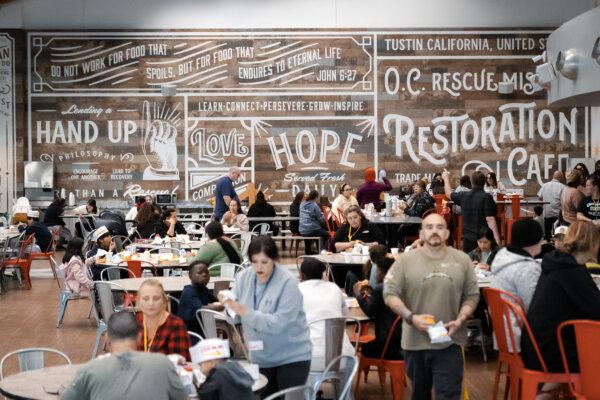
The Orange County Rescue Mission in Tustin, Calif., on Nov. 20, 2023. (John Fredricks/The Epoch Times)