
TEN SLEEP, Wyo.—The alfalfa weevil, scourge of Western ranchers, appears when the frost melts, skeletonizing leaves and profits. There are ways to limit its damage—early harvest, livestock grazing, and intercropping alfalfa with grass—but most growers opt for insecticides.
R.C. Carter, a third-generation rancher in northern Wyoming, recalled a realization he had while using a 1.5-gallon container of concentrated pesticide to spray a 60-acre alfalfa pasture.
“I was pumping this chemical to kill these alfalfa weevils, and it says don’t get it on your skin. And somehow I got it under my armpit. And then on my eyelid. And this stuff burned—it burned for three days—and water didn’t help; you couldn’t wash it off,” he told The Epoch Times at his ranch.
Historically, alfalfa growers used arsenic-based insecticides, which have been mostly phased out, and DDT, now banned for its bio-accumulative and carcinogenic impacts.
In recent years, the pests’ resistance to newer-generation chemicals has proven challenging for ranchers.
R.C. Carter’s wife, Annia, herself a fifth-generation Wyoming rancher, remembered the smell. “I thought, ‘This is going to make you sick when you’re older.'”
Soon after, they learned about health risks associated with glyphosate, the most widely used herbicide in the United States, which early studies found can persist in certain soil conditions for up to 22 years.
“That means even if it’s just put on the soil for the first year, there will still be residual,” Annia Carter said. “It leaches into everything. It doesn’t disappear.”
The experience was a turning point for the Carters, who have since pivoted to “regenerative” or holistic agricultural practices to cultivate the pastureland where they graze more than 1,400 cattle, focusing on regrowing native grasses and building soil health without chemical pesticides, fertilizers, tilling, or monocropping.
R.C. Carter dips down into bright, tall grasses and alfalfa to reveal fat slugs and nubby worm castings.
This “bug life” is exciting to him; it signals progress, as do signs of water infiltration. The Carters routinely test the fields for organic matter and say they’re seeing increases where they’ve grazed cattle and then let the land rest and rebound.
Their 7,000-acre ranch near the tiny town of Ten Sleep—named, as legend goes, for being 10 “sleeps” or nights by horseback, a halfway point, between historic Sioux camps—is a speck in the verdant arterial valleys intersecting parched badlands at the foot of the Bighorn Mountains.
“We used to participate in all the normal commodity agriculture. We didn’t know any better,” he said. “Then we were like, this is wrong. And we started looking for—what’s the off-ramp?”
Figuring that out has alienated them from their community, and caught them between critics on both ends of a roiling debate—ranchers who use conventional practices on one side and conservationists who argue that “regenerative” is a buzzy greenwashing of harmful practices.
All of that, according to the Carters, stems from misunderstanding.


(Top) A farm outside of Ten Sleep, Wyo., on Oct. 14, 2025. (Bottom) A welcome sign located in northern Wyoming on Oct. 14, 2025. (John Fredricks/The Epoch Times)
‘Before the Fences’
Tromping through vibrant pastures, leapfrogging around fresh piles of cow dung, and drawing curious stares and a symphony of groans from the 700 or so Black Angus heifers, the Carters called out for one in particular—Stacey.
“What’s up, good looking?” R.C. Carter said as Stacey sidled up for some petting. The heifer was a “bum,” rejected by its mother, and the Carters and their three sons took turns bottle-feeding Stacey for a summer while the heifer lived at their ranch. A yard cow.
“That’s the spot!” he said, scratching hard on Stacey’s hind quarters as the heifer demurely lifted a back hoof in appreciation.
In addition to their own lands, the Carters have rights to graze on 32,000 acres managed by the Bureau of Land Management (BLM), which puts them at odds with conservationists determined to reduce the numbers of livestock on public lands.
Critics on both sides of the debate who have accused them of overgrazing don’t understand the process or the vision, the Carters said.
“People were calling the BLM, saying this is ruining the land, this should be illegal, it looks terrible,” R.C. Carter said. “But they just don’t understand the strategy, which is a long-term approach.”
Instead of grazing a smaller herd for a longer period on a piece of land, the Carters opt for high-intensity, low-duration grazing, meaning that they sometimes move the animals every day or so, now with the help of virtual fencing.
The concept is based on a much older practice.
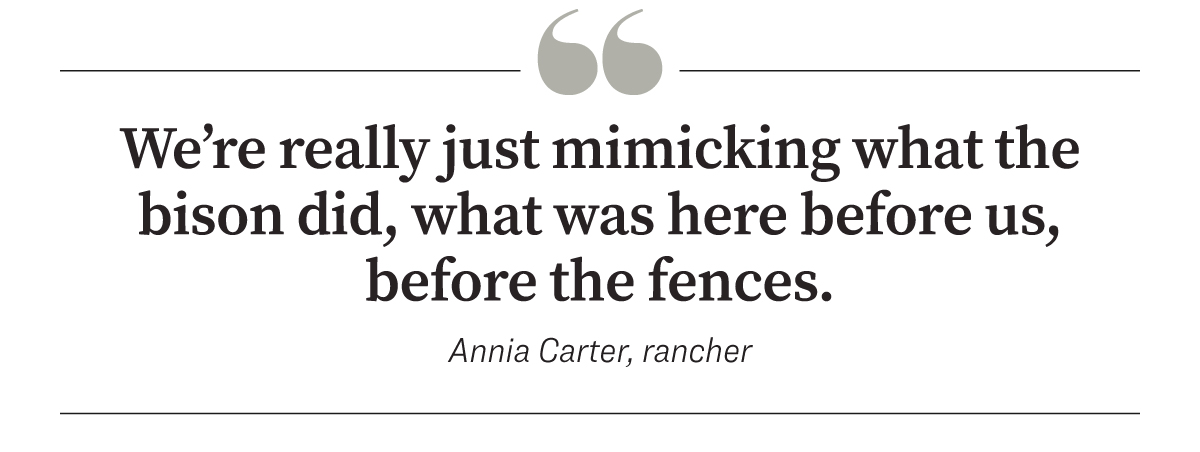
“We’re really just mimicking what the bison did, what was here before us, before the fences,” Annia Carter said.
Large ungulates such as bison and antelope have long populated the Great Plains; they grazed, fertilized, and trampled pastures, mixing soil and seed in the process.
Millions of bison and other herbivores roaming Western rangelands over millennia contributed to carbon-rich soil and diverse ecosystems—which ranchers such as the Carters hope to restore by building on the ancient blueprint.
“We need to create impact and mix the manure and plant the seeds with the cow’s feet,” R.C. Carter said.

Ranchers R.C. and Annia Carter check on their cows outside of Ten Sleep, Wyo., on Oct. 14, 2025. Ranchers such as the Carters practicing regenerative ranching aim to restore carbon-rich soil and diverse ecosystems by mimicking the natural grazing, fertilizing, and trampling patterns once created by bison and other herbivores. (John Fredricks/The Epoch Times)
Around Stacey’s neck, and those of the 700 or so other heifers, is a collar with a solar panel charger, which pings to a satellite tower. An app on Carter’s phone shows exactly how many cows are in the field, and allows him to move the boundary with a swipe of an index finger.
It’s a shock collar, but not as bad as it sounds, Annia Carter said, explaining that the animals may be zapped once when they reach the boundary, but are then quickly deterred by a warning.
“As the cow comes in and she gets close to the new imaginary boundary, she’ll feel a vibration. It’ll beep, and then you’ll see when the cows get close to it, they’re like, ‘Oh man!’ It’s like God’s speaking to them. They’re like, ‘Yeah, I’ve been struck down by lightning before!’” R.C. Carter said. “They respect it real quick.”
Controlling the collared animals via satellite has allowed the ranchers to “fine-tune” their footprint, directing them to mow down a whole pasture, devouring all of the grass and alfalfa—and, potentially, invasive species—instead of grazing selectively.
“We’re using more cattle in less area—we’re really hitting it hard,” he said, “but we are resting longer. So we won’t come back to the same spot every year. You have to let that time for the land and the decomposition and all the lifecycles to happen for it to renew.”
The virtual fencing doesn’t eliminate property or fence lines, but the Carters say it gets them closer to those natural, historic migration patterns—and the model can be repeated on a smaller scale.
It’s also a lot easier on the ranchers. Running cattle on horseback and moving poly wire every day or so is a full-time job that takes the whole family. And if something or someone runs through it—which is more common than you might think, according to Annia Carter—that’s another few days to fix it.
“There’s a lot of oil and gas development here, so the ‘weekend warriors’ would come out and be drinking and cruising through the fence, and you’re like, ‘Oh, man, cows are out. All of them—again!’ It’s just days from hell where you ride until your hands are numb.”

Grass-fed cattle roam the ranch of R.C. and Annia Carter near Ten Sleep, Wyo., on Oct. 14, 2025. The Carters use satellite-connected shock collars to create virtual fencing for the cows, allowing them to manage far more land while reducing labor. (John Fredricks/The Epoch Times)
‘Never Seen It Yet’
Conservationists say the claim that rotational grazing mimics migration patterns of native ungulates such as bison or antelope is an unproven anecdote at best—and at worst a harmful myth propagated by the cattle industry in an attempt to deflect from the damage that livestock cause on public lands.
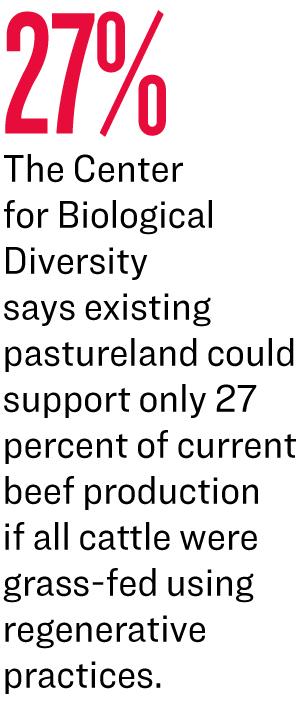
Regenerative grazing also requires 2 1/2 times more land than conventional grazing, according to the Center for Biological Diversity, which argues that there is only enough pastureland in the country to support 27 percent of current production if everyone switched to grass-fed beef and regenerative practices.
The problem, according to the Center for Biological Diversity and others, is that, at current levels, no form of beef production can be sustainable as Americans consume four times the global average of beef, according to data from the U.N. Food and Agriculture Organization.
According to Erik Molvar, a wildlife biologist with the Western Watersheds Project, it simply comes down to scientific evidence.
“We would accept livestock grazing that was fully compatible with maintaining healthy, vibrant native ecosystems,” he told The Epoch Times.
“We’ve just never seen it yet.”
What’s needed for true regenerative grazing, Molvar said, “is not one of these gimmicky rotational schemes; it’s fundamentally reducing the number of livestock on the landscape to very low densities.”
While a recent study from the University of Idaho showed “relatively decent” outcomes, Molvar said, they were based on a rate of 18 percent foliage utilization.
Molvar said the study misrepresented how typical the results were.
“They used that study to greenwash all public lands grazing,” he said.
The 10-year study, which also involved federal and state agencies as well as industry groups, examined how livestock grazing impacts sage grouse populations—a major flashpoint for conservationists.
It reported that “properly managed” grazing had no negative impacts, but could in fact benefit the species by reducing invasive grasses and building robust habitats.
Molvar said he does allow a cautious optimism about the “cutting-edge” virtual fencing technology used by the Carters.

R.C. and Annia Carter survey their ranch near Ten Sleep, Wyo., on Oct. 14, 2025. The couple’s use of regenerative methods has set them apart in their community, placing them between critics—traditional ranchers on one side and conservationists who call “regenerative” a form of greenwashing on the other. (John Fredricks/The Epoch Times)
“There is a lot that we all have to learn about how that can be employed in terms of livestock management and whether it is effective at moving cattle where they’re supposed to be,” he said.
Certainly, it’s better than fragmenting the landscape and obstructing migratory corridors with barbed wire, Molvar said.
And virtual fencing may allow more cattle into areas in which they normally wouldn’t have grazed in the past—easing up on “heavily hammered areas” such as along stream corridors or at springs.
“You might be able to show some real gains there,” Molvar said.
The Carters say they are already doing this.
R.C. Carter acknowledged that natural water points are always an area of high impact.
“So we try to spread those around to limit disturbance,“ he said. ”With the use of the collar, we’re able to access areas [where] the cattle wouldn’t typically go, increasing their [positive] impact.”
Still, Molvar said he suspects that any major improvements are more likely from reduced overall grazing density combined with high-intensity, short-duration programs—not the latter alone.
Ecological Health
Conservationists consider native bunch grasses—and how well they rebound after grazing—to be a key indicator of ecological health.
Areas decimated by livestock grazing in the past, including large areas of the Bighorn Basin, have been converted to cheatgrass “wastelands,” Molvar said, referring to the aggressive invasive species that outcompetes native bunch grasses and increases fire hazard.
Once an area converts to cheatgrass, “you can do all you want in terms of soil organic matter,” but the wildlife habitat will be “incredibly poor” until native bunch grasses are reestablished, he said.
R.C. Carter reported that in the places where he is grazing livestock, native bunch grasses are increasing in health and numbers.
He added, “Cheatgrass biomass is decreasing, and we can show ecological succession.”
The pastures on his ranch are mostly a mix of varieties considered grazing tolerant or moderately so when managed in rotation, and the mix of grass and alfalfa or other legumes helps keep the pasture moist and growing, he said.
Molvar said he acknowledges that quick, intense grazing facilitated by virtual fencing introduces something novel.
Asked whether one day of intense grazing on pastureland can really irreparably wipe out a field, he said, “It’s a good testable hypothesis.”

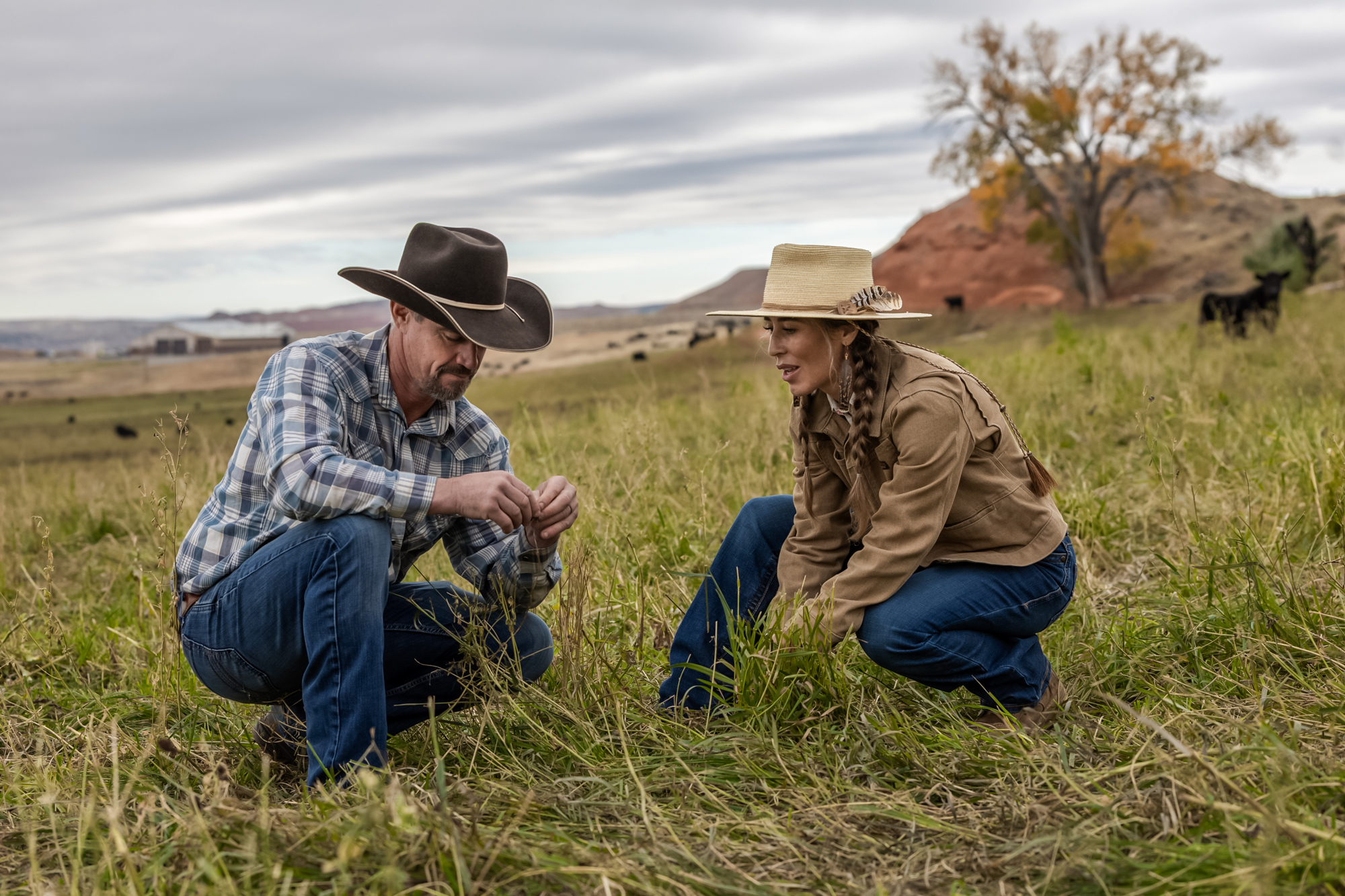
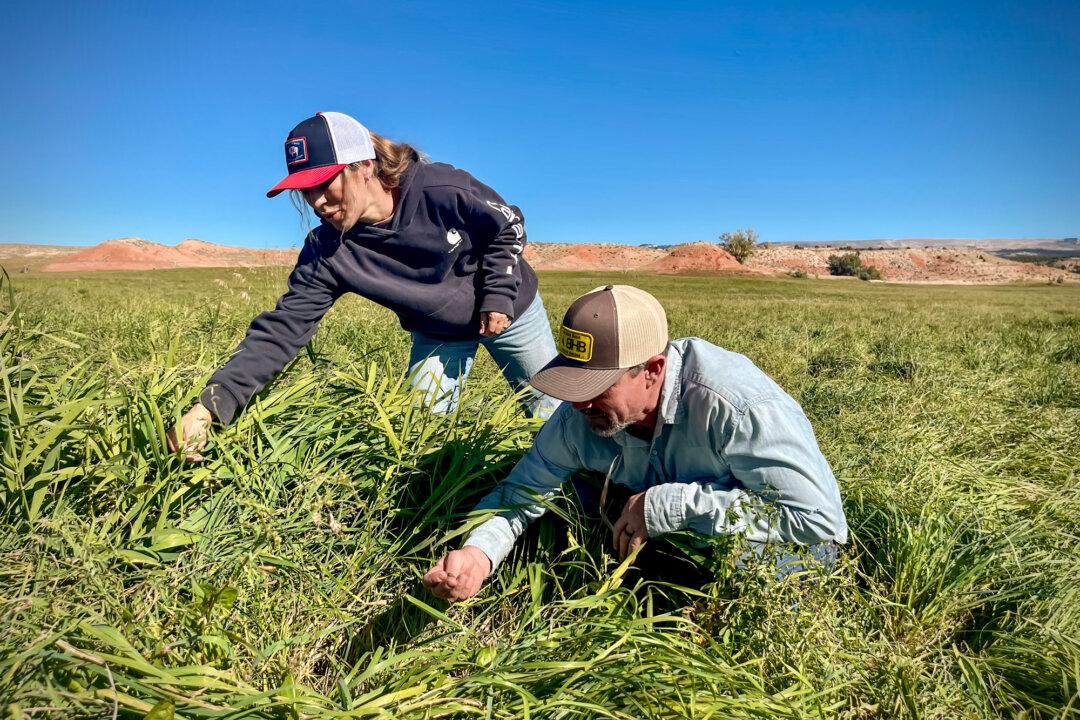
Rancher R.C. Carter looks at a grass sample near his cows outside of Ten Sleep, Wyo., on Oct. 14, 2025. (John Fredricks/The Epoch Times)
The other part of the equation, he said, is that native wildlife also needs to feed on the same lands.
Under their current management strategy, according to the Carters, there is plenty of foliage to feed on.
“[BLM] is telling me I can take 700 cows up onto the mountain and I can stay there for 2 1/2, three months,” R.C. Carter said.
“We did that, and we only grazed less than half of the entire ranch. So we’re fitting into the box they need us to be in. But if we were to transition how we’re managing, we can double the amount of cows.”
Molvar said there is still a need for legitimate science that’s not tainted by industry interests.
“When the livestock industry is funding studies that conclude grazing is harmless or even beneficial, it raises all kinds of red flags because all you have to do is follow the money,” he said.
“Across the West and repeatedly, we see claims that a certain kind of grazing in a certain location is environmentally sustainable. And when we go and look, it’s just as disruptive as everywhere else. That has made us a little cynical.”
Soil and Nutrition
In the past five years, the Carters said, they’ve increased organic matter in some of their pastureland to about 5 percent, up from 1.1 percent, a level that had remained more or less stable for the past 60 years, until they started tinkering with it.
Hoping to standardize such efforts, they founded a nonprofit that offers certification for regenerative ranching through third-party testing for components including soil organic matter and carbon sequestration practices, vitamin and fatty acid levels, and heavy metals and other contaminants.
Resulting food scores reflect both soil health and nutrient density. The idea is to give independent ranchers access to premium markets, and give consumers a window into how their food is produced—and what is ultimately in it.
R.C. Carter said such a system may be more useful than organic certification. He said he is thinking of moms trying to navigate labeling—“Is it grass-fed? Grass finished? What does it mean?”
R.C. and Annia Carter on their cattle ranch near Ten Sleep, Wyo., on Oct. 9, 2025. The Carters founded a nonprofit that certifies regenerative ranching using third-party tests of soil organic matter, carbon-sequestration practices, vitamin and fatty-acid levels, and heavy metals and other contaminants. (Beige Luciano Adams / The Epoch Times)
People will pay more for meat that doesn’t have antibiotics in it, or was raised on pasture, he said.
“But would you rather trust words, or do you want empirical evidence?” he asked.
Advocating such a paradigm shift, R.C. Carter said, puts him between two sides that don’t necessarily welcome change.
“An organic guy tells us you can’t improve on organic, which is the same thing that the guy across the road is telling me—‘That’s the way we’ve always done it,’” he said, referring to conventional ranching.
“The game has changed because we have access to the technology. It’s cheaper, and it’s way less fallible. And it’ll be easier for people, a low-barrier entry if people want to change.”
‘They’re Absolutely Listening’
For the Carters, the path to regenerative agriculture has not been easy or lucrative.
“Any extra money we’ve had, we’ve put into this,” Annia Carter said. “We live very simply.”
But their efforts are converging with an increased global focus on soil degradation and ensuing threats to biodiversity, climate change, and global food security.
They’re also operating during a time when they feel—perhaps for the first time—that people in powerful places are listening.
R.C. Carter was among a group of ranchers who met with Agriculture Secretary Brooke Rollins in August, and the administration has signaled support, not just for increased grazing on public lands, but for regenerative practices.
“I’ve always thought politics wasn’t worth my time; it’s just talk,” he said. “But with this experience, I’m like, ‘holy smokes!’ They’re absolutely listening.
“We asked Rollins about regenerative agriculture, and she’s like: ‘We love it. We don’t know anything about it. How do we do it?’”
Rollins’s office did not respond to questions from The Epoch Times about anticipated policy, regulatory, or legal changes related to regenerative practices or rangeland management issues in the West.
Small family producers face an escalating crisis: heavy consolidation, aging rural populations, layered economic pressures, and the continued decline in farmland has left them increasingly vulnerable.

Northern Wyoming on Oct. 14, 2025. (John Fredricks/The Epoch Times)
The Carters know how difficult the transition is and that they’ll need to inspire confidence.
“Most producers, they’re not going to transition because the system is so rigged against you, you can’t afford to make a $50,000 mistake,” R.C. Carter said.
“It’s so tight that they’re trapped. Somebody has to volunteer and say: ‘I’ll go make the mistakes. We’ll prove this model works, and then we’ll share the information.”
The Carters envision a network of regional hubs, including their own ranch, where people can come and learn from their mistakes.
Annia Carter said: “It doesn’t matter your topography or location or the area. You just work with what you have.”
Currently, she said, the incentives are in all the wrong places, focused on extraction—and, for small family ranchers, survival—rather than sustainability.
“You have to make money to survive, but that comes at the expense of human health. We can do both. If you graze reciprocally, you aren’t just extracting; you’re giving back to the soil, back to the land,” she said.
Investing in a high-tech, holistic approach, she said, may help ensure longevity.
“Show them a new way, and maybe more children would want to hang out on their ranches,” she said. “We want to leave it better than we inherited it; that feels like our responsibility as landowners, to educate the next generation so it will continue.”

Rancher Annia Carter holds a piglet outside of Ten Sleep, Wyo., on Oct. 14, 2025. Carter said that investing in a high-tech, holistic approach may help ensure the longevity of the ranch and keep young people in ranching. (John Fredricks/The Epoch Times)
Recently, the Carters applied for a National Geographic grant. They plan to lease 400 acres of land, about 25 miles west of Ten Sleep, that was used to grow conventional commodity crops: sugar beets, corn, barley.
“We’re going to do this study,“ R.C. Carter said. ”The goal is to build the organic matter, using cows as a tool to transition row crop farmers back to something that is sustainable. And we can build the water quality, organic matter, and show it is a viable economic model to the row crop farmer.”
This particular land has been treated with chemical fertilizers, pesticides, and glyphosate to grow genetically modified monocrops.
The Carters plan to bring in third-party scientists to test the soil and keep a record of progress.
“Then we’ll come in and plant. We’ll put cows on it. We’ll do what we do around here,” R.C. Carter said.
They’ll experiment with a variety of plants to help replace missing nutrients—testing, watching, and adjusting.
“It will probably take several years, but you’ll see improvement within the first year,” he said.
If that can become the new normal, R.C. Carter said, perhaps it can also be monetized.
“That should be an incentive for the ranchers. If you are actually improving your land, your water quality, your runoff, you should be rewarded for that,” he said.
“That way, you can make a little wave, and your little splashes will make a big wave eventually.”